YC's Latest 236 Investments: 'Almost Everything Is Different Now'
"Agent" is fading out of new startups.
Agent Is Fading from New Startups


Crossing Editor's Note (Koji)
Every time Y Combinator announces a new batch of investments, it serves as a weather vane for Silicon Valley and the broader tech venture capital world: what's the hottest direction right now, where is talent flowing, and where is capital heading.
While the startup environments in China and the US differ significantly, following YC has remained a constant priority for Crossing.
This translated article places all 236 companies from YC's Summer 2026 batch within a single AI technology stack framework, making one important shift crystal clear: the center of gravity in entrepreneurship is sinking from the application layer toward compute, chips, training environments, and the physical world.
We may not be able to directly copy these answers, but we can spot trends within them and find inspiration for China's AI entrepreneurs. 🚥
I compiled the full roster of companies from YC's Summer 2026 batch from their website: 236 companies, 470 founders. I then studied each company individually and placed them into different layers of the AI technology stack.
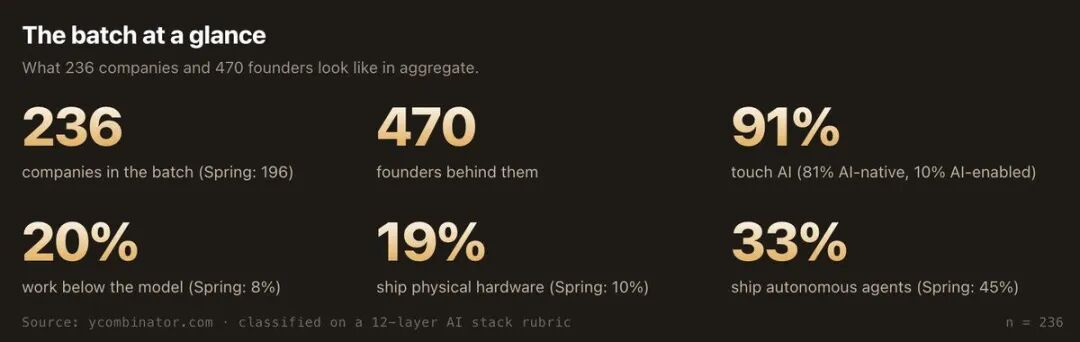
In the previous batch, 95% of YC companies involved AI, and 70% were building Agents.
This batch still has 91% of companies related to AI, but beyond that, almost everything is different.
 YC Summer 2026 Batch Overview
Startups Are Migrating Down the Technology Stack
 AI Technology Stack Layers
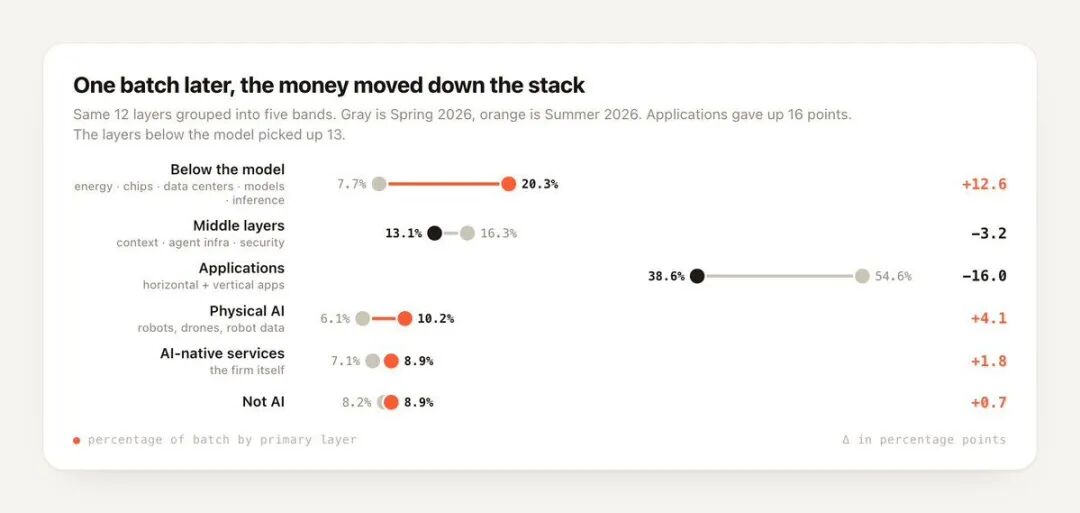
I placed each company into a technology stack layer: energy, chips, and data centers at the bottom, applications at the top. I then reanalyzed the Spring 2026 batch using the same criteria (editor's note: Y Combinator invests across four batches this year) to ensure direct comparability between the two cohorts.
Companies working below the model — energy, chips, data centers, model training, and inference — accounted for just 8% of the Spring batch but have grown to 20% in the Summer batch.
The application layer moved in the opposite direction, dropping from 55% of the entire batch to 39%. Horizontal AI applications fell from 58 companies to 32, while vertical applications held steady at 25%.
All growth is happening either below the model or in the physical world.
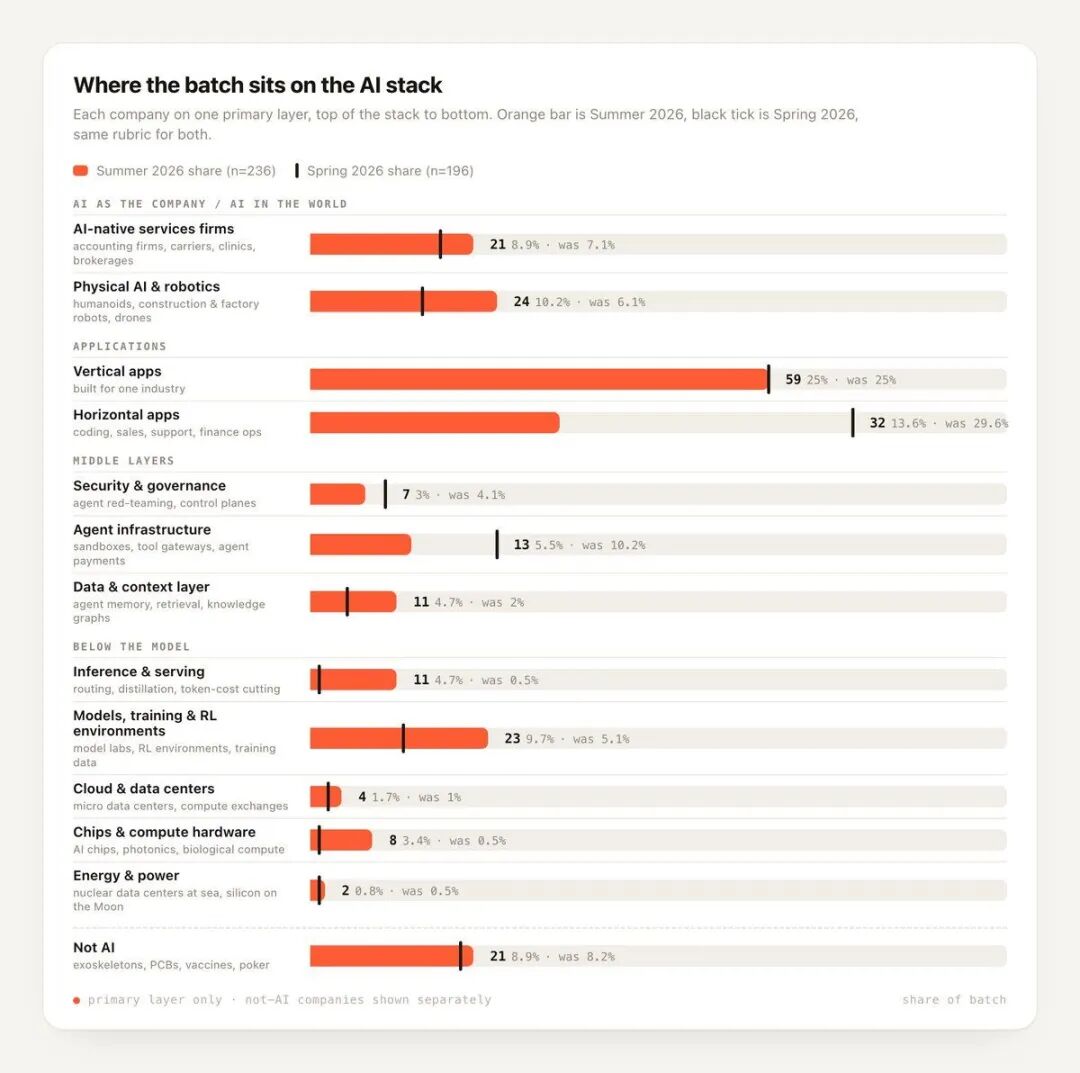 Technology Stack Shifts Between Spring and Summer Batches
"Agent" Is Fading from Startups' Core Narrative
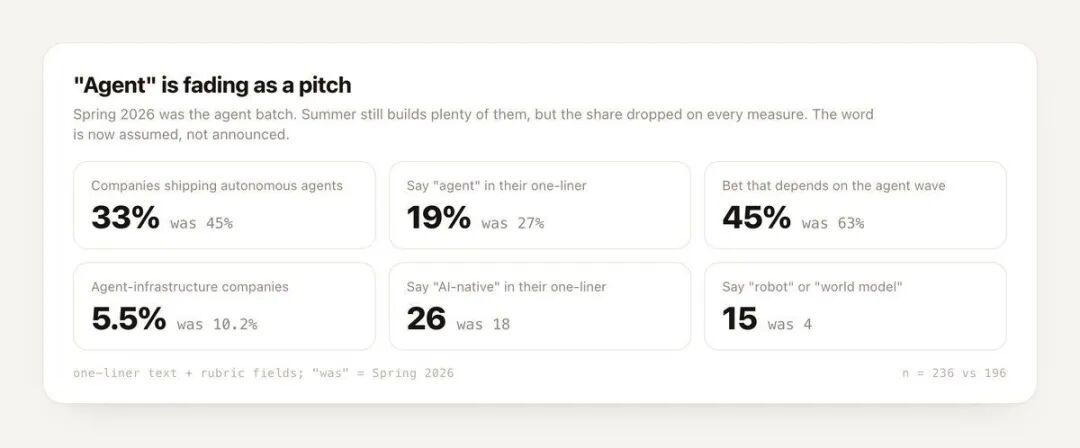 Changes in Agent-Related Companies
In the Spring 2026 batch, 45% of companies launched autonomous Agents; in the Summer batch, this figure is 33%.
In the Spring batch, 27% of companies used "Agent" in their one-sentence description; in the Summer batch, only 19%.
Agent infrastructure companies dropped by half.
No one has stopped building Agents. They've simply stopped putting the word front and center.
Agent is now the default assumption, no longer the startup thesis itself.
What replaced it?
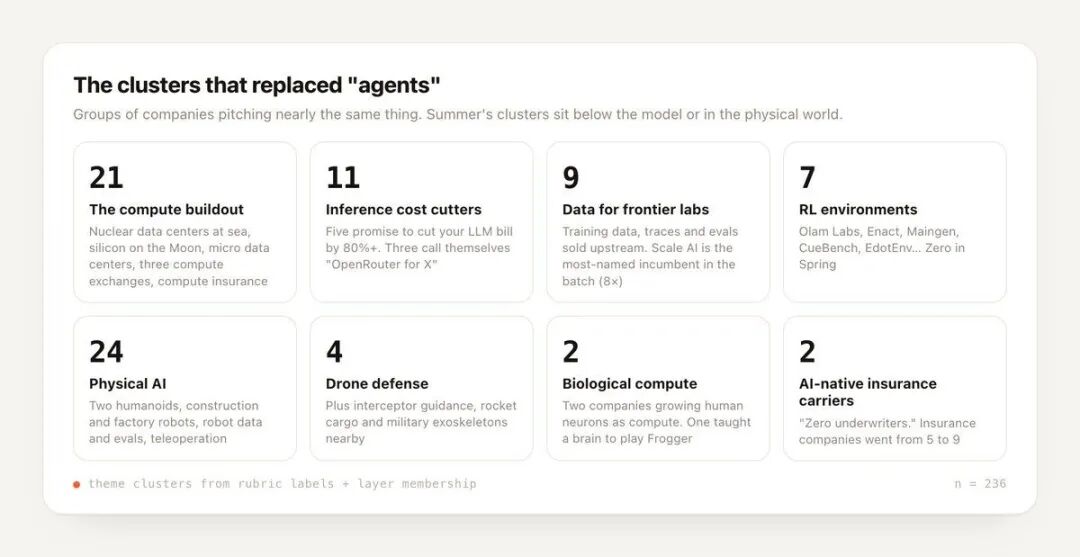 New Startup Clusters
Reading through these companies' descriptions in one sitting reveals four new clusters that hadn't formed at this scale in the Spring batch.
-
Compute buildout: 21 companies. Atomarine is putting nuclear-powered data centers on barges at sea; Ethos wants to manufacture silicon on the moon; Pacific is mass-producing micro data centers; and three companies — Computable, Stoa, and Touchmark — are all building compute marketplaces.
-
Inference costs: 11 companies. Five of them promise to reduce your LLM bill by over 80%; three describe themselves as "OpenRouter for [some domain]."
-
Training data and training environments for frontier labs: 9 companies;
-
Reinforcement learning environments: 7 companies. The previous batch had just 1 company in this category; now YC's own "Reinforcement Learning" tag appears on 14 companies.
The industry giant most frequently challenged in this batch is Scale AI
Eight companies explicitly name Scale AI as the incumbent they're targeting — no other industry giant is mentioned more than 4 times.
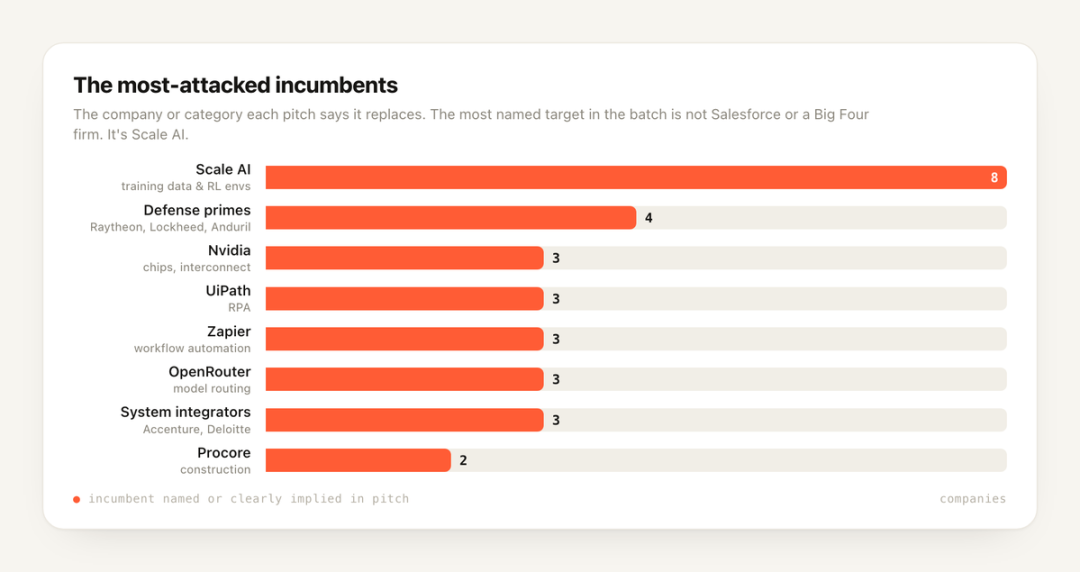 Most Frequently Challenged Industry Giants
Hardware Is Back!
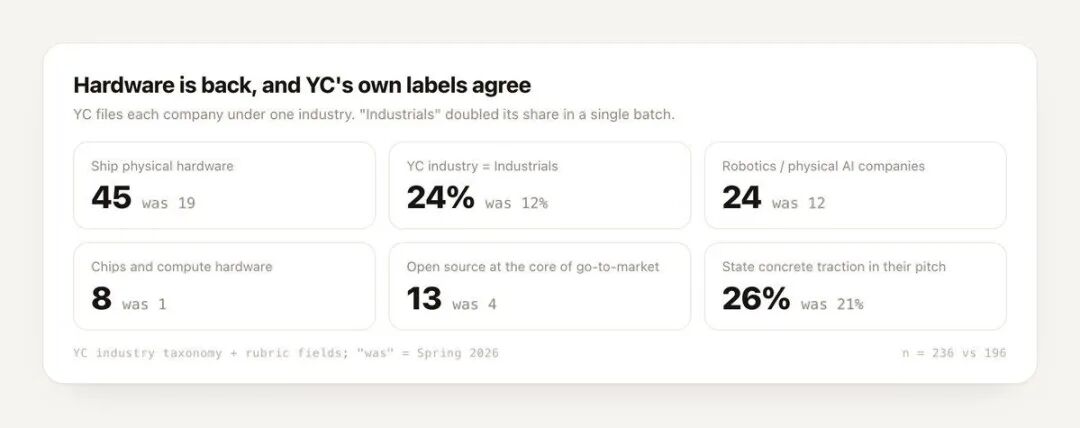 Growth in Hardware and Industrial Companies
YC categorizes each company by industry.
Forty-five companies are shipping physical hardware — double the previous batch. Twenty-four of these fall under robotics or Physical AI, including two humanoid robot companies, plus construction robots, factory robots, drone defense, and robotics data and evaluation companies; another 8 are manufacturing chips or compute hardware, compared to just 1 in the Spring batch.
In YC's classification, "Industrials" rose from 12% of the Spring batch to 24% in the Summer batch.
Founder backgrounds shifted accordingly. Tesla, Palantir, Nvidia, and SpaceX all rose in the rankings as talent source companies. Four hardware leads from Humane — including a Nest co-inventor and the iPhone antenna lead — entered this batch together, building a camera device as a "scanner for the physical world."
21 Companies Don't Sell Software — They Do the Work Themselves, Charging by Results
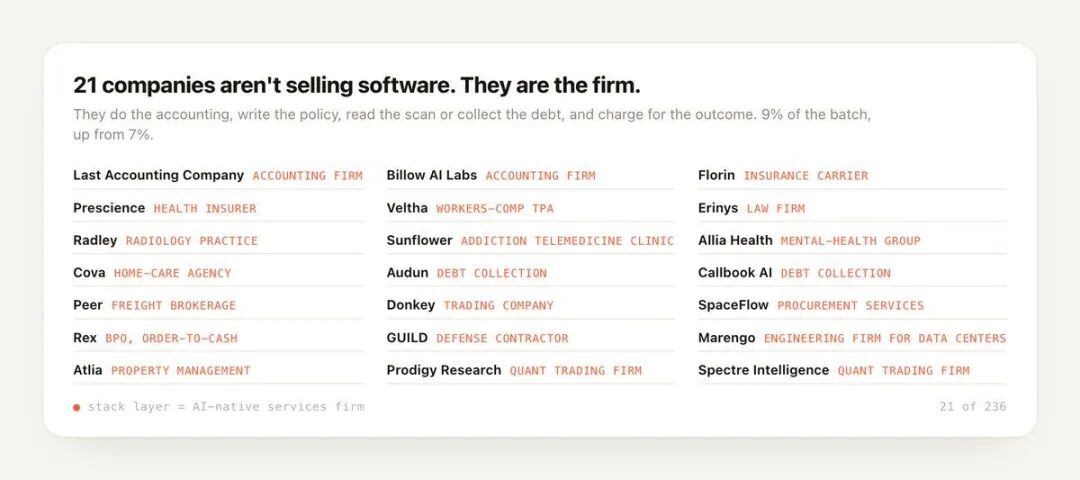 AI-Native Firm Category
Here are two AI-native accounting firms, one of which says it's "killing Deloitte"; an insurance company with zero underwriters; a radiology medical practice that has already acquired a clinic with $4.3 million in revenue; and a law firm.
Also here: a freight brokerage, two debt collection companies, two quantitative trading firms, an addiction treatment clinic, a defense contractor, and a BPO company already processing $500 million in accounts receivable.
These companies do the work themselves and charge by results. They account for 9% of the entire batch.
Sales and Marketing AI Has Receded Sharply
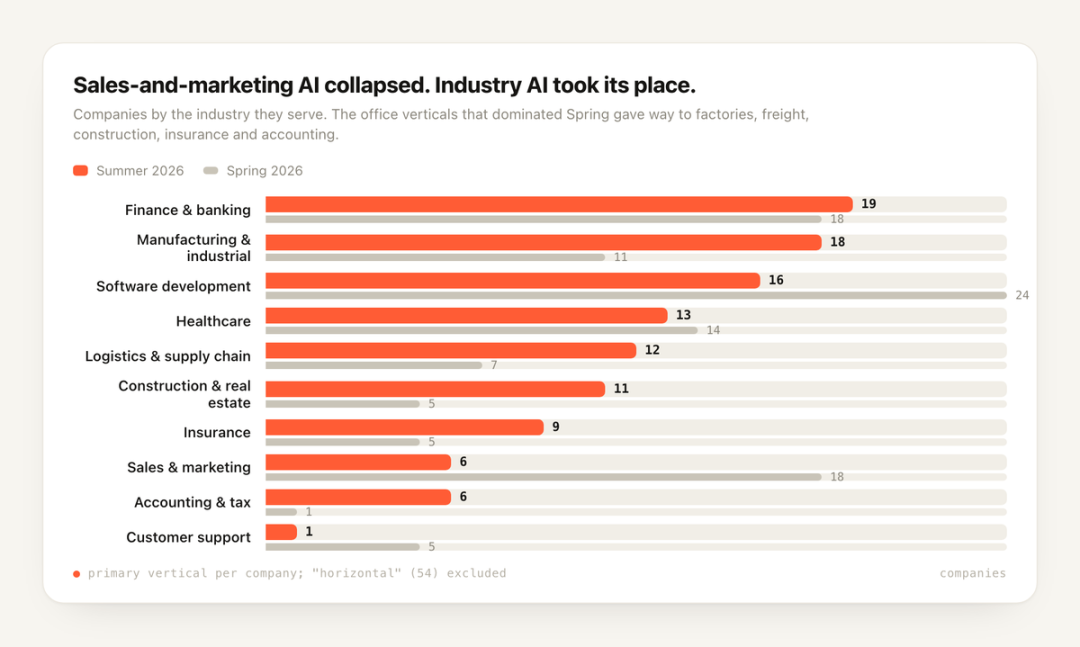 Decline in Sales and Marketing AI
In the Spring batch, 18 companies sold AI to sales and marketing teams.
In the Summer batch, only 6 remain; customer support dropped from 5 to 1.
The industries replacing them all have physical operations:
- Manufacturing: 11 → 18
- Logistics: 7 → 12
- Construction: 5 → 11
- Insurance: 5 → 9
- Accounting: 1 → 6
Who's Getting Into YC: The Youngest Batch Yet
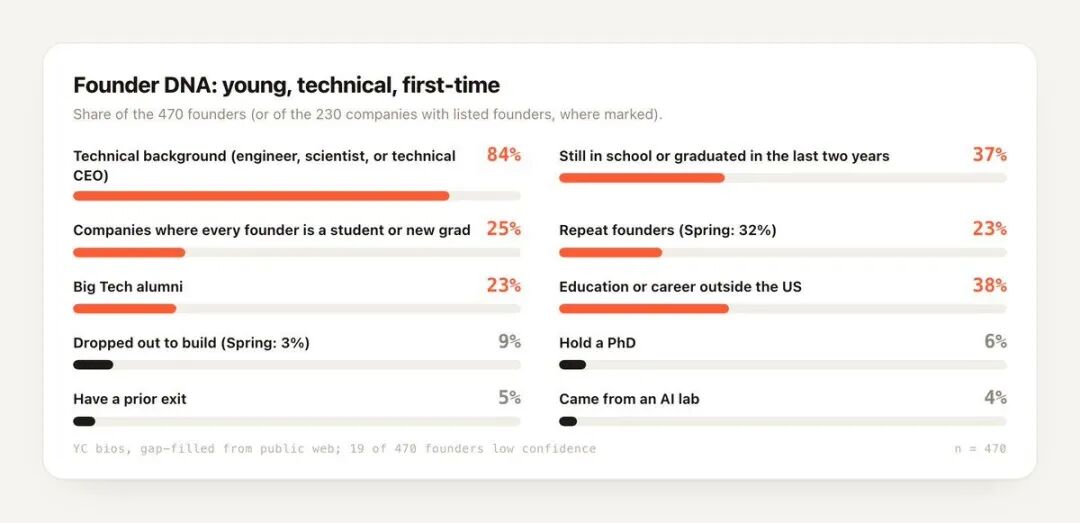 Founder Age and Experience
I compiled the backgrounds of all 470 founders — the youngest cohort I've ever tracked.
Thirty-seven percent of founders are still in school or graduated less than two years ago; 59 companies, or one-quarter of the entire batch, are all-student teams. One company's three founders are all 17 years old.
Dropout founders tripled from 3% to 9%; repeat founders fell from 32% to 23%. Eighty-four percent of founders have technical backgrounds.
These young teams aren't concentrated in the application layer either. One-third of model and training companies are all-student teams, as are one-third of chip companies. These are the frontier areas, not the safer parts of the map.
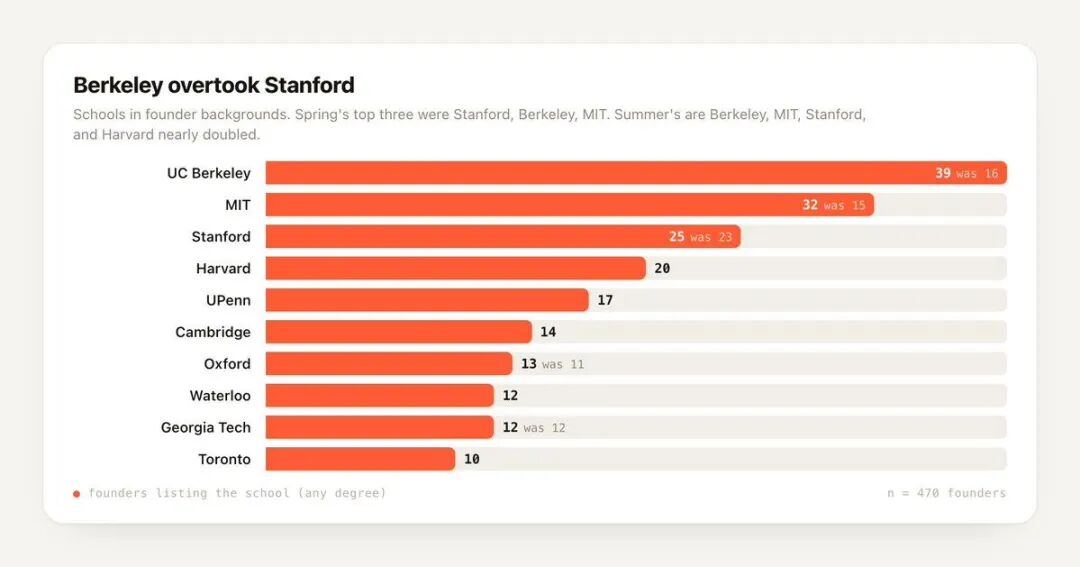 School Background Distribution
UC Berkeley surpassed Stanford: Berkeley 39, MIT 32, Stanford 25, Harvard 20. The Spring batch's top three were Stanford, Berkeley, and MIT.
Amazon became the largest professional talent source for the second consecutive batch: Amazon/AWS 30, Google/DeepMind 15, Meta 13, Apple 12.
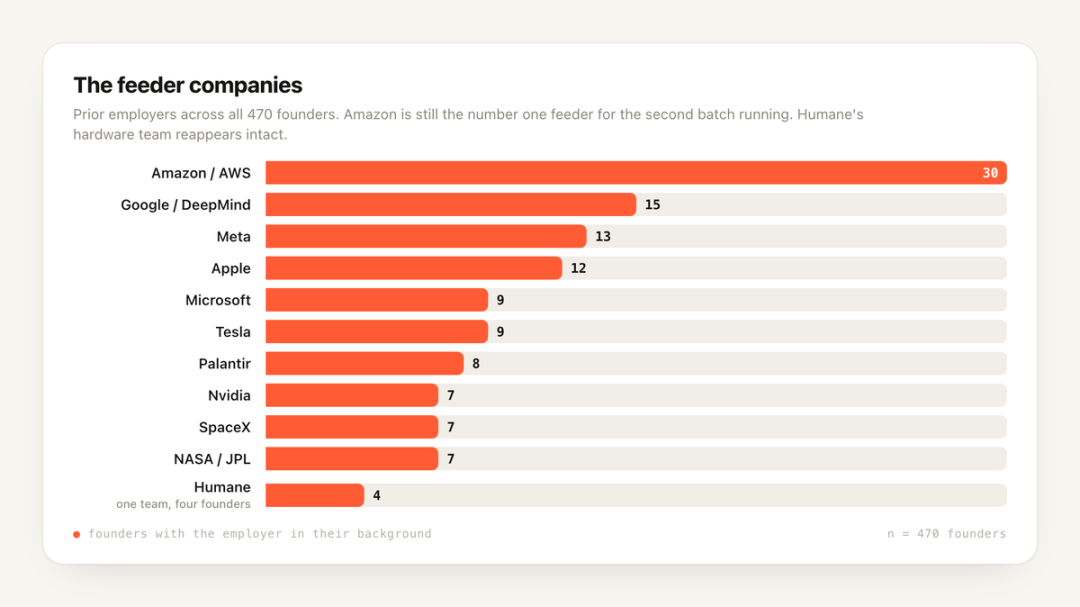 Previous Employer Distribution
Only 19 founders came from AI labs, representing 4% of all founders; none came from Anthropic.
Teams Leaving to Start Companies Together
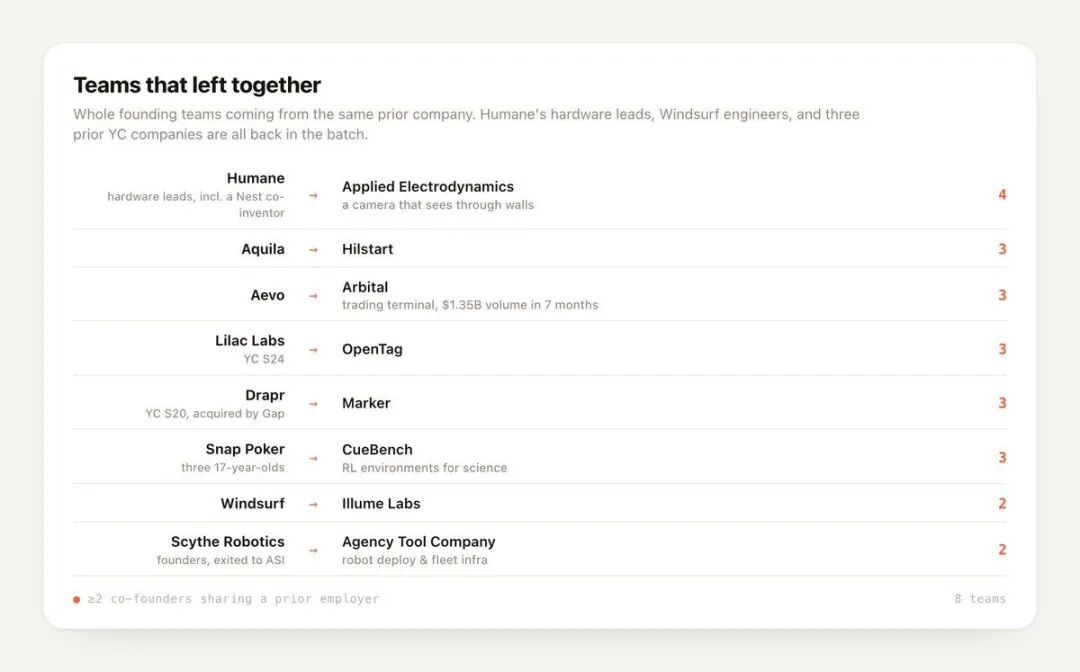 Founding Teams Sharing Previous Employers
Eight complete founding teams share the same previous employer: four members from Humane co-founded Applied Electrodynamics; Windsurf alumni founded Illume Labs; Scythe Robotics founders founded Agency Tool Company.
Three teams with previous YC projects — Drapr S20, Lilac Labs S24, and Sable S19 — returned with new teams.
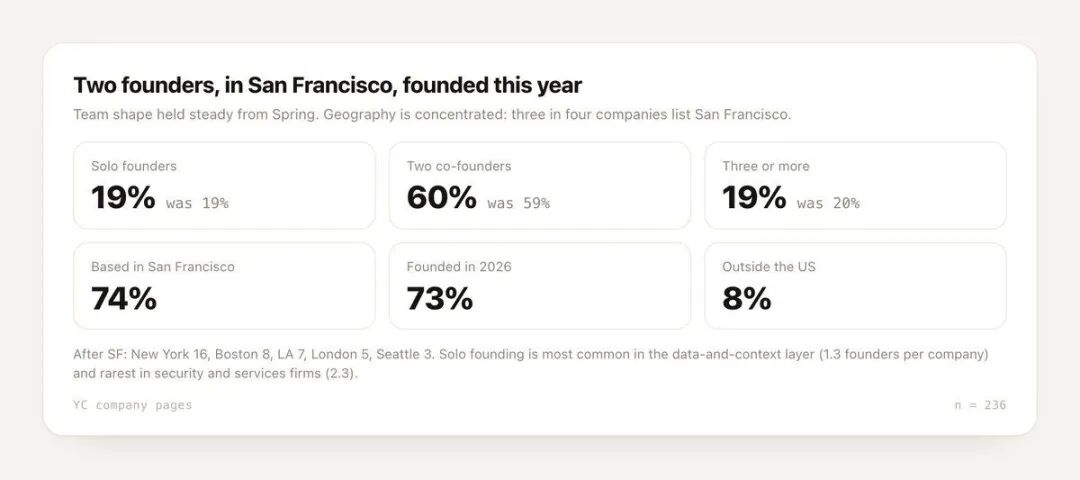 Stable Structural Characteristics Across Batches
What hasn't changed: 60% two-person founding teams, 19% solo founders, 74% based in San Francisco, 71% using single-word company names, 25% using .ai domains. The only notable naming shift is companies with "Labs" in their name increasing from 8 to 14.
What future does this tell us?
Two core takeaways:
1. Founders believe the application layer is already crowded, and they're probably right.
2. Advantage is shifting to places where ordinary wrappers can't follow: training data, training environments, tokens, silicon, and robots.
Compute buildout has become its own startup category, no longer just a hyperscaler story. Twenty-one companies are serving this market, from nuclear-powered maritime data centers to compute insurance; another 11 are selling ways to reduce inference costs.
What truly warrants attention is the "AI-native firm": accounting firms, insurance companies, medical practices, freight brokerages. Their software may look similar to other companies', but what they're actually building is a service business with a different cost structure. That's harder for competitors to replicate than a software feature.
Last batch, everyone was building Agents. This batch, everyone assumes Agents already exist and asks instead: What infrastructure do you run them on? What do you train them with? Do you own the business they work in?
Author: Chris Lu
Original: https://x.com/chris__lu/status/2097515515551809566 Recommended Reading


Join Membership Group