What Should I Do With My Life? | Life Advice from YC Founder Paul Graham

Keep building, and good things will happen.
In my Notion, there's a pinned file called "Articles Worth Rereading Every Year." Every December 31st, I quietly reread them all from start to finish.
Previously, this collection held six articles. Today, I've added a seventh: What To Do[1], freshly published by Y Combinator founder Paul Graham just a couple days ago.
I'm eager to share this one with you all. It answers two crucial questions:
- Where lies the fundamental value of human existence? The answer: Creating genuinely beautiful new things.
- Why is creation so important? Because it embodies humanity's most essential traits: the capacity for deep thought and the courage to explore the unknown.
But before I share the full translation, I want to write a bit about some personal reflections from lately.
Not long ago, after Manus launched and sparked heated discussion across the internet, a wave of critical voices emerged. It reminded me again of a line I've kept on my personal website[2], from Weipin (the founder of Duozhuayu):
Criticism always looks clever; building always looks clumsy.
This resonates deeply with Paul Graham's argument in his article.
My friend indigo also recommended this piece in his newsletter, writing:
"A truly fulfilling life requires both adherence to traditional moral obligations—kindness, responsibility—and conscious pursuit of creation and breakthrough. Only then does the human spirit avoid stagnation, and only then can individuals truly actualize their potential and meaning. The most fundamental thing a person should do is to become a creative person, to create new things that don't yet exist but are beautiful, profound, and meaningful."
Last night, after recording a podcast with Patrick, founder of StressWatch[3], our group walked through the streets of Shanghai. Patrick and I got onto the topic of "luck," and I was reminded again of this image:
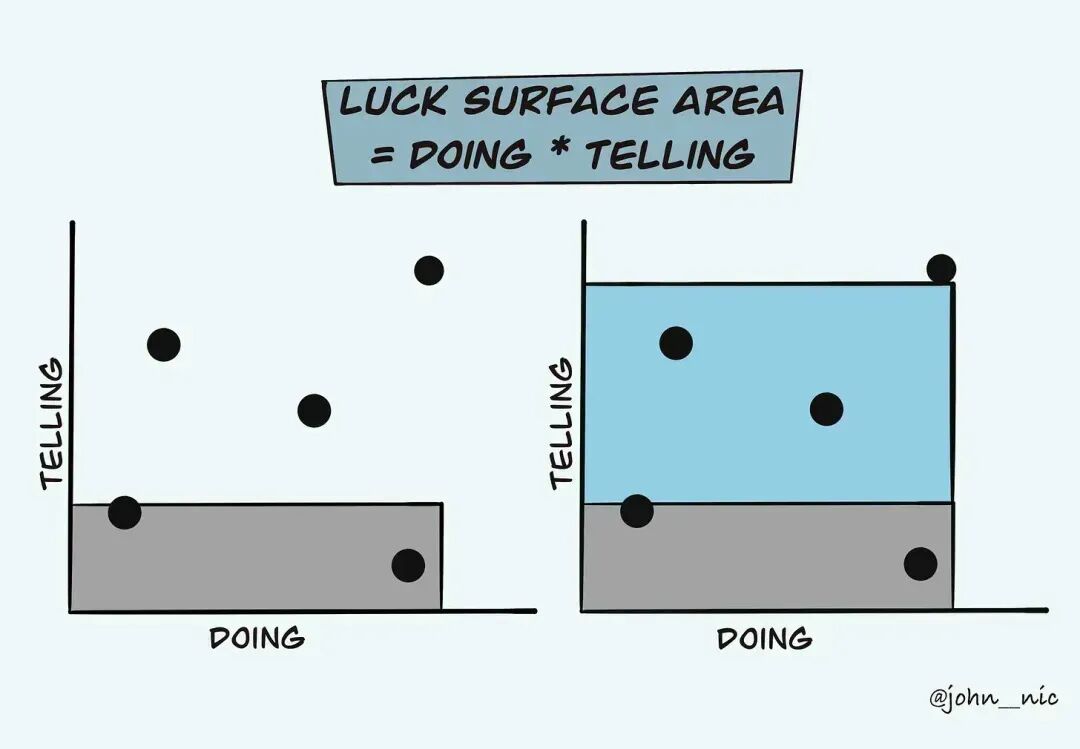
It's attempting to answer: "How does one have good luck?"
Its answer: Luck has surface area. The luck you have in life equals the value you create, multiplied by how many people you tell.
Yes.
Do more things. Then make sure as many people as possible know about them.
I read every Paul Graham article because they consistently deliver both conviction and methodology. Hackers & Painters[4] is practically falling apart from how many times I've read it—these essays gave me tremendous guidance in my early entrepreneurial days.
As PG has aged and deepened in wisdom, he's begun exploring topics of life's meaning and work's value. Though countless articles address these themes, PG's writing stands apart—sharp yet gentle, insightful yet deeply empathetic.
Next, I'll share a bilingual version of this article.
I attempted a human-refined translation with Claude 3.7's assistance. But I've kept the English original because I found that neither I nor Claude 3.7 could fully capture this piece. Only reading the original English can convey it most accurately.
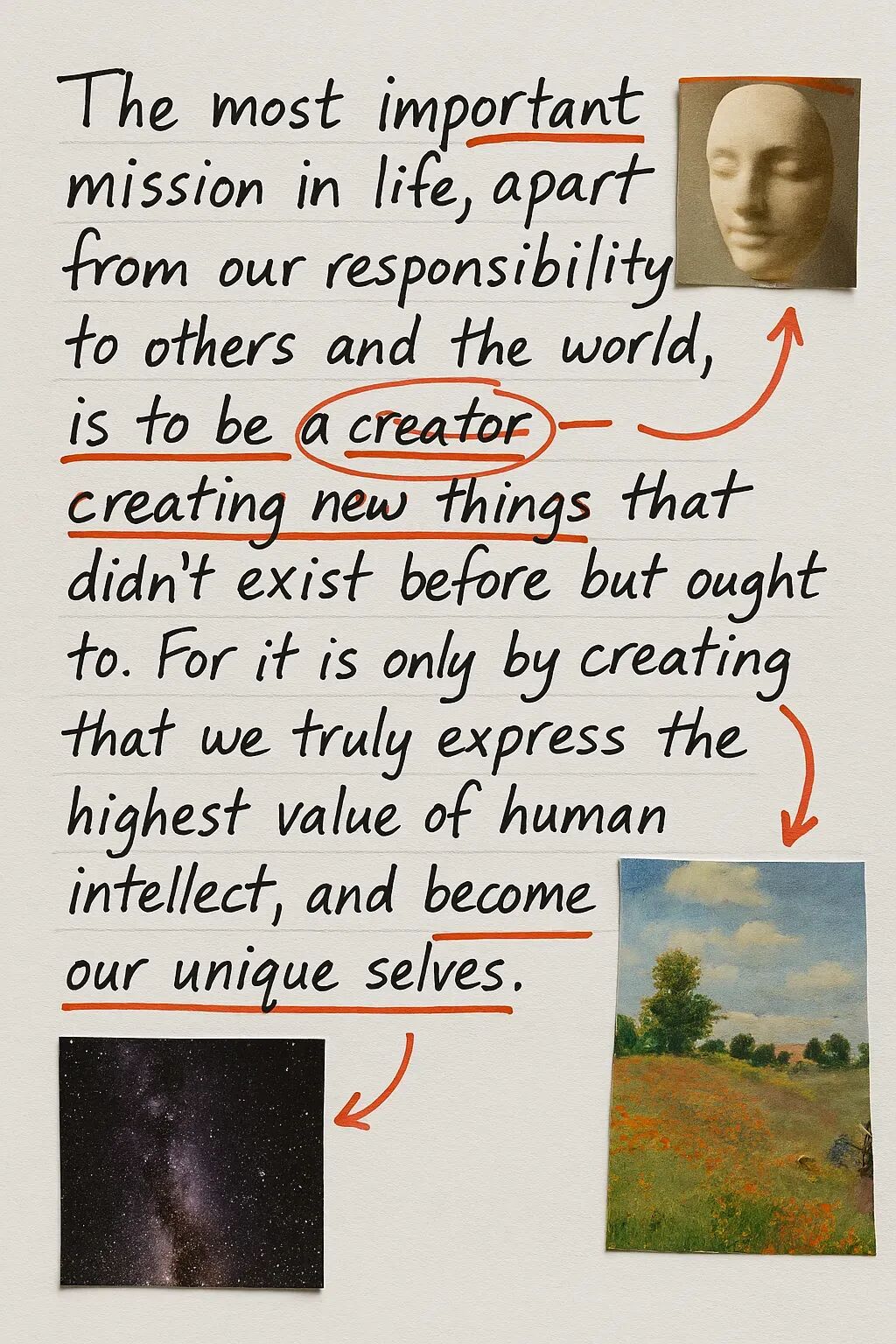
Image from indigo, generated by GPT-4o based on the article's key points
What To Do
What To Do
What should one do? That may seem a strange question, but it's not meaningless or unanswerable. It's the sort of question kids ask before they learn not to ask big questions. I only came across it myself in the process of investigating something else. But once I did, I thought I should at least try to answer it.
What should one do?
This might sound like a strange question, but it's neither meaningless nor unanswerable.
Kids often ask these kinds of big questions, until adults teach them to stop asking such grand-narrative things.
I recently stumbled upon this question while researching something else. Since I encountered it, I figured I should at least try to answer it.
So what should one do? One should help people, and take care of the world. Those two are obvious. But is there anything else? When I ask that, the answer that pops up is Make good new things.
So what should one do?
First: help others, care for the world. These two are beyond question.
But beyond that? When I think about this, the answer that surfaces is:
Make good new things.
I can't prove that one should do this, any more than I can prove that one should help people or take care of the world. We're talking about first principles here. But I can explain why this principle makes sense. The most impressive thing humans can do is to think. It may be the most impressive thing that can be done. And the best kind of thinking, or more precisely the best proof that one has thought well, is to make good new things.
I can't prove why one should do this, just as I can't prove why one should help others or care for the world. These are first principles.
But I can explain why this principle makes sense—
The most impressive capability of human beings is: "thinking." This may be the most remarkable thing in the world.
Yet "the best kind of thinking," or rather the best proof that one has thought well, is to create beautiful "new things."
I mean new things in a very general sense. Newton's physics was a good new thing. Indeed, the first version of this principle was to have good new ideas. But that didn't seem general enough: it didn't include making art or music, for example, except insofar as they embody new ideas. And while they may embody new ideas, that's not all they embody, unless you stretch the word "idea" so uselessly thin that it includes everything that goes through your nervous system.
What I mean by "new things" is very broad. Newton's physics was a good new thing.
Initially I wanted to say create beautiful "new ideas," but that felt too limiting—it couldn't include creating art or music, unless we consider art and music as ideas too. But art and music are more than ideas; they carry far more than that.
Even for ideas that one has consciously, though, I prefer the phrasing "make good new things." There are other ways to describe the best kind of thinking. To make discoveries, for example, or to understand something more deeply than others have. But how well do you understand something if you can't make a model of it, or write about it? Indeed, trying to express what you understand is not just a way to prove that you understand it, but a way to understand it better.
So I prefer the phrasing "make good new things."
There are many other ways to show what "the best kind of thinking" looks like. To make discoveries, for example, or to understand something more deeply than others have.
But none of these approaches compare to actually "making good new things."
If you don't turn a thought into something made, into some kind of "new thing," then you probably haven't truly understood it.
Bringing a thought into creation doesn't just test your thinking — it makes your thinking more complete and more penetrating.
I like this phrasing because it nudges us toward creation.
It causes us to prefer the kind of ideas that are naturally seen as making things rather than, say, making critical observations about things other people have made. Those are ideas too, and sometimes valuable ones, but it's easy to trick oneself into believing they're more valuable than they are.
Criticism seems sophisticated, and making new things often seems awkward, especially at first.
And yet it's precisely those first steps that are most rare and valuable.
So is newness really essential? I think so.
This is obvious in science. If you copied someone else's paper and published it as your own, it would seem not merely unimpressive but dishonest.
It's similar in the arts. A copy of a good painting can be a pleasing thing, but it's not impressive in the way the original was.
By the same token, making the same thing over and over, however well, won't impress anyone — you're just copying yourself.
Note, though, that we're talking about two different kinds of should here.
"Should take care of people and the world" is a duty one must fulfill. "Should make good new things" is about living up to one's full potential.
Historically, most rules about how to live have been a mix of both kinds of should, though usually with more of the former than the latter.

For most of history, the question "What should one do?" got much the same answer everywhere, whether you asked Cicero or Confucius. You should be wise, brave, honest, temperate, and just; uphold tradition; and serve the public interest. There was a long stretch where in some parts of the world the answer became "Serve God," but in practice it was still considered good to be wise, brave, honest, temperate, and just, uphold tradition, and serve the public interest. And indeed this recipe would have seemed right to most Victorians.
Yet there's nothing in these traditional answers about taking care of the world or making new things.
That's a bit worrying, because this question seems like it should be timeless. The answer shouldn't change much.
I'm not too worried that the traditional answers don't mention taking care of the world. Obviously people only started to care about that once it became clear we could ruin it.
But if making good new things is so important, how can the traditional answers have left it out entirely?
The traditional answers were answers to a slightly different question. They were answers to the question of how to be, rather than what to do. The audience didn't have a lot of choice about what to do. The audience up till recent centuries was the landowning class, which was also the political class. They weren't choosing between doing physics and writing novels. Their work was foreordained: manage their estates, participate in politics, fight when necessary. It was ok to do certain other kinds of work in one's spare time, but ideally one didn't have any. Cicero's De Officiis is one of the great classical answers to the question of how to live, and in it he explicitly says that he wouldn't even be writing it if he hadn't been excluded from public life by recent political upheavals.
This is because, in those traditional answers, they were actually responding to a different question: they were answering "how to be," not "what to do."
In past eras, people didn't really have much choice.
Until recent centuries, those who could even ask such questions were the landowning class — also the political class. They didn't need to choose between doing physics and writing novels, because their work was already decided for them: manage their estates, participate in politics, fight when necessary.
While they could do other kinds of work in their spare time, ideally they shouldn't have had any spare time at all.
Cicero's De Officiis is a classic work on "how to live," and in it he explicitly states that he wouldn't even be writing the book if political upheavals hadn't excluded him from public life.
There were of course people doing what we would now call "original work," and they were often admired for it, but they weren't seen as models. Archimedes knew that he was the first to prove that a sphere has 2/3 the volume of the smallest enclosing cylinder and was very pleased about it. But you don't find ancient writers urging their readers to emulate him. They regarded him more as a prodigy than a model.
Of course, there were people doing original work in that era too. While they were often admired, they weren't seen as role models.
Archimedes discovered that a sphere's volume is 2/3 that of its smallest enclosing cylinder, and he took great pride in this. But ancient writers never encouraged their readers to follow his example.
In their eyes, Archimedes was more of a prodigy than someone to imitate.
Now many more of us can follow Archimedes's example and devote most of our attention to one kind of work. He turned out to be a model after all, along with a collection of other people that his contemporaries would have found it strange to treat as a distinct group, because the vein of people making new things ran at right angles to the social hierarchy.
Now, many more of us can be like Archimedes, devoting most of our time and energy to one kind of work.
Archimedes ended up becoming a role model after all, as did a number of others.
In Archimedes's time, people would have found it strange to treat these people as a distinct group, because those who created new things cut across the social hierarchy — they stood out through creative ability rather than social status.
What kinds of new things count? I'd rather leave that question to the makers of them. It would be a risky business to try to define any kind of threshold, because new kinds of work are often despised at first. Raymond Chandler was writing literal pulp fiction, and he's now recognized as one of the best writers of the twentieth century. Indeed this pattern is so common that you can use it as a recipe: if you're excited about some kind of work that's not considered prestigious and you can explain what everyone else is overlooking about it, then this is not merely a kind of work that's ok to do, but one to seek out.
So, what kinds of new things count as valuable creation? — best to leave that judgment to the creators themselves.
It would be dangerous to set any threshold for this, because new things are often dismissed when they first appear.
Take Raymond Chandler: he was literally writing pulp fiction, yet is now recognized as one of the greatest writers of the twentieth century.
This pattern is so common that you can even use it as a guide:
If you're passionate about some kind of work that's not considered prestigious, and you understand what everyone else is overlooking about it, then go for it!

The other reason I wouldn't want to define any thresholds is that we don't need them. The kind of people who make good new things don't need rules to keep them honest.
Another reason we don't need to set standards:
The people who can truly create good things don't need rules to keep themselves in check.
So there's my guess at a set of principles to live by: take care of people and the world, and make good new things. Different people will do these to varying degrees. There will presumably be lots who focus entirely on taking care of people. There will be a few who focus mostly on making new things. But even if you're one of those, you should at least make sure that the new things you make don't net harm people or the world. And if you go a step further and try to make things that help them, you may find you're ahead on the trade. You'll be more constrained in what you can make, but you'll make it with more energy.
So, I believe the principles for living can be summarized as: take care of people and the world, and make good new things.
Everyone has their own strengths and choices. Some people like taking care of others; some are good at making new things.
If you're a maker, remember this: what you create must not harm other people or the world.
Even better, you can aim your creative efforts at helping them. This will place some constraints on your work, but it will also fuel you with greater passion.
On the other hand, if you make something amazing, you'll often be helping people or the world even if you didn't mean to. Newton was driven by curiosity and ambition, not by any practical effect his work might have, and yet the practical effect of his work has been enormous. And this seems the rule rather than the exception. So if you think you can make something amazing, you should probably just go ahead and do it.
What's interesting is that when you focus on creating something amazing, you often end up helping people and the world almost by accident.
Just like Newton. He pursued research purely out of curiosity and the desire for achievement, yet his discoveries ultimately transformed humanity. And this kind of thing is actually quite common.
So if you think you can make something amazing, just go ahead and do it!
A final note:
As long as you keep building, good things will happen.

References
[1] What To Do: https://www.paulgraham.com/do.html
[2] Personal website: https://koji.super.site/
[3] StressWatch: https://100badideas.com/stresswatch
[4] Hackers & Painters: https://book.douban.com/subject/6021440/