Yuanshi Technology Secures Nearly RMB 300 Million Pre-A Funding, Driving Continuous Evolution of Virtual Cells with Closed-Loop Evidence Chains | Dalton Venture Family

**Dalton Venture portfolio company Yuanshi Technology has announced a nearly RMB 300 million Pre-A round, following its consecutive completion of a nearly RMB 100 million angel round and angel+ round — setting a new record for a single financing in China's AI virtual cell (AIVC) sector.** The round was led by Legend Capital, with China Merchants China Direct Investments Limited, JD.com-affiliated funds, CDH VGC, and CMC Capital participating. Dalton Venture invested in Yuanshi Technology during its angel+ round, with the investment led by
Background
Dalton Venture portfolio company Yuanshi Technology has announced a nearly RMB 300 million Pre-A round, following its back-to-back angel and angel+ rounds that together raised close to RMB 100 million. It is the largest single round to date in China's virtual cell (AIVC) sector. Legend Capital led the round, with Huaxia Lingtou, China Merchants China Direct Investments Limited, a JD.com-affiliated fund, CDH VGC, and CMC Capital participating. Dalton Venture invested in Yuanshi Technology during the angel+ round through Aochuang Pioneer Fund, a biomanufacturing CVC fund it launched with listed industry player OPM Biosciences — the first of its kind in the Yangtze River Delta. The fund increased its position in this round.
As AI's progress in coding begins to plateau, the global tech and venture capital world is hunting for the next super-battleground. A growing first-tier consensus points to biomedicine. If coding redefined how the digital world produces things, decoding the laws of life would directly reshape the biological world and human health. But within the long, complex biomedical chain, at which layer can a "biological foundation model" actually emerge? In 2026, industry and capital cast most of their votes for the virtual cell (AIVC).
Beyond the size of the round, the investor list offers a window: why did institutions with such different industry backgrounds and investment experience converge on virtual cells, a direction still in its early days?
The answer lies in a larger industrial shift. Large model companies are extending their life sciences footprint into research tools, specialized teams, and lab workflows. The pharmaceutical industry, meanwhile, has always faced one hard problem: how to judge earlier whether an intervention will produce the intended effect, and what risks it might carry.
Two threads converge here. Understanding the value of virtual cells requires answering two questions first: why are large model companies paying growing attention to biology? And what can cell models offer to our understanding of biology and the drug industry?

Why large model companies are entering biology labs
In 2026, frontier AI companies have pushed into the parts of life sciences where scientists actually work.
Anthropic acquired computational biology company Coefficient Bio in April, launched the Claude Science research workbench in June, and confirmed in company disclosures that it is building a molecular biology lab. From connecting research databases and analysis tools to adding in-house experimental capacity, its buildout is gradually covering the full loop of posing questions, analyzing data, and getting experimental feedback.
OpenAI, after launching its life sciences model and tool Rosalind, announced in October the acquisition of Orchestra Bio, extending its capabilities into organizing and advancing drug discovery programs. Google's Gemini for Science has likewise folded hypothesis generation and computational experiments into its research tooling.
These moves differ in emphasis, but together they signal one shift: AI is becoming more deeply involved in the process of producing knowledge.
Life sciences' appeal starts with real, complex demand. Researchers shuttle between vast literature, experimental results, and specialized tools — forming hypotheses, designing experiments, explaining anomalies, and deciding what to do next. Advances in reasoning, coding, and tool use mean models can now take on more of that work. For large model companies, this is a field where capability gains can translate into real R&D value.
A deeper opportunity lies in the parts of biology that remain under-measured. Existing papers and databases can tell a model what humans have already discovered; but how a new intervention will behave in a new biological context often still requires experiments to answer.
This gives experiments a dual value: they solve the research question at hand, and they supply the model with new learning material. Hypotheses get validated, errors get recorded, uncovered conditions enter the next round of experiments — and only then does the model get a chance to keep revising its judgment of living systems.
From this angle, large model companies' investments in biology mean more than tool sales in the long run. Whoever can keep connecting scientific questions, experiment execution, and result feedback is best positioned to obtain the evidence the next round of model progress requires.
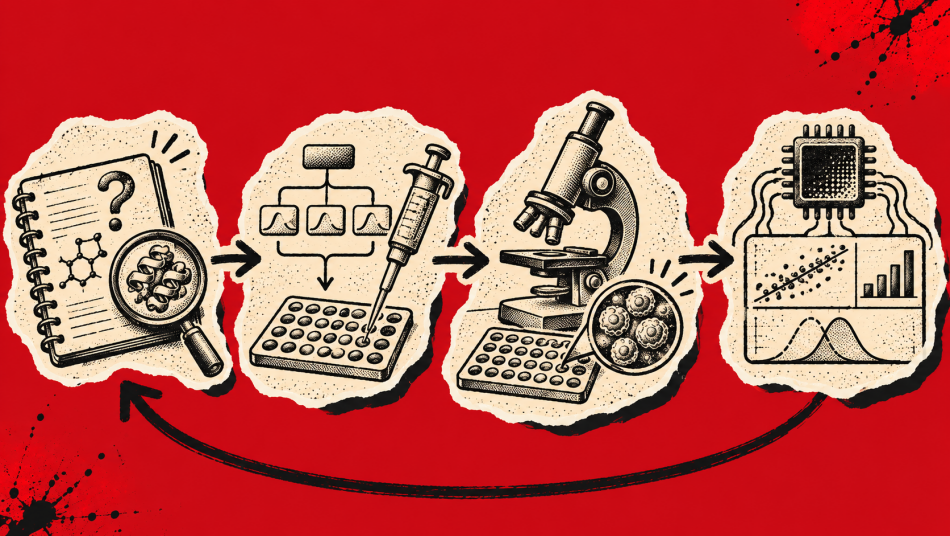
Research workflow: posing questions, designing experiments, running experiments, and feeding back results

Why cells become the carrier for foundation models
But the fact that large language models can organize research workflows doesn't mean they've mastered how living systems operate. The deeper the research, the more it needs models capable of handling concrete biological problems.
Biology's different scales carry different information: DNA sequences record genetic information, proteins participate in molecular interactions, and cells aggregate these changes into observable life activity. Proliferation, differentiation, stress response, even death — all happen within a specific cellular context. The same intervention can produce very different results across cell types and states.
What virtual cells try to learn is precisely these states and how they change: after a gene is suppressed, a drug is added, or the surrounding environment shifts, how does the cell respond?
This also clarifies the relationship between virtual cells and biological foundation models: biological foundation models aim to learn generalizable underlying rules from massive biological data, while virtual cells are the manifestation of this technical route at the cellular scale, mutually supporting biological models at other scales in data and capability. The virtual cell roadmap published in Cell likewise lists connecting molecular, cellular, and multicellular-scale models, along with cross-modal learning, as key components of this direction.
One key is making different measurements genuinely correspond. Gene expression offers important clues about cellular activity states; protein measurements, microscopy, and functional assays provide information from other angles. Samples from the same cell, or with reliable correspondence, can help the model link these observations to the same biological state. That connection requires both experimental design and data quality.
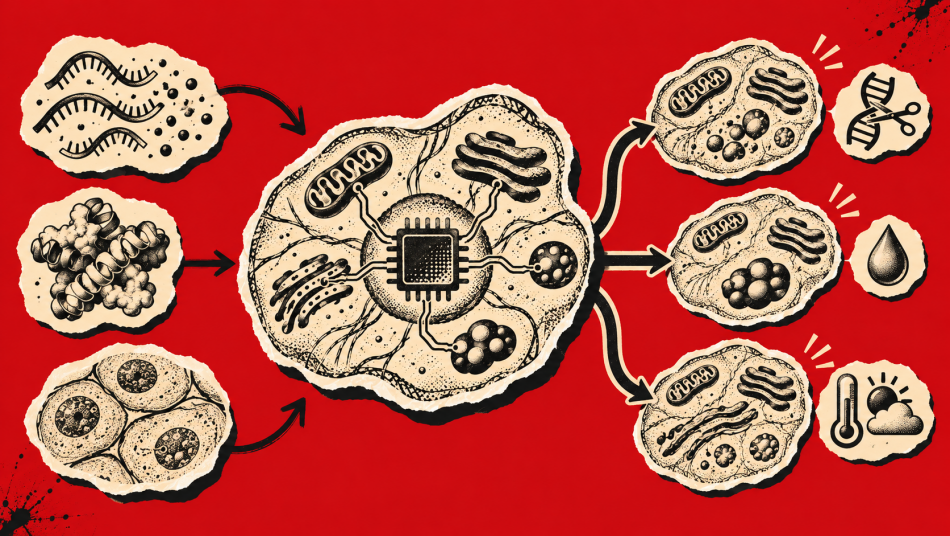
Virtual cells: integrating multimodal information to predict cellular responses under different interventions
Another key is the evidence that interventions provide. Observing that a gene's abnormality co-occurs with a disease is not enough to judge what changing it would do. Only explicit interventions, matched controls, and replicate experiments help determine what a given operation causes under specific conditions. Such data can test model predictions and gradually narrow the range of mechanistic explanations.
The cellular layer matters, then, because it connects observations at different scales with changes that can be repeatedly verified. Broader biological models can test hypotheses here, and cell models can absorb information from sequences, proteins, and other measurements to improve their own predictions.
Arc Institute's STACK, the world's first generalizable virtual cell model, offers an example of how to understand this direction. It makes cell samples themselves the prompt, using information from an existing context to infer another set of cells' transcriptional responses under corresponding conditions — no re-fine-tuning required for each target dataset. It explores a question directly tied to model generality: can the rules in known experiments help us understand biological contexts that haven't been well measured?
It is understood that Dong Mingze, the sole first author of the STACK model, has joined Yuanshi Technology full-time. This gives Yuanshi Technology, at an early stage, core talent who directly participated in developing a frontier international cell model. Frontier researchers moving into industry also adds a dimension worth watching to this wave of virtual cell startups: can model research be more tightly integrated with continuous data production and real R&D problems?

After molecules comes pharma
Why cell models draw attention becomes easier to grasp in the context of drug R&D.
Eli Lilly CEO David Ricks once noted: "Finding a molecule that can bind a target is just the first step. Researchers still need to judge whether the target is truly disease-relevant, whether changing it can produce the intended efficacy, and whether unacceptable toxicity will emerge once the drug enters the human body. For these questions, existing AI models still have clear limitations."
These judgments run through target validation, preclinical research, and clinical development. Even if a molecule-target interaction is accurately predicted, evidence on disease mechanism, cellular response, and human safety still needs to accumulate. Advances in molecule design make the search for candidates more efficient; judging which candidates are worth further investment determines how much of that progress turns into drugs.
Google DeepMind's Pushmeet Kohli argued in a recent discussion that talking about AI accelerating drug R&D requires specificity about which step is accelerated — target discovery, lead molecule optimization, preclinical research, or toxicology. Bigger gains depend on further breakthroughs in the underlying biological questions and models.
The industrial value of virtual cells can be understood along these lines: they promise to help researchers form earlier judgments about efficacy and risk, and direct limited experimental resources toward the questions most worth testing.
Facing multiple candidate interventions, for example, a team can first compare their predicted effects on disease-relevant cellular states and choose which to prioritize for validation. Facing differences in how the same intervention behaves across samples, it can further look for patient characteristics likely to benefit. Facing potential risks, it can fold abnormal responses in normal cells into the next round of experiments.
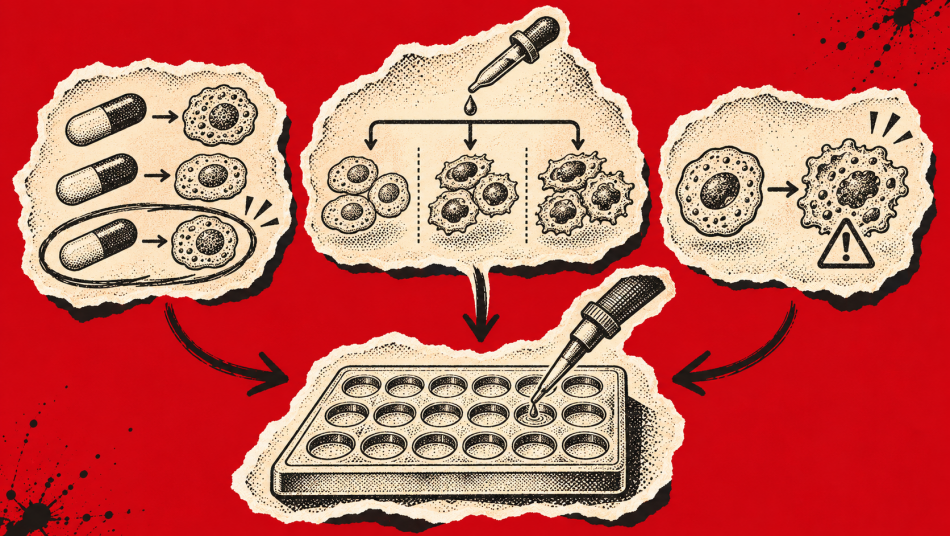
R&D applications: comparing candidates, exploring response variation, and identifying potential risks, followed by experimental validation
These capabilities must be validated one task at a time. Cellular-level predictions also still need to connect with tissue, organ, and clinical evidence. But for R&D teams, as long as a model can deliver reliable incremental value at key decision points, it can affect the choice of a single experiment, the ranking of a candidate molecule, even whether a pipeline moves forward.
This gives virtual cells a clear starting point for value: at earlier R&D stages, making previously murky biological uncertainty more judgeable.

The next threshold: continuously generating valid evidence
Following this logic, a core question in the virtual cell race emerges: where does the data these models need actually come from?
Public databases provide an important starting point for biological models. But for specific intervention-prediction tasks, whether the data covers the relevant cellular context, includes reliable controls, allows different measurements to correspond, and documents experimental conditions clearly — all of this affects what a model can learn.
Repeatedly measuring many similar cells can increase sample counts, but may not fill information gaps around a rare state, a key intervention, or a patient background. For models that need to transfer to new scenarios, effective coverage matters as much as measurement quality.
In describing the data work for the 2026 Virtual Cell Challenge, Arc also stressed the demands that cross-cell-context prediction places on data consistency and quality: technical variation and noise can mask true biological signals. The challenge itself shows that the obstacles models must overcome involve not just algorithms but the experimental data used for learning and testing.
Data production therefore needs to become part of model R&D. Teams should organize experiments around target tasks, linking interventions, cellular contexts, response measurements, and matched controls; then use model errors to identify which conditions remain uncovered and which experiments are most likely to fill critical gaps, and feed new results into the next round of training and validation.
This is why the dry-wet loop deserves attention. Its value comes down to a concrete question: with each additional round of experiments, does the model gain evidence it previously lacked and perform better on independently held-out tasks?
Measuring such a system requires watching data and results together. Is effective intervention coverage expanding, do different modalities correspond reliably, can the cost per unit of qualified data fall; and further, can prediction gains withstand new experimental tests and genuinely help clients make R&D choices.
Once these links run continuously, the data and experience accumulated from individual projects can feed back into later research. This is both the foundation for compounding platform value and the concrete expression of recursive self-improvement (RSI) in biological foundation models.
To Dong Mingze, RSI is far from limited to the model iterating on itself. "The underlying logic of RSI in AI for Biology and in LLMs is the same: find the bottleneck that truly constrains capability progress, and use AI to continuously empower and break through that rate-limiting step." An ideal RSI system, he argues, should cover the full AI R&D pipeline — from software algorithms and data collection to hardware infrastructure — systematically identifying and breaking efficiency bottlenecks at each link. RSI in different fields need not follow identical paths; the key is accurately identifying the most constraining link at the current stage and letting each round of improvement raise the efficiency and capability of the next. Only when this self-improvement capacity extends across the entire R&D system can it form the long-term force driving exponential AGI progress.
Returning to Yuanshi Technology's financing, the interest of different investors can be understood through these interlocking needs.
From a hard-tech investment perspective, what matters is whether model capabilities can be reused across tasks and whether experimental feedback can support continuous learning. From the pharmaceutical industry's perspective, the key is whether efficacy, risk, and patient variation can be judged earlier. From an industrial investment perspective, stable data production and R&D collaboration may become a foundational capability that accumulates over the long term.
These values come from different fields but intersect on cell models: life sciences needs more predictive models, models need more informative experiments, and drug R&D needs both to provide more reliable grounds for decisions.
This nearly RMB 300 million early-stage round offers a vivid sample for observing that intersection. Whether virtual cells can grow into critical infrastructure for biomedicine ultimately depends on whether, problem after problem, they can turn verifiable predictions into usable evidence.
How Yuanshi Technology answers these questions remains to be seen.
Sources
[1] Anthropic, Claude Science, an AI Workbench for Scientists, June 30, 2026.
[2] Anthropic, Corporate Public Disclosure: Acquisition of Coefficient Bio and Molecular Biology Laboratory, November 11, 2026.
[3] OpenAI, OpenAI Acquires Orchestra Bio, October 20, 2026.
[4] Google Research, A New Era of Discovery: Google Research at I/O 2026, May 28, 2026.
[5] EPFL AIMM, How to Build the AI Virtual Cell, December 2024.
[6] Arc Institute, Stack: Simulating Cellular Conditions via Prompt Engineering, Without the Need for Fine-Tuning, January 9, 2026.
[7] Latent Space, "Why AlphaFold Didn't Solve Protein Folding — Pushmeet Kohli, Google DeepMind & Sal Candido, Biohub", October 10, 2026.
[8] Arc Institute, Generating High-Quality Perturb-seq Data for the 2026 Virtual Cell Challenge, October 1, 2026.


ID: daltonventure
Long-press to follow
** R E C O M M E N D E D R E A D I N G **