Creators | Dalton Venture × Jincheng Technology: From AI for Science to AI for Industry
From medicine to materials to food, more and more products are being made by cells and enzymes; from cells and proteins to entire factories, more and more processes are being simulated, designed, and optimized by artificial intelligence. And with that comes a new question: what kind of future will these creators actually build?
Introduction
A revolution in "making things" is underway.
From drugs and materials to food, more and more products are being made by cells and enzymes; from cells and proteins to factories, more and more processes are being simulated, designed, and optimized by artificial intelligence. A new question follows: what kind of future will this group of makers actually build?
To find out, Dalton Venture has launched the "Makers" series, going inside the portfolio companies of its biomanufacturing CVC fund, Aochuang Pioneer Fund, and getting close to the founders who are redefining "manufacturing."
Inside a single fermentation tank, hundreds of biochemical reactions are happening at once. Temperature, pH, dissolved oxygen, feed rate — these parameters are all coupled to one another, and a tiny change in one right now may not fully show up in the final yield for hours. China has the world's largest biomanufacturing fermentation capacity, with annual output exceeding 70 million tons; core products such as antibiotics, amino acids, and vitamins account for roughly 70% of the global total.
With capacity this vast, the most critical decisions on the production line — should we feed now, should the temperature go up, should we intervene when the dissolved oxygen curve looks off — have long depended on the experience of a handful of veteran process engineers. And that experience has two problems: it can't be passed down, because people retire; and it isn't stable, because different shifts operate differently, which turns directly into batch-to-batch swings in output.
What Jincheng Technology wants to do is let AI catch these judgments. Founder Li Jinjin is a professor at Shanghai Jiao Tong University and director of the AI and Microstructure Lab (AIMS Lab). Trained in condensed matter physics, she spent years in first-principles computational research, studied abroad, and returned to her alma mater to teach in 2014. She has led teams in developing several AI platforms, including AlphaMat, a generative large model for materials, and AlphaBio, a protein prediction model. Watching flagship factories lean heavily on veteran engineers' experience while production transformation stalled, she began toying with the idea of using time-series AI to remake the production line. In 2023, as the AI wave swept through, faster-win options like general-purpose large models and consumer AI were on the table. She chose to dive into physical manufacturing — longer cycles, higher barriers — and Jincheng Technology was founded in Shanghai.
1
Factories aren't short on data — they're short on AI that can decide
Chinese factories aren't short on data. Most manufacturers deployed industrial systems long ago, and sensors on the line collect data around the clock. But when it comes to process optimization and complex production decisions, companies still fall back on engineers' experience. Human experience has a ceiling, and many manufacturers are stuck at their current processes, unable to break through on output or energy consumption.
"Many factories aren't short on sensors or massive amounts of production data — they just struggle to use it well. The processes are complex, the mechanisms unclear, the operating conditions constantly shifting. Traditional mechanistic models struggle to adapt, and general-purpose large models don't understand physical constraints, so the plans they produce can't be applied directly to production operations." That's how Li Jinjin describes the state of the industry. In her view, industrial production is fundamentally the continuous transformation of matter in the flow of time — a dynamic process. AI in the past could only do static analysis and after-the-fact prediction; it couldn't intervene in real time or warn ahead of a process already underway.
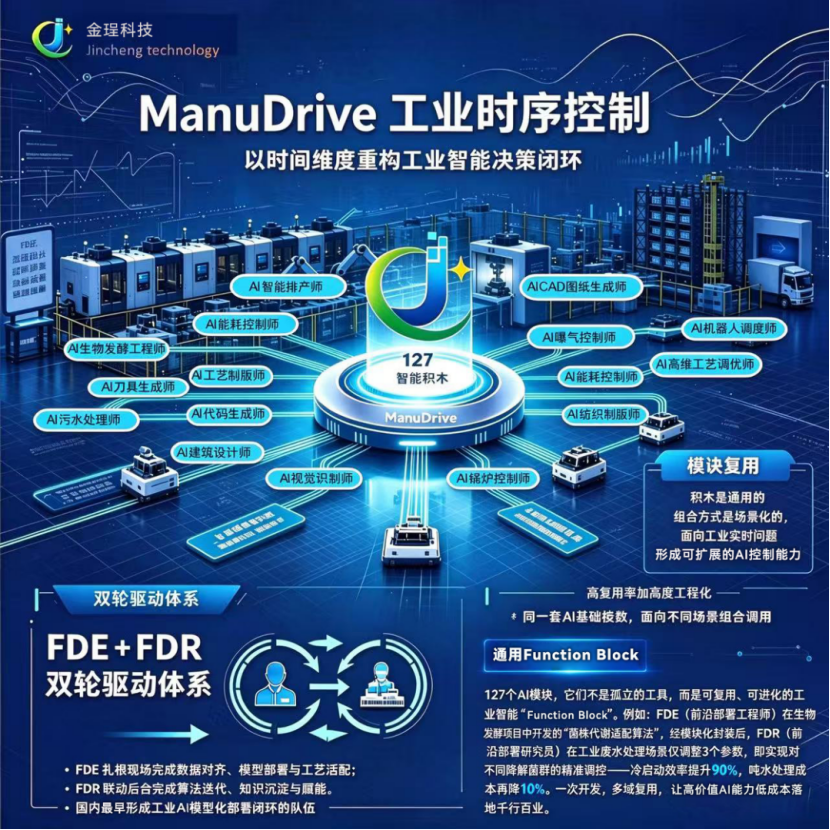
ManuDrive targets exactly this problem. The industrial time-series control model fuses physical mechanisms with on-site industrial data and outputs executable control commands bounded by physical safety constraints, participating directly in production line regulation — optimizing process parameters in real time, compressing production cycles, cutting energy losses, stabilizing product yield, and reducing abnormal equipment downtime. The platform has so far accumulated 127 reusable algorithmic function agents, covering 1.8 million process variables, 1.5 billion physicochemical kinetic data points, and 30 billion equipment time-series data points. These agents fall into categories such as perception, decision-making, optimization, execution, and evolution, covering the full pipeline from data collection and cleaning to model training, inference deployment, and monitoring and alerts.
2
AI doesn't get control on day one
Industrial production leaves no room for unlimited trial and error; one wrong control command can mean an entire tank of product scrapped. Before ManuDrive goes live, the model has to pass backtesting on historical data and on-site testing, clear multiple rounds of review, prove itself across real production batches, and then gradually expand its authority within the boundaries of process safety constraints.
Supporting this rollout is a dual-track "FDE + FDR" team. Forward Deployed Engineers (FDEs) are stationed at the factory, handling data integration, model adaptation, and continuous on-site support; Forward Deployed Researchers (FDRs) work with the Shanghai Jiao Tong University lab, taking real operating conditions sent back from the front line and continuously iterating on the model. Every algorithm update must go back to the production line for validation. The company calls this "industry poses the question, technology answers it." According to Jincheng Technology, it is the first team in China to run the "FDE + FDR" dual-track model end to end.
On the control side, the team uses causal inference to pinpoint the root causes of faults on complex production lines and quantify how process parameters affect product quality; it uses reinforcement learning to let the system find optimal strategies through dynamic interaction with its environment, handling nonlinear, tightly coupled industrial systems.
"A pretty POC isn't a victory. Getting past the pilot and into scaled replication — that's the real test," Li Jinjin says.
3
The first flagship project: a fermentation workshop in Xinjiang
Chuanning Biotechnology is the world's largest fermentation producer of antibiotic intermediates, with annual industrial output value of nearly 6 billion yuan. Jincheng Technology's first flagship project started here, with the team moving into the Yili production base — and the prototype of ManuDrive was born here too.
After the team moved in, the AI went through a long validation period — running batch after batch in real production, gradually expanding its authority within the boundaries of process safety constraints.
During validation, ManuDrive repeatedly proposed control approaches that differed from the veteran engineers' experience — approaches that proved more effective on experimental tanks. As this played out again and again, the process staff's trust in the AI gradually built up. Within a month of going live, the average output of AI-controlled lines had all surpassed the control group under equivalent conditions.
The benefits are concrete. With Jincheng's team enabling it, Chuanning Biotechnology's production line fluctuation dropped by 50% and output rose 3%–5%, generating tens of millions of yuan in incremental benefit per line each year.
4
Turning one success into a replicable capability
Industrial scenarios are highly non-standard. If every customer required re-processing data, developing models, and completing integration from scratch, delivery cycles would be long and scale hard to achieve. Jincheng Technology's answer is to componentize its capabilities. That work began on day one of the Chuanning project — time-series forecasting, anomaly detection, closed-loop control, industrial protocol integration, and other capabilities were gradually extracted into reusable, standardized components.
"Say you're deploying in biomanufacturing fermentation — you pick these 30 agents; in wastewater treatment, you pick another 40; in blast furnace incineration, another 20. With these agents, you can quickly assemble a vertical model," Li Jinjin explains. "Developing a vertical model used to take a year. Now we can build one in as little as an hour." The industry calls this approach "LEGO for industrial AI."
In biomanufacturing fermentation, this reuse is already proven. For fermentation plants making amino acids, vitamins, and other active pharmaceutical ingredients, a company only needs to export historical batch data and call up the pre-built fermentation components; the model can be deployed in one to two days, with no hardware changes to existing lines. The model can reproduce the full fermentation curve, output the metabolic network for the entire future lifecycle, and give dynamic process optimization recommendations that suppress batch-to-batch fluctuation. In the discrete manufacturing scenario of tooling process planning, the platform ingests 2D and 3D engineering drawings and historical machining records, internalizes veteran engineers' tool-path and tool-selection experience into the model, and has the AI automatically output a complete process plan — work that used to take ten-plus days or even months can now be done in minutes. Backed by standardized components, project delivery cycles have shrunk from months at the start to a matter of days.
5
Getting paid from the value created
Traditional industrial software charges by license or by project; customers pay but the results are uncertain, and all the risk sits on the customer's side. In some projects, Jincheng Technology uses a revenue-sharing model: customers don't need a large upfront investment, and the company only takes its share once the AI has actually created incremental value.
Jincheng Technology has now deployed at more than 100 mid-to-large manufacturers, spanning biomanufacturing, chemicals, water utilities, and other sectors. It turned profitable in its third year and signed its first overseas order in July this year. On that first overseas deal, Li Jinjin says: "They saw the real results on our domestic production lines, then we did in-depth technical exchanges, completed solution validation, and finally reached an agreement." This model ties technical value directly to the customer's business results, and forces the team to deliver quantifiable production gains. The investment community has started asking about this Shanghai Jiao Tong University professor, too; quite a few institutions have followed the team to factories, seeing firsthand how the system intervenes in production and adjusts process parameters, and getting real results on energy savings and efficiency gains.
6
From fermentation tanks to more production lines
On the same ManuDrive foundation, Jincheng Technology is moving into more scenarios: AI biomanufacturing fermentation engineer, AI wastewater treatment engineer, AI tooling planner, AI CNC programmer, AI production scheduler, AI textile patterning specialist… The company's line is, "the job changes, the model stays the same." In blast furnace incineration, the system calls on about 20 agents to take part in combustion control; in textile patterning, work once done by hand — size conversion, line-art retouching, pattern filling — is handed to the model; in scheduling, AI dynamically allocates production based on orders, equipment, and staffing; in water utilities, the model can anticipate system drift, improving cold-start efficiency by 90% while reducing chemical dosing and cutting costs.
The bigger opportunity lies in existing production lines. China has the world's most complete industrial system and a massive stock of existing lines. Jincheng Technology believes that if AI can keep extracting efficiency gains from lines that have run for years — without tearing them down and rebuilding — what it creates is new production increment. The next step is to replicate proven capabilities across more lines, more industries, and more countries, and become infrastructure for industrial intelligence.
Li Jinjin clearly senses that the market's yardstick is changing. "The market is gradually moving past hype around concepts — everything comes down to real results on the production line." Investors no longer fixate on model parameters; their questions are increasingly concrete — has the technology actually been integrated into real production lines, can it achieve closed-loop control, does the revenue come from actual value created on the ground.
And in Li Jinjin's view, AI's entry into the physical world won't happen overnight. It takes patience — proving it out batch by batch, and tackling real-world problems line by line.
For the biomanufacturing industry, this rhythm is familiar. Taking a strain from the lab to the factory itself requires scaling up and validating batch by batch. Now, control on the production line is starting to be handed over to data and models in the same way — a little at a time.
(This article is based on public reports and company materials.)
END


ID: daltonventure
Long-press to follow
** Recommended Reading **