CCTV's Top Ten AI Startups: The Only AI Drug Company Is Tsinghua-Affiliated | Dalton Venture Family
Recently, **Dalton Venture portfolio company Shuimu Molecule Biotechnology Co., Ltd. (hereinafter referred to as "Shuimu Molecule")** emerged from 1,200 applicants worldwide in the "**2026 Win in AI+**" entrepreneurship gala, co-hosted by China Media Group and the Hangzhou Municipal Government. After multiple rounds of competition, it **was named one of the "Top Ten AI Visionaries" — the only AI drug discovery company on the list**.

Background
Recently, Shuimu Molecule (水木分子), a Dalton Venture portfolio company, emerged from 1,200 applicants at the "2026 Win in AI+" entrepreneurship gala co-hosted by China Media Group and the Hangzhou Municipal Government. After multiple rounds of competition, it claimed a spot among the "Top Ten AI Visionaries" — the only AI drug discovery company on the list.
The buzzwords of China's AI scene keep cycling through: the Four AI Dragons, the Six LLM Tigers...
This time, the industry's next cohort of star companies got the CCTV seal of approval.
Twelve hundred competitors, whittled down to the Ten Steeds of Chinese AI Entrepreneurship.
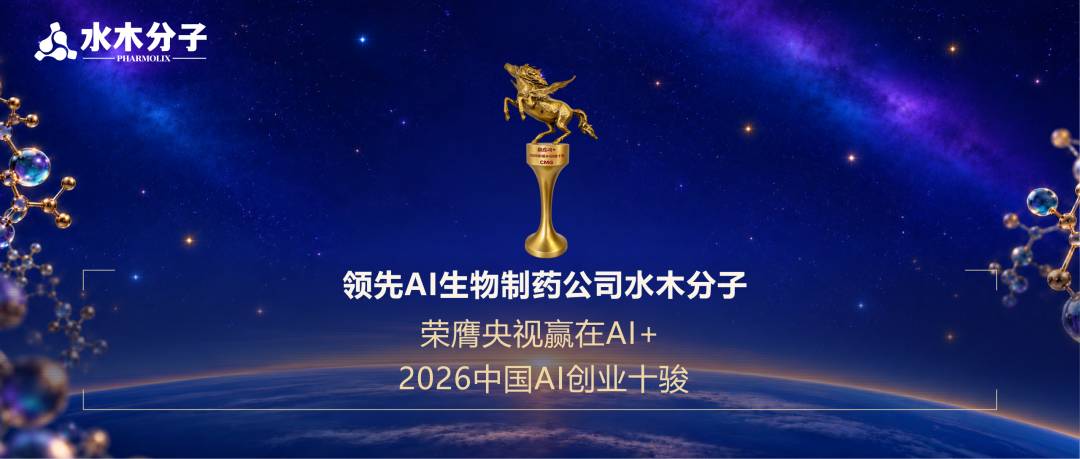
The list spans robotics, intelligent manufacturing, and life sciences. But only one AI pharmaceutical company made the cut — worth a closer look today.
It's working in the hottest area right now: AI-driven biopharma.
Earlier, Moderna and Merck & Co. jointly announced positive results for an AI-assisted personalized mRNA cancer vaccine in melanoma treatment, the so-called "king of skin cancers."
The news was exhilarating, and inevitably raised the question: where does domestic AI pharma stand today?
Through the sole AI pharmaceutical company on CCTV's top-ten list, we might find some answers.
Founded just three years ago, incubated by Tsinghua AIR — founded by Academician Ya-Qin Zhang — with Professor Zaiqing Nie serving as chief scientist.
It's Shuimu Molecule, among the fastest and most comprehensive in deploying AI modules across the board.
The problem Shuimu Molecule aims to solve sits in the deepest waters of drug R&D:
A pharmaceutical expert accumulates decades of experience — how can AI truly put it to use?
The "veteran" team at Shuimu Molecule landed on an answer: conversational AI-native.
Since 2023, they've been advancing the connection between natural language and biological language, bringing those capabilities into their conversational drug discovery platform ChatDD.
Going further, Shuimu Molecule has organized research methods that experts describe through dialogue into skill packages that AI agents can call upon at any time.
Meanwhile, it's directly advancing innovative drug pipelines for autoimmune diseases and cancer, applying the platform to its own R&D decisions, molecular design, and project operations.
Behind this multi-pronged approach lies a straightforward judgment shared by Shuimu Molecule and the broader pharmaceutical industry:
When biopharma meets AI, natural language interaction brings expert experience and judgment into tighter integration with large models' efficient knowledge reasoning and full-atom end-to-end molecular design capabilities.
This human-machine synergy drives extreme R&D efficiency, ultimately delivering real clinical progress and success rates for Chinese innovative drugs.
Four Paradigm Shifts in Drug Discovery
Shuimu Molecule's COO Jie Xing noted on the program that the pharmaceutical industry has a widely cited rule of three tens.
A new drug takes an average of ten years, over $1 billion in investment, with a success rate below 10%.

△Image AI-generated
The challenges go far beyond finding a molecule that binds to a target.
How an innovative drug distributes in the body, whether it achieves expected effects, whether it has unacceptable side effects, which patients might benefit — all these require building a complete chain of evidence.
Frankly, half of "old-school" drug manufacturing relied on experiential judgment, difficult to replicate and hard to feed directly into AI training.
In Zaiqing Nie's view, this is where critical disconnects emerged in past AI drug discovery projects.
Models can predict structures, generate molecules, rank candidate results — but researchers may not fully understand the ranking basis, nor easily feed their concerns back to the model. Computational results can go to experimental validation, yet experts and algorithms lack channels for sustained collaboration.
Shuimu Molecule thus proposed a four-stage framework for drug discovery:
TMDD → CADD → AIDD → ChatDD.
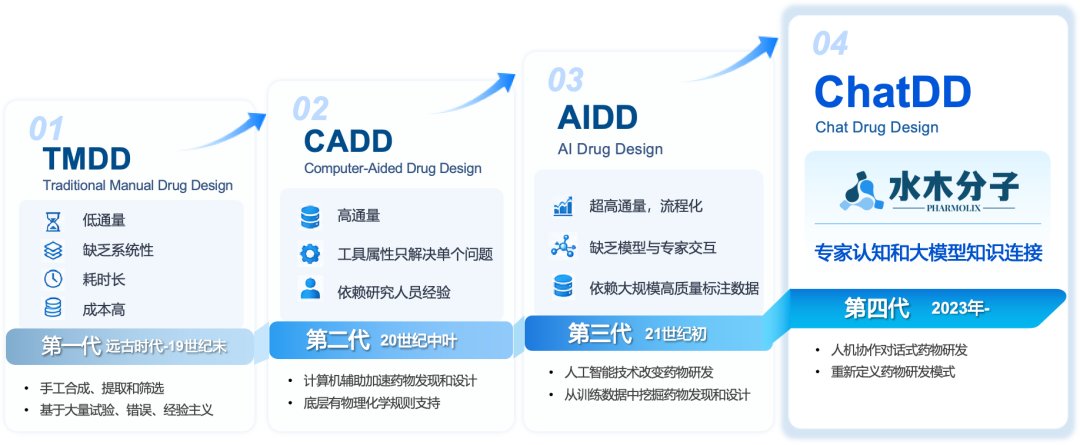
TMDD (traditional methods of drug design) is straightforward — the earliest drug discovery process relying on experimental accumulation and expert judgment.
Then computers began assisting with partial computation and simulation work: CADD (computer-aided drug design).
Later, AIDD (AI-aided drug design) started applying AI to property prediction, molecular generation, and other tasks. But expert experience and intuition proved difficult to effectively interact with and organically integrate into small-model-era AI.
ChatDD (Chat-based drug design) aims to advance something further: enabling experts to participate in task planning, execution, and result correction through natural language dialogue.
This organically combines drug discovery experts' experience and intuition with AI agents' capabilities in high-throughput literature reading, efficient computation and reasoning, and high-quality molecular design and screening — forming a complementary human-machine collaborative R&D model.
Experts pose questions and task objectives; large models decompose them and call tools; results return to experts. Through multiple rounds of interaction, expert experience efficiently participates in every step of AI-driven drug discovery.
In the present moment, where machines haven't yet mastered sufficiently complete information, this is crucial. Conversational interaction makes expert-AI connection possible for the first time.
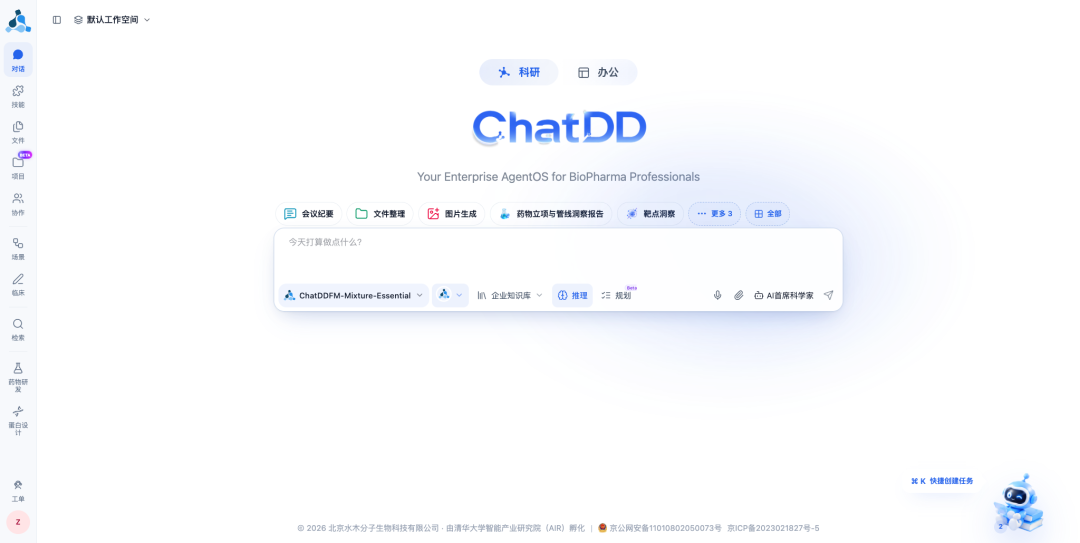
In fact, this is also a forward-looking generational framework.
ChatDD was proposed by Shuimu Molecule in 2023. Now, overseas efforts like GPT-Rosalind and Claude Science are exploring similar interactive directions.
The scope of industry competition is evolving from single-model prediction capability to the organization of entire scientific workflows.
Put more plainly: it's a race to see who becomes the AgentOS gateway for drug discovery first.
Next, taking Shuimu Molecule as an example, let's see how they actually bring pharmaceutical experts' experience into AI scientists' work.
Platform-Pipeline Dual-Wheel Drive
To make AI usable, first you need to see clearly where this experience actually resides.
Some is already written into papers and databases — AI can take it immediately. Some manifests in experts' judgments about current projects, requiring daily interaction to capture. Some can be sedimented into reusable workflows.
Shuimu Molecule is attempting to connect this experience into models and specific tasks respectively, and let them continuously influence what comes next.
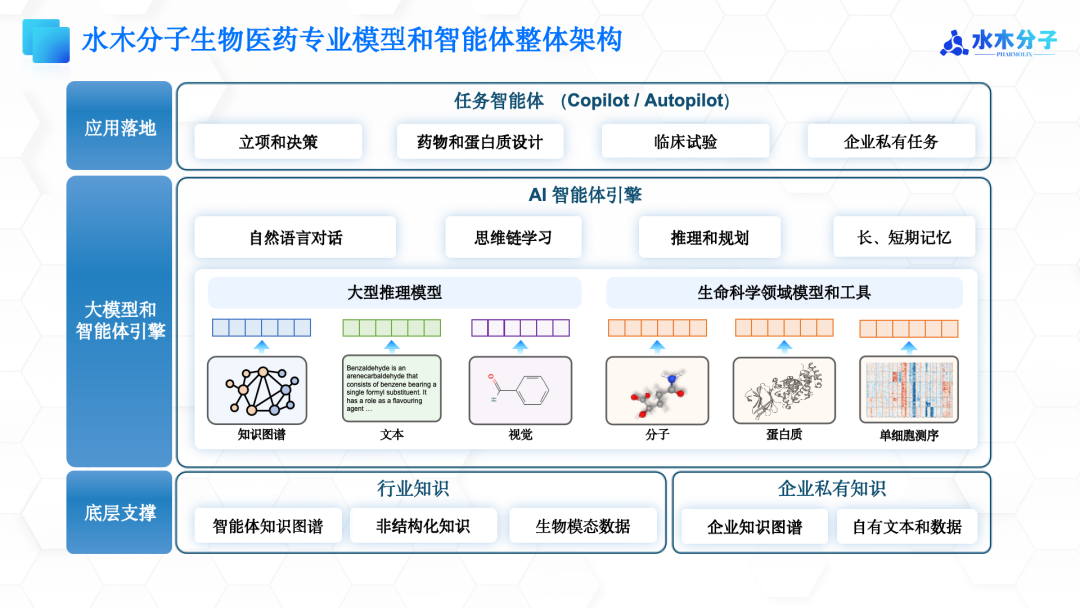
Concretely, this is an upward-extending interactive system built from a model foundation.
Letting Paper Knowledge Participate in Next Design
Take a simple example: suppose a researcher wants to optimize an antibody through mutation. The expert states functional goals; the model ultimately handles amino acid sequences and spatial structures.
There's an obvious language gap here. The first hurdle is integrating relevant knowledge into the base model.
BioMedGPT, which Shuimu Molecule jointly advanced with Tsinghua AIR in 2023, first explored aligning natural language with molecular, protein, and other biological data.
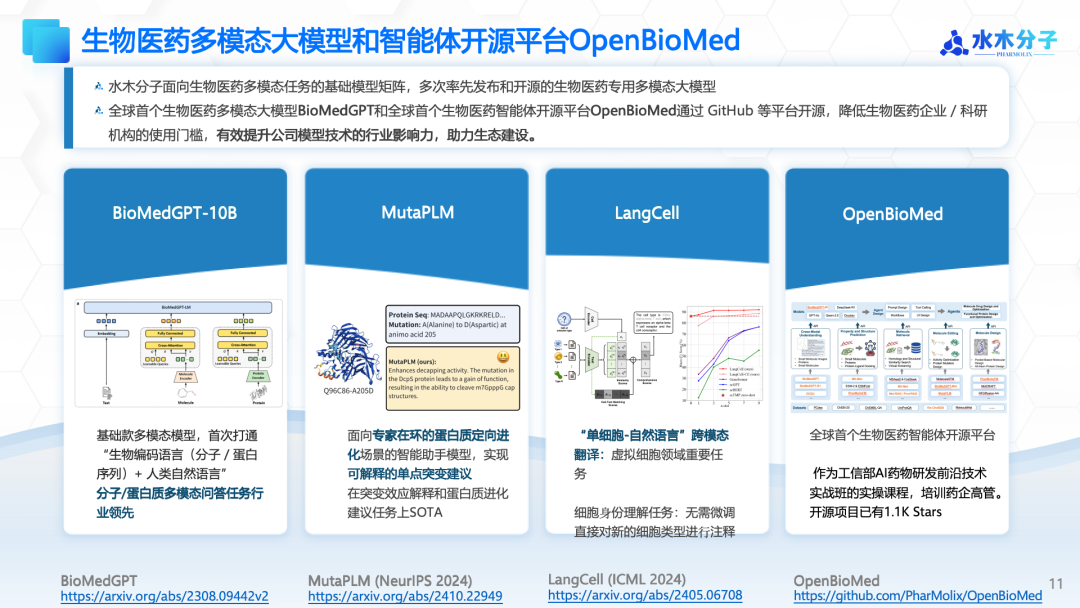
Researchers can ask questions around input biological data, connecting textual knowledge to specific research objects.
Among these, BioMedGPT-10B was the world's first open-source, commercially available 10-billion-parameter multimodal biomedical large model, ranking in the top tier on benchmark tests.
MutaPLM makes this connection more concrete.
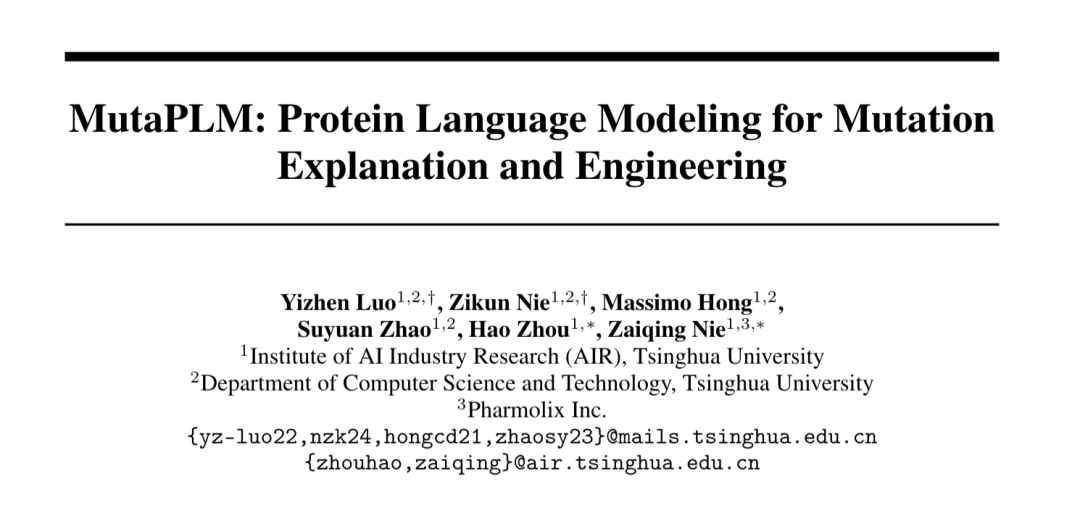
This NeurIPS 2024-accepted research maps textual descriptions of mutation effects to protein mutations, both exploring what changes a mutation might bring and proposing candidate mutations based on researchers' described goals.
Simply put: the former understands "if we change this position, what might happen"; the latter asks "to achieve this kind of change, where might we consider modifying".
Mutation optimization also needs to clear the structure hurdle. Recently disclosed StructEvo introduces structural information into protein mutation optimization, letting candidate search consider spatial constraints.
According to the team, this work has been accepted to NeurIPS 2026.
Behind all this lies a clear technical judgment from Shuimu Molecule: protein design has long faced a "robbing Peter to pay Paul" dilemma.
Changing a few amino acids might enhance binding capacity but disrupt proper protein folding; increasing structural rigidity might improve stability but sacrifice functional adaptability.
So for specific design tasks, the team developed corresponding models respectively. For example, CodeFP — accepted to ICML 2026 — specifically focuses on sequence-structure co-design of functional proteins.
AbGaze further explores full-atom end-to-end de novo antibody design, applying geometric information to sequence and structure generation.
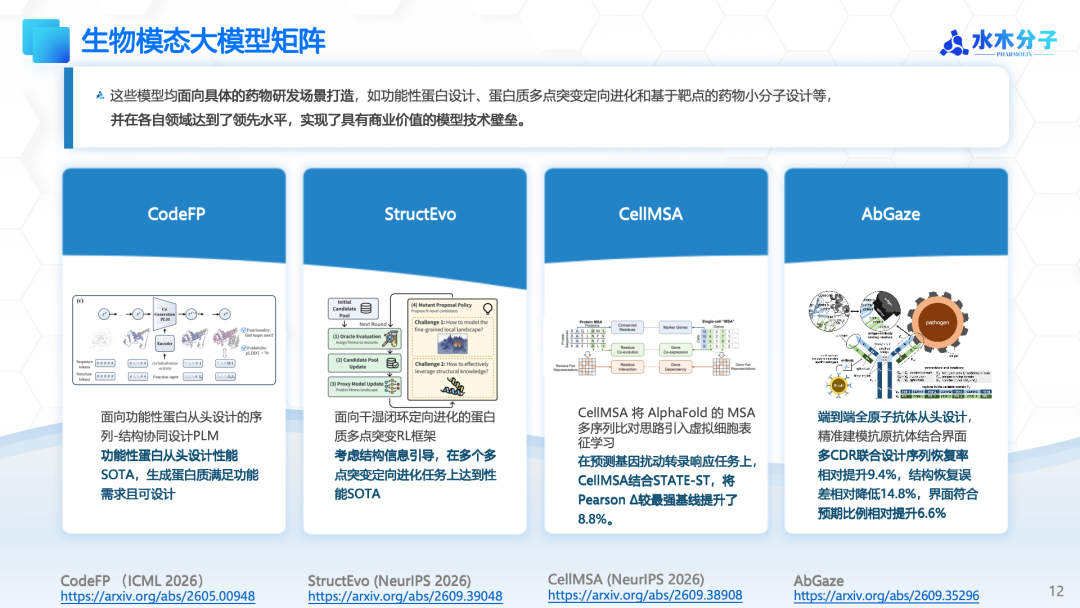
Thus from extracting knowledge from literature to translating functional goals into model analysis and design basis, experts' years of accumulated research gains an entry point to participate in next-round R&D.
The sedimented AgentKG knowledge graph organizes domain knowledge and its relationships, making every answer traceable and sourced.
Experts supplement objectives, constraints, experiential knowledge, and questions through prompts; agents plan tasks and call tools accordingly, returning results.
After receiving results, experts continue querying or adjusting conditions; the next round of tasks changes accordingly. Through round after round of concrete exchange, experience begins deeply participating in the computational process.
So model training absorbs organized knowledge and data; dialogue supplements current task context, influencing direction: as experts use AI, AI also uses expert judgment to organize work.
Turning One-Time Guidance into Reusable Methods
Then a more practical question arises: after an expert has worked through a task with AI, must they start from scratch next time?
This question pushes Shuimu Molecule's work from models and dialogue toward skill packages.
Because expert experience also manifests in research methods: what evidence to check first, when to supplement analysis, how to set screening conditions, which steps require human verification.
These clearly expressible and verifiable processes can all be organized into repeatedly callable skill packages.
This year's first batch of released OpenBioMed skill packages already encompasses 45 professional skills, covering five categories: biochemistry/drug discovery, protein analysis and design, single-cell omics analysis, data retrieval, and tool calling.
Among these, Skill Creator advances expert participation to the workflow creation stage.
Researchers describe task intent, inputs, outputs, and constraints through dialogue; the system assists in organizing workflows, then validates and modifies with actual data, forming skills applicable to corresponding tasks.
Thus one expert's guidance can leave behind sustainably usable methods.
From paper-sedimented knowledge, prompt-expressed current objectives, to verified skill packages — the three function differently but complement each other, jointly pushing experts step by step into AI scientists' work.
Letting Real Tasks Test Collaborative Effects
Ultimately this approach must be tested in real tasks.
At the application layer, this translates to ChatDD for enterprises and Shuimu Zhiliao (水木知了) for individual researchers.
These correspond to two product models: the former is top-down, enterprise procurement driving employee usage; the latter is bottom-up, more suitable for researchers and small teams.
First, ChatDD. Shuimu Molecule CEO Zhuozhi Wang describes its three main modules: Insight, Discovery, and Trial.
Insight first helps experts answer pre-project questions: is a target worth pursuing? Which patients can the resulting drug treat?
This requires simultaneously understanding disease mechanisms, unmet clinical needs, existing research evidence, competing projects, and patent landscapes. ChatDD splits related work among multiple specialized agents, collecting and organizing information to assist expert judgment.
Moving to Discovery, the task becomes how to design and virtually screen molecules.
Experts propose design objectives; the platform organizes computation and candidate screening; results enter researchers' judgment and experimental planning. This is also where Dr. Wang sees revolutionary changes emerging.
Trial extends support to clinical-related work, aiming to improve clinical development efficiency and success rates.
Simply put, ChatDD's most important significance is letting life scientists fully use AI tools through dialogue.
In the past, life scientists often needed to learn programming or communicate back and forth with computational teams to complete these operations. Now everyone can have a truly drug-savvy AI scientist team, communication costs drop, and innovative drug R&D efficiency can substantially improve.
Before joining Shuimu Molecule as Chief Pharmaceutical Scientist, Qi Pan faced two opportunities: entering a company with existing R&D systems using AI tools, or joining an AI-native enterprise starting from AI.
As a pharmaceutical expert, she chose the latter — Shuimu Molecule. Her judgment:
For AI-native companies, AI isn't just a tool or auxiliary means; it may be a driving force that changes the entire drug discovery process.
Beyond project initiation and candidate drug design, ChatDD can also play sufficiently large efficiency-enhancing roles in downstream preclinical and clinical development stages — precisely the high-cost, time-consuming segments.
Shuimu Molecule has already applied this capability to its own R&D projects.
Take Shuimu Molecule's first self-developed pipeline: a bispecific antibody targeting autoimmune diseases.
According to Pan, when the project initially selected targets and R&D directions, ChatDD-Insight was used to analyze disease areas, competitive landscape, and preclinical, clinical, and translational research evidence.
After direction was set, molecular discovery and optimization continued using ChatDD-Discovery.
From target selection based on target biology and clinical evidence, to molecular design and virtual screening, to wet-lab validation and preclinical candidate (PCC) confirmation — this project took only seven months.
Compared to 12-24 months for traditional methods to reach preclinical candidate status, ChatDD has already demonstrated AI integration efficacy in early R&D.
Meanwhile, project data provides more direct feedback to the ChatDD platform: whether computational suggestions hold up in experiments, how to adjust where they don't.
These questions continuously return to the same R&D team; expert experience participates in next-round design through such judgment, execution, and feedback.
This is precisely the value of platform-pipeline dual-wheel drive:
Self-developed projects let pharmaceutical experts continuously use the platform, and let algorithm teams track a task's subsequent results long-term, continuously improving tools and processes.
Overall, Shuimu Molecule's native AI capability forms such a four-layer pyramid structure.
Though entry points differ, they share the same goal: making it easier for researchers to use AI, and letting their professional judgment more fully enter AI's entire workflow.
Shuimu Molecule is gradually solidifying this across four dimensions: AI models, agent platforms and Skills, products, and pipelines.
△Image AI-generated
With internal foundations solid, external efforts haven't lagged either.
Today ChatDD has already taken root among multiple external clients, with several types of cooperation:
- Domestic large pharmaceutical companies: Taking Fosun PharmAID as an example, Shuimu Molecule participates in co-creating R&D agent platforms, embedding AI capabilities into enterprise workflows;
- Biotech companies: The platform serves leaner R&D teams, helping build end-to-end agent-native innovative drug discovery processes, letting members focus more energy on direction judgment;
- CROs: Cooperation further enters CMC operations, clinical trial protocols, clinical study reports, and filing-related process transformation, empowering the CRO ecosystem through AI and laying out pharmaceutical industry services;
- Top multinational pharmaceutical companies: Strategic cooperation covers clinical operations, clinical filings, post-market clinical work, and more.
Commercialization and Open Source Coexisting
Viewed this way, Shuimu Molecule more closely resembles China's Isomorphic Labs.
Both are AI-native companies, both with wet-dry closed loops, both adopting parallel platform-service and proprietary-pipeline strategies.
Similarity also shows in their technical backgrounds:
Both incubated from top AI institutions (Alphabet/Tsinghua AIR), both led by AI algorithm scientists, both carrying deep AI research accumulation.
But correspondingly, Shuimu Molecule leans more toward large-molecule pipelines and technical open source.
On commercialization, platform and pipeline dual growth curves advance alternately, ensuring current monetization speed while leaving higher value ceilings.
2026 will be Shuimu Molecule's commercial scale-up phase, focusing on standardized products with customized projects as supplement. Xing estimates this year's revenue at 3-4x last year's, with pipeline entering development stages and business expansion also expected next year.
Admittedly, platform-pipeline dual-wheel drive isn't rare in AI pharma.
Shuimu Molecule's specific choice combines conversational agents with large-molecule drug discovery — antibodies and such — letting AI deeply participate in sequence design, structural analysis, and molecular optimization.
This means AI's participation depth and value release in drug discovery can be more significant, further amplifying AI-native path advantages.
Supporting all this is still a dream team spanning AI × pharma.
Ya-Qin Zhang, Zaiqing Nie, and Weiying Ma bring AI research and technology industrialization experience.
Zhuozhi Wang previously served as VP at WuXi Biologics, deeply participating in 300+ innovative drug projects with global partnership experience at Bayer; Qi Pan accumulated years of drug discovery and AI application experience at Genentech, Boehringer Ingelheim, Legend Biotech, and Pathos AI.
Jie Xing previously served as VP and CIO at WuXi AppTec, long participating in pharmaceutical industry digitalization, investment and financing, industrial ecosystem operation, and commercialization.
When the value of these experiences converges at Shuimu Molecule, AI-native truly takes root.
This is also my deepest feeling after speaking with Shuimu Molecule: this team has both technical confidence and the persistence to ground ideals in reality.
Whether discussing models, products, or pipelines, their first principles remain hoping technological progress ultimately becomes good medicine that patients can use.
From Tsinghua AIR's research accumulation to CCTV's Ten Steeds stage — in three years, Shuimu Molecule has turned initial judgments into products, and brought products into real R&D.
Its vision is for every pharmaceutical expert to have a truly drug-savvy AI agent team, making innovative drugs no longer expensive, making Chinese new drugs move from following to leading.
But more worth anticipating than embracing AI pharma's next GPT moment is what changes these can ultimately bring patients in terms of innovative drugs.
The laboratory is the starting point; patients are where drug discovery must ultimately arrive.
END