When AI Starts Doing Science: A Recap of the SSCI Leading Fund × Dalton Venture Tong Academy Event

Scientific exploration has no end point, and innovation in the age of intelligence has only just begun.

Tong Academy
From founding to IPO, building a company is a long journey of cultivation. While pursuing technological breakthroughs, startups face challenges across corporate strategy, business models, capital operations, and management.
To better support the steady growth of portfolio companies, we launched the Tong Academy series of post-investment events, creating a platform for entrepreneurs to learn from industry pioneers and innovators, and to foster collaboration and synergistic innovation across the industrial chain.
In this edition, Dalton Venture partnered with the Shanghai SDIC Pioneer Fund to present "Pioneer Link × Tong Academy | AI4S: The Scientific Revolution in the Age of Intelligence," exploring the ongoing transformations of AI for Science and its expanding possibilities for industry.
In recent years, AI has been entering more and more scientific fields — helping scientists predict protein structures, participating in molecular design, and moving into increasingly complex scenarios such as biomanufacturing, drug R&D, and industrial production. When AI moves beyond processing information for us to actually participating in scientific research, experiments, and discovery, what happens to science itself?
On the afternoon of August 28, "Pioneer Link × Tong Academy | AI4S: The Scientific Revolution in the Age of Intelligence" was held in Shanghai. The event brought together participants from government agencies, research institutions, innovative enterprises, investment institutions, and entrepreneurs, engaging in in-depth discussions on the implementation of AI4S in life sciences, biomedicine, and industrial sectors.
Pan Yan, Deputy Director of the Shanghai Municipal Commission of Economy and Informatization; Wen Zhi, General Manager of the Shanghai SDIC Pioneer Fund; and Sun Qi, Founding Managing Partner of Dalton Venture, attended and delivered opening remarks. More than ten innovative enterprise guests from life sciences, biomedicine, and industrial intelligence shared their insights on stage, joining ecosystem partners in a dialogue on "the scientific revolution in the age of intelligence."
Vol. 1
Opening Remarks: AI4S Through the Lenses of Policy, Capital, and Industry
Pan Yan, Deputy Director of the Shanghai Municipal Commission of Economy and Informatization, delivered the opening remarks. He noted that AI4S has evolved from a research tool into a key engine reshaping scientific paradigms and fostering new-quality productive forces — connecting fundamental scientific breakthroughs on one end with industrial innovation on the other. Shanghai has positioned AI4S as a priority in its city-wide AI development strategy, promoting deep cross-integration between artificial intelligence and life sciences, physical sciences, and advanced manufacturing through project mechanisms, public platforms, and policy-guided capital coordination, cultivating fertile ground for technological innovation and commercialization.
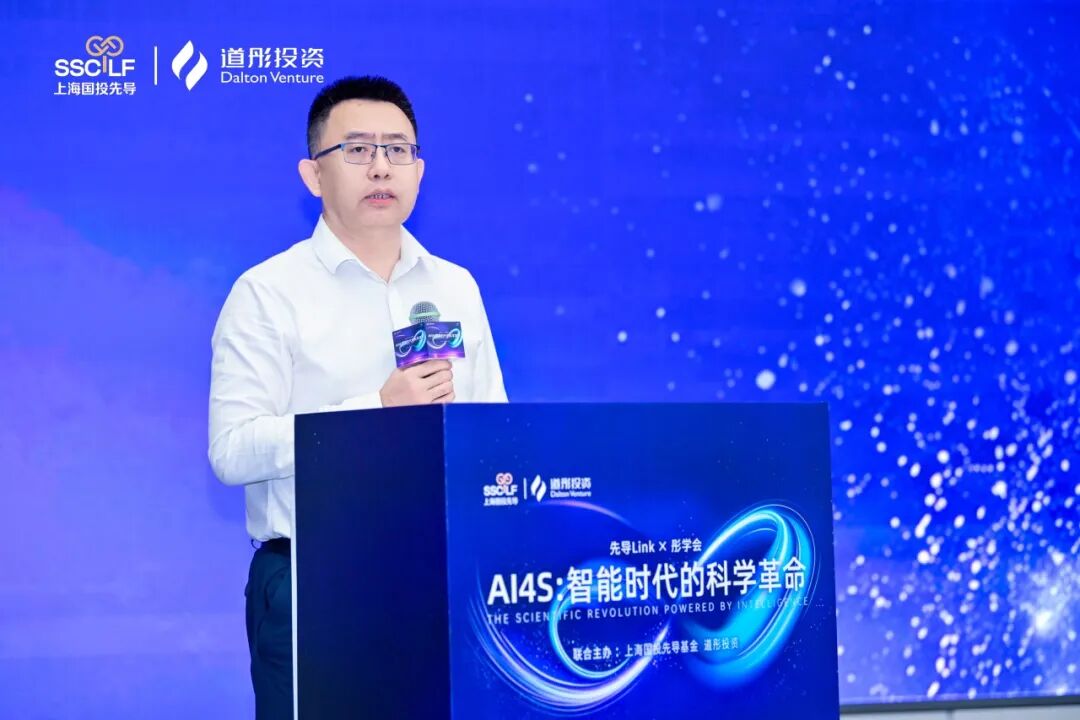
Photo: Pan Yan, Deputy Director of the Shanghai Municipal Commission of Economy and Informatization, delivering remarks
Wen Zhi, General Manager of the Shanghai SDIC Pioneer Fund, stated in his remarks that the fund has long focused on technological innovation and industrial development, and will continue supporting innovative enterprises through capital. He noted that AI4S is reshaping research paradigms, and as patient strategic capital, the fund adheres to three investment principles: prioritizing China-specific implementation scenarios, prioritizing genuine commercial闭环, and prioritizing interdisciplinary teams with integrated wet-lab and dry-lab capabilities.
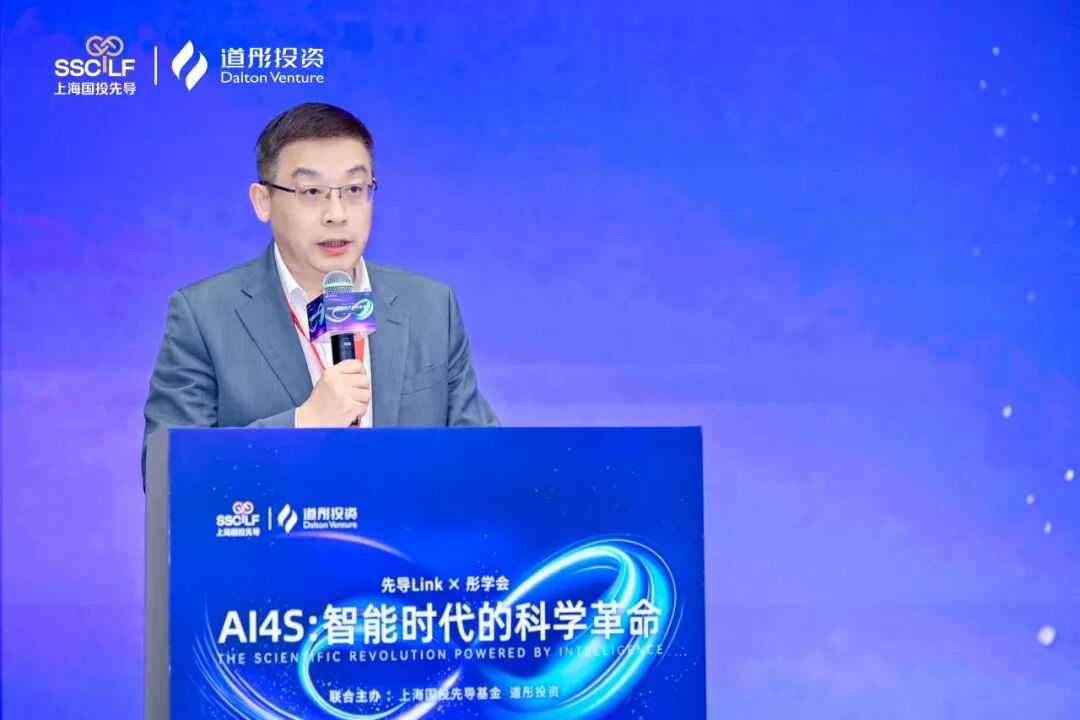
Photo: Wen Zhi, General Manager of the Shanghai SDIC Pioneer Fund, delivering remarks
"In recent years, significant capital, talent, and industrial resources have first concentrated upstream in AI," said Sun Qi, Founding Managing Partner of Dalton Venture, in his remarks. "But no technological revolution stays upstream forever." The challenge is that beyond a few large tech companies, most firms lack the capacity to build their own AI teams and train models. For AI capabilities to truly penetrate thousands of industries, a "middle layer" is needed — midstream AI4S enterprises that translate upstream AI capabilities into scientific discovery and industrial innovation, then empower downstream applications.
"AI for Science is an indispensable middle layer as AI capabilities deepen into industry." This is not mere slogan. This year alone, over 40% of Dalton's new investments have gone to AI-related directions. "Not because AI is hot, but because we believe AI is becoming a foundational capability for future industrial innovation."
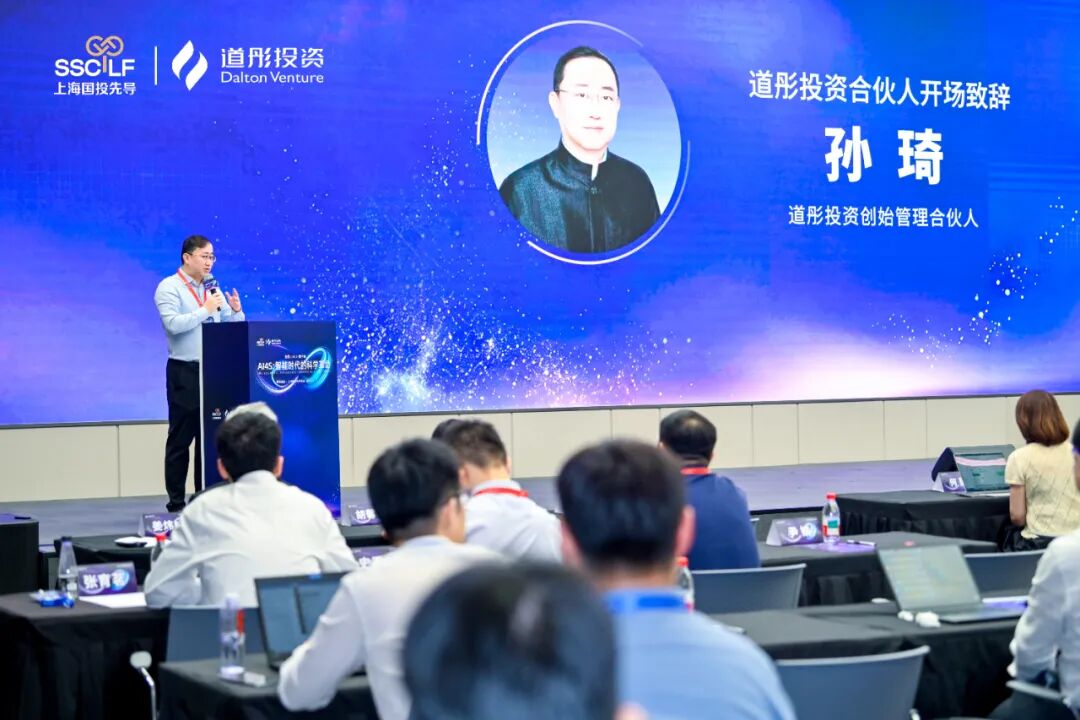
Photo: Sun Qi, Founding Managing Partner of Dalton Venture, delivering remarks
Vol. 2
Keynote Presentations: From Macro Logic to Investment Perspectives
Taking a longer time horizon, AI may transform not just individual industries, but how we understand economic evolution, capital, and even human development itself. Fu Xiaolong, Vice President of the Beijing Tsinghua Industrial Research Institute and Executive Director of the Shanghai Synthetic Biology Innovation Center, presented "AI Cognitive Macroscope: Reconstructing the Underlying Logic of Economy, Capital, and Human Evolution Through AI4S."
He shared three paradigm shifts in the AI4S context: transformations in scientific discovery models, AI Agent real-world interactions, and research instrumentation systems, noting that the key to industrial competition lies in connecting the complete闭环 from micro to macro. He also emphasized that this transformation is reshaping investment logic, with future capital flowing increasingly toward cognitive systems capable of continuous iterative evolution.
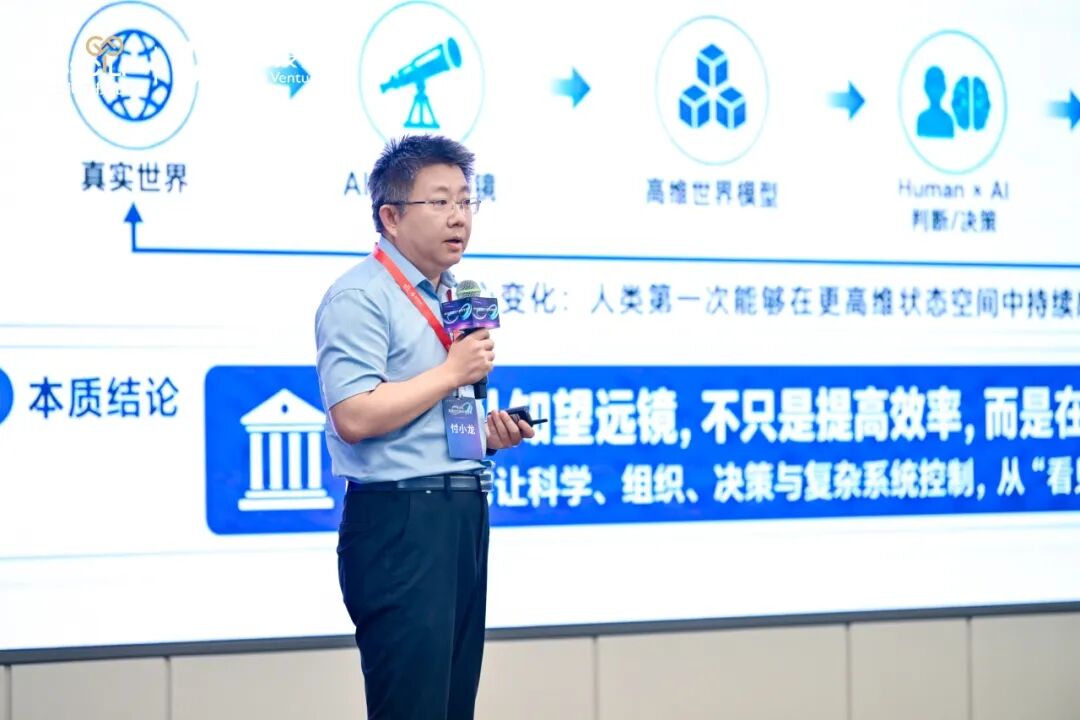
Photo: Fu Xiaolong, Vice President of the Beijing Tsinghua Industrial Research Institute and Executive Director of the Shanghai Synthetic Biology Innovation Center, delivering his keynote
For investment institutions, it's not enough to judge whether a technology will emerge — one must anticipate which industries will be restructured, which new companies will arise, and which opportunities merit positioning for today. Wu Yajie, Senior Investment Manager at Dalton Venture, presented "AI for Life Science × Five Questions on Biomedical Track Investment," sharing her frontline investment thinking on AI4S. She provided in-depth analysis across five dimensions: AI capability value, technical validation standards, team building, business model selection, and investment evaluation direction.
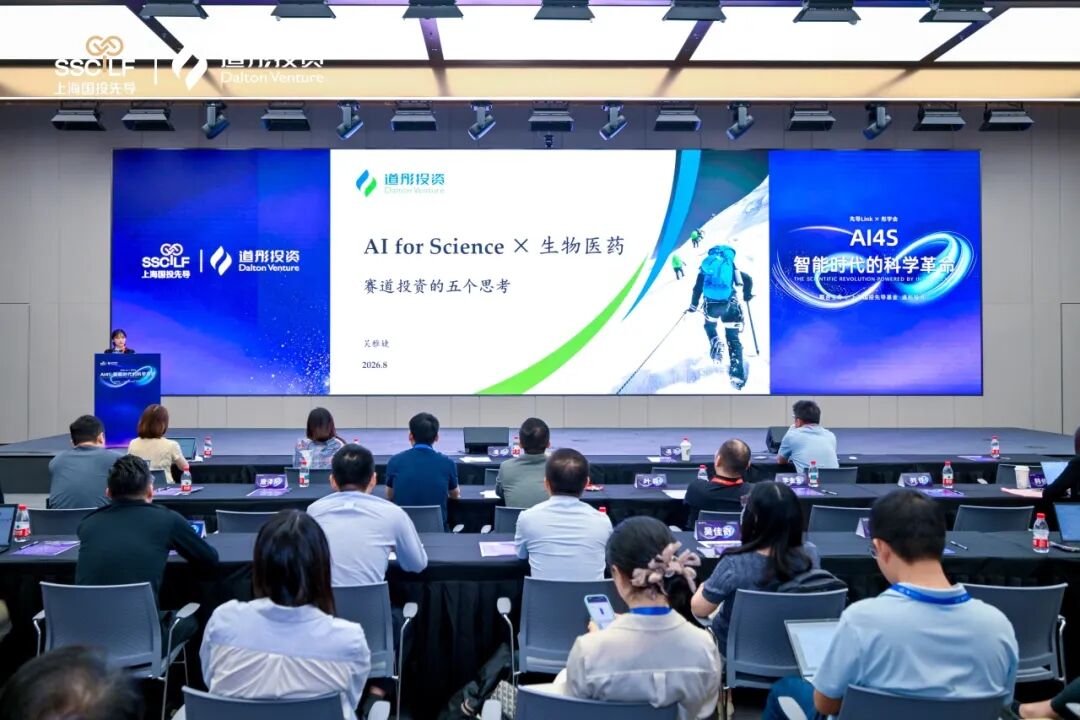
Photo: Wu Yajie, Senior Investment Manager at Dalton Venture, delivering her keynote
Vol. 3
Dialogue: Exploring the Technical Frontiers and Industrial Implementation of AI4S
The first panel was moderated by Ru Tao, Managing Director of Investment Division II at the Shanghai SDIC Pioneer Fund, with Zhang Shuyi, Founder of Qingyan Huazhi; Wu Jiaqi, Founder of Yuanshi Technology; Ye Sen, Co-founder and Head of Scientific Affairs at Xellar Biosystems; and Zeng Zhe, Founder of NewPro and Researcher at the Wageningen Future Food Institute, participating in the discussion.
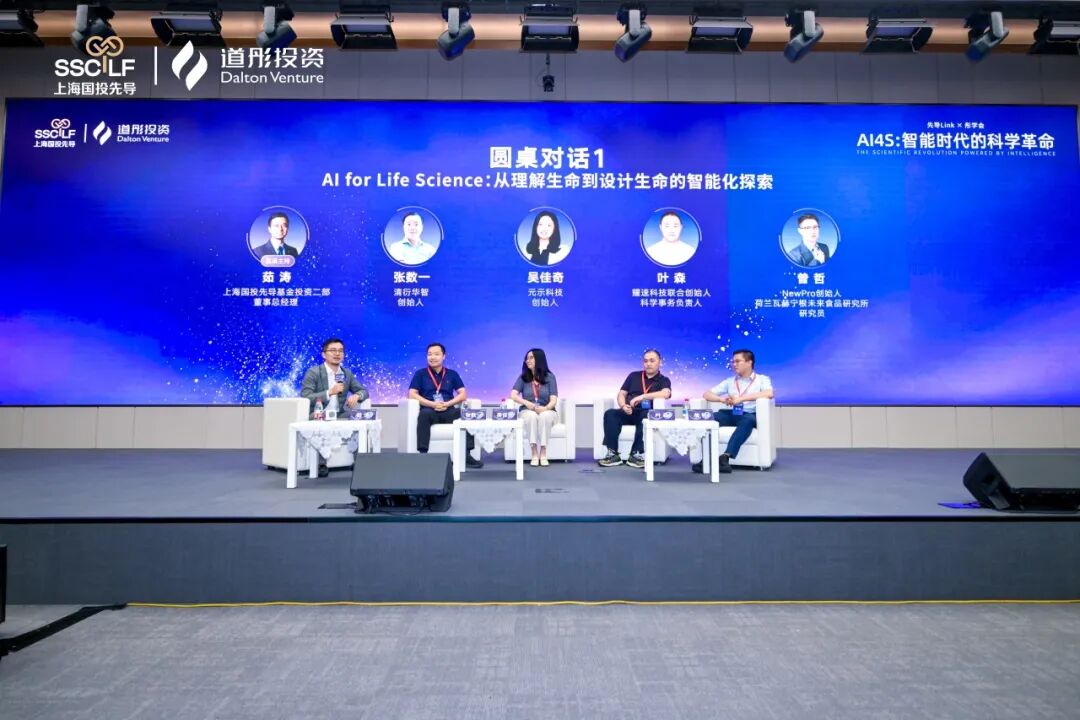
Photo: Panel Discussion 1
The guests came from different life science innovation directions — protein design, synthetic biology, organ-on-a-chip, and future food. The domains appear distinct, yet they share a fundamental question: when AI enters life sciences, are we enabling machines to better "understand life," or have we begun letting machines participate in "designing life"? Drawing from their respective practices, the guests explored how AI is transforming the depth and pathways of life science innovation, and the critical challenges that remain as technology moves from algorithms and laboratories toward real industry application.
The second panel was moderated by Wu Yajie, Senior Investment Manager at Dalton Venture, with Wang Zhuozhi, General Manager of Shuimu Molecule; Liu Chunan, Founder of Saiqiao Bio; Li Xin, Founder of Baiyao Technology; and Shi Yuchen, CFO of Oushisheng, participating in the discussion.
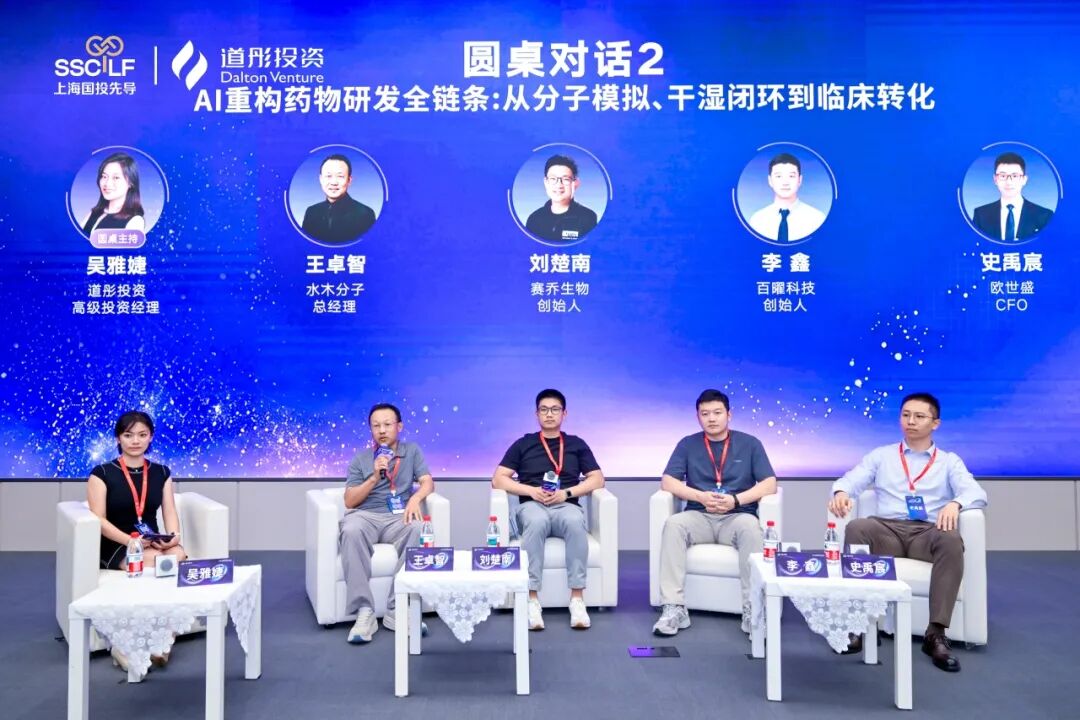
Photo: Panel Discussion 2
Traditionally, innovative drug R&D has relied heavily on extensive experimental accumulation and prolonged trial-and-error, but AI is driving a shift in this model — from molecular simulation and drug design, to AI-assisted experimental validation, to R&D process optimization and clinical translation, AI is gradually entering every stage of drug development. Yet truly empowering drug R&D with AI involves more than model capability improvements: how can AI models more accurately comprehend complex biological data? How can we establish efficient closed loops between computational prediction and experimental validation? How can AI-generated insights ultimately translate into clinically valuable innovative drugs? The guests engaged in deep discussion around these questions that will determine whether AI can genuinely transform drug R&D efficiency and paradigms.
Vol. 4
AI for Industry: A Temporal Industrial Brain for the Physical World
Life sciences confronts the highly complex biological world, but there is another equally complex, equally real world — the physical world. When AI truly enters factories, production lines, and complex industrial systems, it faces no longer just text and data, but time, space, equipment, processes, and a constantly changing physical reality.
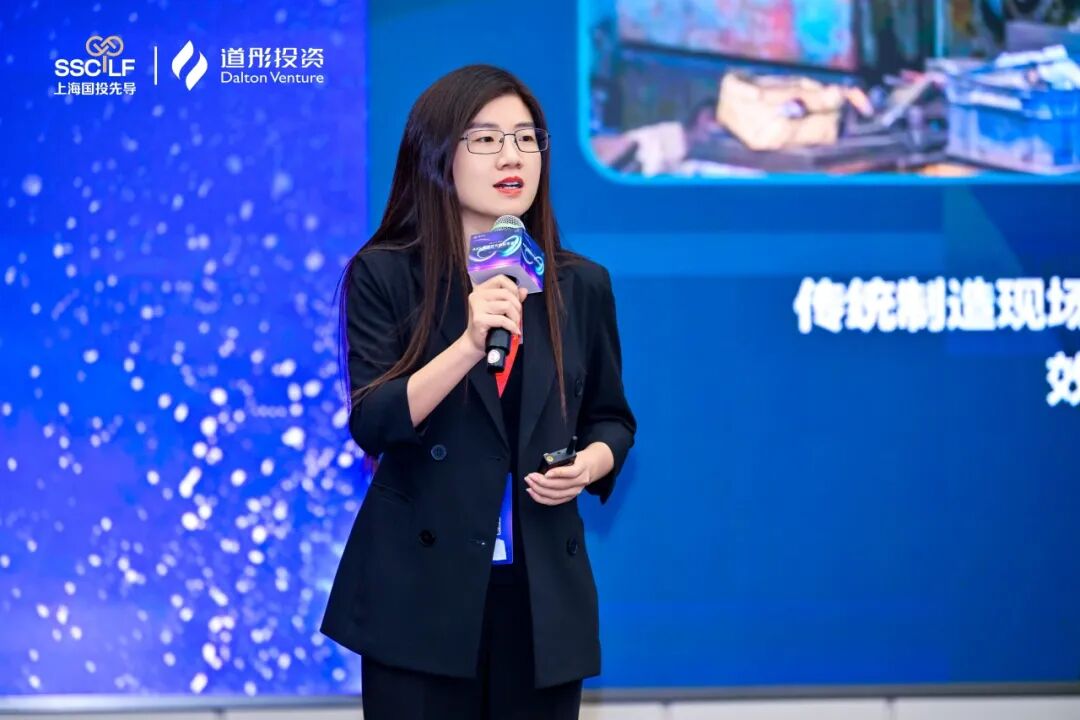
Photo: Li Jinjin, Founder of Jincheng Technology, delivering her keynote
Li Jinjin, Founder of Jincheng Technology, presented "AI for Industry: A Temporal Industrial Brain for the Physical World," sharing the implementation pathway of AI in industrial scenarios. She noted that through the "AI Veteran" industrial temporal general foundation model, the tacit knowledge of industrial experts can be transformed into replicable, iterable industrial intelligence capabilities, empowering existing manufacturing to achieve quality improvement, cost reduction, and efficiency gains.
Vol. 5
No Final Answers, But Better Questions
Three hours of discussion, from protein design to drug R&D, from synthetic biology to industrial brains. AI4S is not a distant concept — it is already changing the tools of scientific research, and may alter the pathways of scientific discovery and industrial innovation.
But this event did not attempt to deliver final answers. For a direction still rapidly evolving, asking better questions may matter more than rushing to answers.
Where will AI take science? Which technologies will truly emerge from laboratories? Which explorations that seem early today will become tomorrow's new industries? These are questions that researchers, entrepreneurs, industry partners, and investors must seek answers to together.
Scientific exploration has no end point,
and innovation in the age of intelligence has only just begun.


ID: daltonventure
Long press to follow
Recommended Reading