To See What’s Next for AIVC, Baiyao Technology Partners with MIT Technology Review on Deep Research | Dalton Venture Family

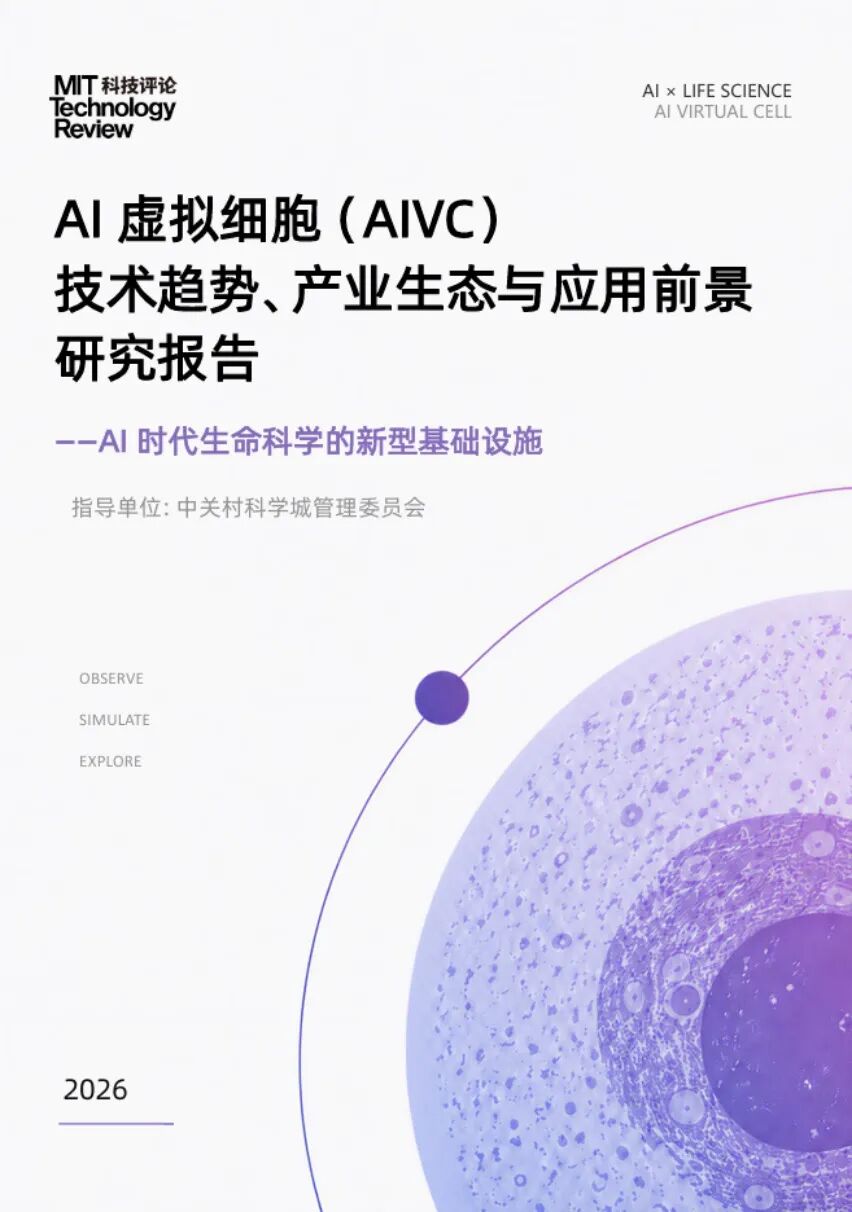
On September 21, the report *AI Virtual Cell (AIVC): Technology Trends, Industrial Ecosystem, and Application Prospects — New Infrastructure for Life Sciences in the AI Era* was officially released. Initiated by **Baiyao Technology**, a **Dalton Venture family company**, the report was researched and written by the *MIT Technology Review* China team, and completed under the guidance of the Beijing Zhongguancun Science City Innovation Development. The report takes a global perspective, drawing on research from dozens of scientific institutions worldwide.

Background
On September 21, the research report AI Virtual Cell (AIVC): Technology Trends, Industrial Ecosystem, and Application Prospects — A New Infrastructure for Life Sciences in the AI Era was officially released. The report was initiated by Baiyao Technology, a Dalton Venture Family company, and researched and written by the MIT Technology Review China team, under the guidance of the Beijing Zhongguancun Science City Innovation Development. It takes a global perspective, drawing on in-depth research into dozens of research institutions, technology companies, and pharmaceutical enterprises worldwide. The report formally defines AIVC as a new infrastructure for life sciences in the AI era, mapping out its technical pathways, industrial landscape, and future trends — offering a systematic reference framework to promote collaboration among research institutions, industry partners, investors, and government agencies, and to advance AIVC from conceptual exploration to scalable application.
Dalton Venture made an early-stage investment in Baiyao Technology in June 2026. The company's core team draws on top-tier scientific foundations from the Chinese Academy of Sciences' Institute of Zoology and the Beijing Institute of Stem Cell and Regenerative Medicine. Since 2023, Baiyao has been deeply focused on developing foundational AIVC large models, concentrating on precise analysis and prediction of cell behavior and state changes. We look forward to Baiyao Technology's continued deep investment in technology, breakthrough innovations, and ongoing efforts to advance AIVC technology deployment and iteration, empowering innovation across life sciences and biomedicine.
Click "Read More" at the end of this article, or copy and open the following link to access the full report:
https://www.mittrchina.com/aivc/index.html
Why Is AIVC Infrastructure,
Not Just an AI Model?
Over the past decade, AI tools like AlphaFold have proven that AI can transform protein structure prediction into a computational problem, and AI-driven drug discovery (AIDD) can significantly improve R&D efficiency at the molecular level. But once we enter real biological systems, clinical translation still faces major uncertainties due to multiple confounding factors — demonstrating that molecular-level success does not guarantee cellular-level efficacy.
For drug R&D and disease research, knowing a molecule's structure or target is often just the starting point. The truly important question is: when a drug enters the human body, when a gene is edited, or when a cell's environment changes — how exactly will the cell respond?
What AIVC attempts to build is precisely a "digital mirror" of cells in computational space.
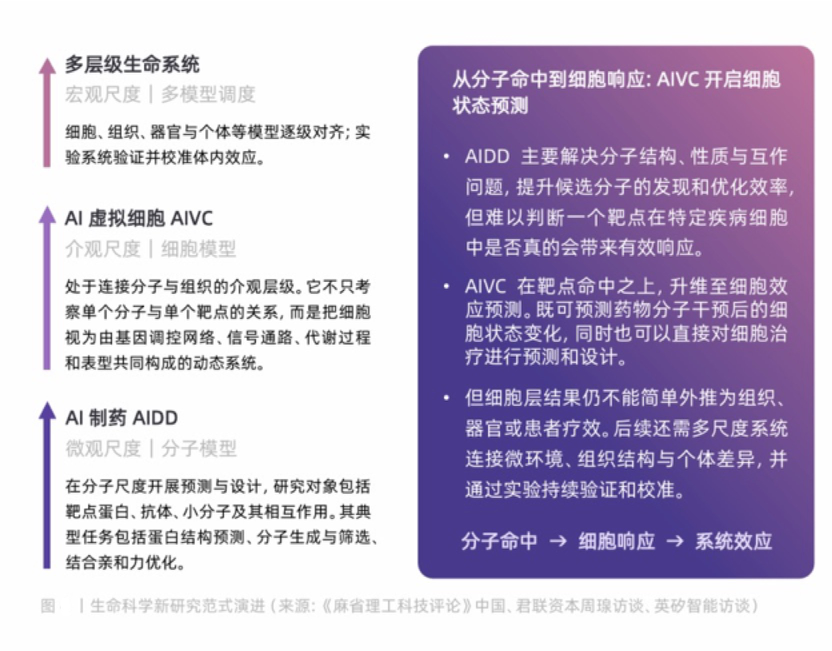
The report proposes that AIVC advances the research object from the "molecular level" to the "cellular level," reconstructing the paradigm for studying life mechanisms. Under this new paradigm, cells are no longer merely objects of experimental observation, but computational systems that can be characterized, simulated, intervened upon, and continuously calibrated. It answers not only "what kind of cell is this," but also predicts "how will the cell change after a gene knockout or drug addition."
The significance of AIVC lies not only in driving an upgrade in life science research paradigms, but also in its potential to mature into reusable computational models and tool platforms serving pharmaceutical companies, research institutions, and medical organizations — spanning basic research, target discovery, drug development, and cell engineering. As data quality, model generalization, experimental validation systems, and related standards continue to improve, AIVC is also expanding into clinical research, patient stratification, and clinical decision support applications.
AIVC Industry Competition Logic:
From Single Models to the "Data–Model–Experiment" Closed Loop
As AIVC becomes a hot field, top research teams worldwide are racing to enter. The report identifies multiple future trends for AIVC, noting that the global AIVC industry is moving from model-scale competition toward a stage of co-evolution between data and models — requiring coordinated development of data, models, and scenarios to gradually build core moats and long-term commercial value.
Trend 1: Model competition shifts from scale expansion to generalization capability and task adaptation
For a long time, the industry has generally followed "scaling laws," improving model performance by expanding data volume and parameter count. But the report notes that simply scaling data or parameters does not necessarily yield better zero-shot generalization. Model performance also depends on training objectives, perturbation coverage, data diversity, cellular context, and task type. Going forward, companies should develop two capabilities simultaneously: building models with cross-scenario predictive power, and vertically deploying models into specific diseases, drugs, pipelines, or related industry domains.
Currently, some research is beginning to explore world-model-style cell state transition modeling, as well as latent-space prediction methods including JEPA. Many existing models primarily learn statistical representations from cross-sectional transcriptomic snapshots, with limited capacity to capture cellular dynamics and intervention responses. World-model approaches attempt to learn state transition patterns under intervention conditions in latent space, aiming to improve prediction capability for unseen perturbations or novel cellular contexts.
Trend 2: Private data and newly produced data are becoming key competitive factors
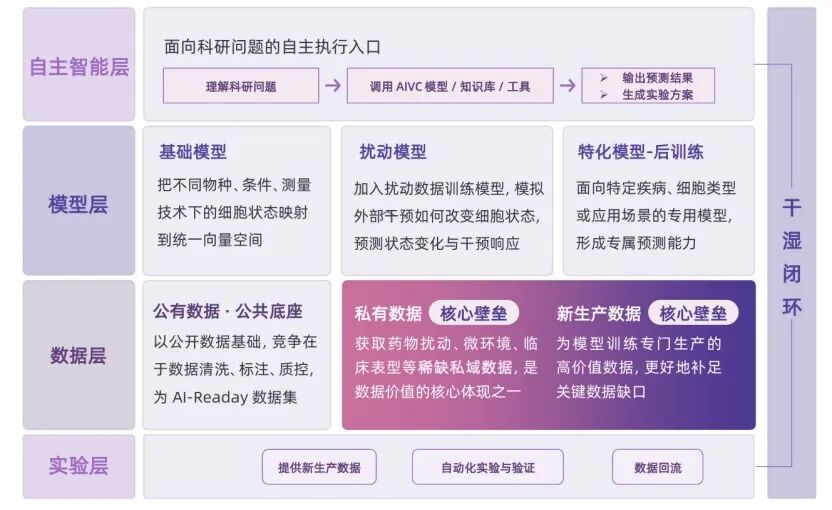
Data factory capability is becoming a core competency for AIVC companies. Data competition is shifting from "comparing scale" to "comparing quality, diversity, and alignment capability." The report emphasizes that public data alone can only support basic model state representation, not differentiated competition. More valuable than public data is access to scarce private-domain data on drug perturbations, microenvironments, and clinical phenotypes, as well as "newly produced data" specifically designed and generated around training objectives.
This type of data features complete baseline controls, dose gradients, time dimensions, and multi-modal alignment — enabling models to learn causal relationships and serving as hard-to-replicate core assets. Companies with multi-modal data production capabilities, standardized data processing systems, and access to scarce clinical data will build deeper competitive moats.
Trend 3: Wet-dry closed loops will become a critical threshold for AIVC industrialization
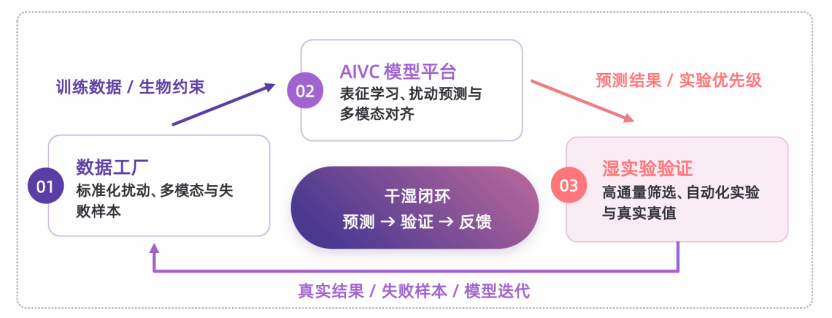
The global AIVC industry is moving from proof-of-concept to industrial value validation. The report shows that at this stage, single-model performance is no longer the sole evaluation criterion — the ability to close the loop of "data production → model prediction → experimental validation → data feedback" is becoming the core threshold for industrialization.
A wet-dry closed loop is not simply automated lab capability, but an integrated system spanning technology R&D, experimental validation, and commercial delivery. It requires companies to not only output high-quality predictions and solutions, but also validate results through experiments and feed experimental outcomes back into model iteration, forming a continuously evolving flywheel.
Baiyao Technology's AIVC Technology Layout and Industrial Practice
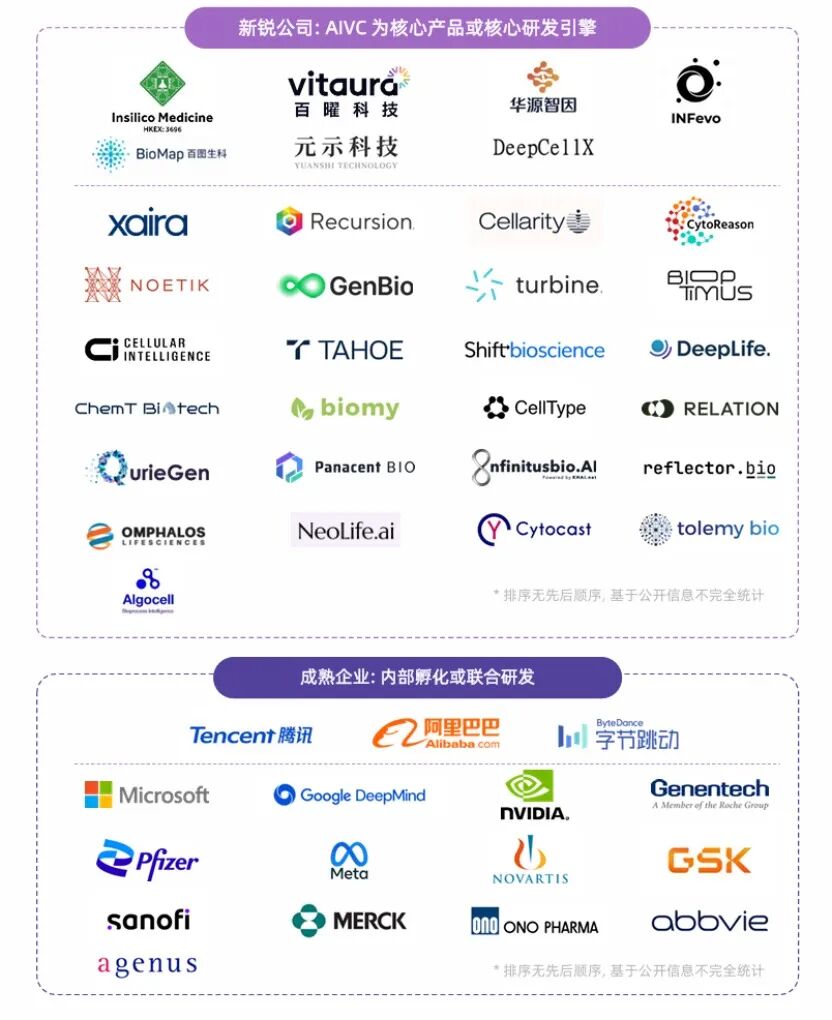
From a global industrial ecosystem perspective, AIVC is forming a landscape involving innovative enterprises, technology companies, pharmaceutical firms, and research institutions. The report includes Baiyao Technology in its map of innovative enterprises with AIVC as a core product or R&D engine, alongside international companies such as Xaira, Recursion, Cellarity, Noetik, and Turbine.
Overall, overseas players started earlier with more mature collaboration systems and are entering pharmaceutical partnerships and industrial validation stages; domestic players are still in early development but are accelerating from technology R&D toward scenario deployment.
Facing the industry wave shifting from technology racing to systems competition, Baiyao Technology is anchoring long-term trends and pursuing simultaneous breakthroughs across model architecture, data factory, and wet-dry closed loop — committed to building a full-stack capability system covering technology R&D through industrial deployment.
Building models from underlying architecture. In June this year, Baiyao Technology released AURA CellOS, the world's first AI virtual cell world model based on the LLM-JEPA architecture — one of the largest publicly reported single-cell foundation models by parameter scale. However, CellOS's core breakthrough lies not in parameter scale itself, but in fundamental innovation to traditional architecture: through collaborative operation of expression and perception perspectives, the model learns stable features of cell state changes in latent space. In public benchmarks, CellOS has achieved multiples-level gaps over mainstream models in prediction accuracy, perturbation modeling, and other core metrics — reaching internationally leading levels.
Using exclusive newly produced data and real-world clinical data as key supports for model iteration. Baiyao is building a data factory centered on real samples and self-produced perturbation data. Through its self-built TM-Perturb-seq high-throughput multi-modal perturbation experimental platform, it produces multi-modal aligned perturbation response data; simultaneously, it has leveraged clinical collaboration resources to accumulate real-world tumor microenvironment and clinical data, forming high-compliance, high-value private data assets that provide strong support for continuous model iteration and scenario deployment.
Closing the wet-dry loop to unlock model and data value. Baiyao Technology will close the complete wet-dry loop from data production, model prediction, wet experimental validation, and data feedback — gradually building a self-iterating technology flywheel. It will launch validation deployments in scenarios including tumor clinical patient stratification, CAR-T optimization, and skin anti-aging target discovery, gradually advancing technology value realization through partnerships with pharmaceutical companies and research institutions.
AIVC is initiating an important leap: making computers not merely recognize the components of life, but understand the operating principles of living systems. This will redefine drug discovery, disease research, and treatment design, and push life sciences from a highly experience-dependent discipline of observation and trial-and-error toward a precise science capable of simulation, prediction, and advance validation.
As a participant in this technological evolution, Baiyao Technology will continue exploring around data, models, and experimental validation — working with research institutions, pharmaceutical companies, and industry partners to jointly advance AIVC from technology research toward real R&D scenarios.
END


ID: daltonventure
Long press to follow
Recommended Reading