Brain-Computer Interface, Beyond Imagination|Dalton Venture × Kongshanci: If Cognition Could Be Modulated

From science fiction to reality, brain-computer interfaces are drawing closer. As humans gain the ability to read, understand, and even intervene in the brain, a new question emerges: where exactly will brain-computer interfaces take us?


Introduction
From science fiction to reality, brain-computer interfaces are coming closer. As humans gain the ability to read, understand, and even intervene in the brain, a new question emerges: where exactly will brain-computer interfaces take us?
To explore this, Dalton Venture has launched the "Brain-Computer: Beyond Imagination" column series, going inside with the entrepreneurs forging this future path.
This is the first installment of Dalton Venture's "Brain-Computer: Beyond Imagination" series. The series seeks to answer one question: when brain-computer interfaces step out of science fiction, how will they transform our lives?
The first stop is Kongshanci — a company focused on cognitive brain-computer interfaces. It is not building any single brain-computer device, but rather constructing a platform for understanding and regulating the brain: magnetic, electrical, and ultrasound technologies serve as pathways to different brain regions; a brain foundation model handles the task of understanding the patterns behind this data.
1
How Much of the Brain Remains Unknown
If asked which organ in the human body is the most mysterious, most people would point to the brain. It determines our memory, emotions, language, and judgment — even defining "who I am." Yet we use it every day without truly understanding it: Why do we dream? Why can a song or a sentence suddenly summon memories from years ago? Why does anxiety persist despite knowing we "shouldn't" feel anxious?
Brain-computer interfaces are opening new possibilities: not merely observing the brain, but understanding it, predicting it, and attempting to intervene. For a long time, the brain was like an unknown continent impossible to enter: we could see its structure through imaging, capture its signals through EEG, but truly understanding how a thought arises or an emotion forms remained distant. If past brain-computer interfaces focused more on "how to insert electrodes and let the brain control machines," the next question becomes — do we have the capacity to truly approach and understand the brain? This is precisely the direction of cognitive brain-computer interfaces (cBCI): concerned not just with motor control, but with more complex cognitive processes like attention, memory, language, emotion, and decision-making.
Kongshanci, which is trying to answer this question, is a domestic company focused on cognitive brain-computer interfaces. Its logic is straightforward: brain diseases lie at different depths, and no single tool can reach them all — so the arsenal must be sufficiently broad. Transcranial magnetic stimulation (TMS), temporal interference electrical stimulation (TI), and transcranial focused ultrasound (tFUS) constitute its "weapons cache"; what truly connects them is a continuously learning "brain foundation model." Among these, ultrasound is the most distinctive card — something that only a handful of companies worldwide have actually achieved.
The story must begin with this arsenal.
2
What Kongshanci Wants to Build Goes Beyond "Brain-Computer Interface"
The most widely circulated brain-computer interface videos online almost all come from motor brain-computer interfaces: monkeys playing games with their minds, paralyzed patients controlling robotic arms through thought alone. To the point that in the public imagination, "brain-computer interface" has become nearly synonymous with "mind-controlled devices" — but this is only one direction. A simple classification:
- Motor brain-computer interfaces are "brain → machine" output;
- Sensory brain-computer interfaces are "machine → brain" input;
- Cognitive brain-computer interfaces (cBCI) form a "read + write" closed loop: recognizing cognitive and emotional states, then applying neuromodulation therapy.
The challenges for cognitive brain-computer interfaces are greater. Motor control generally corresponds to relatively well-defined brain regions; but attention, memory, emotion, and decision-making are not independent "switches" — the same brain region can participate in different cognitive activities, and the same cognitive activity requires coordination across multiple brain regions. What truly determines state is how the entire brain network collaborates at each moment: the brain's commands are not static but dynamically evolving — neuroscience calls this overall operating pattern "brain state," and it changes constantly.
Ximing Wang, co-founder of Kongshanci, once used a drum as analogy: imagine the brain as a lightly crumpled drum skin. When smooth, a strike produces stable, predictable vibrations; but with even subtle wrinkles, the path of vibration and the manner of resonance change — what determines the sound is not where you strike, but the drum skin's overall form at that moment. This is precisely what makes cognitive brain-computer interfaces both difficult and important: they face not fixed targets, but constantly shifting ones.
So Kongshanci does not define itself as a pure neuromodulation device company. What it hopes to build is a platform capable of continuously "reading — understanding — evaluating — intervening" in brain states: acquiring brain signals through EEG and functional MRI, using a whole-brain functional connectivity computation engine to understand relationships between brain regions, further assessing brain state and treatment response, then implementing intervention through magnetic, electrical, and ultrasound methods.
This forms a complete closed loop of "data acquisition — algorithmic understanding — state assessment — therapeutic intervention — feedback optimization." In other words, from "reading the brain" to "decoding the brain," then to "evaluation" and "regulation," this constitutes the complete closed loop of Kongshanci's core technical system.
And in this arsenal, the deepest and most distinctive weapon is ultrasound.
3
What If the Problem Lies Deep in the Brain?
Most known non-invasive neuromodulation methods excel at superficial cortical circuits. But what if the problem occurs deeper? For instance, the core regions of memory circuits are buried deep in the brain — magnetic fields struggle to reach there precisely, and electrical fields have their own boundaries. Ultrasound can. Some of humanity's most important cognitive functions do not occur at the brain's surface. Memory, emotion, reward, and other key circuits all involve deep brain regions. And for decades, one of the greatest limitations of non-invasive brain regulation has been "seeing it, but can't reach it." Ultrasound can non-invasively pass through the skull with millimeter-scale focusing precision to reach deep brain regions, opening space that past non-invasive methods could hardly touch. This is the logic behind Kongshanci's tFUS pipeline.
On the global frontier map of brain science, focused ultrasound modulation remains a vast territory just beginning to unfold: the most internationally recognized product comes from Israeli company Insightec, a large-scale device; on the research side, current systems are mostly single-channel or dual-channel. To achieve "point and shoot" in research and clinical scenarios, every component of an ultrasound system must fit together seamlessly — transducer, drive system, matching circuit, algorithms; any instability in any module degrades the entire system's performance.
This is precisely why Kongshanci chose full-stack self-development: to maximize ultrasound's advantages, they determined that every link must be kept in-house. Its ultrasound system achieves 64-channel phased arrays, which today has virtually no competitors in the market. Because to achieve truly meaningful deep, precise modulation, an ultrasound system must solve three problems: how to pass through the complex skull, how to precisely focus on target brain regions, and how to ensure long-term safety. Kongshanci chose full-stack self-development from underlying hardware through algorithms to navigation systems, using multi-channel phased arrays, brain imaging navigation, and acoustic simulation technology to deliver ultrasound energy precisely to target areas.
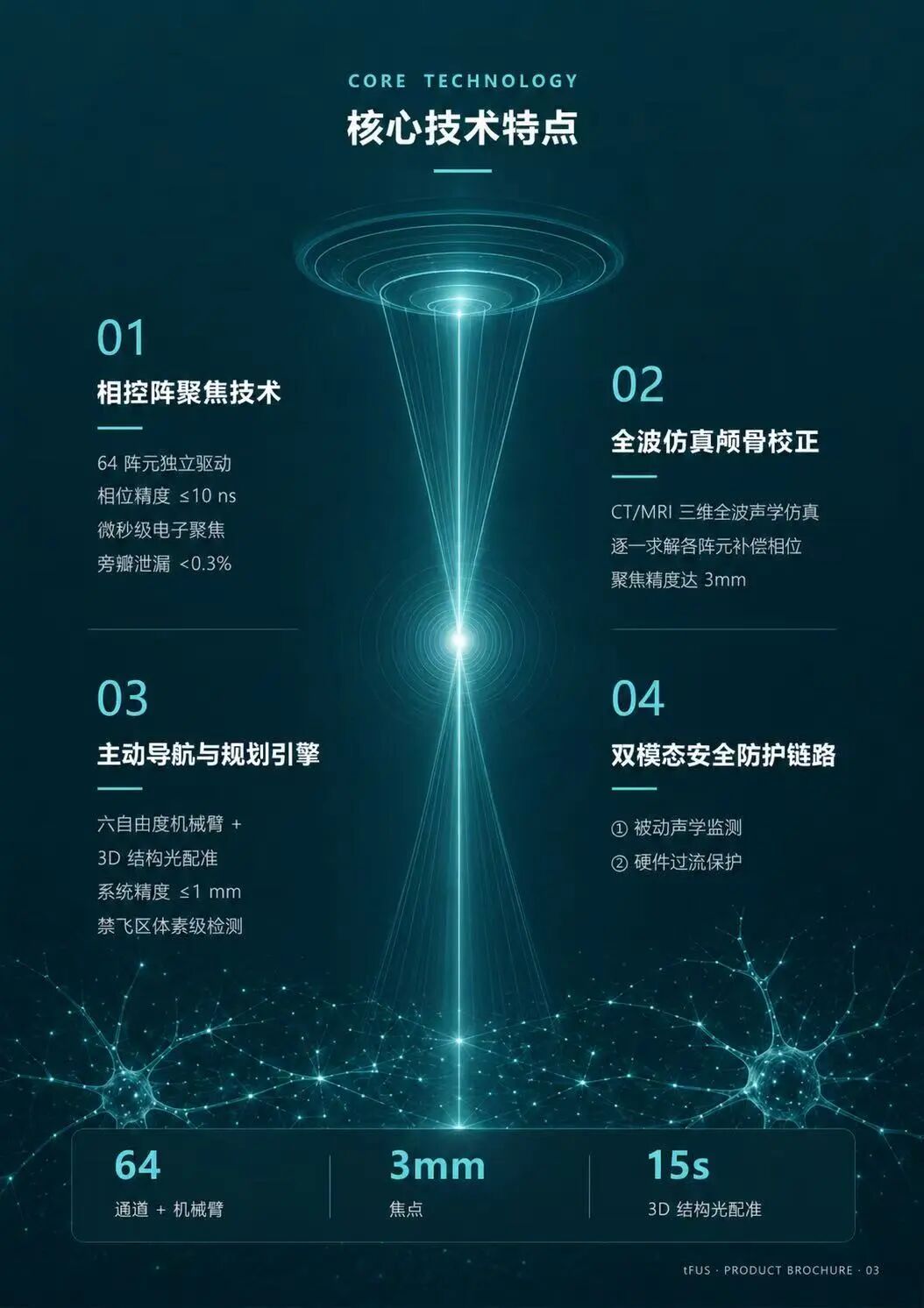
Figure: Kongshanci tFUS Ultrasound System Core Technical Features
(64-channel phased array / 3mm focal point / 15s registration)
More important is the progress: this system is not a prototype, not a concept — it has already been submitted for type testing, and achieved global delivery in September this year, entering research and clinical exploration at domestic and international universities and hospitals. For scientists, this is also an unprecedented research tool: in the past, studying deep brain regions often required craniotomy or animal experiments. While most teams are still telling stories about "full-stack self-development, multi-channel," Kongshanci's devices are already reaching researchers' hands.
4
Why Ultrasound?
This pipeline points to a larger problem: China has nearly 17 million Alzheimer's and related dementia patients, accounting for nearly 30% of the global total [1]. To understand Alzheimer's, one must first understand the hippocampus's role in memory. It is not a simple "memory warehouse," but more like a critical hub responsible for receiving, organizing, and establishing new memories: the new experiences we have each day generally require hippocampal participation to gradually form more stable long-term memories and establish connections with broader memory networks in the cerebral cortex.
This also explains a typical change in Alzheimer's patients: in early disease stages, the hippocampus and other regions closely related to memory formation are damaged first, and patients often begin forgetting things that just happened while still remembering experiences from years ago. As pathology further spreads to broader cortical networks, more distant memories are gradually affected as well. Kongshanci is exploring the use of focused ultrasound to non-invasively modulate deep brain networks related to memory, attempting to provide new intervention pathways for mid-stage cognitive decline in Alzheimer's — this direction remains in early R&D stages today, but it explains why "depth" matters so much.
"First see where the disease is, how large the population is, then decide where to deploy the weapon" — this clinical logic is also written into the company's pipeline planning: depression has advanced to GCP clinical trial stages; sleep disorders, adolescent depression, and other directions are about to enter clinical research; Alzheimer's is in validation stages, and animal experiments for Parkinson's, generalized anxiety, and other directions are already on the schedule. Each pipeline corresponds to a patient population numbering in the millions or tens of millions.
In Kongshanci's layout, magnetic, ultrasound, and electrical technologies have never been competing alternatives, but different tools for understanding and influencing brain states — each with its suitable depth of action, resolution, and clinical scenario. The endgame of cognitive brain-computer interfaces is not any single indication, but a complete set of capabilities for understanding and intervening in the brain.
5
Not a Contest of Routes, But a Toolbox
The first battlefield for this complete set of capabilities is depression. Deep in the inpatient wing of a Shanghai psychiatric specialty hospital, there are two locked doors — behind them are the most severely ill patients, many with self-harm risks. The scale is equally staggering: the Lancet's May 2026 issue published the Global Burden of Disease Study (GBD 2023), showing that in 2023 nearly 1.2 billion people worldwide were affected by mental disorders [2], with depression patients increasing from 102 million to 236 million; China's lifetime prevalence of adult depressive disorders is 6.8% [3], while the proportion receiving adequate treatment is only 0.5%. More棘手的是, this field has no "lab report": whether someone is depressed, and which treatment will work, doctors still rely primarily on questionnaires and experience.
Change is underway. In 2022, SAINT (Stanford Accelerated Intelligent Neuromodulation Therapy), approved by the US FDA, proved the value of individualized precision stimulation: calculating personalized targets for each patient using functional MRI before applying magnetic stimulation, in a double-blind randomized controlled trial of 29 treatment-resistant depression patients, the real stimulation group achieved 78.6% remission rate versus only 13.3% in the sham group [4].
The direction is clear: not finding one fixed answer that applies to everyone, but finding the answer within each person's brain. This is also the path Kongshanci is exploring.
Kongshanci's transcranial magnetic neural navigation system uses AI to reconstruct resting-state functional MRI, compressing individualized target planning from several hours to 15 minutes; its pioneering sub-skull electromagnetic simulation reduces positioning error from centimeter-scale to 0.9 millimeters; traditional 6–8 week courses are compressed to 5 days. The team's preclinical phase data shows: immediate efficacy rate of approximately 80%, six-week efficacy rate of approximately 90%.
To date, this product is simultaneously conducting GCP clinical trials at four national psychiatric centers — Beijing Anding Hospital, Shanghai Mental Health Center, Second Xiangya Hospital of Central South University, and West China Hospital, Sichuan University — with a clinical network covering 15 top-tier tertiary hospitals nationwide. This product line addresses the problem of "how to precisely regulate superficial brain regions" — while ultrasound lets them set their sights deeper into the brain.
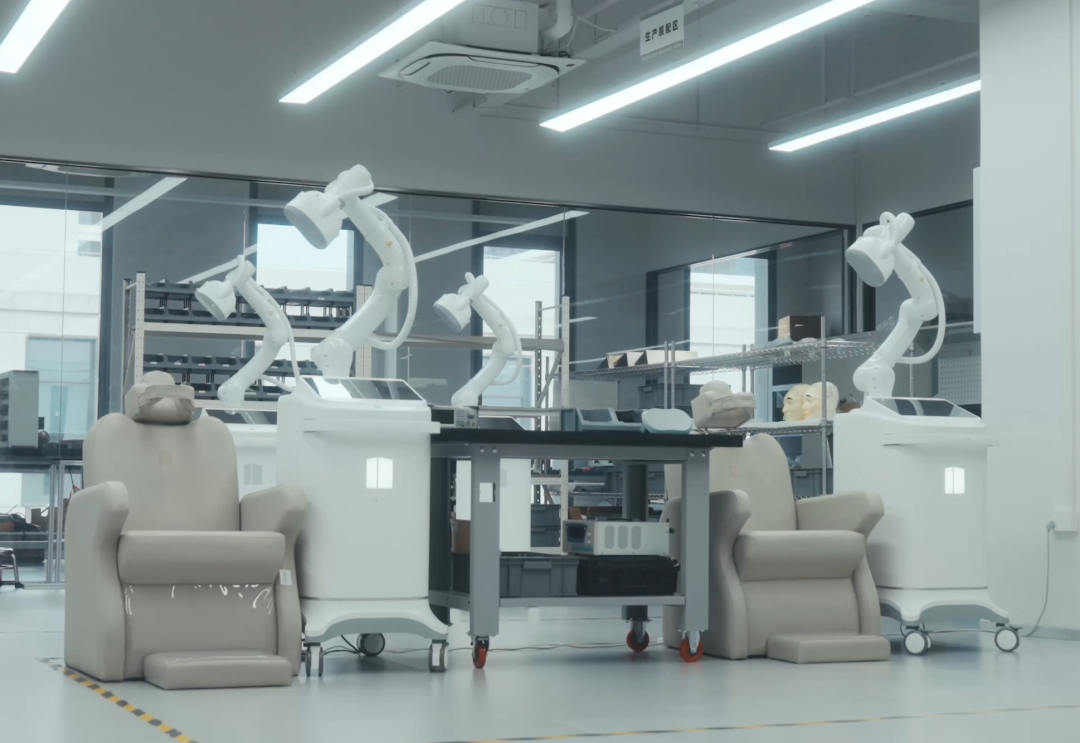
Figure: Kongshanci Transcranial Magnetic Neural Navigation System
Kongshanci's arsenal also includes electricity, and it's targeting: sleep.
After falling asleep, the brain remains actively running: organizing memories, processing emotional traces accumulated during the day; what isn't digested may return as nightmares. For depressed and anxious populations, sleep is often the first thing to become disordered.
Most sleep aids on the market address "falling asleep," and do so open-loop — wear it for twenty minutes before bed, and how you sleep after that has nothing to do with it. Kongshanci is aiming at a different target: slow waves.
Slow waves are low-frequency rhythmic activities produced by the brain during deep sleep stages, believed to be closely related to memory consolidation and brain recovery. Older adults sleeping lightly, neurodegenerative disease patients with poor sleep — behind these lies slow wave deficiency.
But how to precisely enhance slow waves? Traditional methods face a difficulty: for electrical stimulation to reach deep brain regions, stimulus intensity often needs to increase. The result: deep regions are stimulated, but superficial regions feel it too. Kongshanci's explored temporal interference electrical stimulation (TI) takes an ingenious approach — using two high-frequency currents passing through the scalp to "meet" and superimpose at an intracranial target location into a low-frequency beat, achieving near-imperceptible high-frequency components in the brain while the low-frequency component falls precisely within the slow wave frequency range.
Timing of stimulation matters equally: slow waves only appear during deep sleep, and stimulation given too early or too late is useless, or may even disturb sleep. So this device is "closed-loop" — real-time EEG reading to determine which sleep stage you're in, only intervening during the deep sleep window. The team member responsible for this product line wears it to sleep himself, then verifies with hospital polysomnography: before and after stimulation, slow wave density clearly increases. The most subjective feeling is "waking up more alert."
Magnetic, electrical, ultrasound — three weapons, three depths. And what turns the arsenal into a "platform" is the brain behind them.
6
The Real Platform Is That "Brain Foundation Model"
Putting magnetic, electrical, and ultrasound together, you still only see the arsenal; what makes the arsenal a "platform" is the "brain foundation model" (Brain Foundation Model) Kongshanci is building. The starting point is: brain signals are only surface phenomena; what truly needs understanding is the brain state behind the signals — how it evolves over time, ultimately forming different cognitive performances.
Its operation is a closed loop: devices and stimulation methods of different modalities continuously acquire brain data across different dimensions; the model learns from this the evolution patterns of brain states, understanding the brain and finding targets; neuromodulation implements intervention, generating real therapeutic feedback; feedback returns to train the model — perception, understanding, intervention, feedback, cycling repeatedly.
Each turn of this flywheel makes the platform one degree smarter, and this is the true meaning of "platform": not having many products, but all products serving the same brain. The significance of ultrasound in this closed loop thus becomes clear: it is not merely one product pipeline, but enables the model to reach deeper, more complete brain data; the richer the technology, the more the model can learn; the more complete the model, the more it in turn guides how each technology is used.
One more point easily overlooked: this model is not trained separately for any single disease. Ximing Wang pushed his drum analogy further — a drum's sound depends not only on where this strike lands, but on the drum skin's current form; and this form is the accumulated result of all past strikes. The brain's current state is similarly the layered result of all past experiences. So what it learns is not one frame of brain signal, but a segment of cognitive process — depression, anxiety, insomnia are not unrelated labels in its view, but different facets of the same underlying patterns.
7
Making the Brain a Map That Can Learn
What is this model "seeing"? The team once demonstrated a scene: playing video for a subject — gradually blooming flower buds, slowly falling sunlight — while recording whole-brain blood oxygen changes with functional MRI. As scenes shift, different brain regions light up in sequence; and watching the same video, different people show different regions, sequences, and intensities of activation. What the model must learn is the correspondence between external input and brain activity.
All its data comes from real patients, real therapeutic outcomes. Traditional AI models learn from text, images, sound; the brain foundation model learns from human brain activity itself — EEG recordings, magnetic, ultrasound, and electrical stimulation modulation feedback, combined with behavioral performance, cognitive assessments, and clinical outcomes. Every acquisition, modulation, and feedback is a learning opportunity for the model; data enters the model, and the model in turn optimizes treatment — they call this self-reinforcing cycle the "brain intelligence flywheel."
In medical application, this model targets two goals. First, objective diagnosis: today's depression assessment relies on scales, essentially subjective evaluation; but the team has already developed diagnosis prediction based on brain functional connectivity — brain network patterns differ significantly between depression patients and normal individuals, and one MRI scan calculating functional connectivity could potentially provide objective reference. Second, efficacy prediction: for the same depression, does this person respond better to medication or physical therapy? The model can predict response based on brain network patterns — turning "trial and error" into "matching." These capabilities remain in validation, but they point toward that missing "lab report."
The ultimate use of this "brain map" is quite practical: running experiments on a "digital twin" brain — which parameters are effective for which brain states can first be simulated in the virtual brain, then applied to real patients. At this point, a judgment can be made about what Kongshanci is doing: it is not building a better brain-computer device, but attempting to establish infrastructure for understanding the brain, predicting the brain, and ultimately intervening in the brain. Doing this requires three things — high-quality brain data entry points, real clinical scenarios, and the engineering capability to connect both into a closed loop. Many companies in the industry have one of these; few have all three in the same company, and have already run them through registration clinical stages.
8
From Treating Disease to Understanding Cognition,
From Hospital to Home
The boundaries of this path extend beyond treating illness. As humans gain more accurate understanding of brain states, some longer-term questions will be raised anew: Can attention be improved? Can learning states be optimized? Can emotions be regulated more finely? Where is the ceiling of cognitive ability? Kongshanci's attitude toward these directions is clear: they are long-term explorations, and everything discussed today must pass clinical validation — first cure the disease, then talk about enhancement.
What Kongshanci wants to do is transform understanding of the brain into scalable medical products — from hospital to community, to home, ultimately toward wearables. This is not merely commercial imagination: emotional and cognitive problems overwhelmingly occur in home settings rather than hospitals; Kongshanci's stance is that solutions must be serious medical-grade, just increasingly friendly and imperceptible in form. They call the endpoint of this path "human-machine symbiosis" — it even transcends the concept of "treatment" itself.
If traditional brain-computer interfaces solved "how to connect brain and machine," what Kongshanci is attempting to solve is a larger question: can machines truly understand the brain. Ultrasound is one tool for venturing deep into this unknown continent; the brain foundation model may become its method for mapping the terrain. This path is far from its endpoint. But at least, humanity is moving from "seeing the brain," toward "understanding the brain," and then toward "being able to converse with the brain."
9
Dalton Venture Notes
When Dalton first engaged deeply with Kongshanci, what we focused on was not any single device, but their understanding of "the brain problem" itself. The brain-computer interface industry easily falls into technology route contests: magnetic, electrical, ultrasound — which is better? Kongshanci's choice is closer to a clinical question: first see where the disease is, then choose the tool. More importantly, they did not understand brain-computer interfaces as a device — a device can only complete one stimulation, while understanding of the brain can continuously accumulate.
Dalton's website has a line: one day, we will all become patients. Emotional and cognitive problems are never "someone else's issue" — they concern every person, every family. This is why we invested in Kongshanci, and also the original intention behind creating the "Brain-Computer: Beyond Imagination" series.
Appendix: Main References
-
China Alzheimer's and related dementia patient data: synthesized from China Alzheimer's Disease Report and publicly available Global Burden of Disease Study data.
-
GBD 2023 Mental Disorders Collaborators (Santomauro DF, et al.). Updated trends in the global prevalence and burden of mental disorders, 1990–2023: a systematic analysis for the Global Burden of Disease Study 2023. The Lancet, DOI: 10.1016/S0140-6736(26)00519-2.
-
Huang Y, et al. Prevalence of mental disorders in China: a cross-sectional epidemiological study. The Lancet Psychiatry. 2019;6(3):211-224.
-
Cole EJ, et al. Stanford neuromodulation therapy (SNT): a double-blind randomized controlled trial. Am J Psychiatry. 2022;179(2):132-141.
ID: daltonventure
Long press to follow
Recommended Reading