Brain-Computer Interface, Beyond Imagination | Dalton Venture × HuaBrain Safety: Before Risk Strikes, the Brain Knows First

From science fiction to reality, brain-computer interfaces are drawing closer. As humans gain the ability to read, understand, and even intervene in the brain, a new question emerges: where, exactly, will brain-computer interfaces take us?


Introduction
From science fiction to reality, brain-computer interfaces (BCIs) are drawing closer. As humans gain the ability to read, understand, and even intervene in the brain, a new question emerges: where exactly will BCIs take us?
To explore this, Dalton Venture has created the "Brain-Computer: Beyond Imagination" column series, visiting the entrepreneurs charting this future path.
This stop brings us to the BCI application closest to the ground — mines, tunnels, steel mills, and power grids. HuaBrain Safety, a company applying brain-computer interfaces to industrial safety.
Here, BCIs aren't about enhancing human capabilities. They're answering a more fundamental question: how can workplace safety finally see the human condition?
1
The Scene: An Alarm from Six Kilometers Deep
Let me start with something that actually happened. At a tunnel construction site for a major national water conservancy project, the working face extended roughly six kilometers into the mountain. The tunnel was low-oxygen, narrow, with heavy vehicles operating in tight quarters, and the environment relied on mechanical oxygen supply. One morning past nine, the backend system showed a sharp drop in one worker's consciousness level. After the system issued an intervention alert, the worker briefly regained alertness, but his state dropped again — even lower than before. Site managers immediately escorted him out of the tunnel. Subsequent inspection revealed that the oxygen supply equipment had indeed malfunctioned.
In this case, the worker hadn't noticed anything wrong himself, and no visible environmental anomaly had appeared. The system caught the change first. The change was happening in the brain.
Industrial safety has long recognized that the hardest risks to manage come from people. International statistics attribute roughly 88% of safety incidents to human factors; under China's emergency management framework, the figure sits around 75%. Fatigue, distraction, drowsiness, oxygen deprivation, impaired judgment — these states occur daily at every worksite, yet remain almost impossible to quantify. Without knowing who is in a high-risk condition, management has no leverage.
Human-factor risks fall into two categories. One involves people exposed to environmental hazards — mining, heights, confined spaces, toxic conditions that place heavy demands on the individual. The other involves a person's condition creating risk: a single lapse in driving or critical operation can trigger cascading secondary accidents. Whether these risks can be caught early depends on whether we can see the person's state.
The danger of these conditions is that the person often doesn't perceive them, and observers can rarely detect them externally. Someone may still be operating equipment normally while their attention and reaction speed have already declined.
Current industrial monitoring tools are already numerous — cameras, wristbands, positioning systems, gas detectors, equipment sensors — but most of them circumvent the person themselves. Cameras record external behavior; by the time they capture someone collapsing, the incident has already occurred, and uneven lighting, masks, and sunglasses further degrade reliability. Wristbands collect peripheral physiological signals like heart rate and blood oxygen, which typically only show abnormalities when the body nears extreme states. EEG comes from the central nervous system and offers a different class of information: changes in alertness, fatigue, and attention become readable from brainwaves before behavioral anomalies appear.
Safety management has traditionally relied on "human prevention plus physical prevention": regulations, inspections, and monitoring — mostly useful for post-incident review, rarely for prevention. Meanwhile, monitoring has long favored environments and equipment. Gas, temperature, equipment status all have sensors assigned. Only human status lacks quantification. Turning human-factor risks into quantifiable, manageable data is where brain-computer interfaces enter industrial safety.
2
Precursors: The Brain Signals Before Behavior Does
From wakefulness to sleep, human consciousness level changes gradually. Highest during intense focus, lowest during sleep, with gradual transitions between. Medicine has mature monitoring for this — ICU care and surgical anesthesia have long used EEG to assess patient consciousness levels.
Fatigue produces specific EEG changes. As drowsiness sets in, fast-wave activity associated with alert wakefulness decreases, while slow-wave activity associated with sleepiness increases — changes that appear before yawning, nodding, and other external manifestations [4]. Extended driving may also produce microsleeps lasting mere seconds, unnoticed by the person but sufficient to cause serious consequences in a moving vehicle. Such states cannot be detected through self-reporting; they require continuous monitoring of brain state [4].
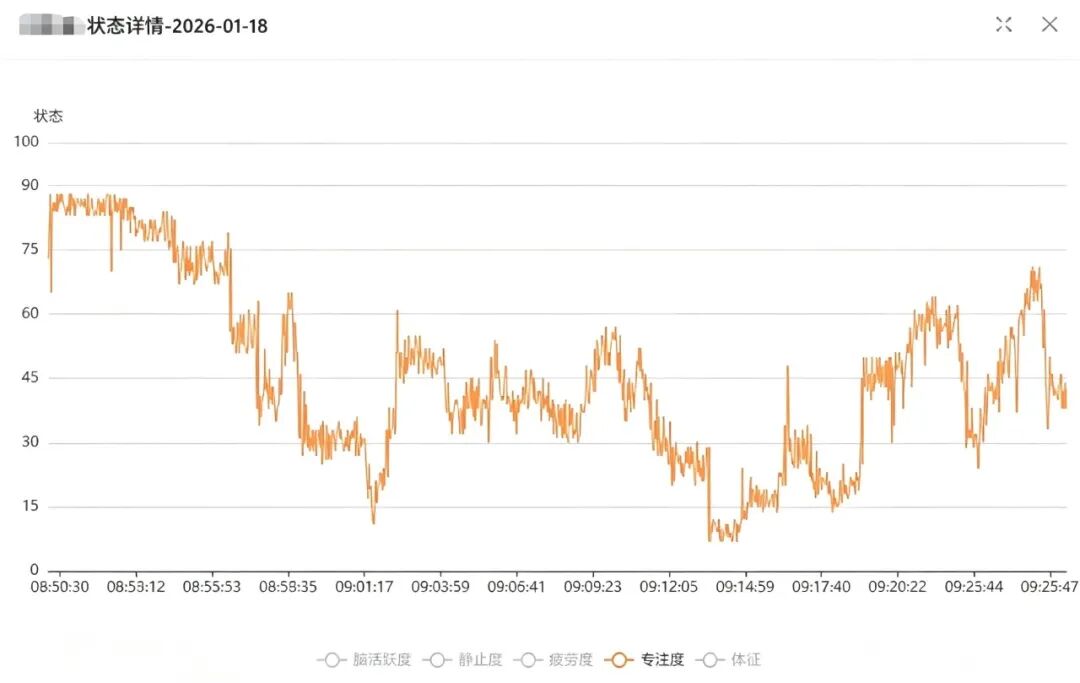
Figure: Focus levels start high, showing a gradual downward trend over working hours.
A more fundamental principle underlies this: neural signal changes precede observable bodily changes. Before poisoning or unconsciousness fully occurs, there exists a usable time window. Take falling asleep at the wheel: brain state changes become identifiable before actual sleep occurs. When a camera shows someone asleep, they already are asleep — but the brain had already started "telling the truth" before that.
EEG is hardly a young technology. In 1929, German psychiatrist Hans Berger first recorded human brainwave signals [5]; for nearly a century since, EEG has remained foundational in neurology and anesthesiology. On the operating table, anesthesiologists monitor not just heartbeat and blood pressure but brainwaves, because brain state determines when a patient falls under and when they might prematurely wake. Yet for all this time, EEG applications barely ventured beyond hospital walls.
Taking EEG from hospital wards into mines, tunnels, and vehicle cabs — making it work continuously while workers are on the job — is another matter entirely. HuaBrain Safety, founded in 2022, does exactly this.
3
Engineering: Taking EEG Out of the Hospital
Hospital EEG equipment can technically capture brainwaves. But simply moving it to industrial settings doesn't work.
Hospital wards and mine tunnels are completely different environments. In wards, patients lie still, electrodes are placed by professionals, and signals are collected under controlled conditions. In mines, workers wear devices for eight-plus hours daily, for two to three years straight; equipment must operate continuously in high-temperature, high-humidity, high-dust, high-vibration conditions. Ordinary electrodes can't survive this intensity. Being able to collect signals is merely the starting point — what industrial scenes truly test is reliability and stability.
The second hurdle is signal quality. Raw signals at industrial sites run about 50 times higher in amplitude than laboratory environments. Muscle electrical activity and motion artifacts from walking, sweating, and equipment operation drown out the faint EEG signals. HuaBrain's solution is an edge-cloud fused filtering approach: multi-stage bandpass filtering and motion-aware recognition at the hardware level, plus adaptive real-time high-order filtering in the cloud, stabilizing EEG voltage within ±200 microvolts to approach laboratory-grade signal quality. Another constraint is channel count. Fewer collection points on the worker's head means less obtrusive wear, but also less information for algorithms — completing state recognition with single-channel data in high-noise environments requires AI algorithm support.
The third hurdle is false alarms. Industrial scenes don't allow product磨合 periods. Warning systems with high false alarm rates won't be trusted by workers or usable by management; warnings delayed by even seconds lose meaning. The device ultimately got integrated into an existing piece of personal protective equipment. Safety helmets are already mandatory for every worker — putting one on requires no change to work routines, with EEG collection modules and status monitoring functions built right in. The currently mass-produced smart safety helmet terminal weighs just over 100 grams, runs over twelve hours on a charge, works immediately upon wearing, and adapts to requirements across mining, chemicals, power, driving, and other industries.
The fourth hurdle is market access. Mining equipment must obtain coal safety and mining safety certifications, with stringency comparable to medical device registration. HuaBrain formed a joint research group with relevant national certification bodies, spending eighteen months to establish consensus on access standards for BCI products within the coal safety and mining safety frameworks; according to the company, its product is the world's first BCI device to receive mining product safety certification. Chemical scenarios require explosion-proof certification; power scenarios require electromagnetic interference resistance — different industries carry different access conditions.
The final hurdle is data. Hospital data comes from patients; laboratory data is mostly collected at rest. Industrial BCI needs data from healthy workers during actual operations — data with no pre-existing source, accumulated only in the field year by year. This accumulation can't be compressed: devices must first adapt to frontline operations, then pass through laboratory calibration, metric confirmation, and accuracy improvement before the data becomes usable. HuaBrain's database currently exceeds several hundred thousand hours, with EEG aligned on the same timeline as ECG, blood oxygen, motion, posture, and environmental signals. By the company's account, with multimodal data fusion, the system's high-risk warning accuracy exceeds 90%.
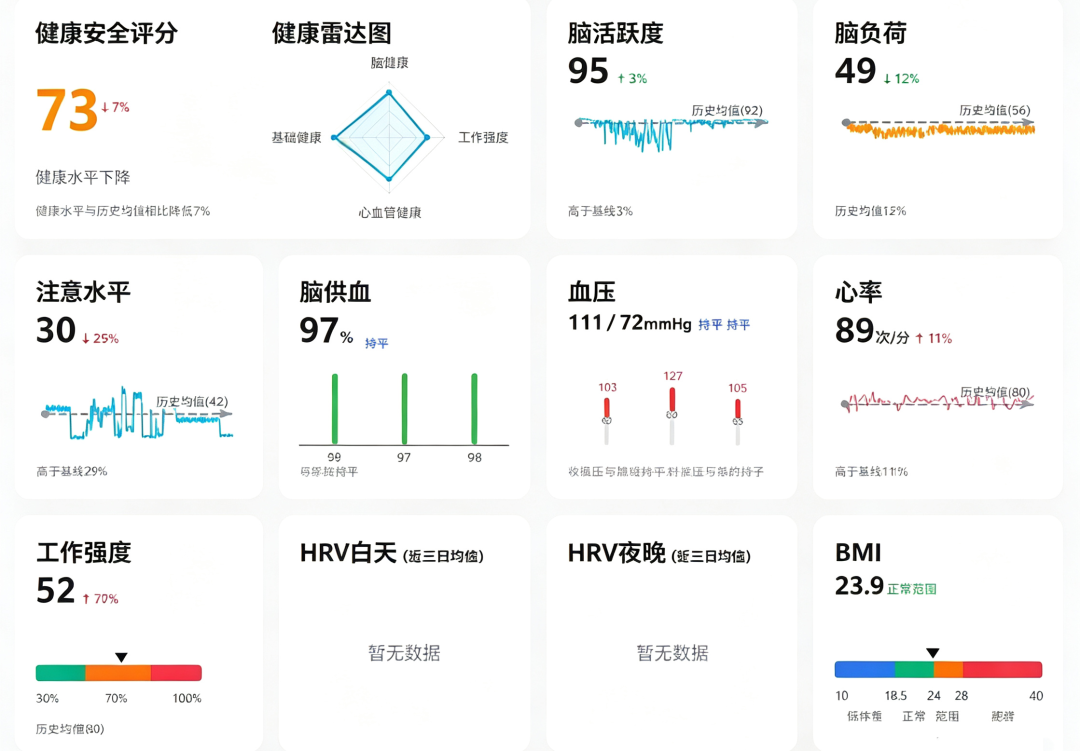
Figure: HuaBrain — Personal Health Abrupt Change Tracking Model.
This data accumulation brings an additional benefit. EEG characteristics vary enormously between individuals; the system must adapt to different people rather than requiring daily recalibration. Long-term, continuous tracking of the same person happens to provide the best baseline for judging "whether they're normal today." Workers wear their safety helmets every shift; data generates automatically without anyone's deliberate cooperation. As data accumulates, monitoring value extends beyond safety: at one client enterprise, over 65% of operations staff are above age 50, making daily health monitoring and trend alerting an increasingly real demand.
4
Response: What Happens After the Alarm
Monitoring is only the first step. What happens after the system detects someone's abnormal state determines whether this is decoration or tool.
Take a shield tunneling project on Beijing Metro Line 13's extension that HuaBrain mentioned: the system indicated poor condition in a shield machine operator. Management contacted him for verification, learning he'd had severely insufficient rest the previous night; the project then arranged temporary reassignment.
Shield operation demands high sustained attention and operational stability, yet someone sitting at their post is difficult to judge for fatigue by appearance alone. This case records the complete chain: status flagged, on-site verified, position adjusted. In the full project design, alerts route to the individual or relevant managers by risk level, with site supervisors taking measures like reminders, rest breaks, or reassignment based on working conditions; for shutdowns, evacuations, or medical response, existing site protocols apply. Post-response comes logging and review — the normalized status curve serves only to provide partial information, with final decisions still requiring on-site assessment of fitness to return to duty.
The entire system runs as an industrial internet platform, covering pre-shift assessment, during-shift monitoring, incident warning, risk response, and post-incident analysis across a full shift from start to finish; the platform outputs daily health monitoring and risk reports, turning each warning into a traceable record.
That water conservancy project from the opening also recorded a more complete response. At 9:27 a.m., a worker triggered an alert; backend data showed him in a drowsy state for the subsequent ten-plus minutes. The system issued two audio-visual prompts to him personally, while managers completed verification and response. Such incidents weren't rare in the past — but when they occurred, no instrument could record them; handling depended entirely on individual experience and self-awareness. Now they've entered management visibility.
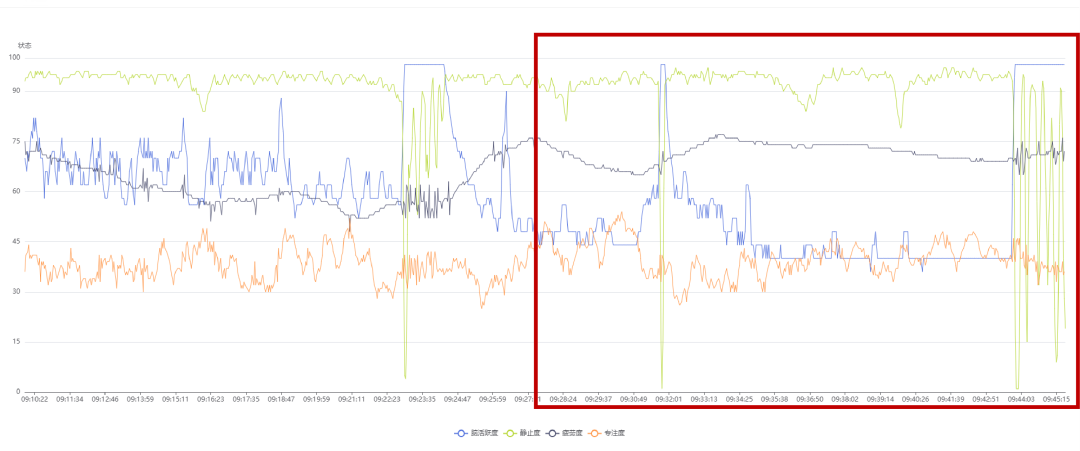
Figure: In a real case from the water conservancy project department, a worker triggered an alert at 9:27; managers confirmed drowsiness. Backend records show drowsy state from 9:27:11 to 9:44:03.
This chain is already operating at larger production scales. A Phase I project at Baotou Steel Group covered over 200 drivers and operators across molten iron hauling, iron ore, rail beam, and ore dressing positions, with the system issuing over 80 fatigue warnings and enabling on-site intervention in 130-plus potential human-factor incident risks; Phase II construction has already begun. For managers, fatigue and focus levels finally have quantifiable data, giving scheduling and intervention a basis.
Moving from pilot to routine use is another gradual process. HuaBrain has completed applied exploration in multiple real industrial scenarios, with some projects entering batch deployment and normalized trial operation, currently organizing accumulated experience into more replicable delivery methods.
5
The Choice: Why Industry First
Most BCI companies start with healthcare. Why did HuaBrain head first to mines, construction sites, power grids, and steel mills?
"The direct layer is demand." Industrial sites already have relatively complete equipment and environmental monitoring, yet workers' fatigue, alertness, and attention states during shifts remain difficult to continuously grasp — positions like mining vehicle operation, shield machine operation, and power construction happen to let such information directly serve rest arrangements, position adjustments, and on-site verification.
This starting point determined HuaBrain's subsequent technical evolution. Shortly after founding, devices entered the Sichuan-Tibet Railway, Beijing Metro, Chongqing Metro, Guangzhou Metro, plus coal mines, metallurgical plants, and power sites, running in real working conditions for three to four years. Requirements came from the field; signal processing, algorithms, and platforms iterated with the field — the opposite of taking laboratory technology and searching for scenarios.
Policy also shows clear support for this direction. In 2025, the Ministry of Industry and Information Technology and six other departments issued the "Implementation Opinions on Promoting Brain-Computer Interface Industry Innovation and Development," proposing to promote trial and early adoption in hazardous materials, nuclear energy, mining, power, and other key industries, building industrial safety management platforms to warn of oxygen deprivation, poisoning, fainting, and other incidents [1]. The State Council's State-owned Assets Supervision and Administration Commission led establishment of a BCI innovation consortium, with 11 central SOEs jointly advancing application deployment. At end-2024, HuaBrain became the hosting unit for the Ministry of Emergency Management's BCI key laboratory, and led drafting of 16 national standards covering infrastructure, power, ports, petroleum and petrochemicals, mining, metallurgy, and transportation driving.
Meanwhile, the Work Safety Law establishes investment in workplace safety as a corporate legal obligation [2], with the corresponding market for personnel safety investment estimated at trillions annually. Currently, HuaBrain's equipment is deployed in mining, metallurgy, petrochemicals, driving, ports, and power industries, with clients mostly leading enterprises in their sectors.
From a validation logic perspective, healthcare requires longer registration and clinical cycles; industrial validation is more direct: whether equipment is reliable in real conditions, whether warnings are accurate, whether management changes as a result — the field gives answers quickly.
6
Boundaries: What Workers Care About, and What Can't Be Crossed
One unavoidable question comes from workers. Are they willing to have their "brains read"?
HuaBrain's team observes that frontline workers' concerns are practical: whether this thing helps them, how to operate it in emergencies, whether it's troublesome. "We never communicate with workers about monitoring brainwaves — brainwaves are just technology. We talk about product functions."
What should employers know about employee states, and what shouldn't they? The industry has clear rules: laws and regulations including the Personal Information Protection Law have explicit provisions on collection and use of personal information [3]; state-owned enterprise clients have strict information management systems; HuaBrain, as supplier, performs system operation and maintenance within the scope of commercial terms; the system also supports localized deployment, with data remaining inside the enterprise.
Looking back, founder Zaixi Tang says he first believed industrial BCI could become a business after numerous clients repeatedly confirmed the same thing: personnel state management is their long-term pain point, and the costs enterprises pay annually are real. The industry consensus he most disagrees with is that "non-invasive BCI technology has low barriers." In his view, being able to collect EEG and being able to use EEG well are two different things; the real difficulty lies in analyzing which indicators from noise strongly correlate with real working states.
7
Epilogue: Protect First, Enhance Later
Previous stops in this series wrote about how BCIs expand human capabilities — regulating cognition, restoring movement, rebuilding language. HuaBrain Safety offers an answer from another direction: before enhancing humans, protect them first.
Return to that tunnel six kilometers deep. When the oxygen supply equipment failed, no instrument alarmed first. The first signal came from the human brain.
In mines, tunnels, and steel mills, what BCIs aim to do is make accidents come later — or never come at all. When the system captures brain signals before the person does, workplace safety — something done for decades — finally gains a new lever.
8
Dalton Venture Notes
In the first three installments, we kept asking: how to get closer to the brain. This installment's question is different: can BCIs first get closer to the scene? Mines, tunnels, power grids — the roughest scenes this series has visited, where technology has no room for performance, only reliable or unreliable outcomes.
What drew us to HuaBrain Safety was its accumulation from immersion in real working conditions. Hardware for extreme environments, signals in fifty-fold noise, several hundred thousand hours of scene-tagged data, a complete set of industry access qualifications — these have no shortcuts, only project-by-project accumulation.
Dalton Venture has deployed different technical routes in the BCI field. Some companies face healthcare; others face cognition and consumer scenarios. HuaBrain Safety showed us another judgment: industrial safety may be among the earlier scenarios for this technology to form commercial闭环. Demand is rigid, payers are clear, and value can be directly measured.
Appendix: Main References
-
Ministry of Industry and Information Technology et al.: "Implementation Opinions on Promoting Brain-Computer Interface Industry Innovation and Development," August 2025
-
Work Safety Law of the People's Republic of China (2021 Amendment)
-
Personal Information Protection Law of the People's Republic of China, 2021
-
Lal, S.K.L. & Craig, A., A critical review of the psychophysiology of driver fatigue, Biological Psychology, 55(3): 173-194, 2001
-
Berger, H., Über das Elektroenkephalogramm des Menschen, Archiv für Psychiatrie und Nervenkrankheiten, 1929.
ID: daltonventure
Long press to follow
Recommended Reading