Brain-Computer Interfaces, Beyond Imagination | Dalton Venture × Naoyu Technology: Thoughts Trapped in the Body

From science fiction to reality, brain-computer interfaces are drawing closer to us. As humans gain the ability to read, understand, and even intervene in the brain, a new question arises: where will brain-computer technology actually take us?


Introduction
From science fiction to reality, brain-computer interfaces are getting closer to us. As humans gain the ability to read, understand, and even intervene in the brain, a new question arises: where will BCIs actually take us?
To explore this, Dalton Venture has put together a series called "BCIs: Beyond Imagination," sitting down with the founders building along this frontier.
This stop takes us to the human brain's most distinctive ability — language. BrainSpeech Technology, a brain-computer interface algorithm company focused on language decoding.
It doesn't build electrodes. Instead, it wants to give the whole industry a "decoding foundation" — helping people who have lost their voice send the words they want to say back out of their bodies.
1
Speech: A Relay Race Under One Second
What happens in the brain when a healthy person says, "Nice weather today"?
First comes the intention to speak — you know what you want to say. The intention becomes a preparatory motor signal. That signal enters the motor cortex and is transcoded into commands that can drive muscles. The commands travel down the nervous system to the mouth, and the jaw, tongue, and throat muscles fire in sequence. A sentence, and it's out. The whole process takes under a second, and we almost never notice it happening.
The reasons people can't speak vary. Some involve damage to the brain's language functions themselves — a stroke affecting the language center, for example, can impair a patient's ability to understand and formulate language. Others are different: language and cognition are intact, but the connection from the brain to the vocal organs is severed. Brainstem stroke and ALS both fall into this category. These patients can understand and can think of the words; the signal just can't reach the muscles.
How large is this population? About one-third of stroke survivors experience some degree of language impairment [1]. Data from the Chinese Stroke Association shows roughly 3.3 million new stroke cases in China each year [2] — more than six new cases per minute on average. Globally, there are about 40 million people with aphasia, around 10 million of them in China [3]. The ALS population is smaller, about 60,000 to 100,000 patients in China [4], but most of them will gradually lose the ability to speak over the course of the disease.
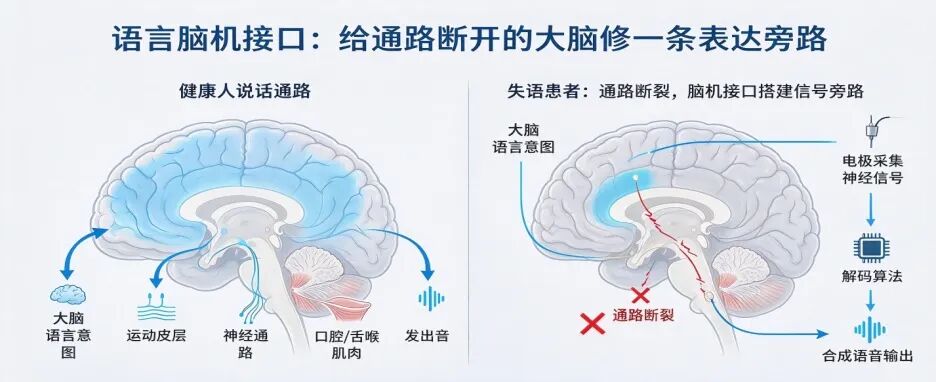
Figure: Language BCI: building an expression bypass for a brain whose "pathway is disconnected"
Historically, most of what medicine could offer was a workaround for speech: eye trackers, spelling boards, typing devices controlled by remaining muscle function. These all share one problem — they're too slow. Spelling letter by letter with the eyes, a simple sentence often takes tens of seconds or more. BCI takes a different approach: build a bypass next to the break point. Motor signals no longer drive the mouth muscles directly; instead they're decoded, reconstructed into sound, and played directly through an external device.
2
Why Is Language Decoding So Hard?
Language decoding lagged behind motor decoding in its early days, though the gap has been narrowing in recent years. The difficulty lies in several very concrete places.
First, language is the upper limit of how fast humans can output information. Speech is high-density, high-dimensional, and fast. At natural speaking rate, a person produces over a hundred words per minute, and behind each word is a string of pronunciation commands precise to the millisecond. The demands on the decoding side are inherently high.
Second, language is uniquely human. Motor research can start with primate experiments, but language research must be done in real people — stricter experimental conditions, fewer cases. This is a major reason language BCIs got off to a late start.
There's another layer of difficulty in the signal itself. The human brain has roughly 80 billion neurons, yet the most advanced recording devices today can capture at most about 30,000 neural signals simultaneously — an area equivalent to a coin on a football field [3]. Reconstructing highly structured language from such sparse signals requires a great deal of innovative work.
One more detail illustrates how fine-grained language decoding has to be: the electrodes aren't listening for a vague "wanting to speak," but for the individual motor intentions of the lips, tongue, jaw, and throat. The motor commands for each of these articulatory organs have their own corresponding locations on the cortical surface, and the decoder has to tell them apart one by one.
For Chinese speakers, there's an extra dimension to solve — tone. "Da, da, da, da" — the same syllable with different tones means completely different things. Chinese EEG decoding models can't simply be ported from English. Accumulation of Chinese neural signal corpora has only just begun, and BrainSpeech is currently preparing a Chinese corpus and related research.
3
Acceleration: From a Few Vowels to a Full Sentence
The acceleration of language decoding over the past two decades has rested on three maturing conditions: safer implantable electrodes, AI capable of processing high-dimensional neural signals, and enough real patient data.
In 2009, the BrainGate team led by Brown University first enabled a locked-in patient to synthesize vowels in real time using implanted electrodes [5]. Over the following decade, researchers used the monitoring windows of epilepsy patients with intracranial electrodes to gradually map how the speech motor cortex encodes articulation [6]. By 2021, a patient unable to speak spelled out complete sentences merely by "attempting to speak" for the first time — 15 words per minute, with a vocabulary of 50 words [7].
On August 23, 2023, Nature published a paper — in research at the University of California, San Francisco (UCSF), a patient who had been unable to speak for 18 years regained speech at about 78 words per minute. For the first time, a computer synthesized speech directly from brain signals and simultaneously drove a talking digital face [8]. A few months later, Nature listed brain-computer interfaces among "seven technologies to watch in 2024" [9].
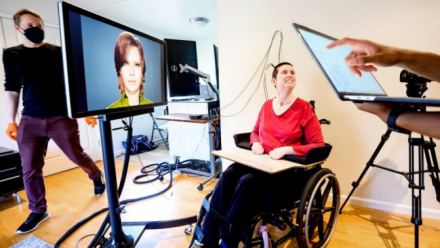
Figure: A UCSF clinical trial patient attempts to speak; brain signals are decoded to drive a digital avatar's speech synthesis
The subject of the UCSF paper was a female patient. In 2005, at age 30, she suffered a brainstem stroke and was unable to speak normally for the next 18 years. To express herself, she strapped a laser pointer to her head and pointed at letters on a board one by one, while someone else helped spell out the words — at only 14 words per minute. After becoming a trial subject in 2022, a cortical electrode array with 253 electrodes was placed on the surface of her speech motor cortex [10]. When she "attempted to speak," the electrodes captured the signals that should have driven her lips and vocal cords. The algorithm first translated the neural signals into 39 phonemes, then a language model assembled them into sentences. Ultimately, she regained speech at 78 words per minute — more than five times faster than the old device [8]. The system also reconstructed her own voice from recordings made before her stroke, simultaneously driving a digital face with full lip movement and expressions [10].
Ran Wang is one of the paper's authors, responsible for building and implementing the speech decoding algorithm. The team's early research was done with epilepsy patients who could speak normally. But applying the same approach directly to aphasic patients fell short of expectations — the neural activity related to articulation in someone who hasn't spoken for over a decade differs from someone who speaks every day. The technical problems in between needed to be solved anew.
Beyond that, there's another common industry challenge: the systems above were all painstakingly built around a single patient. Swap in a different patient and you nearly have to start over. Whether every patient can benefit and keep benefiting is the industry's next-stage question. BrainSpeech, which Ran Wang founded after returning to China, is trying to solve it.
Ran Wang earned his bachelor's degree from Tsinghua University, his PhD from New York University (NYU), and then did postdoctoral research at UCSF. He participated in the algorithm development for the world's first aphasia BCI clinical trial, with results published in Nature and PNAS. He was also among the earlier scholars to introduce the Transformer architecture into neural signal decoding — the NOVA architecture is work along this line.
4
Training: How an Aphasic Patient Learns to "Speak" Again
What does an aphasic patient actually go through from surgery to speaking again? After electrode implantation and surgical recovery, the patient enters the training phase: a pre-set sentence appears on screen, the patient "attempts to speak" as instructed, and the system simultaneously records neural signals. The same sentence is repeated multiple times, then another sentence is introduced. This data is used to train the decoding model, and after training comes tuning — real-time decoding latency, vocabulary range, synthesized voice timbre all need item-by-item adjustment to keep up with the patient's rhythm.
Data collection itself is physically demanding. Patients need to concentrate for extended periods, repeatedly "attempting to speak," and each session can only last so long — so data collection is split into multiple phases spanning many days. After each phase, researchers also test with pre-set sentences, comparing the machine's decoded output against the correct answer word by word, to confirm how much the model has actually recovered from brain signals.
The process is lengthy because brain signals vary greatly between individuals. The algorithm is bound to a single patient's fixed electrode positions and can only be tuned with small-sample personalization. In other words, past speech BCIs relied heavily on "one model per person" — every new subject required extensive data collection and a fresh round of personalized EEG-to-speech calibration training. Stanford's subject went through 26 collection sessions spanning months; UCSF's subject used 16 sessions over several weeks. The time window after craniotomy and implantation is limited, and every day shaved off the adaptation period is a day sooner the patient can actually use the system.
5
Generalization: Swap in a New Person — Can It Still Understand?
Training a separate model for each patient has multiple precedents in the industry. But the real-world problem is that neural activity patterns differ between people, electrode placement positions differ, and recording equipment conditions differ. A model that performs well on one patient often requires fresh data collection and retraining for the next. Even for the same patient, today's signals may differ from tomorrow's.
This ability to "keep working beyond the conditions it was trained on" is called generalization. It has three tiers: first, the same patient using the system repeatedly under the same conditions, with the model staying stable; second, the same patient producing new words and sentences not seen during training, with the model handling new combinations; third, a completely new patient, with the model needing only minimal adaptation to get up to speed. The industry has largely achieved the first tier, is working through the second, and the third is the real bottleneck — and where BrainSpeech has invested most deeply.
Generalization is hard, which also makes data the most-discussed resource in this industry. But data can't just be piled together and used: different institutions use different electrodes, different recording standards, different experimental conditions — directly merging them for training doesn't necessarily help. What the industry truly lacks is a foundation model that can understand different brain signals, different tasks, and different people, then do minimal adaptation for specific patients.
BrainSpeech's approach is to move BCI from "one model per person" toward "cross-subject." The team calls it a "neural ChatGPT": a large model that treats brain data as a new modality, driven jointly by neuroscience and AI [3]. The emphasis on "large model" here isn't about parameter count — it's about learning shared patterns from multiple patients' data and transferring those patterns to the next patient. In the past, each patient's data was single-use, staying locked inside that person's model. On this path, they become the next patient's "priors."
6
The Solution: Signal, Position, and Sound
Once the cross-subject goal is clear, the next question is: how? BrainSpeech's approach can be summarized in three steps, addressing signal, position, and sound respectively.
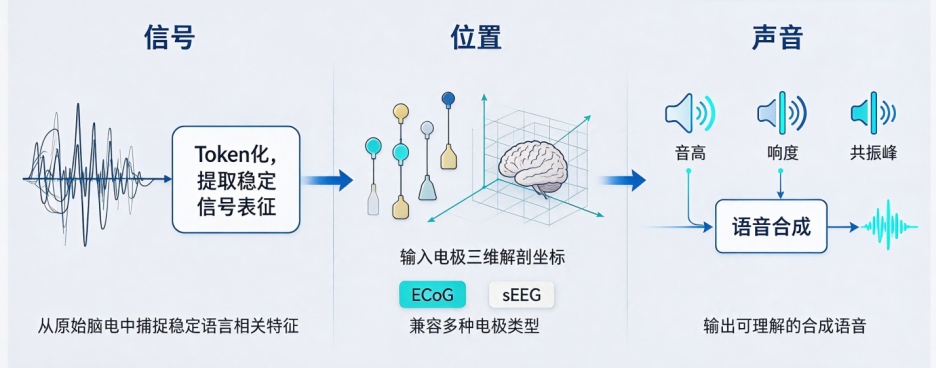
Figure: Cross-subject language decoding framework
The first step is signal. Neural signals are extremely complex — a tangle of high-dimensional data composed of many electrodes, time points, and frequency bands, like a ball of tangled yarn. Handing this raw data directly to a model means feeding it a lot of noise and individual variation. So BrainSpeech's first task is to untangle this "ball of yarn": extract more stable intermediate representations from the complex raw neural activity — representations that are easier to compute and understand — before passing them to the model. The team calls this step "tokenization." Its significance isn't "turning brainwaves into text" but rather organizing raw signals from different patients and different devices into a form the model can compare and learn from.
The second step is position. The actual location of electrodes in each patient's brain varies greatly — a major reason data from different patients is hard to align. BrainSpeech's self-developed NOVA architecture enables the model to account for differences in electrode position, so data from different patients can be placed into the same reference frame.
The third step is sound. Neural signals differ vastly between individuals, but everyone's voice can be broken down into the same set of vocal parameters: pitch determines how high or low the voice is, loudness determines intensity, and formants correspond to mouth shape and vowel characteristics. Rather than having the model generate every sound sample point directly from brainwaves, BrainSpeech first predicts a set of key vocal parameters, then a synthesizer reconstructs the sound. Replacing the decoding target from an entire waveform to a finite set of parameters is like giving different brains a common exit: the model learns the mapping from neural signals to vocal parameters, and this parameter system is shared by everyone. This approach has completed cross-subject validation on data from multiple patients.
7
Filling In the Gaps: How Much Can AI Help?
At the current stage, language BCIs are closer to decoding a rough framework of semantic content or language intention; restoring language word for word from the brain remains difficult. The emergence of large language models brought a new idea: brain signals themselves may be incomplete, but LLMs have already learned the relationships between words and contextual patterns from massive text corpora. Once brain signals provide partial information, the model can use context to predict and fill in. The industry's common approach today is for the front end to extract information from brain signals and the back end to use language patterns to organize the incomplete information.
This also raises an interesting question: when a patient's words are accurately spoken, how much comes from brain signals and how much from the model's language completion? This question can't be fuzzy — what the patient finally says must be as close as possible to what they want to say, not what AI thinks they should say.
Ran Wang has a straightforward explanation: "Brain signal decoding is like typing; the language model is like an input method. The input method can correct errors and suggest completions, but the characters you type first have to be close enough." The team's rule of thumb is that raw decoding accuracy needs to cross about 50% before language model completion becomes a net positive.
This also explains why testing during the research phase must be rigorous: researchers give the patient a predetermined sentence, have them attempt to say it as instructed, then compare the machine's decoded output against the correct answer item by item. Only this way can you know how much the system actually recovered from brain signals, rather than how much AI guessed correctly.
There's also a more fundamental boundary: the system doesn't decode any random thought that floats through the mind, but "attempted speech." The patient must actively and completely "speak" a sentence at the neural level — the muscles just don't execute it. Without this active "attempt," there are no signals to decode. The agency of expression always remains with the patient.
8
A BCI Company That Doesn't Build Electrodes
In the BCI industry, companies enter at different points — some make electrodes, some make implantable devices, some make complete systems. BrainSpeech's choice is different: it doesn't build electrodes.
"BCI hardware forms haven't converged yet." There are many input modalities — ECoG is one, sEEG is another, and teams are also working on flexible electrodes and microelectrode arrays. Output applications go far beyond today's forms. Both the entry and exit points are changing rapidly, and BrainSpeech sits in the middle at the decoding position, working on "key common technologies": language decoding is the first application, but not the only one.
This positioning creates three differences. First, it doesn't depend on any particular electrode type — both invasive and non-invasive signals can be connected, adding a degree of freedom in modality. Second, generalization capability — adapting to new users and scenarios with less data and shorter time. Third, the algorithm itself is general-purpose: the same decoding framework handles both language and facial movements — the simultaneous decoding of speech and face in that Nature paper was a demonstration of this capability.
On the deployment path, BrainSpeech is pursuing both invasive and non-invasive lines: first completing indication validation and registration in medical settings, then gradually extending to broader populations and scenarios. The team also plans to open its decoding solutions to upstream and downstream hardware makers and developers in the future. This path has received industry recognition as well — related work won the 2023 International BCI Award.
9
Language Is Not the Endpoint
When humans perceive the world, visual information accounts for roughly 60–70%, while language accounts for only about 30%. But among all human sensory channels, language is the only one with both input (listening) and output (speaking) capabilities, and it's the most efficient way to express thought [3]. The endpoint of language decoding may not be language itself. Today, the most mature and most understandable interface is language: a thought is organized into a sentence, the sentence is spoken, another person hears it. This is the information interface humans have used for hundreds of thousands of years. But language itself is a form of "compression" — our brains may simultaneously hold images, emotions, sense of direction, motor intentions, and abstract judgments, yet in the end we must output them one word at a time.
If BCIs continue to advance, what happens? Today, an aphasic patient wants water: they first attempt to say "I want water," the system decodes the language, a caregiver hears it, and then goes to get water. In the future, there might be another possibility: the patient generates a clear need, the machine recognizes the intention, and a smart device executes it directly — language might not even be a necessary step. Academia has already begun exploring from "attempted speech" toward "inner speech" — no longer studying only "attempted articulation" but beginning to study language activity inside the brain when there's no obvious articulatory preparation. Moving further from there gets us truly close to the "mind reading" of science fiction.
That's a more distant future. What's more concrete right now is simply letting a patient's unspoken words be heard again.
10
Epilogue: Whose Voice Is It?
A sentence like "Nice weather today" — from intention to sound — takes a healthy person under a second. A patient receiving BCI clinical assistance took 18 years to complete that journey. When the digital avatar on screen first spoke in her own voice, what technology returned was never just "how many words per minute" — it was the pathway between a voice and its owner.
Today, this technology still requires patients to actively "attempt to speak" before it can read the language in the brain. But it has at least proven one thing: even when the body cannot produce sound, the sentence in the brain can still find a way to be heard.
11
Dalton Venture Notes
Motor BCIs help patients do things again; language BCIs help patients return to human relationships. For patients who have lost their voice, "can't speak" is often closer to the essence of loneliness than "can't move." That's why we've spent the most time in this direction.
Globally, the teams that have gotten language decoding into Nature are few and far between, and Ran Wang was the algorithm lead on one of the core efforts. What matters more to us is that the team has put its deepest investment into generalization and compatibility — the two hardest things standing between language BCIs and the hospital ward, and the two things this industry is watching most closely.
Dalton has positioned across different technology routes in the BCI field, always driven by the same question: on which end user does the technology ultimately deliver? Language decoding fills in the "expression" piece of the puzzle.
Appendix: Key References
-
NIH/NIDCD "Aphasia" topic page: about one-third of stroke survivors have aphasia
-
Beijing Daily client, "China Sees 3.3 Million New Stroke Cases Annually, Onset Age Trending Younger," October 29, 2025 (Chinese Stroke Association data)
-
Gulou Micro News, "'Neural ChatGPT' Lands in Gulou: BrainSpeech Achieves 90% Accuracy on 1,000 Words," February 22, 2026. Data and judgments in the article regarding aphasia population size, neural signal sparsity, and the value of language come from Ran Wang's introduction in that report
-
Beijing municipal government website, "Professor Fan Dongsheng of Peking University Third Hospital: ALS 'Hard to Cure, But Treatable'": approximately 60,000–100,000 ALS patients nationwide
-
Guenther, F.H. et al. A Wireless Brain-Machine Interface for Real-Time Speech Synthesis. PLoS ONE 4(12): e8218 (2009). DOI: 10.1371/journal.pone.0008218
-
Anumanchipalli, G.K. et al. Speech synthesis from neural decoding of spoken sentences. Nature 568, 493–498 (2019). DOI: 10.1038/s41586-019-1119-1
-
Moses, D.A. et al. Neuroprosthesis for Decoding Speech in a Paralyzed Man with Anarthria. The New England Journal of Medicine 385, 217–227 (2021). DOI: 10.1056/NEJMoa2027540
-
Metzger, S.L. et al. A high-performance neuroprosthesis for speech decoding and avatar control. Nature 620, 1037–1046 (2023). DOI: 10.1038/s41586-023-06443-4. Both papers published online August 23, 2023
-
Eisenstein, M. Seven technologies to watch in 2024. Nature 625, 844–848 (2024)
-
UCSF website: How Artificial Intelligence Gave a Paralyzed Woman Her Voice Back, August 23, 2023
END



ID: daltonventure
Long-press to follow
** Re c o m m e n d e d R e a d i n g **