Brain-Computer Interfaces, Beyond Imagination | Dalton Venture × Zhudong Technology: Rebuilding a Connection

From science fiction to reality, brain-computer interfaces are coming closer to us. When humans gain the ability to read, understand, and even intervene in the brain, a new question arises: where exactly will brain-computer interfaces take us?

Introduction
From science fiction to reality, brain-computer interfaces (BCIs) are drawing closer. As humans gain the ability to read, understand, and even intervene in the brain, a new question emerges: where exactly will BCIs take us?
To explore this, Dalton Venture has launched the "Brain-Computer, Beyond Imagination" column series, stepping into the world of entrepreneurs charting this future path.
This is the second installment of Dalton Venture's "Brain-Computer, Beyond Imagination" series. In our last stop, we documented the quest to understand and modulate the brain from outside the skull; this time, we go inside.
Zhudong Technology, a company focused on invasive brain-computer interfaces. It isn't simply manufacturing a particular BCI device — it's building a high-bandwidth channel between the intracranial and extracranial worlds. Movement, vision, and emotion are the three directions this channel opens toward.
1
The Journey of a Glass of Water
Right now, pick up the glass of water beside you.
The action is so simple it's hardly worth mentioning, yet your nervous system completes a lengthy relay for it: your eyes transmit the cup's position to the visual cortex, the visual cortex hands off coordinates to the motor cortex, the motor cortex generates commands, and those commands travel as electrical signals down the spinal cord to finally reach the muscles in your hand — contract, grasp, lift.
The brain processes information through electrochemical collaboration: neurons generate electrical impulses, what we commonly call "firing," through the movement of ions across cell membranes. Every hand raise, every thought, every surge of emotion is fundamentally the result of vast numbers of neurons firing in coordination, then communicating across cells via synaptic neurotransmitter release.
Once this chain is broken, "picking up a glass of water" becomes impossible again. There are two main causes of interruption: one is a severed transmission line — spinal cord injury cuts the cable between brain and body, the command center remains intact but commands can no longer get through; the other is damage to the command center itself — stroke, ALS, and other diseases attack the brain directly.
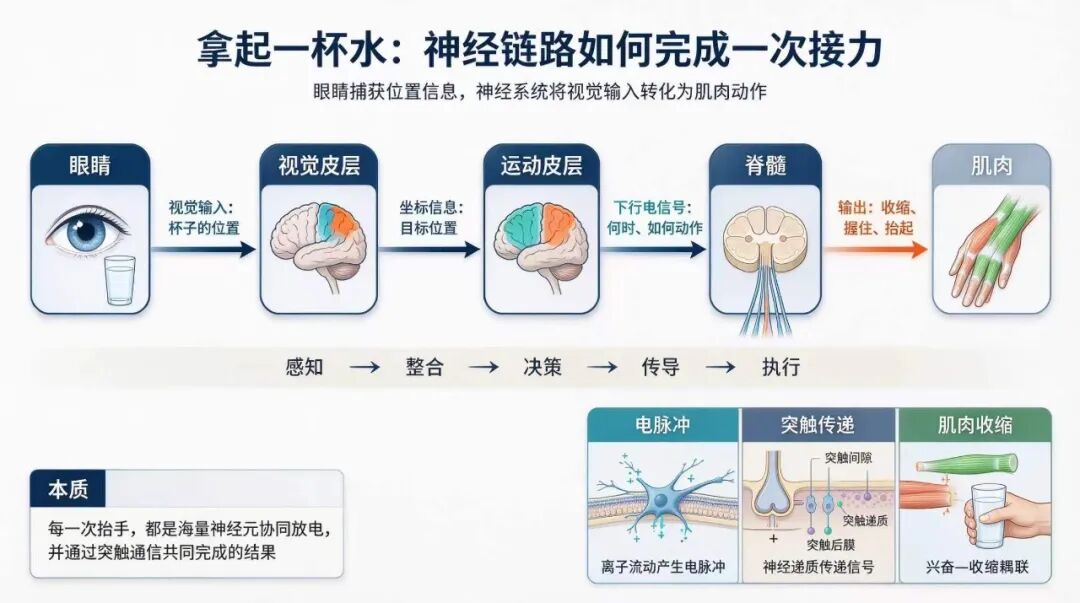
Figure: From "wanting to grasp" to "grasping" — the neural relay behind a glass of water
Behind this "disconnection" lies a vast population. The World Health Organization estimates that over 15 million people worldwide live with spinal cord injury [7]; in China alone, there are more than 28 million existing stroke patients [8], a significant proportion of whom have varying degrees of motor dysfunction. For many of them, that severed transmission line represents the entire distance between themselves and normal life.
Could we extract the signal before the break and finish the remaining journey for it? This is the question motor BCIs seek to answer, and also the first of Zhudong Technology's three pipelines to advance toward clinical application.
2
Movement: Routing Signals Around the Break
For a long time, medicine's answer for paralyzed patients has been "compensation" rather than "reconstruction": wheelchairs replace legs, braces stabilize joints, rehabilitation training awakens residual function as much as possible. Later mechanical arm solutions took a step forward: through eye tracking, voice, or residual electromyographic signals, patients could manipulate a robotic arm mounted on a wheelchair to grasp objects. But the robotic arm remains a "third hand" outside the body — it doesn't belong to you, every movement requires awkward translation, and no tactile sensation feeds back. What patients get isn't "my hand," but a machine that demands laborious direction.
Motor BCIs take a different approach: since the break is in the spinal cord, read intention directly at the most signal-rich point before the break — the motor cortex — and route commands around the break to the execution end. This path's feasibility has been validated in human trials: in January 2024, Neuralink implanted its N1 device in a young man paralyzed by a diving accident; weeks later, he moved a cursor, played chess, and played strategy games by thought alone in a livestream, with cursor movement speed even exceeding that of ordinary mouse users [9].
In November of the same year, Neuralink announced the CONVOY study, extending control from computer cursors to assistive robotic arms — participants could build on existing studies to further explore controlling external devices with implants; in subsequent disclosures, an ALS patient named Nick could already manipulate a robotic arm via brain signals to bring food to his mouth [9]. From cursor to robotic arm, motor BCIs are entering daily life scenarios patients face every day: eating, retrieving objects.
Cursors and robotic arms are just starting points. The true endpoint of this path is reactivating the patient's own body — using decoded movement intention to control exoskeletons, or directly activating muscles through functional electrical stimulation, so that the "paralyzed hand" becomes a hand again. From controlling a cursor to controlling the body lies a gap in signal precision requirements: moving one finger versus five fingers demands bandwidth of entirely different magnitudes.
This is precisely where Zhudong Technology's motor pipeline focuses its efforts. The motor BCI "Tianshu" targets patients with movement and language dysfunction caused by stroke, spinal cord injury, and ALS, aiming to help paralyzed patients achieve motor function reconstruction. Relying on high-bandwidth signal acquisition across 1,024 channels, the team's goal is to progress from coarse commands of "move or don't move" to finger-level fine motor decoding.
Notably, this pipeline points toward real life from day one: the Tianshu system uses a wireless fully implanted design, leaving no visible trace after implantation, with charging and data transmission completed wirelessly. For patients, this means it isn't a device to be carefully maintained, but a part of the body — precisely the threshold that mechanical arm solutions never crossed.
3
Foundation: 1,024, Ultra-Fine Flexible Electrode Wires, and Full-Stack Self-Development
Supporting all three pipelines is the same foundation. Below, we detail three key aspects of this foundation.
First, 1,024 channels. The intention to raise a hand isn't the decision of a single neuron, but a pattern formed by thousands of neurons firing in coordination in the motor cortex. Too few recording channels is like guessing an entire image from a handful of pixels; the more channels, the finer the firing patterns that can be distinguished, and the higher the degrees of freedom in decoded movements. Channel count is the bandwidth of brain-computer interfaces.
Currently, fully implanted BCI products in human trials mostly have electrode channel counts between 64 and 256 [3]; at the top stands Neuralink's N1 with 1,024 electrodes [9]. Zhudong Technology's Tianshu system also has 1,024 channels — one of only two tickets to the global first tier, one in Fremont, one in Shanghai.
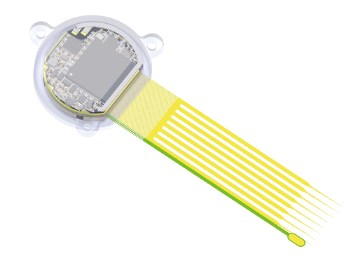
Figure: "Tianshu" 1,024 channels
Second, flexible electrode wires with 1-micron line width, roughly one-fiftieth the width of a human hair. Why go so fine? First consider the environment electrodes face: brain tissue has the consistency of soft tofu, and pulses slightly with every heartbeat and breath. A relatively thick, rigid foreign object left inside long-term will undergo repeated micro-friction with tissue, triggering an immune response that grows a dense glial scar around the electrode — impedance rises, signals gradually attenuate, this is the fundamental reason implanted electrodes have struggled to work for a lifetime [13].
Making flexible electrode wires fine while retaining sufficient strength: electrodes need to adapt to brain pulsation while having enough strength for implantation. These electrode wires achieve 0.4N tensile strength, capable of bearing a 10g weight. On wires dozens of times finer than a hair, conductive and insulating layers must be laid simultaneously; achieving micron-scale line width without breaking, cracking, or shorting relies on semiconductor-grade micro-nano processing. Implantation precision has long exceeded human hand limits — Neuralink's electrodes are so fine they must be handled by dedicated surgical robots [9]. In truth, the real challenge of 1-micron flexible electrode wires isn't "fineness" itself, but fineness with flexibility, flexibility with strength: materials, processing technology, and implantation operations together constitute this technical barrier.
Third, full-stack self-development. From chips, electrodes, and algorithms to clinical systems, Zhudong Technology employs technologies covered entirely by its own patents. General-purpose chips and computing power aren't scarce in consumer electronics or AI, but the BCI track remains far from mature: existing components aren't designed for capturing microvolt-level brain neural signals. Currently, technical approaches in this market are still converging, and traditional suppliers lack sufficient commercial motivation for high-cost custom development. More critically, brain-computer interfaces are a deeply coupled system: noise from electrode acquisition, signal fidelity of chips, and decoding capability of algorithms are interlinked; even individually sourced premium parts are difficult to assemble into stable, high-precision intent recognition. Before a mature supply chain forms, the only choice is building full-stack capability from scratch.
4
Vision: A World Re-illuminated
The Lancet Global Health 2021 global eye health report estimated approximately 43 million blind people worldwide [10]. In China, the visually disabled population exceeds 17 million, with approximately 450,000 new cases of blindness annually [15]. For patients with acquired blindness, such as common blinding diseases — corneal disease, glaucoma, retinal disease, optic nerve damage — the pathology mostly occurs in the eye and signal pathway, while the visual cortex at the back of the brain responsible for processing vision often remains intact.
Vision doesn't form in the eye. The eye converts light signals to electrical signals; true "seeing" occurs in the visual cortex. The core concept of visual BCIs is to bypass the damaged eyeball and optic nerve: capturing images through a camera, encoding them as electrical stimulation signals, and directly writing them to the visual cortex.
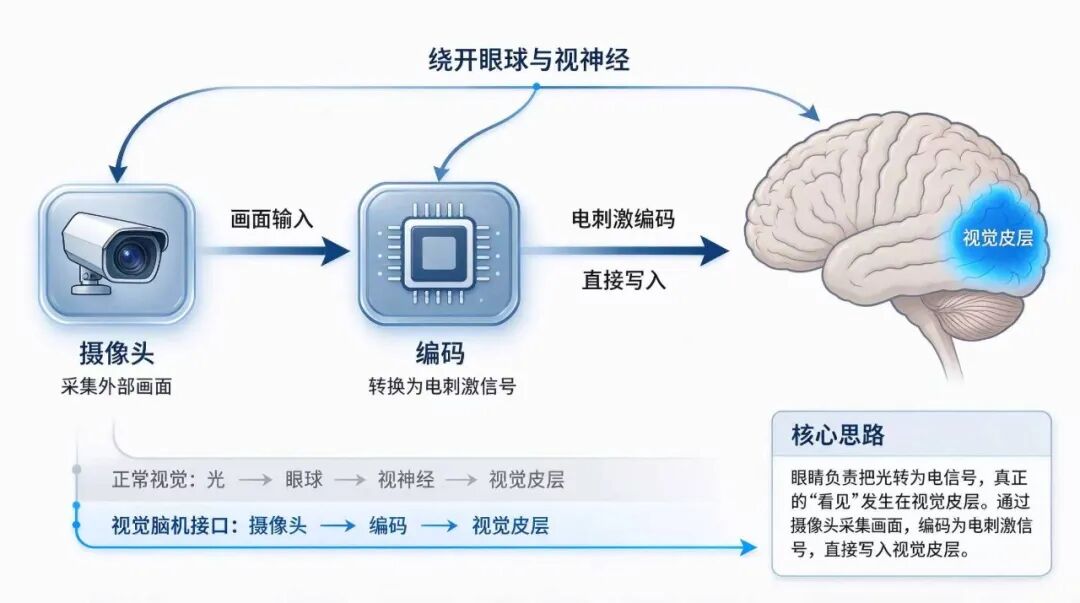
Figure: Visual brain-computer interface — bypassing the damaged eyeball and optic nerve
Human exploration of visual cortex electrical stimulation spans over two centuries. Early researchers discovered that electrically stimulating the brain's visual region caused subjects to perceive points of light. In 1968, the first visual cortex prosthesis emerged: researchers implanted 80 electrodes in a blind patient, producing points of light by activating different electrodes to help the patient recognize simple shapes [16]. In subsequent decades, industry technology continued iterating, electrode precision constantly improving. In 2021, an overseas team used a 96-channel electrode array to help a patient blind for years re-identify basic shapes and letters [16].
Within this technical evolution, Zhudong Technology's disclosed 1,200-channel visual BCI system ranks among the leading global publicly disclosed visual prosthesis solutions; currently 1,200 channels suffice to present outlines: table edges, door frames, approaching human figures. The team has interviewed hundreds of blind individuals, receiving remarkably consistent answers: "Their first request is just to let me see things." Seeing things means walking without falling into ditches, not hitting telephone poles, means being able to go out alone.
Why do visual BCIs start with the acquired blind? Because those with acquired blindness once established complete visual mappings in their visual cortex, and related visual memories remain preserved. The brain has the capacity to recognize, integrate, and interpret meaning from light spot signals produced through electrical stimulation [13]. Recognizing outlines is just the first step; as research progresses on neural mechanisms, stimulation principles, and other foundational technologies, along with iterative optimization of algorithmic models, functions including field of view, color, and depth perception will gradually be realized in visual BCI products. In the future, they will have the opportunity to see a more real world again.
5
Emotion: From Always-On Light to Mind-Reading Closed Loop
In 2026, approximately 320 million people worldwide suffered from depression [11]. Within this vast base, roughly 30% of patients respond poorly to existing medications; these patients are known as treatment-resistant depression patients, for whom current drug and psychological therapies have limited effect.
But "changing the brain with electricity" is something medicine has validated for decades. Deep brain stimulation (DBS), approved by the US FDA for Parkinson's disease in 1998, has been implanted in over 200,000 patients globally [12], with indications expanding from Parkinson's to dystonia, epilepsy, and even obsessive-compulsive disorder. DBS proved something fundamental: putting electrodes in the brain and modulating brain function with electrical current works clinically.
However, most DBS today is more like an always-on light — once activated, it outputs fixed continuous stimulation regardless of the brain's real-time state. What if the light could first see the room before deciding how to illuminate it? This is precisely the logic of Zhudong Technology's emotion pipeline: bidirectional closed loop. First read brain activity related to emotion, identify state, then apply precise adaptive modulation when needed: enhancing during depression, suppressing during mania.
"Normal people are born with the ability for emotional self-regulation. What we want to do is give that ability back to those who've lost it," describes Zhudong Technology CEO Guojia Wu of this pipeline's goal.
6
Why This Path Must Go Inside the Skull
With all three pipelines described, a shared prerequisite surfaces: they all require placing electrodes inside the skull. Why? The answer lies on two levels.
The first is physical. The skull and scalp attenuate neural electrical signals. Recording brain activity through the skull is like listening to whispers in a room through a wall: you can tell there's sound, but not who is speaking or what they're saying. Non-invasive devices excel at determining "what state the brain is in," but currently struggle to answer "which direction does this finger want to move." Some teams have attempted intravascular approaches: shaping electrodes as stents delivered through the jugular vein to blood vessels near the motor cortex, avoiding craniotomy. But signals still pass through a blood vessel wall, with clear limits on channel count and signal precision [9]. To obtain high-bandwidth signals approaching single-neuron level, direct contact with the cerebral cortex is the most feasible path.
The second is first principles. Light, magnetism, and ultrasound seeking to modulate nerves must first complete an energy form conversion, with each conversion bringing energy loss and diffuse scope of effect. But the information carrier of nerves themselves is electrical signals; when collecting and applying electrical stimulation, the chain is more direct, response faster, and positioning more precise. "What brain-computer interfaces truly establish is a connection between inside and outside the skull — a bidirectional exchange," says Guojia Wu. "The bandwidth of this connection determines its value."
Invasive and non-invasive approaches aren't an either/or route dispute. Magnetic stimulation, ultrasound, peripheral electrical stimulation each have their application scenarios. In real clinical practice, drugs, non-invasive modulation, and invasive modulation each play their role: drugs are the foundational treatment, while the latter two provide higher-precision intervention options for patients with limited drug efficacy. Different technologies jointly serve treatment needs, differing only in applicable populations and scenarios.
Meanwhile, invasive BCIs themselves will evolve toward less trauma and more convenient operation. Guojia Wu has this vision: as implant surgical robots mature and electrode leads continue miniaturizing, future implant procedures may not take two or three hours, but become outpatient minimally invasive operations, like cardiac stents evolving from early open-chest surgery to today's catheter interventions. Making implantation as simple and quick as minimally invasive intervention — this is the direction Zhudong Technology is working toward.
7
At the Other End of AI Is the Human Brain
Beyond medicine, Zhudong Technology is also thinking about and planning for the integration of BCIs with AI. Currently, BCI empowerment of AI mainly divides into two directions. Both share a common background: the bottleneck current AI development encounters. Today's large models rely on massive text, image, and other data training, and supply of quality publicly available text data sources is already tightening. For AI to continue iterating and upgrading, it needs both entirely new data sources and inspiration from the underlying mechanisms of biological intelligence. The brain happens to provide both simultaneously.
The first direction is drawing on the brain's working mechanisms to improve AI architecture, generally known in the industry as the "brain-based model" approach.
Some mechanisms from neuroscience can inform AI: when the human brain receives information, it prioritizes signals that deviate from its own expectations, without processing all input frame by frame — this mechanism is called predictive coding, with mature theoretical models formed by the late 20th century [17]; the hippocampus converts short-term memory to long-term memory and actively fades unimportant information; the visual pathway hierarchically extracts lines, contours, and objects, with only small numbers of neurons activated each time.
Introducing these mechanisms into model and robot design aims to reduce AI's dependence on data volume: enabling robots to learn new tasks from just a few demonstrations, and run at lower power consumption in familiar environments. This direction doesn't rely on real brain data, but on understanding of brain working mechanisms.
The second direction is using real brain data collected by BCIs to train and calibrate AI models. In the past, machines had only two indirect ways to understand human internal states: through language and action expression, with very low information bandwidth — many sensations like subconscious intentions, fatigue, and dull pain are difficult to describe through external behavior; or manual scoring and labeling of AI outputs one by one, with high cost and low efficiency.
BCIs can directly convert human intentions, emotions, attention, and other internal states into high-bandwidth signals usable by machines. Brain signals have many uses: they can serve as preference signals replacing manual scoring to complete AI alignment; they can transmit continuous movement intention to embodied models, with models planning paths and controlling robots to complete entire action sequences, no longer limited to a few preset commands; they can also collect visual cortex signals when people imagine images, for training multimodal models — academic research has already confirmed the feasibility of reconstructing imagined images from brain activity [18].
These two paths ultimately converge at embodied intelligence. Embodied intelligence requires a complete closed loop of "perception, understanding, decision-making, execution, feedback": brain-based models give robots human-like memory and environmental adaptive capabilities; brain data transmits human intention directly to robots; and feedback signals generated by the human brain after receiving execution results can in turn optimize the robot's action strategy.
Zhudong Technology has already begun laying out in relevant directions.
8
330 Million, and a Window of Opportunity
In August 2026, Zhudong Technology announced completion of a 330 million yuan angel round, with CASSTAR, Legend Star, Dalton Venture, Inno Angel Fund, Unity Ventures, Huada Songhe, and LYFE Capital among the institutions joining [4]. By strict criteria of "clear amount, single round, standard angel round," this is the largest angel financing in China's BCI field to date [3]. This financing occurred against an industry warming backdrop: in the first half of 2026, China's BCI field disclosed 72 funding rounds totaling 6.73 billion yuan [1].

Brain-computer interfaces aren't a suddenly emerging new concept — decades of scientific research accumulation and DBS clinical application have long laid foundations — but for a long time, challenges including long-term electrode stability, neural signal decoding, and human implantation safety confined most solutions to laboratory stages. Now, multiple conditions in technology, clinical practice, and industrial support are simultaneously changing: high-throughput flexible electrodes, dedicated chips, and AI decoding continue iterating; domestic invasive BCIs have also completed key steps of registration, prescription, and insurance inclusion [2][3]; medical insurance pricing item establishment and multi-department industrial support policies have been successively introduced [5][6]; a complete industrialization pathway is taking shape.
9
Dalton Venture Notes
One detail from the interview period: just days before our exclusive interview, a delegation of BCI field visitors arrived at Zhudong Technology. The team demonstrated a movement decoding system for them: two patch-style flexible electrode sensors attached to the arm, and after brief calibration and training, real-time control of a flying object completing takeoff, hovering, and obstacle navigation using only faint electrical signals from arm muscles.
Surface electromyography utilization is actually not easy: signals are weak, susceptible to interference, and signal characteristics vary between individuals; stably extracting movement intention from them requires long-term algorithmic accumulation. This demonstration showed that the team already possesses considerable maturity in decoding surface signals.
And what Tianshu seeks to read is intracranial signals. Compared to surface electromyography, cerebral cortex electrical signals have higher intensity and carry richer information dimensions. That surface signals can achieve such control precision also foreshadows considerable decoding potential for intracranial brain signals.
Returning to that glass of water. For someone with spinal cord injury, from "wanting to grasp" to "grasping" lies a severed transmission line; for someone with acquired blindness, from "wanting to see" to "seeing" lies a failed lens. What Zhudong Technology seeks to do is re-establish a connection above the break — and at the other end of that connection is not just a machine, but a person's original life.
Appendix: Main References
-
BCI Brain Era: "330 Million Angel Round, a 6-Month-Old Company's BCI Gamble," August 2026
-
Tong Zhang News Agency: BCI industry related reports, July 2026
-
BCI New Voice: Domestic largest angel round financing observation related reports, August 2026
-
VBData: "Exclusive | Zhudong Technology Completes 330 Million Yuan Angel Round Financing," August 2026
-
National Healthcare Security Administration: "Neurological System Medical Service Price Item Establishment Guide (Trial)," March 2025
-
Ministry of Industry and Information Technology et al.: "Implementation Opinions on Promoting BCI Industry Innovative Development," August 2025
-
World Health Organization: Spinal Cord Injury Fact Sheet, April 2024
-
National Health Commission of the People's Republic of China: Cerebrovascular disease prevention and treatment related documents, 2024
-
Neuralink official blog and public reports (New Scientist, 36Kr, etc.), 2024-2025
-
The Lancet Global Health: Global Eye Health Commission (vision beyond 2020), 2021
-
World Health Organization: Mental Disorders (Depression) Fact Sheet, 2025
-
Xiehe Medical Journal: Research on neuropsychiatric dysfunction after DBS in Parkinson's disease patients, 2025
-
Tech Power Ranger: "Blindsight Receives FDA Designation, Elon Musk Deified Across the Internet, Can the Blind Really See Again?" September 2026
-
Karumbaiah, L. et al., Relationship between intracortical electrode design and chronic recording function, Biomaterials, 2013
-
Ministry of Health National Blindness Prevention Office, CCTV, and other public data (China adds approximately 450,000 new blind people annually)
-
BCI Community: "A Brief History of Visual BCIs: From a Point of Light to a World," July 2026
-
Rao, R. & Ballard, D., Predictive coding in the visual cortex: a functional interpretation of some extra-classical receptive-field effects, Nature Neuroscience, 1999
-
Chen, Z. et al., Seeing Beyond the Brain: Conditional Diffusion Model with Sparse Masked Modeling for Vision Decoding (MinD-Vis), CVPR, 2023
Long press to follow
Recommended Reading