Brain-Computer Interfaces, Beyond Imagination | Dalton Venture × Gestalt Technology: When Brain-Computer Interfaces Begin to See the Whole Brain

From science fiction to reality, brain-computer interfaces are drawing closer. As humans gain the ability to read, understand, and even intervene in the brain, a new question emerges: where exactly will brain-computer technology take us?


Introduction
From science fiction to reality, brain-computer interfaces (BCIs) are drawing near. As humans gain the ability to read, understand, and even intervene in the brain, a new question arises: where exactly will BCIs take us?
To explore this, Dalton Venture has curated the "Brain-Computer, Beyond Imagination" column series, stepping into the journeys of entrepreneurs forging this future path.
This is the third installment of Dalton Venture's "Brain-Computer, Beyond Imagination" series. In our first two stops, we profiled companies pursuing non-invasive cognitive BCIs that modulate the brain from outside the skull, and invasive BCIs that implant 1,024 electrodes inside the cranium. This stop explores another possibility.
In January 2026, Gestalt Technology was founded — China's first ultrasound BCI company. It doesn't place electrodes into the brain; instead, it sends ultrasonic waves through the skull to read and regulate neural activity.
1
0.13%
In early 2024, Neuralink completed its first human implant. A coin-sized device was placed in the skull, with 1,024 electrode contacts positioned near the motor cortex. Within weeks, a quadriplegic patient could move a computer cursor, play chess, and play games using thought alone. This stands as one of the most emblematic advances in invasive BCIs to date, proving that with sufficient proximity to neurons, humans can indeed decode motor intent from complex neural firing patterns.
1,024 channels sounds like a lot, but placed within the entire human brain, it's vanishingly small. The brain contains roughly 86 billion neurons. By Gestalt's own calculations from public interviews, a current high-throughput implant system covers approximately 0.13% of the total cortical surface area [1].
The extent of coverage determines what tasks are possible. If a paralyzed patient wants to control a cursor, a robotic arm, or even move a single finger, the system must instantaneously determine: left or right, lift or lower, index finger or thumb. In these scenarios, the advantage of directly reading electrical activity is difficult to replace.
But much of what happens in the brain isn't as clear-cut as "which finger wants to move." Someone may know perfectly well there's no danger, yet anxiety won't stop; chronic pain persists long after wounds have healed; Alzheimer's patients lose what just happened before anything else. Behind these phenomena lies not a single neuron or isolated brain region, but a network.
Gestalt founder Lei Peng once used urban traffic to explain this distinction: whether a city runs smoothly doesn't depend on any single traffic light, but on how all traffic lights are sequenced. You can monitor one intersection with extreme precision, but to truly understand the whole city, you must see what happens between many intersections [1].
This is the problem Gestalt aims to solve.
2
If the Brain Is a Network, It Needs Another Kind of "Eye"
Over past decades, humans have developed many methods for observing the brain, each suited to different questions. Functional MRI (fMRI) can visualize large-scale brain activity and remains one of modern neuroscience's most important research tools, though it relies on blood-oxygen signals that lag neural activity by 3 to 10 seconds [2]; EEG devices are portable with millisecond temporal resolution, suitable for daily and long-term state monitoring; intracranial electrodes sit directly adjacent to neurons, reading the finest motor intentions. Each technology has clearly applicable scenarios — the first two installments of this series profiled companies on two of these paths.
Meanwhile, a major category of clinical needs falls between these methods: pain, mood, and memory-related diseases, whose key brain regions often lie deep — in the thalamus, hippocampus, cingulate gyrus — with treatment requiring a non-craniotomy approach. What's needed is a method that can reach deep structures, cover networks, and avoid open-brain surgery.
Gestalt is betting on ultrasound. Ultrasound is hardly unfamiliar — obstetric scans, abdominal ultrasounds, echocardiograms have been used in medicine for decades. Its therapeutic entry into the brain also has precedent: in 2016, the U.S. FDA approved MRI-guided focused ultrasound for treating essential tremor, focusing acoustic energy onto abnormal targets in the thalamus, thermally ablating them and stopping patients' tremors [12]. This is high-intensity, irreversible usage.
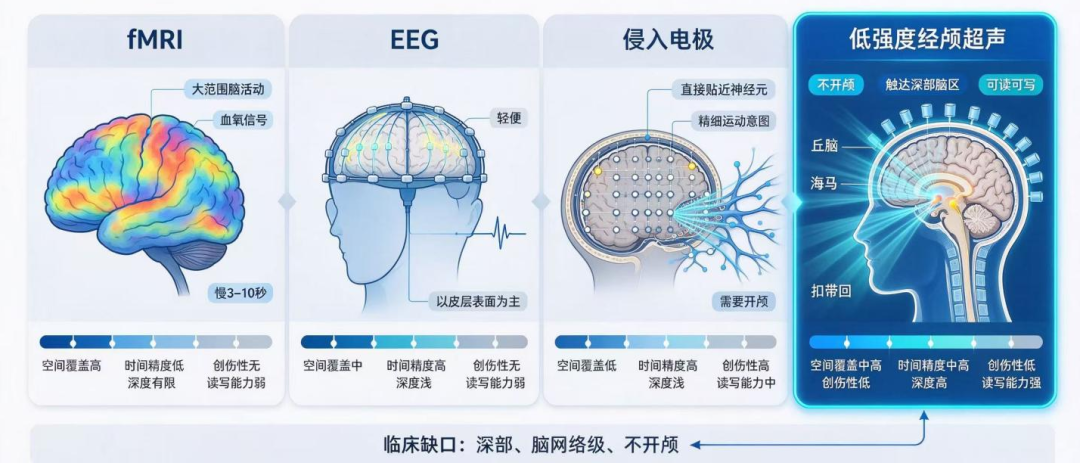
Figure: Comparison of four brain observation technologies
Over the past decade, research teams have gradually discovered that low-intensity focused ultrasound can reversibly modulate neural activity — exciting or inhibiting target regions — without damaging tissue [1]. In the brain, ultrasound is acquiring an entirely different identity: it can not only "see," but also "intervene" — regulating neural activity.
3
How Deep Can a Beam of Sound Penetrate the Brain?
Imagine many people throwing pebbles into water simultaneously. Each ripple is weak, but if timing is controlled so all waves superimpose at one location, that point's energy becomes significantly stronger. Phased-array ultrasound does something similar: multiple transducer elements emit sound waves, and by adjusting each element's phase and timing, the waves converge at a specific location after passing through the skull.
According to Gestalt's public disclosures, transcranial focused ultrasound (tFUS) can achieve 4–8 mm focal spots, reaching depths of 6–7 cm below the skull [6] — sufficient to access the thalamus, hippocampus, and other deep brain regions associated with pain, emotion, and memory.
Today's relatively mature clinical transcranial magnetic stimulation primarily affects the cerebral cortex, yet many complex neural circuits don't exist only at the surface: memory formation depends on the hippocampus, emotion involves the amygdala and multiple limbic regions, and pain is continuously processed by areas including the anterior cingulate cortex. One of ultrasound's key values is the potential to reach these locations without craniotomy.
This constitutes what Gestalt calls "writing": by controlling parameters like energy, frequency, and pulse, local neural activity is altered — sometimes enhanced, sometimes suppressed. Without opening the skull, precise modulation of specific brain regions becomes possible, with multiple targets addressable simultaneously [2].
4
The Same Sound Waves Can Also "Read" the Brain
Neural activity is extraordinarily energy-intensive. When a brain region activates, it demands more oxygen and glucose; nearby microvasculature rapidly adjusts blood flow. Functional ultrasound imaging (fUS) observes precisely this change. Functional MRI leverages the same class of signals: neither directly reads neural firing, but rather observes blood-flow changes induced by neural activity. The difference is that ultrasound can operate in smaller, more flexible device form factors.
Per Gestalt's public data, current functional ultrasound imaging (fUS) achieves spatial resolution of approximately 100 microns, temporal resolution below 100 milliseconds, with continuous monitoring of cortical and deep brain activity [6]. With equivalent device volume placed at the same position, ultrasound can image 25% of total brain volume, reaching deep structures and enabling multi-region synchronous monitoring — by contrast, high-throughput implanted electrodes cover 0.13% of the cortical surface [1][2].
"Reading" and "writing" can occur on the same device: first observing which brain regions show abnormal activity, then applying modulation to target locations, with pre- and post-treatment changes fully recorded. This is the closed loop Gestalt hopes to create [2].
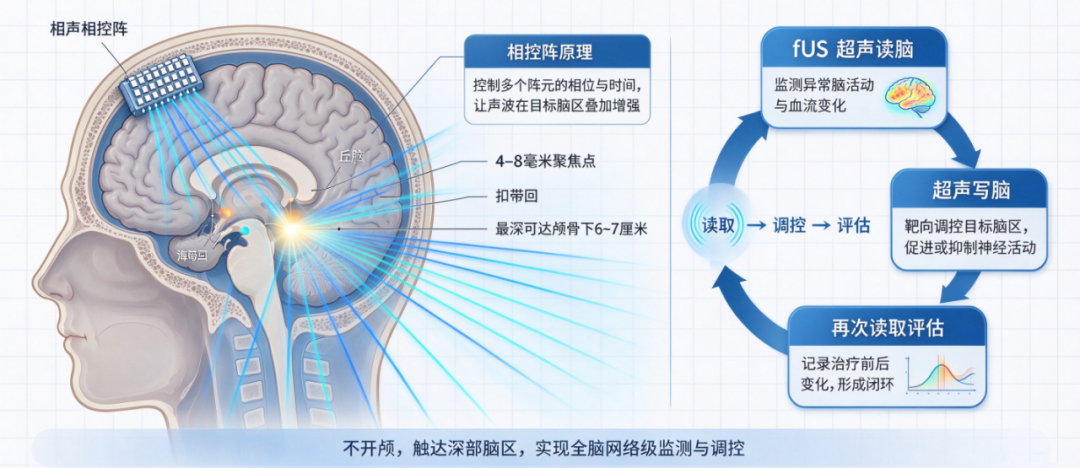
Figure: Phased-array ultrasound — penetrating the skull without craniotomy to achieve closed-loop brain reading and regulation
What ultimately determines a technical path isn't the spec sheet, but the disease. Paralyzed patients need speed: the cursor must follow the thought, requiring electrodes adjacent to neurons; chronic pain patients need reach: pain circuits hide deep in the brain, with treatment requiring a non-surgical premise. Different needs, different paths. Gestalt's first problem set is pain.
5
First Problem: Chronic Pain
Pain seems simple: injury where it hurts. But chronic pain isn't. When pain persists for months or years, it ceases to be merely a signal from the body periphery — the brain itself may be reshaped by prolonged pain. One frequently studied region is the anterior cingulate cortex (ACC), involved in both pain perception and the emotional experience of pain.
Chronic pain affects over 10% of adults globally [7]. Current treatments each have limitations: analgesics carry tolerance and dependence issues, nerve blockades and similar interventions offer short-lived effects, and for drug-refractory patients, remaining options often involve invasive neuromodulation surgery.
Overseas small-sample human studies have attempted ACC stimulation via focused ultrasound: after approximately 40 minutes of treatment, subjects' pain levels dropped by roughly half, with effects lasting one to two weeks, good tolerability, and no serious adverse events [2][8]. In depression, publicly reported studies show that low-intensity focused ultrasound applied to bilateral subgenual cingulate cortex (SCC) produced significant improvements in mood and depression scores compared to sham stimulation, appearing within 24 hours and persisting at least 7 days [2].
Gestalt has also publicly disclosed plans to formally release its first-generation chronic pain product and initiate related clinical trials by end of 2026, with plans to complete NMPA Class III medical device registration and advance toward market approval within 1–2 years.
Gestalt's subsequent planned directions include stroke rehabilitation, depression and anxiety, Alzheimer's disease, sleep, and epilepsy [1], with established collaboration frameworks with Huashan Hospital, Peking Union Medical College Hospital, and West China Hospital, among others. These diseases appear widely varied, but share a clear commonality: most aren't about a single brain region completely failing, but about abnormal functioning of neural networks — consistent with Gestalt's fundamental view of the brain.
6
The Real Hurdle Is Outside the Brain: the Skull
If ultrasound holds such promise, why hasn't it become a mainstream BCI technology? The answer lies outside the brain: the skull.
Human soft tissue is relatively ultrasound-friendly, but the skull isn't a uniform shell — thickness, density, and internal structure vary by location. After ultrasound waves pass through, they attenuate, scatter, and refract; energy meant to concentrate at one point may deviate from target. More troublesome still, every person is different. So the core engineering problem in transcranial ultrasound has never been "can sound be emitted," but "can it be calculated accurately": after passing through this specific person's skull, where will the focus deviate? How much will energy attenuate? Can it still land precisely on the target brain region? All this must be known before the sound is emitted.
Current industry practice uses CT imaging to build individualized skull models, simulating acoustic wave propagation, then correcting phased-array element parameters based on results. The 2016 FDA-approved essential tremor treatment used precisely this approach [12]. Some companies are also exploring other skull-bypassing methods: creating "acoustic windows" in the skull, or using genetic modification to make neurons more ultrasound-sensitive [11].
In one interview, Peng made a notable remark: "Attenuation cannot be solved, but the effects of attenuation can be precisely calculated" [3].
Barriers in this field comprise an entire capability chain: skull modeling, acoustic field simulation, phased-array control, real-time navigation, safety monitoring, clinical parameters, and accumulated human data over time. In June 2026, Gestalt inaugurated its global headquarters and Phase I super-factory in Chengdu, exceeding 16,000 square meters, with Class 10,000 cleanrooms and GMP-compliant manufacturing [6]. After scientific principles are established, the next challenge is transforming them into products that can be stably manufactured, reliably used, and rigorously validated.
7
The Same Starting Line Globally
Ultrasound research isn't new, but ultrasound BCIs truly emerging from laboratories into startups and capital markets has only become pronounced in recent years. Since 2025, a wave of Silicon Valley entrepreneurs and investors has entered this direction: OpenAI founder Sam Altman co-founded Merge Labs, raising $250 million at approximately $850 million valuation, focusing on an "ultrasound + genetic modification" approach; Coinbase founder and former Neuralink co-CTO formed Nudge, securing a $100 million Series A led by Thrive Capital; LinkedIn founder Reid Hoffman also invested in ultrasound BCI company Sanmai in 2025; teams including Forest Neurotech and Spire are advancing from imaging, modulation, and BCI angles respectively [2].
In invasive BCIs, China entered when the United States already held first-mover advantage with leading teams. Ultrasound BCIs differ: foundational science has accumulated for years, but combining imaging, modulation, algorithms, clinical application, and BCI interfaces into complete product pathways has only recently begun. How to penetrate the skull? How to achieve stable long-term brain activity reading? Which indications truly work? These questions remain unsolved by American teams, and equally unsolved by Chinese teams. Peng has repeatedly noted that compared to invasive BCIs, China's time lag in ultrasound BCIs is much smaller [7] — "major global players are essentially at the same starting line" [2].
Gestalt completed a 150 million yuan angel round approximately three months after founding, followed by a 420 million yuan angel+ round in July 2026, totaling 570 million yuan across both rounds [8].
8
What Can AI Do Here?
Peng himself has offered a quantitative description: "Gestalt is roughly 60% BCI, 40% AI for Science" [7].
AI here isn't an add-on; it first addresses a specific problem inherent to ultrasound itself. Functional ultrasound reads blood-flow signals, and blood-flow changes lag neural activity by one to one-and-a-half seconds. In Peng's view, this is precisely where AI can contribute: if models can accurately learn the correspondence between blood-flow changes and neural activity, there's opportunity to compress effective response time to around half a second, and further enhance system performance [7].
This is also the starting point for Gestalt's "brain foundation model": collecting multi-modal brain data including EEG, ECoG, ultrasound blood-flow signals, MRI, and other physiological signals, allowing the model to learn mapping relationships between different brain signals [7]. Devices observe the brain, ultrasound influences the brain, and models interpret what happens in between. Peng likens the first-generation model to "GPT-1.0" [8].
But training brain models and training language models aren't comparable in difficulty. Language models have internet-scale data, while every hour of high-quality human brain data means a device, a subject, an ethics protocol, and often doctors and researchers. And every brain differs — age, disease, medication, sleep, even that day's mood can alter data. So what's truly scarce for brain models isn't parameter count, but high-quality, continuous, cross-modal data corresponding to real behavior and clinical outcomes. Whoever truly enters clinical practice gains the opportunity to continuously generate such data. In this sense, Gestalt's ultrasound BCI and brain model endeavors aren't two businesses, but front and back ends of the same chain.
The external environment for this direction is also shifting. In 2025, Nature published a foundation model for mouse brains; in 2026, Nature Biomedical Engineering published NeuroSTORM for functional MRI, and Nature Neuroscience published BrainIAC for brain structural imaging [11]. Neuroscience is experiencing its own "foundation model moment."
Behind this work lies Peng's long-term assessment of the relationship between AI and brain science: they are "two sides of the same coin" [7]. What today's AI industry does is continuously increase compute and data, building multimodal physical models on silicon; BCIs take another path — understanding the only known system with true general intelligence, the human brain, building multimodal models on carbon. If these two model systems can eventually map onto and validate each other, a true connection between silicon-based and carbon-based intelligence becomes possible.
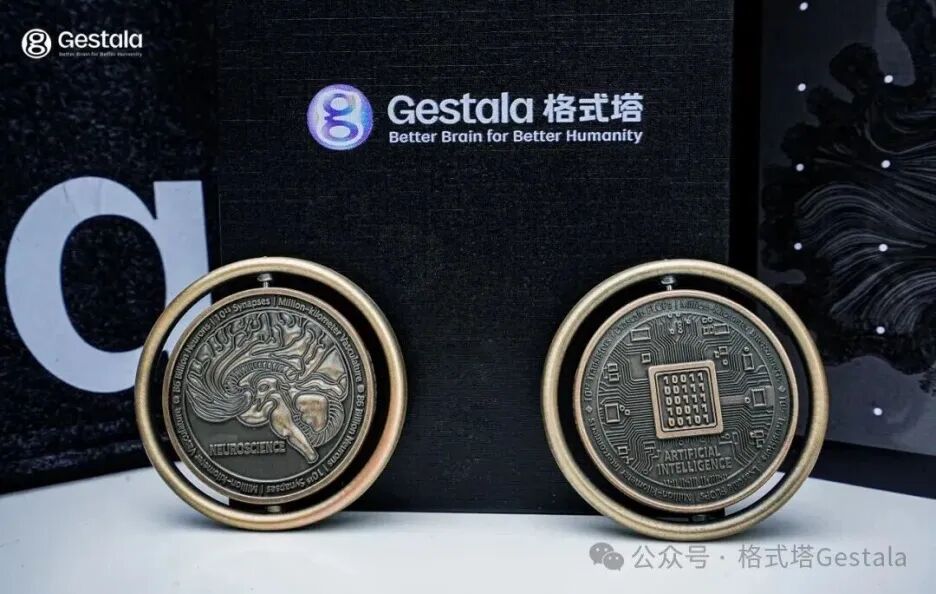
Peng likes using the "Rosetta Stone" to describe this process: that stone recorded the same content in different scripts, enabling humanity to finally decipher Egyptian hieroglyphs. In his view, AI models and brain models may become a new "Rosetta Stone" — if they can eventually explain and map onto each other, humanity may truly understand intelligence itself. "I believe this could happen within the next fifteen years" [7]. For Gestalt, the immediate path is direct: get devices into clinical use, let data train models, then let models make subsequent readings and treatments more accurate.
9
Sixth Venture
Understanding Gestalt still requires understanding something of Peng. But the key isn't "he's founded six companies."
Born in 1980, Peng has lived through China's most intense cycles of internet entrepreneurship: he built online communities, group-buying platforms, and founded Keruyun, a restaurant SaaS company. In 2019, Keruyun was acquired by Alibaba for approximately 1 billion yuan, and he entered Alibaba's local life division [3]. These experiences explain his facility with fundraising, organization, and productization, but not why he would come to brain science.
The truly relevant turning point came in 2021. That year, Peng and his university classmate, Chinese Academy of Sciences researcher Hu Tao, co-founded NeuroXess, entering invasive BCIs and reaching China's first tier within four years [2]. In 2025, he visited ultrasound neuroscience teams domestically and internationally, ultimately concluding that compared to invasive BCIs where a clear leading格局 had formed, ultrasound remained at an earlier, more open stage [3]. On January 1, 2026, Gestalt was founded. Tianqiao Chen joined as co-founder — his Tianqiao and Chrissy Chen Institute, established nine years prior, had invested over $1 billion, supporting teams at Caltech, Shanghai Huashan Hospital, and Shanghai Mental Health Center through donation and co-building models [2].
Meanwhile, at age 45, Peng became a doctoral student at Fudan University's Institute of Science and Technology for Brain-inspired Intelligence, systematically studying neuroscience anew [4].
As for why he started this venture, Peng's own answer is simple: "Genuine excitement about a new赛道 is the most important reason." On The Paper's podcast, he summarized two qualities entrepreneurs need: "Curiosity is the motivation to start things; resilience is the ability to get things done — neither can be absent" [3]. For the long赛道 of brain science, he says he's willing to invest 10, 15, even 20 years. On the Liangshuo program, he scaled the brain directly to the cosmos: "Human consciousness is actually the universe observing itself." Asked why he does this, his answer was: "Every morning, I'm awakened by dreams" [5].
10
Epilogue
Gestalt (Gestala) — the name comes from a century-old psychological concept, Gestalt: the whole is greater than the sum of its parts. The company's official explanation at founding was: "The brain is not a mechanical accumulation of neurons, but a grand whole working in concert" [2].
Less than a year since founding, this judgment is becoming concrete milestones: two funding rounds totaling 570 million yuan, Chengdu global headquarters and super-factory inaugurated, Shanghai headquarters inaugurated, collaboration frameworks established with Huashan, Peking Union, and West China hospitals, first product expected to initiate NMPA registration by end of 2026 [2][6].
On the day Gestalt was founded, Peng said: "Gestalt isn't defined by any single technology. We have only one true object of study — human intelligence" [9].
11
Dalton Venture Notes
After producing the "Brain-Computer, Beyond Imagination" series, we've increasingly come to believe that BCIs won't ultimately converge on any single technology. Invasive electrodes pursue high bandwidth, low latency, and fine control; non-invasive technologies using magnetism, electricity, and ultrasound seek different balances between safety, depth, coverage, and clinical scenarios. There is no winner among technical paths; the real question is always: facing a specific disease, what method can bring patients the greatest real benefit at reasonable risk?
What draws us to Gestalt is its choice of a still very early question: if what truly matters in the brain is networks rather than single points, humanity may need a new tool to observe them. Whether ultrasound can become this tool, no one can conclude today. But early-stage investment doesn't always mean waiting until a question already has answers — more often, we must judge: is the question important enough, are new solutions emerging, and is there a team worth spending years to verify it.
This is precisely the problem Gestalt is working to answer.
Appendix: Main References
-
"Challenging Neuralink: What Is the Ultrasound BCI That Silicon Valley Heavyweights Are Flocking To?", Silicon Valley 101, October 2025
-
"Tianqiao Chen Bets Again! China's First Ultrasound BCI Company Gestalt Technology Officially Founded", Gestalt Technology WeChat official account, January 2026
-
"Podcast | Dialogue with Gestalt's Peng Lei: From Internet to BCI, A Serial Entrepreneur's Ultimate Exploration", The Paper, 2026
-
"45-Year-Old Fudan Doctoral Student Re-entrepreneurs, Raises 570 Million in Six Months", Fudan University, August 2026
-
"The 'Gestalt' Moment of BCI — Peng Lei on 'Inner Universe' and Entrepreneurial Restart", Dragon TV Liangshuo program transcript
-
"Sixth Venture, 420 Million Raised | Peng Lei at Yabuli Forum Innovation Annual Meeting on BCI and AGI Future", Cyzone / Yabuli Entrepreneurs Forum, July 2026
-
"Securing 420 Million Angel Round! Exclusive Interview with Gestalt's Peng Lei: After Five Years in Electrical BCI, Why I'm Betting on Ultrasound", Silicon Observer Pro, July 2026
-
"Dialogue with Gestalt's Peng Lei: AI's Next Stop Is Interpreting the Human Brain", GeekPark, July 2026
-
"From Understanding Intelligence to Creating Intelligence" (Gestalt global headquarters opening speech), Gestalt Gestala WeChat official account, July 2026
-
"Founder's Notes | China Will Become an Important Base for Neuroscience Innovation", Gestalt Gestala WeChat official account, September 2026
-
"Deep Dive | Neuroscience's 'Copernican Moment': How a Chinese Neo Lab Is Rewriting Transcranial Imaging Neuroscience Infrastructure", Z Potentials, 2026
-
U.S. FDA: Approval information for MRI-guided focused ultrasound for essential tremor treatment, 2016
END