The Creators | Dalton Venture × Baiyao Technology: Let Drug Trial and Error Happen First in Virtual Cells

From drugs and materials to food, more and more products are being made by cells and enzymes. From cells and proteins to entire factories, more and more processes are being simulated, designed, and optimized by artificial intelligence. And with that comes a new question: what kind of future will these creators actually build?

Introduction
A revolution in "making things" is underway.
From drugs and materials to food, more and more products are being manufactured by cells and enzymes; from cells and proteins to factories, more and more processes are being simulated, designed, and optimized by artificial intelligence. A new question follows: what kind of future will these makers create?
To explore this, Dalton Venture has launched the "Makers" series, going inside the portfolio companies of its biomanufacturing CVC fund Aochuang Pioneer Fund to meet the entrepreneurs redefining "manufacturing."
A new drug typically takes more than a decade and billions of dollars to go from first concept to market, and many programs fail on the gap between preclinical research and how the human body actually responds. One statistic the industry cites again and again: existing drugs cover less than 5% of the human genome.
Baiyao Technology wants to close that gap. The company, which focuses on AIVC (AI virtual cells), is connecting real experimental and human data, models at different scales, scientific agents, and experimental validation into a continuously learning R&D system. A virtual cell, in essence, teaches a computer the rules that govern real cells — a researcher knocks down a gene or adds a drug, and the cell's response is first simulated in virtual space before deciding what real experiments to run. Baiyao's core technology foundation is CellOS, a next-generation virtual cell world model.
Founder Xin Li is a National Science Fund for Distinguished Young Scholars (Overseas) awardee who conducted frontier research on cell fate at MIT.
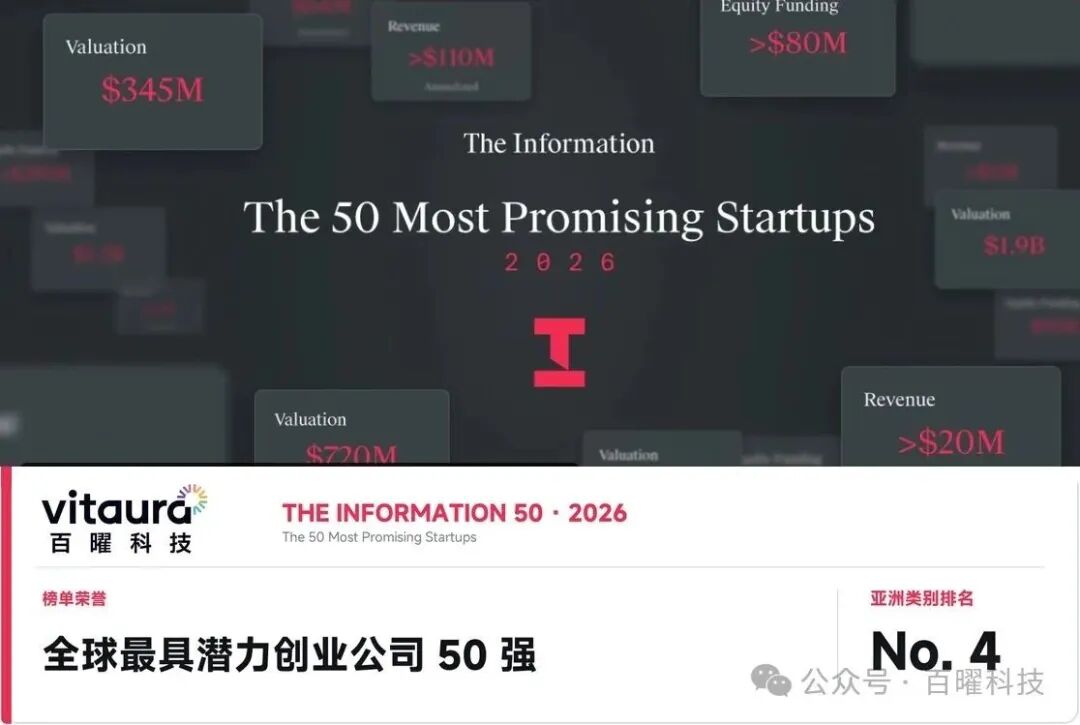
Baiyao Technology recently earned a place on The Information's "50 Most Promising Startups of 2026" list on the strength of its leadership in AIVC — only six companies from Asia made the cut — a sign that its technical strength and commercialization potential have drawn international attention.
1
What questions should a virtual cell answer?
Several foundational conditions in this field have matured at the same time in recent years: omics data is accumulating rapidly, the representation learning, transfer learning, and predictive capabilities of biological foundation models keep improving, and automated experiments are beginning to provide feedback at scale. Against this backdrop, pharma companies and research institutions are also looking for more efficient ways to do R&D. Several representative models have emerged globally — Geneformer and scGPT learn cell states from single-cell data — but Baiyao is focused on something further: how cell states change, and how models can guide real interventions.
"We believe virtual cell models need to answer four levels of questions, step by step," says Fan Yang, co-founder and COO of Baiyao Technology. First, what state is the cell in now? Second, after a genetic, drug, or environmental perturbation, what happens to the cell? Third, which genes and regulatory relationships actually drive that change? Fourth, among a large set of candidates, which experimental hypotheses should be validated first?
Around these four levels, Baiyao is building a virtual cell technology system that combines data production, foundation models, specialized models, and RSI technology.
2
Continuously leading the technical evolution:
from biological priors to understanding cell states
Single-cell data is noisy and varies widely across batches, and expression data alone makes it hard for models to distinguish correlation between genes from true regulatory relationships. Facing this common industry challenge, the team recognized early on that cell foundation models cannot rely on scaling data alone — biological knowledge needs to be brought into model training.
In earlier work such as GeneCompass and CellGraphCompass, the team was among the first to try incorporating biological priors during pretraining. Ablation experiments showed that adding these priors generally improves model performance on downstream tasks such as cell type annotation and gene regulatory network inference. This moves models beyond learning statistical associations between gene expressions, letting them draw on existing biological knowledge to identify potential regulatory factors, infer gene regulatory relationships, and predict intervention responses.
Among the team's published work, this approach was first validated on GeneCompass. The founding team's results landed on the cover of Cell Research in 2024, academic confirmation of the value of the team's forward-looking technical judgment.
From GeneCompass to CellGraphCompass and now CellOS, the team keeps pushing cell foundation models from learning expression patterns toward understanding cell states — and asking a more fundamental and more challenging question: how can a model truly understand the state of a cell?
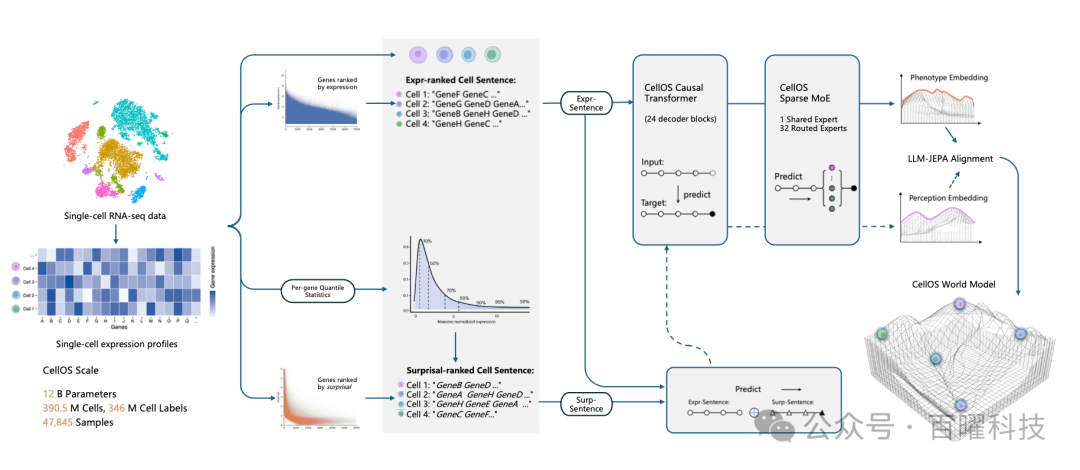
CellOS is the first virtual cell foundation model in the field to use a latent-space alignment architecture, built on an LLM-JEPA strategy. If you follow the language-model approach of reconstruction and have the model restore each gene's expression value item by item, it easily overfits to technical noise. CellOS takes a different approach: instead of reconstructing values item by item, it compresses cells into a "latent space" that represents their biological state and learns the relationships between different states.
From introducing biological priors to latent-space cell state modeling, the team has stayed focused on the core challenges of cell foundation models, laying out its approach before the industry reached consensus on a technical path and continually expanding what virtual cell models can do.
3
A global virtual cell challenge
Once a model is trained, its capabilities need public scrutiny. In 2025, Baiyao's founding team took part in the first Virtual Cell Challenge, launched by the Arc Institute in the United States, and finished first in China on the overall leaderboard. The inaugural event focused on predicting genetic perturbations within the same cellular context: given a cell's initial state and a gene perturbation, can the model predict changes across the entire transcriptome after perturbation? Evaluation looked not only at average error but also at whether the model could distinguish different perturbations and recover the genes that actually changed.
"If a model just outputs the average state of all cells, even if the overall error looks low, it can't tell researchers how different interventions differ." Accurately identifying perturbation specificity is an important prerequisite for models to serve candidate target ranking, intervention screening, and experimental design.
The 2026 competition raised the difficulty further, upgrading the goal from "predicting new perturbations in the same cellular context" to "zero-shot prediction in cellular contexts the model has never seen perturbation data for." Organizers selected six cell lines from different tissue backgrounds; entrants could see only the unperturbed expression states of these cells and the target genes to be knocked down with CRISPRi, then predict the full expression profile after knockdown.
4
From skin anti-aging to engineered cells
On top of the foundation model, Baiyao is developing specialized models for different tasks. A specialized model isn't a retrained, scaled-down version of the foundation model; it adds data, objective functions, and evaluation criteria for a specific R&D task on top of general cell representations. Baiyao's collaboration with skincare brand MAGELINE on the α-KG skin anti-aging mechanism was the first project to complete a full loop. The project needed to answer: through which targets and pathways might α-KG act in keratinocytes and fibroblasts, and which mechanisms are most worth validating next?
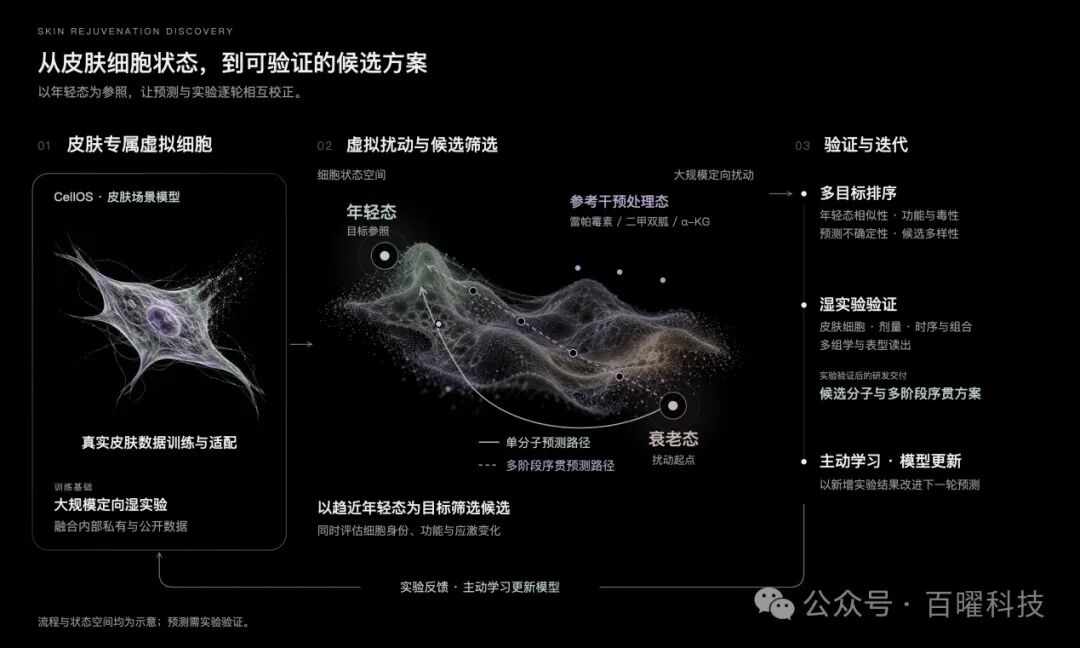
The team mapped skin cell states before and after treatment into a unified representation space, used virtual knockdown and virtual overexpression to simulate candidate gene perturbations, and observed whether cell states moved in the direction of the real α-KG response, ranking candidate driver genes accordingly. Model predictions were then compared with expression changes in real treated cells; only when the two corroborated each other did a candidate mechanism move to higher priority. The project has completed the first loop — from single-cell measurement to virtual perturbation to comparison with real responses — and produced mechanistic leads. Further validation through targeted knockdown, qPCR, and protein assays is still needed.
"We want the model to play the role of narrowing the search space and ordering the experiments, not replacing wet-lab conclusions with computed results," Yang says.
On the biomanufacturing side, Baiyao is building virtual cell models for engineered cells such as CHO and HEK293.
CHO cells are widely used to produce antibodies and recombinant proteins, while HEK293 is common in viral vector and gene therapy production. Traditional cell line development requires vector design, host engineering, clone screening, culture condition optimization, and scale-up validation in sequence, each step involving a huge number of combinations and relying on experience and round after round of experiments. Baiyao is building virtual cell models for these two types of engineered cells, aiming to provide sequence-design-level engineering plans and support a million simulations per hour. Researchers first define a goal — higher yield, say, or maintained cell viability — and the model jointly evaluates vector elements, host cell engineering targets, and culture process conditions, filtering a large set of combinations down to a small number of candidates worth testing; experimental results then flow back into the model to refine the next round of design.
5
What's really missing is three types of data
Asked what data virtual cells most lack, Yang argues the problem isn't the volume of ordinary single-cell data. Much of the public data consists of static cell snapshots produced by different labs, single-modality and low quality. What's truly missing is three types: real clinical data linked to patient phenotypes and clinical outcomes, causal data aligned before and after genetic perturbation, and multimodal aligned data.
None of this is available from public sources, so Baiyao chose to build its own pipelines. One pipeline targets the clinical tumor microenvironment, connecting patient samples, spatial multi-omics information, and clinical outcomes; the other targets single-cell CRISPR perturbation, using CRISPR to intervene in genes one by one and recording changes in cell state before and after, giving the model training data with causal information. Sample acquisition, standardized experiments, sequencing, data governance, and model training are linked into a single chain, so data can be continuously produced and fed back. On top of the pipelines, the scientific agent CellAURA handles hypothesis generation and experimental design, and the automated experiment system Vitaura AutoLab runs validation and feeds results back to the model.
Over the next year, Baiyao's most important goal is to have this already partially validated system reliably produce predictions in real projects, forming a capability that can be replicated across more R&D tasks.
As for the question posed in the series preface — what kind of future will these makers create? — Yang's answer is a "digital experimentation ground" for the life sciences: every state and inference across the dimensions of life can first be computed at scale in a virtual environment before real experiments begin. "AIVC won't replace scientists, and it won't replace real experiments. It will give researchers stronger abilities to observe, reason, and decide, shifting experiments from extensive trial and error toward more directed validation."
END


ID: daltonventure
Long-press to follow
** RECOMMENDED READING **