Raybeam Medical Raises Tens of Millions in Angel Round Led by Dalton Venture to Advance Laparoscopic Intraoperative Radiation Therapy Robot

Recently, **Raysure Medical (hereinafter referred to as "Raysure"), an innovative company developing intraoperative radiotherapy robots for endoscopic surgery, announced the completion of a multimillion-yuan angel funding round**. The round was led by Dalton Venture, with participation from Shuimu Tsinghua Alumni Fund, Fortera Capital, and HETANG Venture Capital. The proceeds will be used primarily for animal and clinical trials, product technology iteration, core team expansion, and technology platform development.

Background
Recently, Raystream Medical (hereinafter referred to as "Raystream"), an innovator in laparoscopic intraoperative radiation therapy (IORT) robots, announced the completion of a tens of millions of RMB angel round. The round was led by Dalton Venture, with co-investment from Shuimu Tsinghua Alumni Fund, Fortera Capital, and HETANG Venture Capital. The proceeds will be used primarily for animal and clinical trials, product technology iteration, core team expansion, and technology platform development.
Cancer surgery has been getting less and less invasive: from open surgery to laparoscopy and thoracoscopy, and now to surgical robots, doctors are performing increasingly complex procedures through channels just millimeters to centimeters wide.
But radiation therapy equipment hasn't kept pace. Mainstream intraoperative radiation devices are still designed for open surgery, with wide radiation fields and bulky footprints. If a doctor wants to add a radiation dose during a minimally invasive procedure, they face a choice between "staying minimally invasive" and "making a larger incision."
Could radiation also take the "minimally invasive route"?
In 2026, a startup founded by Tsinghua University alumni — Raystream — offered its answer: constrain a high-energy electron beam into a slender tube, allowing it to pass through a laparoscopic channel like a "laser beam," approaching the tumor or surgical margin to deliver localized irradiation directly during the operation.
Capital responded faster than expected. Shortly after its founding, the company completed a tens of millions of RMB angel round, led by Dalton Venture with participation from Shuimu Tsinghua Alumni Fund, Fortera Capital, and HETANG Venture Capital. By July 2026, its first functional prototype had rolled off the line, with animal experiments launching in parallel.
For Raystream, this isn't a story of import substitution. What it truly aims to do is leverage the technical and manufacturing heritage of "Two Bombs, One Satellite" and "national strategic equipment" to migrate the most advanced accelerator technology from research and industrial settings into the operating room.
The Minimally Invasive Challenge of Intraoperative Radiation
Completing tumor surgery doesn't mean treatment is finished. For a significant portion of cancer patients, postoperative radiation therapy is still required. But the traditional workflow requires waiting for wound healing and infection or inflammation to be controlled before starting — often a gap of several weeks or longer.
Yet the period immediately after surgery is precisely when local tumor tissue undergoes massive changes.
Thus, one key value of intraoperative radiation is moving part of the radiation dose forward to the surgical site itself.
Specifically, it can deliver multiple clinical benefits: filling the vacuum period before postoperative radiation; providing a localized dose boost that lets the target receive higher doses without harming normal tissue; seizing exposure opportunities unique to the intraoperative setting to directly irradiate areas that would be difficult to target precisely after surgery; and using radiation to replace "wider excision," thereby preserving organ function as much as possible.
All these benefits point in the same direction: the patient completes both resection and a single high-dose, close-range radiation treatment in one surgery, with fewer side effects and faster recovery through a minimally invasive approach.
But traditional intraoperative radiation has a fundamental limitation: it can only be performed during open surgery.
In open surgery, the lesion is fully exposed and radiation can reach it directly from outside; once the incision shrinks to the scale of a laparoscopic trocar, large equipment struggles to deliver radiation along narrow pathways to the target.
Raystream's team captures this shift vividly: the electron beam from a conventional accelerator is like a "flashlight" with a wide divergence angle; what Raystream aims to do is make the electron beam more like a "laser pointer," sending energy along a fine channel to achieve precise treatment while minimizing scattered radiation in the operating room.
This is precisely where the product begins.
Turning the "Flashlight" into a "Laser Pointer"
Electron beams are well-suited for close-range radiation therapy due to their dosimetric properties.
Compared to low-energy X-rays, electron beams can form a relatively uniform "plateau region" at a certain depth, with dose dropping rapidly to zero beyond the treatment depth. For shallow targets ranging from millimeters to centimeters, electron beams can deliver the target dose while avoiding damage to deeper tissues.
Dose rate also directly affects surgical workflow. Raystream's solution achieves routine dose rates of 10–60 Gy/min, completing a treatment case in under a minute — significantly reducing the tens of minutes of operating room occupancy required by conventional equipment.
But electron beams have a natural engineering bottleneck: they tend to diverge after leaving the accelerator. Over distance, what was originally a concentrated beam gradually broadens until it can no longer pass through the slender channel of a laparoscope. This is why electron-beam intraoperative radiation has historically been limited to open surgery or large-surface treatments like skin cancer.
Tsinghua University's long-standing research on high-quality beam flow and high-gradient acceleration technology addresses precisely this class of problems, with applications already spanning research facilities, customs security inspection, and industrial radiography. Raystream has taken this technology to its extreme, delivering high-collimation electron beams through slender tubes to meet the need for close-range irradiation via minimally invasive access.
The technical challenges have been systematically deconstructed, step by step.
More Than Just a Smaller Accelerator
If the story were simply about miniaturizing an accelerator, Raystream wouldn't be compelling. What truly determines whether it can enter clinical practice is whether the device can integrate into surgeons' existing workflows.
The scenario Raystream targets is this: after tumor resection, the intraoperative radiation robot quickly approaches the surgical table, uses a robotic arm to complete autonomous positioning, aims the accelerator at the laparoscopic channel, targets the tumor bed or surgical margin for fully automated irradiation, then exits the surgical area, returning the operative space to the surgeon.
It functions more like a "robotic assistant" for the surgeon, rather than a complex device that requires doctors to gather around and operate.
This is the "product definition" the team repeatedly emphasizes. In their understanding, medical device innovation isn't merely about "pushing parameters higher" — the equipment must integrate into doctors' established workflows with minimal friction, reducing additional training and operational burden, shortening surgical time, and improving operating room turnover efficiency.
For doctors, this boils down to a very simple question: precision, efficiency, and convenience.
"Surgeons don't just care whether the radiation can reach the target. They also care whether the radiation behaves like a scalpel — delivering dose exactly where it points, with rapid dose falloff beyond the treatment depth to minimize damage to surrounding normal tissue."
Based on such clinical demands, Raystream built ultra-compact accelerators, high-quality beam flow, small-field high-dose monitoring, human-machine interaction, multi-modal image fusion, visual guidance, robotic arm motion control, autonomous planning, and physics AI into a single integrated product system from the design stage.
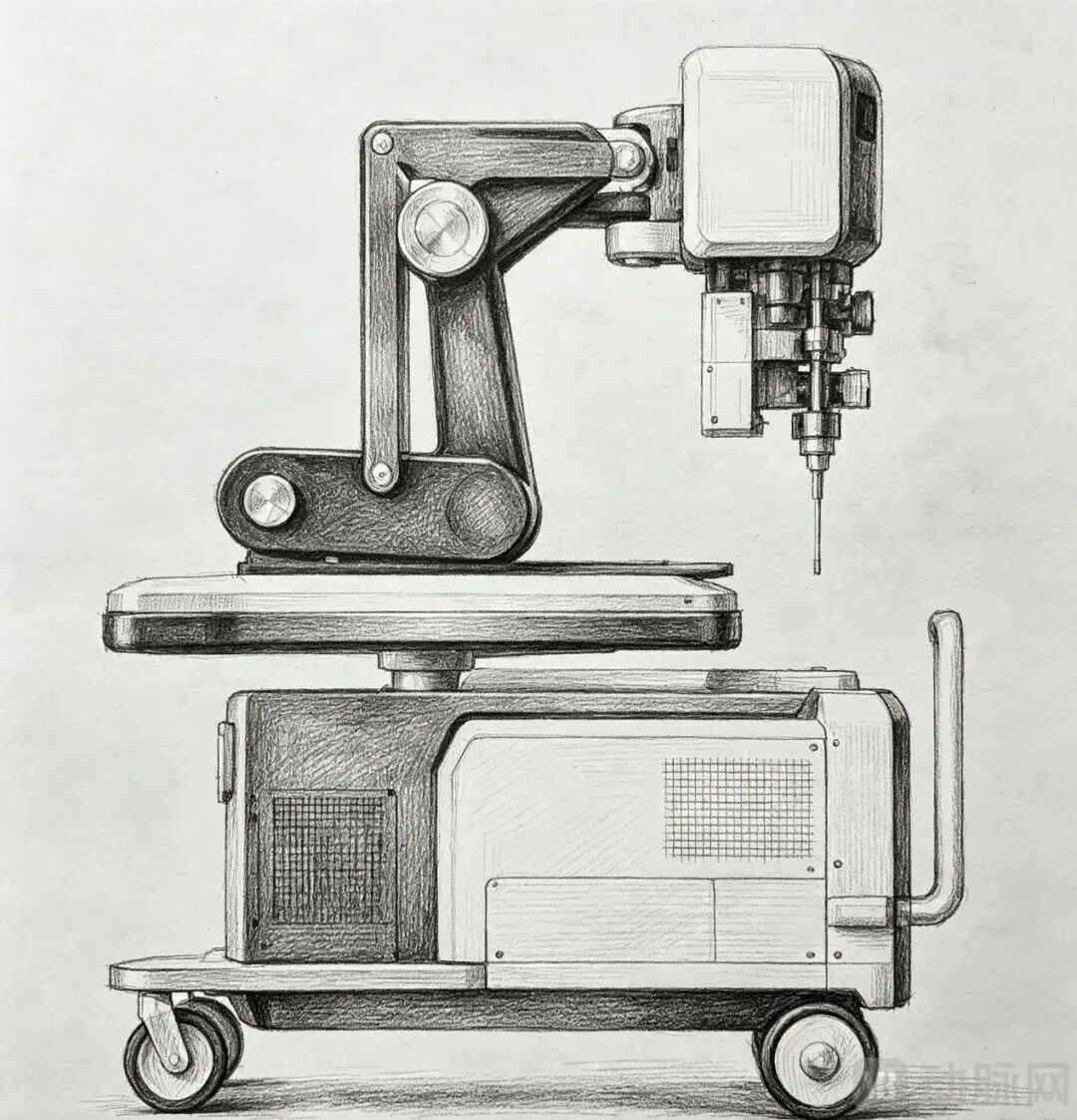
Laparoscopic intraoperative radiation therapy robot design rendering
In hardware terms, the complete device weighs roughly equivalent to a motorcycle, requires no dedicated radiation shielding construction for a therapy room, and can be deployed in hybrid operating rooms or even standard operating rooms. It achieves precise positioning through a robotic arm, is compatible with standard laparoscopic systems, and is planned for future integration with intraoperative microscopic imaging systems and laparoscopic robotic systems.
One Underlying Technology, Two Product Paths
The laparoscopic intraoperative radiation therapy robot is only Raystream's first step.
Its second product pipeline is a natural-orifice electron-beam brachytherapy system, targeting replacement of traditional radioisotope-based afterloaders and addressing limitations of external beam radiation.
Conventional brachytherapy relies on radioactive isotopes. The technology is mature, but every step — source management, transport, replacement, and shielding — presents barriers.
Raystream's approach takes a different path: rather than placing a radioactive source inside the body, it sends a fine electron beam through natural orifices to approach the lesion, with actively adjustable energy, dose, and direction, optimizing upon the isotropic dose distribution characteristics of radioactive sources.
Thus Raystream has gradually formed a "one underlying technology, two product pipelines" strategy: one path enters through laparoscopic surgery to become a "new assistant" for surgeons; the other path goes through natural orifices to become a "secondary weapon" for radiation oncologists.
Looking further ahead, Raystream also plans to integrate the radiation therapy head onto surgical robot arms, allowing surgeons to complete both surgery and radiation within a single control system.
This is the space it truly aims to open up — not replacing any existing equipment, but enabling radiation therapy to gradually embed itself, in a cross-disciplinary manner, into surgical treatment workflows from its current position as an independent treatment环节 in the radiation oncology department.
From Technology Prototype to Clinical Validation
As a preclinical-stage startup, Raystream's current prototype has entered animal experimentation, with overall R&D progressing at a rapid pace. Our observation of this company at this moment focuses on how it validates cutting-edge new technology into a viable clinical treatment pathway.
Regulatory approval is only the first hurdle. For an entirely new treatment technology, accumulating clinical evidence, expanding indications, integrating into treatment pathways, and establishing expert consensus and clinical guidelines — each step requires long-term collaboration among physicians, hospitals, and the academic community.
Raystream's team doesn't shy away from this. In their view, the key to breaking through lies in driving collaboration among physicists, clinicians, and product teams, thereby reconnecting two long-separated worlds: radiation oncology and surgery, accelerators and laparoscopy, physical technology and clinical needs.
"People who only do physics research can hardly imagine the specific scenarios in an operating room, and surgeons don't understand how far accelerator technology has advanced. True product definition comes from continuous collision between both sides."
The team summarizes Raystream with three keywords: innovation, choosing a path with no ready-made answers; agility, advancing a large-scale medical device with shorter decision chains and faster iteration; and mission, rooted in Tsinghua researchers' decades of persistent dedication: from shouldering "Two Bombs, One Satellite" research攻关 half a century ago, to supporting industrial technology development during the reform and opening period thirty years ago, to today empowering "Healthy China" construction.
These three words must ultimately converge on a single outcome: using world-leading research achievements to create world-first products and applications.
When a beam of high-energy electrons can pass through a millimeter-scale minimally invasive channel, when close-range radiation equipment can enter surgical workflows like a robotic assistant, treatment modalities that originally belonged to different departments now have the opportunity to be recombined on the same operating table.
Surgery has already moved from "large incisions" to "minimally invasive." What Raystream wants to do is make radiation therapy follow the same path.


ID: daltonventure
Long press to follow
Recommended Reading