2026 VC Promotion Roundup

Universal celebration.
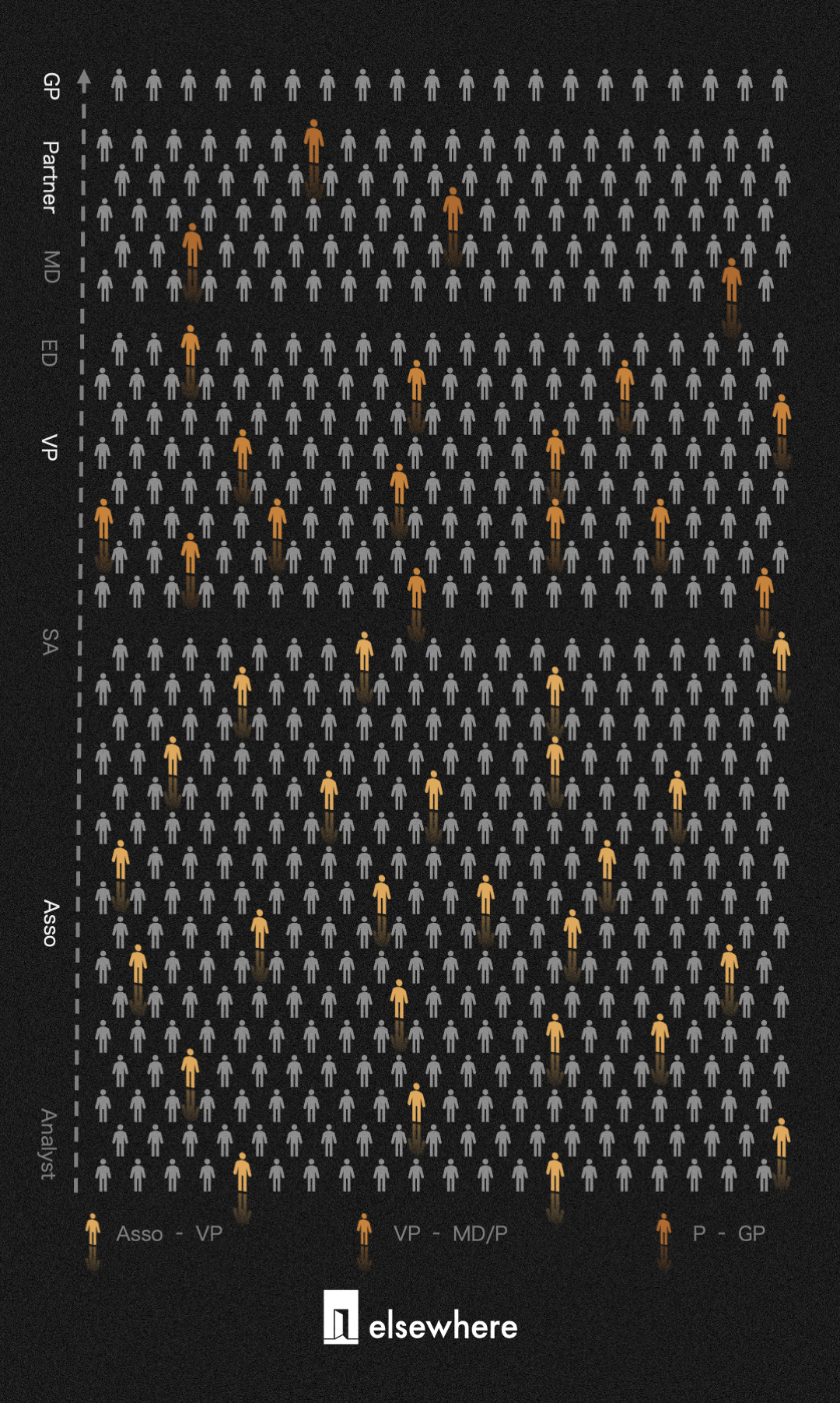
@Guo Yunxiao
After this relentless, sleepless AI New Year, many funds have completed a sizable round of promotions.
Why this topic merits discussion: for dollar-denominated funds, the past few years have brought sweeping liquidation and shakeout. Today, active dollar investors in the market number fewer than 500. Against this backdrop, the upward path has grown relatively congested — not only are fresh faces rare from the outside, but many mid-level investors have been stuck at the same rank for years internally.
Yet as the AI industry climbed steadily from 2024 into 2025, and with select model companies, chipmakers, and consumer firms going public, promotions have finally resumed. The dollar fund universe remains a shadow of its former self, but inside these firms, the ladder is moving again.
Through conversations across the industry, elsewhere tallied promotions at nearly 20 dollar-denominated VC firms (about all that remain at the table). Here's what we found:
A Decade of Grinding, One Year of Ascension
The recent round produced four newly minted managing partners (GPs): Yuan Liu of ZhenFund, Chenyao Wu and Haojun Li of GGV Capital, and Yu Chen of Yunqi Partners.
All four were previously partners. Within investment firms, promotion to managing partner signals a shift from core deal-maker to broader managerial responsibility — and, of course, a change in carry allocation.
Yuan Liu's promotion stems from the returns he generated on Manus, and from this phenomenon that captured ZhenFund's ethos. The two new GPs at GGV have each been with the firm for over a decade; at this established dollar VC, the new lineup can be read as a fresh team for the AI era. Yu Chen's investing career began alongside Yunqi itself — a homegrown managing partner whose early bet on MiniMax and four-year path to a Hong Kong IPO were pivotal to his ascent.
Promotions among the rank-and-file were numerous as well.
We understand that 5Y Capital, Gaorong Ventures, and Oasis Capital each have new partners. Gaorong promoted two simultaneously.
Source Code Capital elevated four post-90s investors, one of whom received two promotions within a single year, leaping from VP to MD. For Source Code, the promotions spanned multiple levels, reflecting a well-structured bench: room for young investors to grow, and senior figures to take on greater decision-making authority. Their focus areas center on AI, semiconductors, robotics, and intelligent manufacturing.
Sequoia Capital China also conducted an unusually large round of promotions. Notably, roughly four investors rose from MD to partner, six from VP to MD, and several associates to VP. This wave reflects the maturation of Sequoia's recent strategic bets: some played key roles in the firm's AI and technology investments, others delivered standout performance on major buyout deals.
Sequoia is known for having the industry's highest bar for advancement. Within its hierarchy, the progression from VP to MD to partner represents a qualitative leap. Making MD means access to certain management meetings and a listing on Sequoia China's website. Worth noting: the newly promoted partners include post-90s investors, and among the new MDs are those born in 1995 or later.
Many of those mentioned above have spent about a decade in investing, yet long lingered at the same rank. This may connect to what Huadong Wang of Matrix Partners told elsewhere in an interview about vintage: after 2016, it was already garbage time for internet investors. And by classical VC experience, a young investor needs roughly ten years to reach partner — from first check to IPO to cash in pocket.
But AI has clearly accelerated everything. For many of these newly promoted partners, the journey from investment to realized outcome compressed into just two or three years.
30 New VPs and the "Four Heavenly Kings"
The densest concentration of promotions, however, fell between associate and VP.
This is the cohort of young faces now entering the market: Sequoia, ZhenFund, 5Y Capital, Source Code, Jinqiu,光合 (Guanghe Ventures), Ming势 (MingShi Capital), Oasis, and others all made such promotions. The profile: born around 1995 or later, entered the industry after 2020, with the youngest being just 25 — a post-00s VP at a dollar fund.
Guanghe Ventures promoted three post-90s VPs this round, including one born after 1995 focused on AI investments. Internally, the firm views elevating technically trained young people as "structural adjustment" to close the time gap between the organization and technological trends. It's a telling formulation.
Vertex Ventures promoted three investment directors to executive directors, with portfolios concentrated in embodied robotics and AI.
For younger investors (around associate level), the industry has even coined a term: the "Four Heavenly Kings." Reactions to this label vary widely, as does the sentiment behind them.
By our incomplete count, the dollar market has produced at least 30 new VPs this year. They are extraordinarily active, covering the vast majority of deals in market.
Unquestionably, these investors have landed in a better vintage: within their first few years in the industry, they've encountered a massive AI wave. As Shan Shan Guo of Zhuofei Capital once told us, hitting a unicorn was practically a high-probability event in the mobile internet era. These young investors harbor the same conviction, and already display identifiable traits.
First, extreme effort. Over the past two years, most young investors have met with nearly a thousand founders — the equivalent of meeting 1.5 people every single day without a day off. Investors across age groups have expressed exhaustion at the current market, partly driven by this intensity. But it isn't wasted effort. One theory holds that by exhausting the universe of startups, they can almost guarantee meeting a future giant valued at just tens of millions of dollars. Whether they can recognize it is another matter.
Second, extreme confidence. Among the young, "Are kings and nobles born, not made?" is a prevailing mood. Just as young founders can recite the stories of Zhang Yiming and Wang Xing by heart, this generation grew up surrounded by investor narratives. They know intimately that this generation of startups could rapidly make their careers. Some even believe they will "surpass the older generation soon."
Third, extreme anxiety. AI is already a consensus industry, with investor attention intensely concentrated — leading to abundant club deals and, consequently, competition among investors and even within the same firm. One young investor told us he barely dares travel to the U.S., for fear of missing new deals back home.
Like young founders, young investors are among the principal drivers of today's frenzied environment.
Not long ago, we invited some young investors to participate in a game; a significant portion were among this promoted cohort. When we explained the rules, one reaction was: "Great, another battle to fight."
The Scramble for Young Talent
At more junior levels, most funds are hiring aggressively. Executive search firm TTC told us that dollar fund recruiting demand is exceptionally strong right now.
But the requirements have shifted. One early-stage fund said they had experimented with training STEM PhDs, but this approach has been disproven in an increasingly competitive environment. The reason is simple: the market has no time for PhDs to learn "what investing is."
From finance backgrounds, to industry or research backgrounds, the desired profile has now become "young, hardworking, AI-native, ready to source and execute from day one." Any growth process that feels remotely slow no longer matches today's pace. Per TTC data, most dollar funds maintain 10-20% turnover, with no decrease despite the heated market.
Beyond moving between firms, another significant destination is portfolio companies. This has been an option for young investors in recent years: those who left mega-funds to join AI and robotics startups have, by all accounts, achieved strong financial outcomes.
As the previous cohort departs and new supply fails to keep pace, young investors have only grown more coveted.
MONOLITH's VC team, for instance, has iterated to version 2.0 over the past two years. Xi Cao once described them in an interview as "like a gang — five or six people, five or six guns." One fund has become something of a Whampoa Military Academy: its young investors have dispersed to other institutions, then returned to the market with exceptional vigor. One fund head has spent the past six months meeting virtually every young investor in the market one-on-one. Several funds are actively recruiting media-background talent to support frontline investors in scanning for opportunities or rapidly scaling market presence; earlier, Sequoia China supported TeGong Universe/Guancha with similar logic.
These are all signs of an early-stage industry.
The Core Is Organization
Beyond the investment team, back-office and middle-office staff at various firms have also received promotions, broadly reflecting increased workload and contribution. At Source Code Capital, for example, over ten colleagues in back-office and other teams were promoted, spanning IR, finance/legal, HR, and administration. At ZhenFund, two entire back-office departments saw across-the-board promotions.
One top-tier VC told us this was the busiest year for their finance team in the firm's history.
Some funds schedule promotions for March, April, or later, so we don't yet have visibility into all firms. But without question, this should be the most widely celebrated year for most funds in recent memory. ZhenFund told us that "the pace and magnitude of promotions are at notably prominent levels for recent years." Vertex Ventures stated they "set new highs for recent years in both number and speed."
How to win in this market, and what kind of organization is required to do so, may be among the foremost questions occupying VC leaders today. In this industry, the answer always comes down to people.
From current results, the performance of a significant portion of dollar funds correlates not only with how much they believe in AGI, but with the depth of their investment team bench. After all, most of the newly emerging founders are themselves post-95. In theory, one generation of founders begets one generation of investors. The stratification and rejuvenation of fund teams isn't speculative — it's imperative.
So it's not only a new generation of founders stepping onto the historical stage. A new generation of investors is too.
Cover image: Illustrated