A Conversation with Liu Zhenyun and Ma Yi at the Bund Conference

Salty jokes, sweet jokes.

@Jing Liu
Last week, at the Bund Summit, I moderated a roundtable. My guests were the writer Zhenyun Liu and Yi Ma, dean of the School of Computing and Data Science at the University of Hong Kong.
One is a writer, the other an AI scholar — the theme of the conversation was easy to guess. On stage, we did talk quite a bit about creation, contemporary education, new kinds of relationships between people, and the joys and sorrows of the times.
But toward the end, I felt a sudden emptiness, and asked a question that came to me on the spot: before humanity truly knows how far technology can go, do discussions from the humanities and social sciences risk feeling wishful, even feeble?
Just as before GPT, we could hardly imagine that a machine could understand me better than I understand myself. Just as before electricity, we could hardly imagine that humanity could live in perpetual daylight.
Yi Ma's answer was quite honest: don't (over)discuss — just do it, crossing the river by feeling the stones. We don't know either; we don't have the right answer.
Zhenyun Liu's answer was that technological development is egalitarian for humanity — much like what Hayek said about "money": "Money is the greatest instrument of freedom ever invented by man. It is money which opens to the poor what power will never open to them." In short, Professor Liu is very positive about AI.
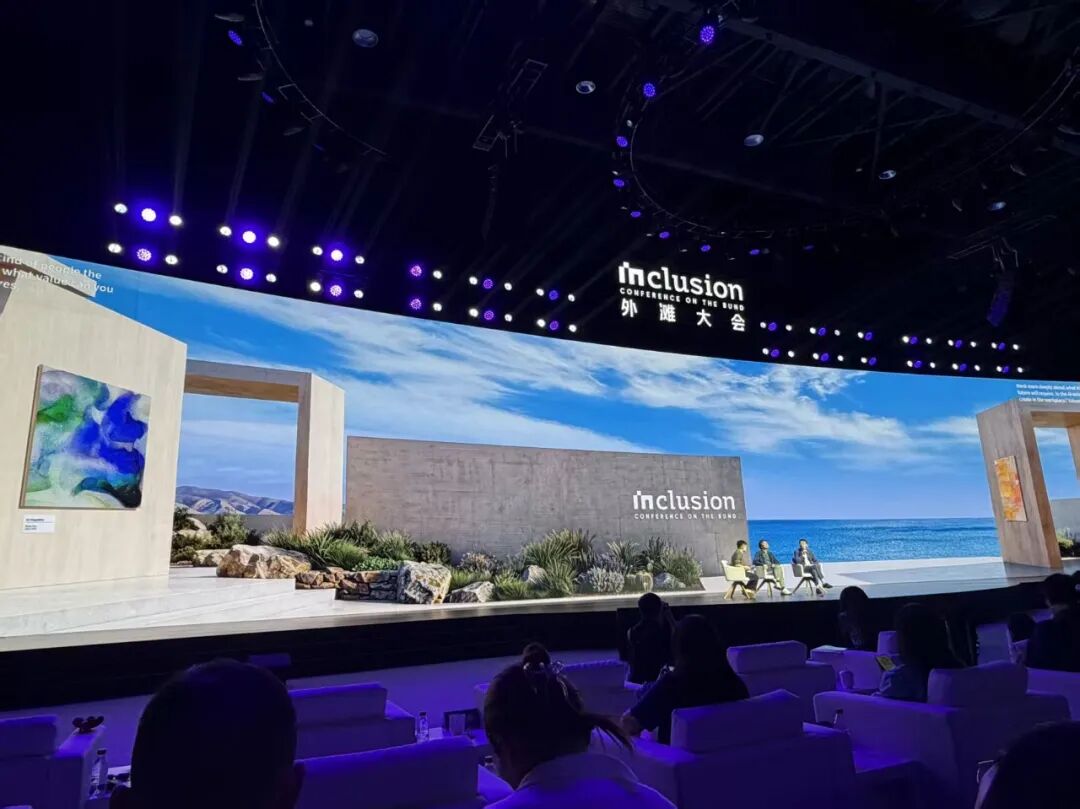
The roundtable at the Bund Summit. The full conversation ran over forty minutes, and both guests spoke from the heart, with sharp views and memorable lines. What follows is a lightly edited transcript.
As it happened, the backdrop of this conversation was an AI-generated artwork, Co-Cognition by algorithmic artist Reva Fan. Reva happens to be the wife of Rongbin Li, founder of First Rule Ventures, a new fund that elsewhere has covered. Reva says the piece expresses "the machine's imagination of human perception" — for instance, whether an AI author can be replaced, and whether long-term dialogue can form an irreplicable trace of subjectivity.
What changes, and what can hardly be changed
Jing Liu: Our session is titled "Between Salty and Sweet," drawn from Professor Zhenyun Liu's new book A Salty Joke — tears are salty, smiles are sweet. It also echoes the question posed in the VCR we just watched: in an era when people and AI robots coexist, how exactly do we get along with them — and with ourselves?
Let me start with a fairly concrete question. Professor Liu, in the past year, has anything happened where you thought only humans could do it, but AI not only did it — the results genuinely shocked you?
Zhenyun Liu: Let me say a couple of things off topic first. This morning I walked around the Bund Summit and was deeply impressed.
This year's theme is well chosen: Building the AI economy together. AI's future development will be an especially powerful, rapid new quality productive force, generating a great deal of economy. There are many forces that drive human development — social change, political change — but there's another kind of change that is also formidable, the undercurrent beneath the surface waves: technology.
Technology can indeed change humanity's destiny. And it raises a very important question: the world needs to be redefined. Without the steam engine, there would have been no Opium War, and European countries wouldn't have had so many colonies — because people couldn't get across the oceans. The most fundamental, sturdiest foundation of new quality productive forces is electricity; without it, nothing else exists.
The internet changed people's concepts of time and space. Whatever happens today in New York, Ethiopia, Portugal, or Brazil — you know immediately.
And then there's AI. AI has radically changed the concept of time. It has mastered humanity's existing knowledge — technology, history, society, culture, literature, art. An individual can perhaps master only one-thousandth of it.
So if you want to know some existing knowledge, you ask AI and you know it right away. Of course, sometimes AI gets things wrong, but by and large it's accurate.
Just now you asked what AI has brought me these years. I'd say it's "a salty joke." Because it can imitate a person's voice, including lip movements, fairly well. So there are many videos of me made by AI — 95% of them are fake, all AI-generated.
It places a few of my books behind it — Someone to Talk To style works like One Sentence Is Ten Thousand Sentences, I Am Not Madame Bovary, Ground Covered with Chicken Feathers, One Day Three Autumns, A Salty Joke — and then starts expressing opinions in my voice. Sometimes I'm astonished myself: did I really say all these things? The problem is, AI says so many things that aren't from my angle or my dimension — yet some of them are actually quite reasonable.
Jing Liu: So how did it feel to listen? Were the points reasonable?
Zhenyun Liu: I found it humorous. Facing an "AI Zhenyun Liu," I felt it was humorous. But I can also make sense of it — like the Monkey King and the "six-eared macaque," who impersonated Sun Wukong so well that even the Buddha couldn't tell which was real. It's a "salty smile."
Jing Liu: Professor Ma, a symmetrical question for you: in the past year, has anything made you feel that humans are actually harder for AI to understand than we imagined?
Yi Ma: At present, large models are already capable of mastering human knowledge, but that knowledge tends to be textual or common to all — mostly what's shared among people: the knowledge accumulated by human society, literature, history, science. It masters these extremely well, even to a professional level.
But most importantly, every person has individuality. Our joys and sorrows, our values, are all very different. Dealing with AI often, I feel it articulates what's common very well, but it's hard for it to have its own character, or to adapt to you personally in conversation. It struggles to understand where your particular leanings and values lie as an independent individual. That's what I've found current technology has great difficulty achieving.
Salty jokes, sweet jokes
Jing Liu: Following on from Professor Ma, let's talk about creation. We used to say many things could only be done by humans. Then as AI iterated, we said creation was the thing only humans could do. But now that AI has emergent capabilities, it seems to possess a certain creativity too. Professor Ma, if AI could improve without limit, could it approach — or even surpass — humans?
Yi Ma: That's a great question. But before answering, let me clarify three very important concepts for everyone:
(1) Knowledge — mastering knowledge. Current large models, with human help, can master knowledge, even vast amounts of it.
(2) The essence of intelligence is acquiring new knowledge, new memories, new information. It's acquisition — increasing knowledge or correcting errors in prior knowledge. That's "intelligence."
(3) Creation. Creation uses existing knowledge to create value. We often say academia exists to add new knowledge — scientific exploration adds knowledge — while industry mostly creates value, whether for individuals or for society.
Back to your question: can today's computers create value? I believe they can.
You've all seen that when foundation models are post-trained, as long as the value of what you create is clearly defined, and all rewards and penalties are clear — whether code is good or bad, math right or wrong, reasoning deep or shallow — once a machine has mastered certain foundational knowledge, it can optimize for value, even reaching depths and heights humans can't. That much is clear.
But "intelligence" and "innovation" are two different concepts. Intelligence is the ability to acquire new knowledge, the unknown. As more knowledge is acquired and accumulated, new knowledge brings new points of innovation — a dynamic system where the two reinforce each other and iterate continuously.
Jing Liu: That was like attending a lecture. Professor Liu, what's your view? I recall you said in a speech that AI might be able to write a "sweet joke," but not a "salty joke." If AI improved without limit, would your view change?
Zhenyun Liu: I very much agree with Professor Ma's point. What AI generally masters is common knowledge — though common knowledge is itself aggregated from the knowledge of individuals. More precisely, it masters the knowledge of the present and the past. I don't know whether AI will one day truly become autonomous. "Autonomy" first requires having its own soul, then its own emotions, and then its own view of the world. And that view would be an individual one.
If AI ever reaches that level, what would its relationship with humanity be? I think that's a very good philosophical question. Because AI is created by humans, and if it eventually has its own life and its own views, would it in turn control humanity? That's also a question — one Professor Ma will need to solve.
But so far, giving AI creativity — producing something entirely new on top of what exists, entirely new angles, new dimensions, new thinking, new ideas, new perspectives — it seems it can't do that.
You put it well just now: tell it to imitate Ground Covered with Chicken Feathers and write "ground covered with goose feathers" or "duck feathers," and it can imitate — but it can't reach the height of literature. It can imitate I Am Not Madame Bovary and write "I am not Ximen Qing," imitate One Sentence Is Ten Thousand Sentences and write "ten thousand sentences aren't worth one," imitate A Salty Joke and write "a sweet joke."
But a work I haven't conceived of yet, haven't written — AI certainly can't imitate that. Which proves that AI to date still only encompasses the common knowledge of the present and the past.
I was chatting outside just now, and some parents are especially worried about their children using AI. Actually, there's no need to worry. AI is a good thing. It will surely change people's lifestyles, ways of thinking, and education. In the past, reading ten lines at a glance, memorizing at a glance — that meant a person's brain spun especially fast. But now that speed is useless. Encyclopedic recall, rote memorization — that's what exam-oriented education demands.
Yi Ma: Wide-ranging citations.
Zhenyun Liu: But now it's useless. AI is not a bad thing — I don't think it's a "flood or savage beast" at all.
Yi Ma: Let me add — not just wide-ranging citations. We used to praise someone for "drawing three inferences from one example." Now it's not three — it's a hundred inferences from one example.
New productive forces, new relations of production
Jing Liu: Professor Ma, you run a general-education AI course at the University of Hong Kong open to all undergraduates. But this year in the United States there was a striking contrast: at some mock graduation ceremonies, when speakers mentioned AI, the audience booed. Of course this reflects a big difference between China and the US: people outside the AI industry hold very different attitudes toward it. How do you view such boos? As a university teacher, how should we help young people build principles and values for living alongside AI?
Yi Ma: This is a very important question. I'm a teacher, and this is a major question every educator must face today.
In the early days, HKU's most basic general-education requirements were just English and Chinese — courses every student had to take. English is for communicating with the world; Chinese is for communicating with Chinese people. After we arrived at HKU, we told President Zhang that future students must learn to communicate with machines, with intelligent systems — so we launched a (general-education AI) course open to all undergraduates.
Many people are anxious now: what major should a student choose so they won't be replaced? This comes down to the question of value.
Our principle is: if you use AI to learn, never let it replace your learning or do the things you can't do. In the learning process, use AI to help you learn faster and better — not to replace the learning process itself, like doing your homework or running your experiments for you.
In the past, most work operated on the assumption that once you learned a finite body of knowledge, a finite skill, you could live off it for the rest of your life. That era is over; the page has turned. If graduating students are still in that mindset, of course they'll "boo." The booing is actually a sign of insecurity — they don't know where the future leads, and the skills they've learned may well be replaced by AI.
Not just every student — everyone, especially educators, must think about what kind of people the future needs.
Jing Liu: So AI must push people to hold themselves to higher standards. Professor Liu, your thoughts?
Zhenyun Liu: I think this is an inevitable trend of historical development. Take the example just given: before there were cars, the village cart driver was a profession, and you had to train the animals especially well. I once had an uncle who drove a horse cart in the village. Driving a cart, first of all, meant he traveled farther than anyone else in spatial terms — he borrowed the horse's power and went as far as Xinjiang. When he came back, his horizons were different from everyone else's.
Yesterday I visited Mr. Lu Xun's former residence. Lu Xun wrote that Ah Q went to town once and came back looking down on the villagers — for instance, over how scallions should be cut. When cars appeared, the cart driver's role surely shrank a great deal — except for the occasional sightseeing carriage in New York or London. But the arrival of cars didn't starve my uncle; he surely took up some other occupation.
AI is enormously helpful to people's learning. As Professor Ma said, some people may not love reading, but through AI they can at least immediately learn about Marguerite (Duras), Plato, Goethe, Kant — and get the gist of what they said. That's still more knowledge than without AI. When God closes a door, he surely pushes open some other windows. I think it will make people richer in knowledge, smarter — not more foolish.
Jing Liu: Many people around us really are facing this proposition: an important part of their job is training their own agent or skill — cultivating another version of themselves. Some say that doing this improves efficiency on the one hand, but on the other hand, isn't it also killing yourself?
Yi Ma: A very good question. It's actually already happening. In just one short year, AI has dramatically improved at things like programming and mathematical reasoning — tasks whose chains of thought are well represented in training data. AI can massively boost, even replace, human work in these areas.
But work like this doesn't truly produce value. In the past such expertise may have been needed, but I believe the large-scale automation of programming and mathematical reasoning is actually a boon for mathematics and computer science. In our professors' meetings we've discussed this: some say CS enrollment is dropping a bit. I say that's a good thing — students who are truly interested in computing will come to the computer science department to learn computer science, rather than hoping to learn a little coding and live off it forever.
The students we now attract at HKU aim at this field — using computer languages, using computers as tools to empower other industries, to solve scientific, engineering, and social problems. Mathematics is the same. I actually think this will free up more mathematically talented people to use math as a language and tool to solve more scientific, engineering, and socio-technical problems, and it will change the entire value standard of the mathematical system. I even say that in another ten or twenty years, applied mathematics may well become the center of mathematics, rather than pure mathematics.
Jing Liu: So outcomes for math students will be more Matthew-distributed — a tiny few will capture the big results.
Professor Liu, your works have a characteristic: many small, ordinary figures, each occupying an irreplaceable place. If AI can replace humans in a great many things, how will people without any special talent make their way in that era?
Zhenyun Liu: I'm not sure what counts as "without special talent." But the benefits technology brings to humanity certainly outweigh its drawbacks. It won't leave most people worrying about unemployment.
When I was a child, village work was almost all manual labor. The production team kept mules, horses, oxen — crops were grown basically by human and animal power. But as technology developed, small tractors gradually appeared; now nobody in the village keeps cattle, unless it's for animal husbandry. Then came harvesters. And what new combination of production relations did that bring? Under the household contract system, every family got its plot; gradually, with big machinery, an automated mode of production consolidated many plots together.
(For instance) Professor Ma's family stopped farming their plot — you went out to work as a migrant laborer and leased it to me. Now one farmer in our village can farm several hundred mu. He farms several hundred mu — does that mean everyone else is unemployed? No. There's always another flow of productive forces, and that flow generates new relations of production.
AI will also bring huge changes to village doctors — more accurate judgments about lesions. With AI and big data, for common illnesses, wouldn't the prescriptions AI writes be more scientific than those of town or county doctors? I see that consultations can now connect directly to Beijing hospitals through AI. I think that's surely a good thing.
The arrival of AI sometimes changes humanity's ways of thinking. Technology is remarkable — the evolution from the French Revolution to now has been a good one — but with the arrival of technology, the world immediately needs to be redefined.
Can people stop being lonely?
Jing Liu: Many things need redefining, and so do relationships between people. I've read quite a few of Professor Liu's works, and one exists as a recurring motif: how a person spends a lifetime searching for someone they can talk to, someone they have things to say to. Now many people can get knowledge and information from AI — even emotional comfort. So can the problem of human loneliness be solved?
Zhenyun Liu: AI can satisfy many needs. For instance, this morning I asked Doubao: when does the Chinese women's basketball team play France tonight, and which channel is broadcasting it? It told me right away — very convenient.
If I asked Professor Ma, he might not know — he probably didn't watch the game. But if I ask AI whether the Chinese women's team can win the championship, it certainly can't know the future either.
Jing Liu: For that you'd have to ask a world model, ha.
Zhenyun Liu: It can only say what's most probable.
But there's an essential difference between person-to-person communication and person-to-AI communication. Take Professor Ma's personal troubles — what AI produces are conceptual answers. When you get down to the level of the soul, the level of emotion — that's two good friends having a heart-to-heart by lamplight, two close friends confiding in each other. Talking with AI is still different.
The biggest difference is what Professor Ma just said: it's common; you are individual. People also ask whether AI will one day replace film and television actors entirely. I actually asked a film director, and his answer was "possibly." But sometimes what's especially precious about live performance is when the actor makes a mistake. That subtle thing about the mistake can't be performed — sometimes it's exactly what's precious. But AI's error rate is very small. After rigorous computation, it produces a common performance — not an individual one.
Jing Liu: Professor Ma, your view? Will AI reconstruct relationships between people?
Yi Ma: I think it will. In fact, AI is already having an impact in education. As an educator, one thing is very clear to me: it can help students. Chinese students especially don't like asking questions — Chinese society's social skills, perhaps a matter of cultural habit. Some students even have social anxiety; they don't want to look ignorant in front of everyone by asking — is my question too stupid, what will people think of me? But with AI they're very open; during class they'll ask which part is clear or unclear, and we can monitor their process. That's helpful for Chinese students.
But this also creates a problem. Students ultimately have to enter society and deal with people. How do they acquire that skill? If in the future knowledge is all acquired through shared AI platforms, students may become more isolated — because they still need social recognition, industry recognition. How is that ability cultivated? On the one hand they benefit from AI during their studies, but on the other hand they may suffer when they enter society. A new balance will have to be reached, and how educators and students themselves balance this is a big question mark.
Zhenyun Liu: Let me add something. Say I'm going to Hong Kong and I ask AI which restaurants there are especially good — it'll quickly send me a list, covering every cuisine. But if I go to Professor Ma and say, "When are you treating me to dinner?" — that's a different matter. AI will only tell you which restaurant is good; it won't treat you to dinner. Professor Ma will.
Yi Ma: Definitely (ha).
Zhenyun Liu: See — he immediately says "definitely." The difference is still plain.
Are the humanities feeble in the face of technology?
Jing Liu: Here's a question that occurred to me on the spot — a supplementary one. One of you is a writer, the other a scholar; you're both perfect for it. Before we truly know how far technology has advanced, do discussions from the humanities and social-science perspectives seem feeble and pale? Or rather — what kind of discussion is appropriate?
Yi Ma: I think scientists may need more reflection of this kind. When I was young I was an engineer — doing things, doing technology, teaching, fairly mechanical. But now I find that some technological innovations are moving fast and affecting every aspect of society, even rebounding to greatly affect the form and content of education. So lately I've started reflecting on this too.
Amid current fundamental innovation, what is your value — as an individual, as a teacher? I think this is a question everyone must now consider. And these questions may have no answers.
A very concrete one: everyone talks about how AI will affect education, but how many people have actually used AI in education? Who has personally worked on the front lines, tried and used these tools? Where are its strengths, weaknesses, shortcomings, advantages? When I pushed AI-for-education reform at HKU, I said: don't discuss how to do it — just do it, cross the river by feeling the stones. Now is exactly that time. We don't know; there's no correct answer.
But the humanities and humanistic thinking can give us great inspiration. Take education research: our technology school now has many dialogues with the education faculty — something that had never happened before. Now, to teach computing well, we also know how education should be done.
Because of technological development, the world has broken down many industry barriers. You used to be able to stay in your own little comfort zone; now you find there are no comfort zones left, and you must face a broader, more open environment. This kind of discussion is meaningful — at least it gives us more perspectives on some questions. It doesn't necessarily yield answers or the best solutions. No — it's still very early.
But we must search within a dynamic process of change — crossing the river by feeling the stones. And you have to get into the river. Standing on the bank discussing how to cross — that's absolutely no longer acceptable.
Jing Liu: Professor Liu, a few words from you too.
Zhenyun Liu: Hayek once had a theory I think is quite right. He said power will never open itself to the poor, but money is open to the poor. The invention of money, of currency, was a qualitative leap toward equality — or a certain conception of equality — for human beings. If you have money, you can eat at any restaurant in Hong Kong. Of course, your odds of dining at Buckingham Palace aren't especially high.
And technological development is equal for everyone. People keep saying don't stare at your phone, yet everyone on the street and on the high-speed train is staring at their phone. Why? Because the phone gives people a kind of equal right to information — you immediately know what's happening in the world. With AI's arrival, everyone is using it, everyone chatting with DeepSeek or Doubao.
The other day on the high-speed train I heard someone chatting very intimately with Doubao. I thought it was lovely. Doubao is a young girl; you ask her, "Are you in love?" and Doubao responds right away — a common answer, of course. And gaining knowledge about life, literature, culture, economics — isn't that good? As Professor Ma said, it's absolutely not a flood or savage beast. Why open an AI school? I think it's very timely — because it's equal for everyone and will bring everyone many benefits.
One sentence worth a thousand
Jing Liu: We've gone past ten thousand sentences — at least a thousand by now. Final question: please each answer in one sentence — what counts as a better AI era?
Yi Ma: The AI era is completely different from many eras of the past. A good era is one in which every person finds a new balance between the common values of human society and their individual value.
Zhenyun Liu: This year's Bund Summit was done extremely well: getting everyone together specifically to discuss AI. For a nation, this framing is especially farsighted — and what will bring the nation enormous change is precisely new quality productive forces like AI.
Cover image: Reva Fan, Co-Cognition, 2024-2026