A Conversation with Sam Guo: Staying Out of the Fray, but Keeping on Winning
Truck drivers, sour kiwis, counterfeit cigarettes and booze — and the legends of investing.
@Jing Liu
In an earlier elsewhere interview with Huadong Wang, we talked about someone who also claimed to be boring, someone who said "while others all in, I in all."
That person is Colin Guo.
Colin Guo keeps a low profile — so low that people outside the investment industry probably don't know him. But list some of the companies he's invested in, and he'll snap into focus: Pinduoduo, Xiaohongshu, Mingming Henmang, ZTO Express, J&T Express, ANE Logistics, Full Truck Alliance, Lalamove, BOSS Zhipin, Agibot, and more.
His investments in a string of logistics companies and in Pinduoduo especially highlight his style: grounded, patient, and willing to make big bets. He's generated over $10 billion in fund returns, across different industries and stages, making him one of the most accomplished young partners in China's investment industry.
When he first joined Sequoia Capital China, Guo's job was research and cold calling — but it was through those calls that he found ZTO Express. When investing in ZTO, he interviewed hundreds of people and wrote a 100-page research report for the investment committee. When ANE Logistics hit trouble, he and the founding team went on a city-to-city roadshow to give franchisees confidence. When he invested in Pinduoduo, it was Christmas — most peers were on vacation — but he deployed nearly every possible due diligence method and ultimately staked a large sum.
Many people find Guo's story inspiring. But he considers himself lucky — lucky to have discovered fields that others saw as thankless but that clearly held hidden treasure.
As an investor with a consulting background, Guo can seem somewhat buttoned-up. But in contrast, his life keeps producing curious coincidences: when he picked "Colin" as his English name in elementary school, the back of the card showed a truck driver — an odd prefiguring of his investment career. His mother is a colorful criminal police detective; his wife is a content creator. He even worked with Feng Tang once...
As he himself puts it: he's a pretty contradictory person. Sometimes rational, sometimes lost in thought; sometimes risk-averse, sometimes craving risk.
In October 2024, after 14 years at Sequoia Capital China, he transitioned to investment partner and founded Entropy Management (卓飞投资), a new fund focused primarily on public equities and philanthropic support.
Why did he make this choice?
This is Colin Guo's first-ever interview. He revisits his logistics investments, Pinduoduo, and his 14-year investment career in detail, much of it never before shared publicly. For the full conversation, please listen to the complete audio on Xiaoyuzhou App, or watch the full video on Bilibili and other platforms.
The interview follows:
A Decision
Jing Liu: You spent 14 years at Sequoia. Why did you finally decide to leave?
Colin Guo: Was there a single moment? Probably not. It was more of a continuous thing — for example, I gradually found my footing in public markets.
Jing Liu: You could have done public equities while staying too.
Colin Guo: For me it was a choice. If I continued with private markets, I could still access the best AI companies. But I had to ask myself: would I need to work as hard, as diligently, and have as much luck as I did in the previous 15 years? There are many young investors doing excellent work now.
But for me, could I surpass my past self? I had no answer.
Jing Liu: Could you say you're afraid of failure?
Colin Guo: I'm afraid of regressing. Or maybe I'm somewhat avoidant about this. Many people in their forties have families, elderly parents, children — their worldview has already shifted somewhat.
Jing Liu: How much did the fear of regressing weigh in your decision to leave?
Colin Guo: Twenty percent.
Jing Liu: What was the other eighty percent?
Colin Guo: Public equities mattered more to me. Doing public markets would be relatively easier, and I wouldn't carry historical baggage.
Jing Liu: You spent so many years in private markets and have signature deals — why switch to public equities?
Colin Guo: The two worlds are very different. Private markets center on people; public markets center on companies and businesses. Private markets emphasize power law and home runs; public markets emphasize drawdown control and risk management. Even curiosity plays out differently — private markets demand continuous learning, while public markets value discipline and circle of competence.
So these are completely different species. I feel more similar to the public markets crowd. Private market people meet tons of people every day; I'm a quiet person who recharges in solitude.
Jing Liu: When might you return to private markets?
Colin Guo: Public equities is our current focus. When we do private markets again is more a matter of bandwidth.
Jing Liu: A good friend of yours said you're someone who really hates losing. So could this be understood as finding another way to win?
Colin Guo: I think so. You certainly hope to keep doing better. Investment is especially like this — if you can win, you barely even need management. No one wants to work in a losing fund.
Cold Calling the First Deal
Jing Liu: There's very little information about you online. Let's start from the early years of your career. What about before you joined Sequoia?
Colin Guo: My first job was at Siemens, mainly in supply chain — I was there two years. Then McKinsey for five years. The industry I researched was transportation.
Jing Liu: Did that have much influence on your later investment career? For a long time after joining Sequoia, you also covered logistics and supply chain.
Colin Guo: Actually the domains were quite different, but many things were related — like the MECE principle I was trained on at McKinsey: mutually exclusive, collectively exhaustive. And focus group research methods. These still influence my work greatly.
Jing Liu: A good friend from McKinsey praised you, saying he only understood "beyond the mountain, another mountain; beyond the person, another person" after meeting you — that you quickly became a team leader. What allowed you to stand out?
Colin Guo: I was mainly doing research, with tasks assigned by consultants — what the industry calls "requests": every day I'd receive different requests and respond within a certain timeframe.
Maybe my responses rarely got sent back. Before responding I'd think quite a bit — like standing in the other person's shoes, wondering whether I'd met their expectations. I think it was mainly being relatively conscientious.
Jing Liu: Just relatively conscientious?
Colin Guo: Conscientiousness matters. Many people aren't conscientious. Smart people may be even less so. Some might spend three to five minutes on a request; I might need an hour.
Jing Liu: He also said you're "very reliable" — his most important assessment of you over twenty years.
Colin Guo: Probably related to responsibility. If I see a so-called deadline, for me that's a very important goal line. Also, I always hope to do better than my previous self, so I'd review my responses repeatedly — though I still always felt dissatisfied.
Jing Liu: How did you join Sequoia?
Colin Guo: A headhunter found me. I met Neil (Neil Shen) and Kui (Kui Zhou) in Shanghai. It happened that Michael Moritz was also in Shanghai — I met with him too.
I remember asking him: what's the mark of a successful VC? He said: "You trust me, I trust you." Mutual trust among partners in a partnership. That left a deep impression.
Jing Liu: He didn't describe VC success with any data metrics.
Colin Guo: Right. At the time I didn't fully understand, but I increasingly did later.
Jing Liu: What was the first thing you did after joining?
Colin Guo: Still research. I looked at jewelry, antidepressants, cold chain logistics, financial leasing, online games, ultra-high molecular weight polyethylene fiber — all over the map.
That period was when all industries were blooming. To this day I still get annual invitations from the sewage treatment industry association.
Jing Liu: You did research at McKinsey, then research at Sequoia — do you naturally like research?
Colin Guo: Not really. And consulting research and investment research are vastly different — completely different things. The former aims to give a diagnosis: what's wrong, here's your prescription, usually with benchmarks. But VC is mostly new industries without mature companies to benchmark against.
Many VC decisions happen in 24 hours — what research can you do? Of course now with public markets, it's different again.
Jing Liu: Many people mention that when you first started investing, you spent a long time cold calling, that you paid your dues.
Colin Guo: There was no WeChat then — it was basically finding contact information through various business directories and industry associations, calling to ask if companies had fundraising plans. The hardest part was whether you could keep calling, because many people would reject you — just like when you get a spam call now.
Jing Liu: Did any pleasant surprises come from cold calling?
Colin Guo: We were looking at the express delivery industry, called 10 numbers, 3 picked up. One of them was ZTO Express.
Jing Liu: So your first investment came from a cold call.
Colin Guo: Yes. Actually several deals were. With ZTO, we called the front desk, left contact info, and later CEO Lai (Lai Meisong, ZTO's founder) actually responded.
Jing Liu: Who were the other two that picked up?
Colin Guo: One was YTO Express, one was a second-tier express company with a three-character name. But various coincidences, and I liked CEO Lai as a person: steady, not extreme. I was a greenhorn; I wanted to play it safe for my first shot.
Express Delivery, Fake Liquor, and a 100-Page Due Diligence Report
Jing Liu: The express delivery industry was barely capitalized then. How did you talk with ZTO?
Colin Guo: I was the first investor CEO Lai had ever met. There were three of us total, meeting at a hotel on Shanghai's outskirts. The whole meeting was three to four hours — they asked only one or two questions, I basically did all the talking. Sometimes we'd both fall silent for stretches, because I'd run out of things to say, then continue after a while.
Jing Liu: Everyone was somewhat confused.
Colin Guo: Yes. And CEO Lai was especially taciturn. Once he suddenly asked me: how would you value me? I actually didn't know — there wasn't a single listed express company at the time. I thought and said: let's do 16x PE. That was roughly my estimate.
Jing Liu: Mobile internet was rising then — why focus on express delivery instead?
Colin Guo: Sequoia had already invested in some e-commerce companies, but we noticed these companies were also investing in logistics — Alibaba, JD.com, Vipshop all had some layout. Around Spring Festival 2011, I wrote an email to Neil saying I thought this was good timing. Neil replied quickly, very supportive.
I worked on ZTO for about a year — probably my longest deal.
Jing Liu: Why so long?
Colin Guo: I did thorough due diligence: visiting sorting centers, trunk line operations, interviewing many drivers, peers — hundreds of people in total. But that was manageable. The real difficulty was aligning on language.
Many of them spoke with regional accents; it took time to build trust. I basically went every two weeks. I had no other projects then, so I gradually made it like a second home. Once at the cafeteria, a senior executive said to me: stop doing investment, I'll give you a franchise to run.
Jing Liu: Hundreds of people interviewed — how long was your due diligence report?
Colin Guo: You probably can't imagine — I wrote 100 pages. I don't know why I wrote so much; it covered everything in exhaustive detail. I remember designing a cover, like a consulting firm report.
Now I think 6 to 8 pages maximum is enough. Every word fewer is a sign of skill.
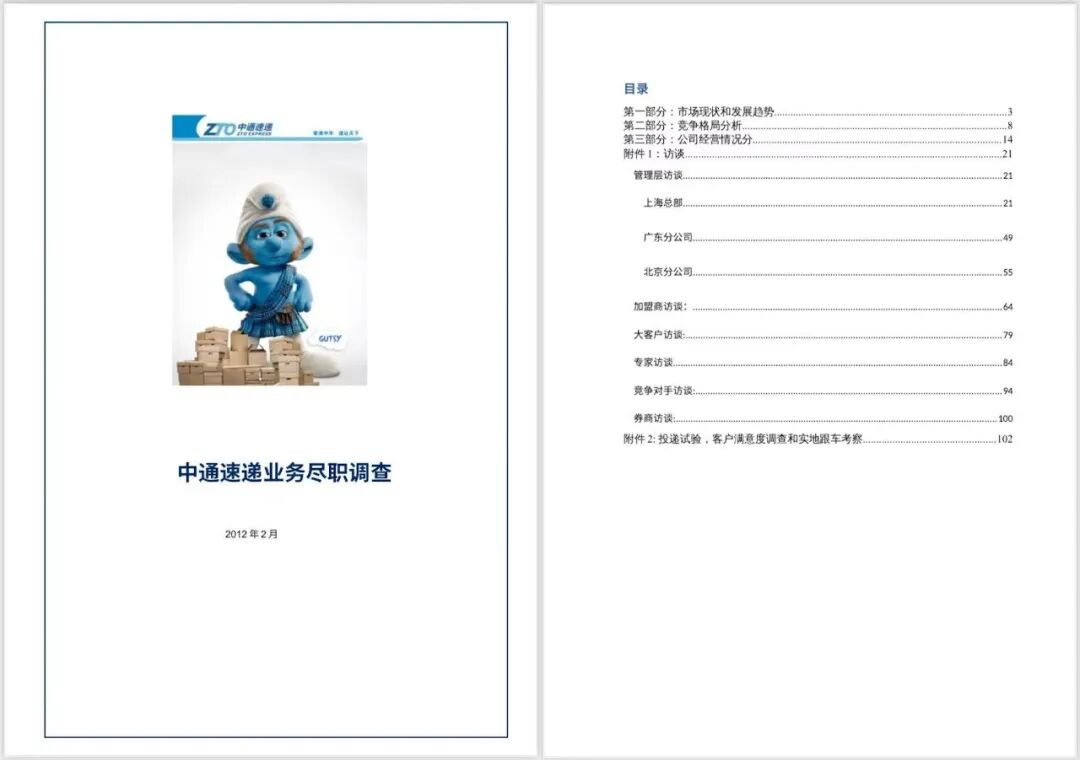
First memo: 102 pages, designed a cover
Jing Liu: What was the partners' reaction to 100 pages?
Colin Guo: Not sure if they even finished it. If it were me, seeing 100 pages, I'd just read the first few.
Jing Liu: At least they'd be moved by your effort.
Colin Guo: Probably not, haha. They're all experienced people.
Jing Liu: A bit green, perhaps.
Colin Guo: Too eager to do well. Back then I could write several pages on a single trunk line. Why the same vehicle type, same cargo, such price differences? Were there relatives among the bidders? Prices differed with relatives versus without.
Jing Liu: In such a down-to-earth industry, any special experiences?
Colin Guo: This really is a barrier to entry in this industry. Years later a woman in PE told me that on her first day doing a logistics deal, she wanted to leave — the cigarette smoke in the room was too intense, she could barely think. A senior once told me he had looked at logistics too, but when he brought red wine to the boss's home, they didn't drink red wine at all — couldn't even start a conversation.
Sometimes you have to drink to get to the point. Like at an express franchise, if the other person goes to play cards, do you go? Maybe only then do you get closer to them, do you make new discoveries. Back at the office, there's nothing on the computer.
Jing Liu: I heard you've consumed a lot of fake cigarettes and fake liquor.
Colin Guo: Yes. I barely smoked or drank before, but this industry has lots of fake cigarettes and fake liquor. I couldn't tell the difference — maybe the ones that gave me headaches afterward?
Jing Liu: Looking back, does it seem quite wonderful?
Colin Guo: Of course. If you asked me to go back to that time, one project per year — there's no such opportunity anymore. Most good industries are highly competitive, like CES this time where everyone's rushing to go.
Jing Liu: ZTO went public five years later. If you did this investment again, what could be better?
Colin Guo: Should have put in more money — but investment is always like that. Also, don't write 100-page research reports.
Turning One Investment Into a Portfolio
Jing Liu: Express delivery and logistics seem to have become your stronghold in investing.
Colin Guo: My mentor at Sequoia, Xing (Liu Xing), once told me: investment should draw inferences about other cases from one instance, find connections by analogy. I went home and thought: since I finally got into logistics, I should dig deeper.
After investing in ZTO, I had some name recognition in this circle — after all, no capital had ever paid such attention to private express companies. Someone recommended a less-than-truckload company; I immediately flew to Qingpu, Shanghai, met the founder, and closed the investment within two weeks. That company was ANE Logistics.
Jing Liu: How many pages was the ANE due diligence report?
Colin Guo: ...A few pages.
Jing Liu: That's fast progress.
Colin Guo: Haha. But this experience was very different from ZTO: a few months after our first investment, the money was burned through; we added a second round, soon gone too. ZTO never had this situation — I panicked a bit.
ANE was having a meeting in Hangzhou then; CEO Qin (Qin Xinghua, ANE's founder) was speaking passionately on stage, while I sat below with my heart pounding. I remember clearly: that night I walked lap after lap around West Lake, telling myself: venture capital really has risk. I really thought this money was gone.
When I walked back to the hotel, I couldn't just accept it. I wrote something in English on my phone: "It's not over until it's over."
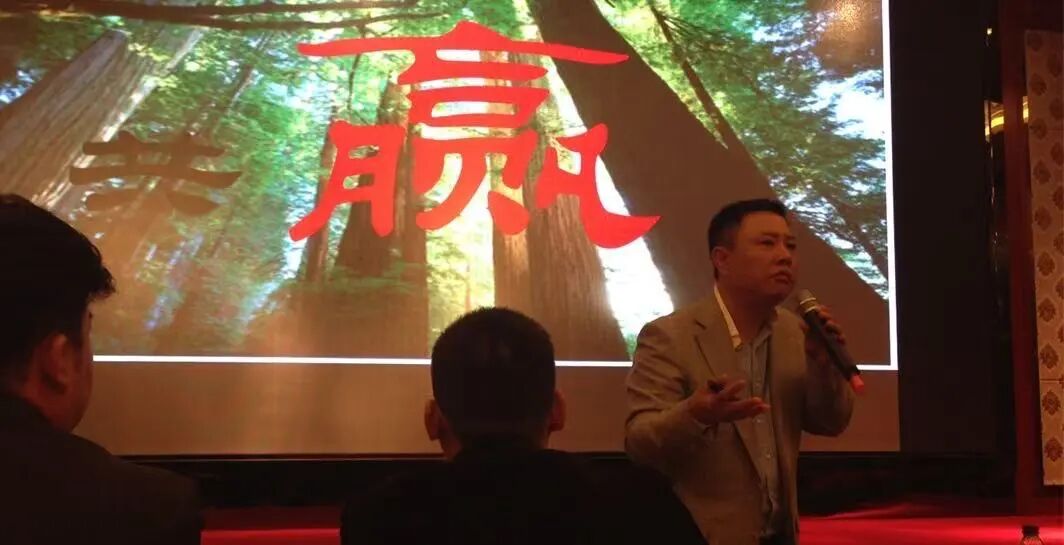
ANE Hangzhou network meeting — I took a photo of CEO Qin that day as a keepsake
Jing Liu: What did you do then?
Colin Guo: A colleague and I redid the company's budget, sorted out their advantages, pricing, etc., and helped them find money everywhere.
For a period, we went to franchisee meetings across regions. The most important thing at these meetings was giving confidence: first the founder speaks on vision; the business head speaks on franchise policy; the regional head speaks on execution. Then I go on stage, as the investor representative, speaking on my investment logic. Chongqing, Kunming, Xi'an — city by city on tour.
Near the end of the meetings, music would play, young colleagues holding baskets of cash would shout to the audience below: we've already received this much in franchise fees — are you going to pay?
Jing Liu: Does it seem a bit funny in retrospect?
Colin Guo: I feel emotional. They really pulled through again and again. Our returns on this investment were quite good too.
This greatly influenced how I invest: for the first time I understood that venture capital can go to zero at any time. After this, our progress in logistics was rapid — over ten investments within two to three years.
Jing Liu: What kind of world is the logistics industry?
Colin Guo: People here value relationships. Often founder-investor relationships come in waves; years later when you reconnect, the feeling may be long gone. But not in logistics.
Probably because this industry has few bubbles. People here aren't浮躁 [fúzào, restless/frivolous], because there's no environment to make them so.
Jing Liu: Are you someone with a sense of the jianghu [rivers and lakes, the rough-and-tumble world]?
Colin Guo: I really don't have that. But what's most important for an investor is being an ordinary person. I don't need to be of the jianghu, but I can engage with it.
Jing Liu: Back then colleagues were investing in seemingly more glamorous tech and internet — did you feel you were working in a thankless industry?
Colin Guo: Not at all. The results here were so good — shouldn't others be envious?
Jing Liu: Many investor peers mention you with admiration for your results, but also feel you've endured hardship, that it's inspiring.
Colin Guo: I didn't feel it was hardship. Maybe my experiences were easier than looking at AI — AI competition is too intense, you have to worry every day whether others have already brought something to committee.
Investing in Pinduoduo: The Most Fantastical Month of My Life
Jing Liu: Let's talk about Pinduoduo. This is also the deal that brought Sequoia its largest returns through you.
Colin Guo: Many investors looked at this deal; Neil asked me to follow up. I went to their office on Yuyuan Road.
There's actually quite a connection: Colin Huang and I both have the English name Colin, and our WeChat avatars were somewhat similar — people often mixed us up when messaging. We're both also from foreign language schools (Guo attended Nanjing Foreign Language School; Huang attended Hangzhou Foreign Language School).
Jing Liu: Why Colin?
Colin Guo: It's quite magical. In elementary or middle school, the teacher had us pick English names. I randomly chose Colin, but on the back of each card was a drawing of what that name represented. Do you know what mine was? A truck driver.
Jing Liu: That's so fated...
Colin Guo: Actually I checked later — Colin's etymology doesn't seem to be truck driver. Maybe the teacher just drew randomly.
Jing Liu: When you were looking at Pinduoduo, the investment industry's conventional wisdom was: e-commerce's fate is sealed, hard for new companies. This was also one reason most people passed after looking.
Colin Guo: I'll just speak to my personal experience. At the end of 2016, I placed two orders on Pinduoduo: one was kiwis from Pujiang, Sichuan — 12 for 29.9 yuan; the other was Hearttex kitchen paper, 6 thick rolls for 24.7 yuan.
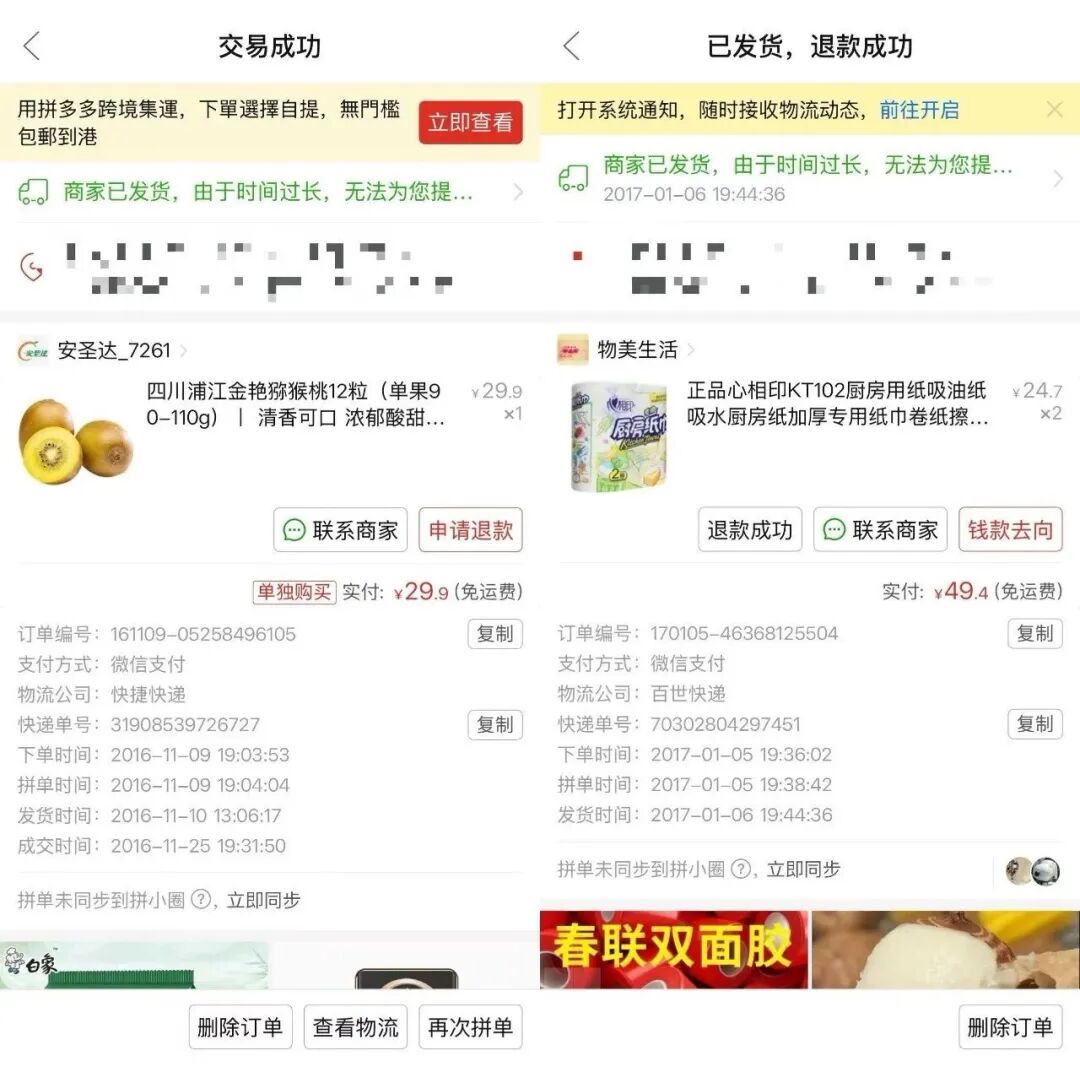
First and second orders on Pinduoduo
When they arrived, some kiwis were sour — definitely not comparable to the imported supermarket downstairs. The kitchen paper, I was actually using to replace dish rags, so overall it was cheap.
I had a feeling then, which I later wrote in my report: we discovered a new trend in consumption upgrading.
Jing Liu: But the sour kiwis were negative feedback.
Colin Guo: It was negative feedback. But what if I didn't live in a first-tier city, didn't have an imported supermarket downstairs? Let me ask you: a small kiwi that's sweet, or a large kiwi that's sour — which is higher quality?
Jing Liu: The small one?
Colin Guo: Actually different people have different answers. If you're gifting, regardless of sweetness, you'd choose the large one. But if you're controlling sugar, you'd choose the small one. These are non-standard goods. Besides fruit, clothing is another major category of non-standard goods.
Everyone's aesthetics, style, wearing occasions are different. Demand differs between cities too: fourth-tier looks to second-tier, second-tier looks to first-tier.
Jing Liu: Some investors say they passed because they received a box of rotten fruit.
Colin Guo: Maybe their rotten fruit was my sour kiwis. Years later at a small dinner, many people who had participated in due diligence were there. But I found that even after 5 years, some had never placed an order — where did their conclusions come from?
Jing Liu: Some people had doubts about Pinduoduo's data at the time.
Colin Guo: It was indeed growing very fast. Of course e-commerce has some水分 [shuǐfèn, moisture/water content — figuratively, inflated numbers], so reasonable skepticism was normal. I hired a McKinsey-background vendor who did very careful research; also an ITDD team — verifying data at the system level. This may have been the first time someone approached due diligence from this angle.
There was also this context: the due diligence was around December 2016, around Christmas, when many USD fund investors were on vacation. Someone called me to probe for information — they were already in Hawaii. Our due diligence continued from December 2016 to early February 2017. We spent enough time.
Jing Liu: Manbang Group's Zhang Hui's assessment of you: among all the investors he's met, rarely does someone at the partner level still participate so deeply in due diligence.
Colin Guo: I indeed participated throughout Pinduoduo's due diligence, joining about one-third of the calls. Our interviews were divided into deep and shallow; deep interviews were further segmented by city and age group. Layer by layer until the full picture emerged. The workload was substantial.
For the final investment decision, I staked my personal career on it. What I consistently insisted on was ensuring sufficient investment amount — later we bet a relatively large sum.
Jing Liu: What gave you conviction?
Colin Guo: The more due diligence, the more confident I became. I remember in the Beijing office pantry, a colleague ran up asking: Colin, what if this money goes bad? I said: then I'll have to resign.
But that night going home, my heart was still a bit fluttery. Though later I thought — many good investments feel heart-stopping at the moment of commitment.
Jing Liu: What was luck in this investment?
Colin Guo: Some. First, people may feel you're grounded, conscientious, with a good track record, so the IC trusts you more. Second, at the time I thought with unchanged product form, the company would at least have three to five times return — but honestly, I didn't think it would become a hundred-billion-dollar company.
Jing Liu: And the speed was extremely fast: from founding to IPO, Pinduoduo took only three years.
Colin Guo: It's quite interesting. In that roughly one-month period, three major life events were happening simultaneously: I was promoted from MD to partner; the Pinduoduo investment; and my wife and I getting our marriage certificate. Though I didn't realize the connections between these things at the time. That was a very important month for me.
Investors Are Better Off Without Too Many Hobbies
Jing Liu: Your investments span many areas — ZTO, ANE, Pinduoduo, Xiaohongshu, Mingming Henmang, now large models, robots, etc. Any common methodology?
Colin Guo: Observation matters. For example, Mingming Henmang — I saw it in September 2020 while walking around Changsha on a business trip: on that street there were several snack store names, but this one's decor was the most eye-catching, giving an urge to enter.
Also empathy, and the circle needs to be large enough. For example, maybe I don't look at consumer, but I still have to try to understand people eating spicy strips.
Jing Liu: How do you understand?
Colin Guo: It's not a special ability — there was a period when I was losing weight, my method was unusual: I'd open Douyin to watch mukbang, watching streamers eat sour-spicy noodles, roujiamo, I'd chew along, and then feel full.
Jing Liu: ...That's not a special ability?
Colin Guo: There's a term "androgynous mind" — I think investors need to become such people in some ways, without too many personal preferences. I hope I can become such a person.
Jing Liu: Any failed investment cases?
Colin Guo: There was a logistics company. Its gross margin was already very low; theoretically we shouldn't have invested. But for a period its gross margin fluctuated oddly high and low — later we realized it was because they had extended accounts receivable. This was a fatal issue.
This is also why I prefer public markets: private market fundamentals still center on people; research on business essence is limited.
Jing Liu: Do you think success and failure experience in investing can be accumulated? Or should one not be too obsessed with it?
Colin Guo: I've reflected on this before — three things in VC investing don't have much value.
First, IC debates. Sometimes arguing red-faced, getting emotional — I mean the arguing itself is meaningless; it's still Michael Moritz's point.
Second, many predictions are meaningless, because early-stage investing changes too much.
Third, post-mortems are mostly meaningless too, because no two leaves grow identically.
Jing Liu: You probably know many former colleagues say you're quite intense?
Colin Guo: Maybe over-execute. Once I get moving I'm very fast — this may create some pressure for people.
Don Valentine had a video saying investors divide into several types, one being outstanding but not easy to get along with. I'm not making excuses for myself — I may be that type. Investors often have to say no.
Jing Liu: You did seed investing for several years — you seem to prefer early versus mid-to-late stage?
Colin Guo: I think this is okay. But there's one thing I can't break through myself. Whether stocks or companies, my tolerance for losing money is relatively low.
Jing Liu: Not sure if I can say this: you internally still pursue things that can be explained, can be attributed. Our previous guest Huadong Wang said you two are somewhat similar.
Colin Guo: Attribution has attribution's way of playing, non-attribution has non-attribution's way. The downside of attribution is getting slapped in the face daily.
Jing Liu: Can you accept constantly getting slapped in the face?
Colin Guo: I think I can either way. Still that phrase: investors should preferably not have too many preferences.
Jing Liu: Do you sometimes inadvertently reveal preferences, then use reason to tell yourself to overcome them?
Colin Guo: I really don't have preferences. I'm interested in everything, but not that interested. There are many such people in secondary markets.
One Lifetime, Two Lifetimes
Jing Liu: So your Xiaohongshu bio says: a boring investor.
Colin Guo: I think I am quite a boring person. Every time people ask what my hobbies are, I can't name any — besides investing.
But being a boring investor is fine, because your life is simple. Once I read Munger's book — he said money flows from active secondary market investors to boring investors' pockets.
Jing Liu: Feng Tang also worked at McKinsey, did you work together?
Colin Guo: We collaborated on one project. He was certainly very popular, especially with female colleagues, haha.
Jing Liu: As someone who considers himself boring, did you envy him somewhat when young?
Colin Guo: Not really. Actually there are quite a few such people around.
Jing Liu: Any plans for Entropy Management?
Colin Guo: We hope the future overall allocation will be 1:1 investment and philanthropy. Currently the main focus is public equities; philanthropy is non-profit investment and support. We mainly support young entrepreneurs, young teachers, and young artists.
Jing Liu: If you were ten years younger than today, with roughly similar achievements, would your choice be different?
Colin Guo: Then I might continue with private markets, invest in AI. I think in that case I'd have higher probability of doing better. This opportunity cost is calculable. And I wouldn't be married yet, haha.
Jing Liu: But with technology advancing so much, if many people can live to 120, is ten years that big a difference?
Colin Guo: An entrepreneur friend once said to me: can a person live two lifetimes? If you can live to 120, that means two 60-year periods. If you have two 60-year periods, would you want to stay in the same track but run faster in the second half, or completely different tracks.
If I asked my mother — she's a criminal police detective, much more interesting than me — she might say two lifetimes is better. But I seem to have chosen one lifetime.
Jing Liu: Why not try two lifetimes?
Colin Guo: For someone without hobbies like me, it's hard.
Jing Liu: So your only hobby is investing? What if one day you can't do it anymore?
Colin Guo: I don't know what I'd do.
Jing Liu: What influence did your detective mother have on you?
Colin Guo: She's very competitive. There are very few women in her field, but she can do everything. I remember as a child there were many criminal case, murder case books in the bookcase — I was even afraid to go to the study.
When I reported to McKinsey, she accompanied me to Shanghai to rent a place. After the agent left, I said let's sign; she said wait, and kept shaking the window — occupational habit. But her interests are much broader than mine.
Jing Liu: Your mother's a detective, and I know your wife is a content creator — why do you seem so serene?
Colin Guo: Isn't this good? Their interestingness pairs well with my uninterestingness.
Jing Liu: What's the craziest thing you've done?
Colin Guo: Seems like nothing. My mother went skydiving in New Zealand at 70, but I haven't even done that.
Full Audio/Video Version

Cover image: On-site photography