The Other Half of AGI

"She is everywhere."
@吴睿睿
OpenAI has Fidji Simo, its only CEO besides Sam Altman; Anthropic has Daniela Amodei, Dario's sister and company president, to whom all executives report save one chief of staff who reports directly to Dario, and who in turn answers to the board.
The two AI companies that have defined this era have, independently, handed "everything beyond the model" to a woman. This made us wonder: what about the other side of the ocean?
We looked around and found that not only do they exist, there are quite a few.
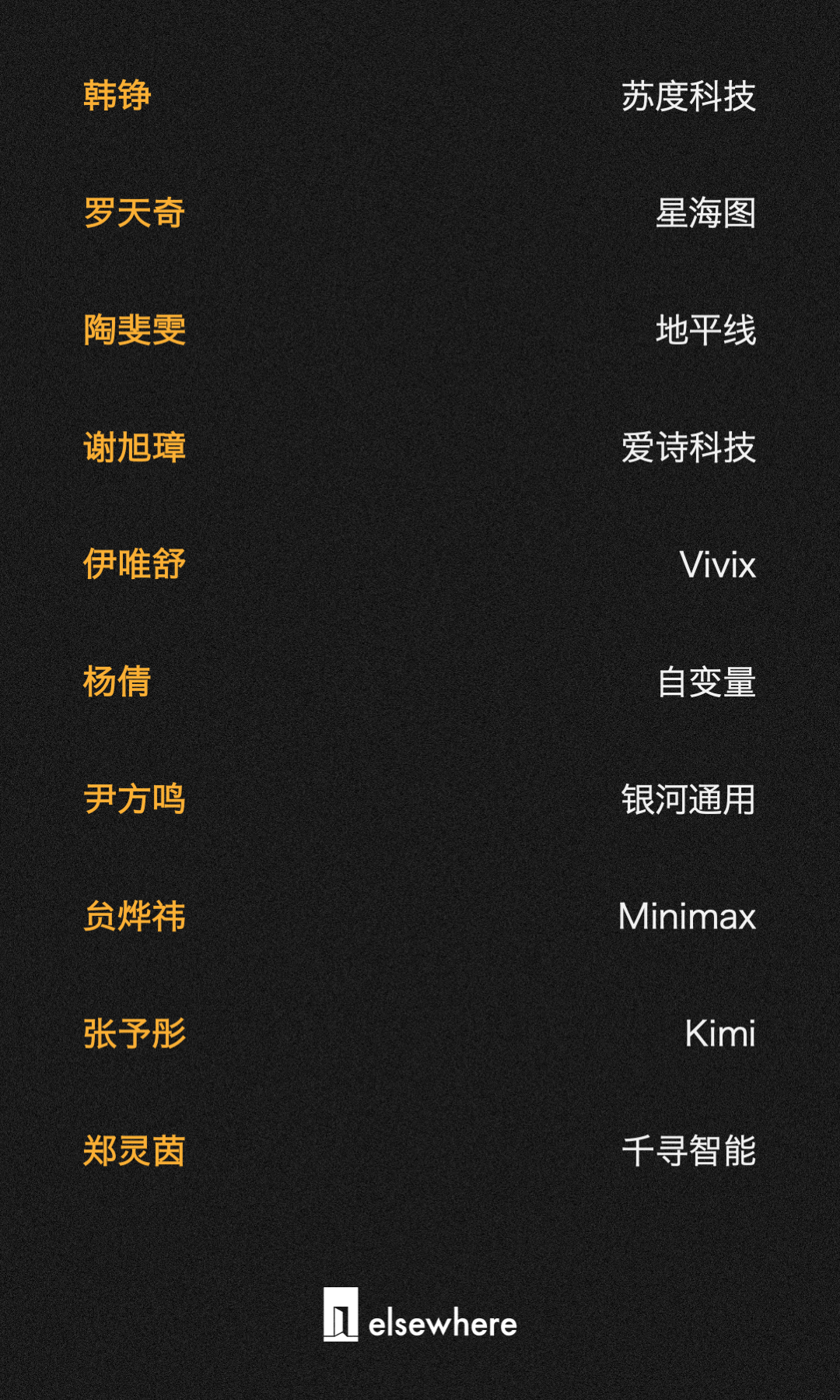
There's Yutong Zhang at Moonshot AI, Yeyi Yuan at MiniMax, and Vivian Yi at Vivix. Their titles vary: some are presidents, some are CEOs or co-founders, but their actual roles share a common thread — while algorithms and R&D remain primarily the domain of technical founders, most everything else that constitutes a company tends to fall on them.
Apart from a few who appear publicly on camera, most keep an extremely low profile. The spotlight falls on the CEO; they handle what the light doesn't reach: financing, people, finance, legal, government relations, PR, commercialization, and sometimes even product development.
Simply put, the CEO leads the chase for AGI; they make sure the people chasing AGI can function as a company.
He is somewhere.
She is everywhere.
Unlike the "number two" figures of the internet era — Joe Tsai to Jack Ma, Martin Lau to Pony Ma — the women in AI and embodied intelligence companies are often not traditional CFOs or COOs in the conventional sense: they typically don't oversee a single function, but rather the sum of nearly all functions beyond technology.
At some companies, the vast majority of non-technical departments report to them. Rank-and-file employees may rarely see the CEO, but will encounter them repeatedly in final interviews and business reviews; externally, unless the CEO's presence is absolutely required, investors, clients, media, and government officials will most likely meet with them instead.
An employee at one model company described the presence of the male CEO versus the female president this way: He is somewhere. She is everywhere.
In how they operate, some are meticulous about every detail, others cut through knots quickly — but without exception, they hold thousands of threads in their hands.
These responsibilities are easily lumped together as "things beyond the model," as if the model is the real work and the rest is merely operational trivia. But how you buy chips upstream, how you raise capital, how you drive C-end growth and B-end sales downstream — all of these ultimately determine whether a model can continue training, whether a product survives to its next version.
Training the model is certainly the central act, but a model's success has never happened solely inside a training cluster.
Therefore, they aren't completely walled off from technology. At some companies, they attend important meetings in the algorithms and R&D departments, jointly deciding with the CEO where to allocate resources, when to launch products, and how long a particular technical direction remains worth pursuing.
Through long-term engagement with the market, they've also grown more attuned to shifts in temperature.
Many model company employees have told me they pay close attention to: how far rival models have progressed, which benchmarks competitors are targeting; when a competitor closes a funding round, how close their cash reserves come to ours. Then, they turn around and help set direction internally with the CEO, pushing the pace.
Sometimes, they even need to be more stable and diligent as managers than the CEO himself.
A few months ago, one model company's training hit an impasse. The CEO's work rhythm slowed; employees privately asked again and again: "What's the CEO doing?"
Finally, a female co-founder sought out the CEO and forced him to re-examine several possible directions. She pushed him repeatedly to face reality: if the model doesn't work, the next round won't get funded; without funding, the company gets no next attempt. They fought many times before the CEO emerged from his paralysis.
This kind of relationship defies any single title. They are not the founder's subordinate, nor merely the person who cleans up messes. Often, they must believe in the founder's technical judgment, yet also pull him back to the table when he loses judgment or avoids it.
This also explains why what's most scarce in this position isn't any particular professional skill, but trust.
How does trust form?
Trust isn't built through a single funding round.
Whether or not they come from an investment background, their contribution to the company often begins with financing. But money is never just money. Alibaba's nearly $800 million for Moonshot AI, the late-2022 funding round that propelled MiniMax into the "Big Six" of large model startups, the rapid $1.32 billion valuation for Vivix — all carried strategic significance far beyond the capital itself.
Yet while there are many precedents of "investor turned executive," fundraising ability is clearly only the visible part.
When investors join companies, some remain stuck in the "head of fundraising" role, while others see their scope continually expand. The former can find money when the company needs it; the latter gradually get involved in operations, growth, organization, and strategy, eventually beginning to shape what kind of company it should become.
This certainly depends on experience and background, but the more critical factor is the capacity for continuous self-evolution.
Even during her GSR Ventures years, Yutong Zhang spent two years as head of operations at FunPlus. After joining Moonshot AI, her domain didn't remain confined to capital, but expanded outward from operations and growth. For who she is now, "increasingly unlike an investor" — presumably a very sweet compliment.
And the founder's trust in them is built bit by bit through this process: accomplish one thing, then take on another; understand both the technical vision and how to translate it into budgets, organization, product, and revenue; stand behind the founder, yet be willing to stand opposite him when necessary.
Conversely, companies without such a figure often suffer not from lacking someone to handle financing or PR, but from lacking someone who truly holds the organization together.
Perhaps coincidentally, on Xiaohongshu I noticed that the tech companies most complained about for organizational management almost all lack such a role. Though of course, it could also be that public sentiment has simply been managed.
Rumor has it that one company, talent-rich yet organizationally troubled and long poached by rivals, saw its number one fly into a rage and confront a competitor directly: "I'm suing you!"
Another number one wanted to pivot direction, only to discover he couldn't claw back budgets and resources already approved to subordinates. Business heads had become regional warlords; only then did he realize he wasn't actually a real manager.
As for "star teams" where members immediately seek out financial advisors to prepare independent funding rounds after a fresh raise — many investors have long grown accustomed to this.
High density of technical talent doesn't automatically generate an efficient organization. Quite the opposite: a gathering of smart, expensive, self-driven people often needs someone all the more to handle power, resources, and direction.
About organization, not gender
Which brings us to why so many women have emerged in this position.
This role often develops from investment, IR, strategy, and similar positions — fields that already had substantial female representation. This is first and foremost a demographic phenomenon of talent supply and career path formation, not something requiring explanation through stereotypes like "women are better communicators" or "women are more detail-oriented."
Of course, we've also found many excellent male examples in this role. Han Zheng, CEO of Sudu Tech, after two successful startups, helped translate his longtime friend suho's research into a company; Xie Xuzhang at AISphere, after shepherding round after round of internal fundraising, gradually stepped into the spotlight.
What truly merits attention isn't gender, but the organizational evolution of tech companies today. Rather than traditional "companies," "labs capable of commercialization" may be the more apt description.
In the past, CEOs were expected to handle "people, money, and operations" because technology, organization, supply chain, and distribution could all determine a tech company's rise or fall. But in today's tech companies, the greatest victory is first and foremost a victory of model or core technology. Technical founders devoting most attention to technology isn't necessarily lopsidedness — it may well be the right path.
From this perspective, the mid-game results of competition among the "Big Six" of large model startups are, to some degree, a victory of "scientist-CEOs" over "technically literate managers."
Today, CEOs need to present as technology idols more than ever. Many model company employees have told us their criterion for choosing where to work is: which company is more likely, and faster, to reach AGI.
For these repeatedly courted talents, they follow someone who can lead them to fulfill a grand vision. Perhaps this is why Sam Altman, despite his eloquence and commercial acumen, has long faced complex evaluations from Silicon Valley's technical circles.
But the more technology-supreme a company, the more it needs someone to catch everything beyond technology.
Thus some founders are even willing to relinquish the CEO title to find their own Yutong Zhang. In 2023, one model company's number one publicly posted a "hero wanted" notice to hire a CEO for himself. In casual conversation, many investors have mentioned being invited by portfolio companies to serve as CEO.
This doesn't mean business cedes ground to technology. Quite the opposite: it means scientist-CEOs have realized that as long as companies are composed of carbon-based life, where there are people there are rivers and lakes, and the loyalties and grudges of those in the arena don't dissipate with technological leadership.
Below is the list of "the other halves" collected by elsewhere. It should be noted that this is a highly subjective compilation. Their importance within each company may vary depending on whether you ask the individual, the CEO, or employees. Additionally, the list is not sorted by gender but alphabetically by name.
Cover image source: François Leclerc du Tremblay, L'Éminence Grise, 1873, Museum of Fine Arts Boston