How Are There Such Bizarre AI4S Founders

A new issue of elselier — a story so bizarre it's hard to know where to begin.
@Chen Zhiyan
One morning in early May, I walked into an office near Xixi in Hangzhou. The person I was there to meet had just been roused by a colleague, climbing up from the floor. He wore a dark gray fleece beanie pulled tight over his head, a purple short-sleeve compression top that showed off clearly defined muscles, and a long black skirt.
"Hippie, right?" he asked.
He's a 26-year-old guy named Odin (Zhang Haotian). A few months ago, he founded Valhalla Technology in Hangzhou.
What this startup wants to do looks almost impossibly ambitious: build a general-purpose AI model to understand the fundamental laws of life itself. From there, move AI beyond predicting molecular structures toward understanding, generating, and validating the interactions between biological molecules. Rather than the "expert models" that specialize in a single modality and can easily rack up short-term benchmark scores, Valhalla wants to build a foundation model for "full-modality connection."
elsewhere had come prepared to hear a dense AI4S story. What we got was something completely unexpected —
Two stints as a monk; joining then quitting a Nobel Prize lab; two bachelor's degrees and two master's degrees; obsessed with Norse mythology yet devoted to studying Zen; and finally, deciding to start a company building a world model pointed at the microscopic world.
Seen this way, a muscular man in a long skirt — that's actually one of the more understated details about Odin.
So even with a laundry list of labels attached — Baker Lab, AI4S, an education background spanning biology-physics-computer science, "prodigy" dropout turned founder — Valhalla didn't immediately set the VC world on fire. Maybe partly because Odin's story is just too bizarre?
This edition of elselier tells you Odin's story.
Flipping the Table
In 2023, Odin applied to Baker Lab (David Baker's lab). David Baker hadn't won the Nobel Prize yet.
"When I applied, I bet he'd win within two years. Didn't expect he'd win that same year."
But when Odin actually entered this world-class lab, it wasn't the pure academic world he'd imagined. Because of the Nobel effect, he said, the lab had become the site of a "globalized" struggle around scarce resources.
"The British and Indians are one faction; Americans are another; Chinese are another." So Odin spent enormous amounts of time preparing polished slides, playing the game of "making the boss believe I'm right."
He was miserable. One week, he drank an entire case of red wine and his weight shot up. After muttering "this is so stupid" countless times, he decided to leave, having spent barely over a year there.
This is just a small episode in Odin's life. But it fully exposes what drives so many of his choices: I've had enough.
In his final year of high school, he decided school would only make him mediocre, so he stopped going. Every day he'd wake at 5 a.m., bike ten kilometers to the library, and self-study until 10 p.m. before biking home.
In Shanxi winters, Odin never wore gloves while riding.

Photo and caption by Odin:
In this millennium I only love myself
A lonely stone fills the entire sky
He later got into Zhejiang University's School of Pharmaceutical Sciences, choosing physics as his double major. The two degrees' schedules constantly conflicted, so Odin simply stopped attending classes for either. He retreated to the library again, reading about general relativity, reading Einstein's biography.
By junior year, Odin was second in the physics school's graduate recommendation ranking. But because he wasn't officially a physics school student, a weighted algorithm pushed his ranking down.
Odin decided to make this public on the school's internal network. Facing teachers and administrators who tried to talk him down, he asked: "If I were the leader's son, would you treat me this way?"
He said that was the first time he realized fairness is sometimes a privilege, one only the powerful get to enjoy.
"You've read Animal Farm, right? All animals are equal, but some animals are more equal than others."
So he buckled down. Buried himself in the lab reading papers, generating ideas, grinding out models again and again on a single RTX 3090 in crude conditions. By graduation, he'd published his research group's first top-tier paper.
In that paper, published in Chemical Science and titled "Learning To Evolve Molecular Conformations From Thermodynamic Noise For Conformation Generation," Odin proposed how to simulate the intuitive process of "scattering particles randomly in water and, through constant collisions with surrounding water molecules, arriving at the final steady-state particle conformation distribution" — accomplishing this with deep generative models and achieving early-stage geometric deep learning for molecular design.
Even so, a thesis spanning physics, computer science, and pharmaceutical science earned only a 3.9 out of 5.0.
Sacrifice
Odin chose this English name himself.
The secondary reason was "it sounds a bit like my Chinese name." His Chinese name is Zhang Haotian — "the h in hao is silent, the t in tian is voiced." But mainly it's because of the name's best-known meaning: Odin.
In Norse mythology, Odin sacrificed his right eye to drink from the well of wisdom.
"I see wisdom at any cost. To gain wisdom and power, you have to sacrifice many things: family, love, even worldly fulfillment," Odin says.
The name also partly reflects his experiences.
When Odin was very young, his parents divorced. Throughout childhood, he shuttled between relatives, eventually living with his grandmother. Odin felt his grandmother always had a narrative of "pity" around him, of "having suffered so much."
He didn't like it.
"Pity knows nothing of respect for great misfortune, great ugliness, great failure," he said. "Pity weakens the one pitied, binding their mind and strong arms."
Later, pursuing the double degree often brought distress from being misunderstood; because Shanxi's gaokao didn't test listening, Odin's English was poor at first, and he spent three years grinding out language test scores; he also experienced the deaths of family members and the loss of a partner.
Odin says he's had three major transformations in life: realizing relying on parents is worse than relying on himself; realizing relying on a boss is worse than relying on himself; realizing relying on intimate relationships is worse than relying on himself.
Rebellion
The king's way is to be utterly alone.
This is Odin's favorite quote from his favorite historical figure, Yongzheng. "Firm and unyielding, none can steal his ambition; ten thousand thoughts cannot disturb his heart." Odin cited another line from Yongzheng Dynasty.
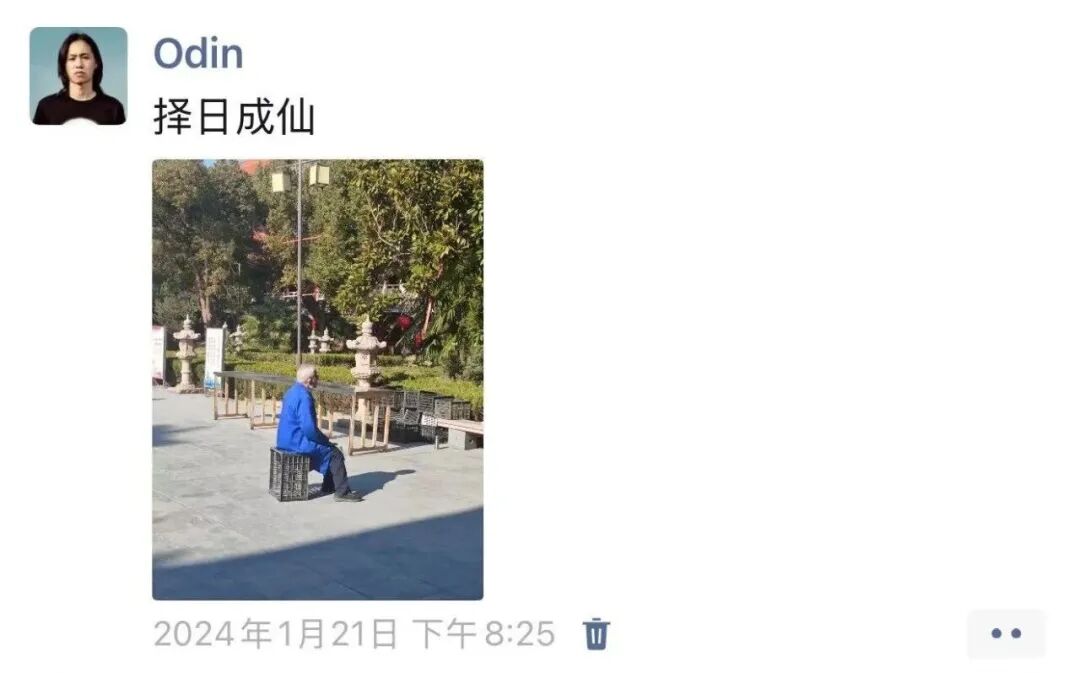
A WeChat Moment from Odin in 2024
In early 2025, to secure maximum freedom and control for his startup, Odin showed a remarkably strategic side.
From Seattle, he orchestrated remotely. Using the "Nobel Prize lab" brand and the competitive pressure of major tech companies eager to get involved, he persuaded a risk-averse domestic lab to accelerate its entry. Meanwhile, he reconnected with seven students he'd collaborated with at Zhejiang University and rapidly assembled a team.
To solve the problem of not having a PhD — which creates a series of obstacles in China — he leveraged a previously collaborated contact to convince a Hong Kong professor he'd only met once, who had already planned to stop taking students, to resolve his academic affiliation.
Xing Meng, partner at 5Y Capital and Odin's investor, told me he'd met nearly ten founders in similar directions in a short time, and Odin was the most striking. The factor that ultimately drove the investment decision: Odin's ability to integrate resources and achieve benchmarks within limited resources.
"With compute resources at one-fifth of the top-tier teams, without enough money to hire CROs for experimental validation, he still managed — through academic collaborations he pulled together and extremely limited compute — to produce data competitive with global top models," Meng said. "You can feel that his hunger for success is extraordinarily intense."
Odin once cited in an interview Nietzsche's concept of "master morality": true master morality isn't about self-restraint, retreat, or renunciation, but constant striving and creation.
Previously, as first author and co-corresponding author, Odin helped advance the ODesign open-source research project through Lingang Laboratory in collaboration with Shanghai Pujiang Laboratory, the University of Washington, Harvard, MIT, and other research forces — positioned as the world's first full-modality molecular design foundation model.
Simply put, Google DeepMind's AlphaFold solved the problem of "seeing" protein structures. What Odin wants to solve is the problem of "designing" molecular interactions — a world model pointed at the microscopic world.
But ODesign, as an open-source research project, still has distance to cover before becoming a true microscopic molecular world model. Odin's thinking began revolving around this question: how to evolve from a model that generates molecules into a system that can participate in the full real-world drug development pipeline?
This is the answer they seek. Under this logic, his technical roadmap can be summarized as:
- AI4Bio: First build profitable biological applications, serving pharmaceutical companies;
- AI4AI: Establish a self-iterating scientific research infrastructure that lets AI propose hypotheses and attribute like a scientist;
- AI4Phy: Ultimately connect the model to hardware, building a self-driving automated laboratory.
In the core team, CTO Kejun Ying and co-founder Jiaqi Wang both come from Baker Lab. Odin says he's CEO, to some extent CTO, and also the most frontline employee. For a startup, this "trinity" is crucial.
"Have you ever thought about why all founding emperors were warrior emperors?" Odin suddenly asked me. Then answered himself: "Because you can't just have vision, you have to lead from the front."
"Starting a company is rebellion," Odin said. Specifically: overthrowing the previous generation of AI for Science.
Practice
Odin has been a monk twice.
The first time was in first grade, in his hometown of Mount Wutai, Shanxi.
Because his birthday happened to fall on the same day as Gautama Buddha's, Odin began practicing with a master on Mount Wutai around age six or seven. He once spent three full months on the mountain, spending each day chanting sutras.
The second time was after graduating from Zhejiang University, at the Zhejiang Buddhist Academy for a short retreat. But he later realized he simply couldn't sit still — the kind of seven-day meditation without looking at a phone wasn't his "way."
Odin says he was evaluated as "having the root of wisdom" by his Mount Wutai master from a young age. His earliest practice leaned toward Pure Land Buddhism; as he grew and his understanding deepened, he gradually shifted toward Zen. Pure Land emphasizes precepts and other-power, while Zen's core lies in self-power, subtracting inner attachments and delusions.
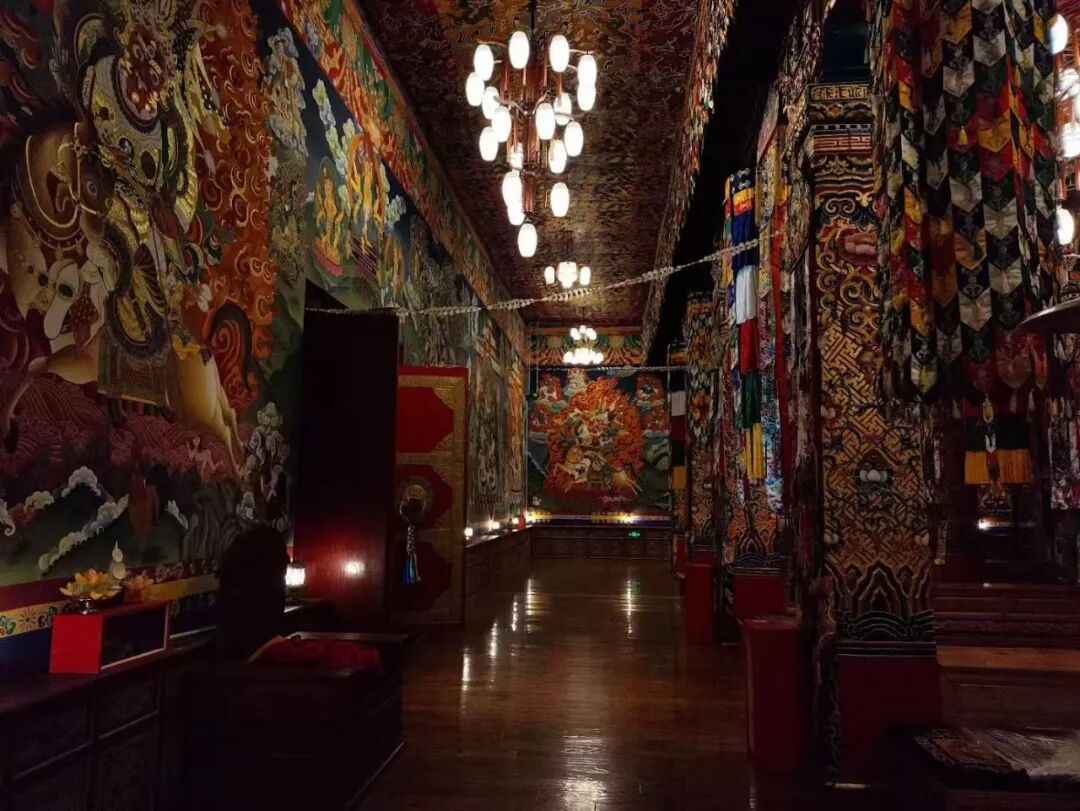
The temple where Odin practiced
The choice to study in America also had some connection to his Zen practice.
"I went to America looking for those hippies who were playful and brought beautiful visions to all living beings. But once there, I found America no longer has hippies. That era is over."
As for "becoming a monk," Odin's current framing is: "The Dharma is in the world, not apart from worldly awakening. To seek bodhi apart from the world is like seeking a rabbit's horn."
This comes from Huineng, known as the "Sixth Patriarch of Zen" — meaning Buddhist practice cannot be separated from daily life; seeking enlightenment apart from the world is as futile as looking for horns on a rabbit.
"To see Buddha you don't need to shave your head, you don't need to behave well. When you can feel the morning fog in the morning, and feel yourself feeling that fog — you've already seen Buddha."
Recently, Valhalla Technology completed its first funding round of tens of millions of RMB, led by 5Y Capital.
"Valhalla" comes from Norse mythology. It is the name of the hall Odin established in Asgard: Odin's handmaidens, the Valkyries, fly to human battlefields, select the bravest fallen warriors, and bring their souls back. The chosen einherjar train by day, feast and resurrect by night, building strength for the apocalyptic battle of Ragnarök, to fight alongside Odin in the end.
"If you ultimately succeed, what kind of world will that be?"
"A world full of creativity, where the power to create is returned to those who execute."
"What if you fail?"
"I don't really want to succeed. I just want the freedom to fail more freely."
The facts in this article are primarily based on Odin's account and do not constitute investment advice.
Cover image: Peter Nicolai Arbo, The Wild Hunt of Odin, 1872, Nasjonalmuseet