Even More Legendary Than Amen Ring Is Its Founder

It's not called Amen Ring anymore — please call it: Glorify Ring.
@Guo Yunxiao
When AI hardware first caught fire last year, elsewhere heard about a company with a rather unusual angle: a Gen Z founder building a smart ring for the world's billions of Christians — and raising serious money right out of the gate.
The exact company name wasn't clear; many simply called it the Amen Ring.
The next time we heard of it, the company had merged with an overseas software firm backed by a16z and others, boasting 25 million downloads. This, despite their ring product having yet to officially launch.
The company's real name is Confidein (referred to hereafter as Amen Ring), founded less than a year ago. Its core product is a smart ring that uses AI to assist with religious practice.
On May 20, overseas outlet CBN reported that Amen Ring and Glorify had merged under the unified name Glorify. The official product version is expected this summer, with the ring set to "gently vibrate throughout the day to remind or record the wearer's prayers."
Glorify, the acquired company, is a British faith-tech firm founded in London in 2020. It operates the world's largest Christian devotional app, having raised over $80 million from top investors including a16z and various celebrities.
According to elsewhere's reporting, Amen Ring has also completed several funding rounds with backing from multiple leading dollar-denominated funds, raising tens of millions of dollars. Post-merger, Glorify's existing shareholders including a16z will transfer directly to the new company's cap table.
On the day of the announcement, the company released a merger video. In it, Glorify founder Henry Costa and Amen Ring's co-founder sat side by side, alternating as they explained the decision.
Open the new company's website today, and you'll see almost nothing but the ring.
elsewhere saw its pre-production sample in April. By then, its design and functionality matched what appears on the site now. During that meeting, Amen Ring founder Leo also mentioned the merger in progress — and how he would lead this new company to greatness as its incoming CEO.
We were deeply skeptical whether this 24-year-old could pull it off. Now, skepticism has turned to curiosity: how exactly did he do it.
This edition of elselier presents the story of Amen Ring — or rather, Glorify CEO Leo.
The Mystery
One of Leo's investors went from first hearing about the merger to its completion in roughly three months.
He spoke with Leo once during that period; Leo told him he'd "gotten much better terms than last time." The next time they spoke, the deal was nearly done. "Leo moves incredibly fast," he said.
Another Amen Ring investor told me that every time Leo came to update him, the merger was further along than before. Working with Leo, he felt, often went like this: "Every time you see him, his story has advanced."
But the process itself remains a mystery. At this point, it had been just over six months since the first funding round.
Before the merger closed, most investors were themselves uncertain. A large part of this was that they hadn't actually been at the negotiating table. Most of the communication happened directly between Leo and Glorify founder Henry Costa.
The two companies hadn't interacted much before; at most, they were both faith-tech startups.
Their only prior intersection came this February, when they co-hosted a small event in Los Angeles. Leo flashed by in the event video.
Someone close to the original Glorify tried to analyze why the six-year-old company made this decision: as a niche-market product, its scale couldn't truly compare to general social products, and long-term commercialization efficiency was never that high; founder Henry Costa came from a prominent Christian family, and religion clearly mattered more in his life than the business he founded; plus, some shareholders had exit needs. So a merger like this made sense.
Another fairly important reason: the original team and shareholders including a16z also saw, to some extent, the potential of hardware-software integration — a smart ring worn at all times could create new interaction paradigms and business models.
According to Leo's account, post-merger, the original Amen Ring team will lead the new company's future, while the Glorify brand is preserved, and most shareholders including a16z will enter the new company's cap table.
In the merger announcement video, Amen Ring's co-founder also explained the branding decision: "We chose Glorify because this name already means so much to tens of millions of users worldwide."
Leo sees the merger not just as a business decision, but as a mission. In his eyes, combining a software company with a hardware company gives the new firm a shot at becoming "the Apple of faith-tech." When people look back at this century's history of faith, Leo wants this company to have a place in it.
"We are making history."
The most critical part of this somewhat improbable merger happened across just three days.
Henry Costa flew from London to Los Angeles and spent three days with Leo.
Leo told us that over those three days, they barely discussed product, terms, or valuation.
"We just talked about me." The things he told us — where he came from, his family's life in America, how he came to faith, what he wanted to build. Leo said he simply told Henry all of this. Three days later, Henry flew back to London. After that, the merger happened.
We asked Leo: during those three days, what did he think most moved the other side?
"I don't know," he said. "I really don't know."
The Miracle
Smart rings are a category of智能硬件. Finland's Oura Health (commonly known as Oura Ring) dominates over 70% of this market. Since 2013, Oura Health has raised roughly $1.5 billion, currently valued at about $11 billion, with recent reports of an IPO filing.
Beyond fashion, Oura Ring focuses on health monitoring. But there's another use case — like the rumored 4 million units sold in the Middle East of the Zikr Ring.
The key difference from Oura Ring is that this type of religious ring serves human faith practices, using the ring's counting function to replace traditional implements. The Zikr Ring comes from iQibla, a smart ring company founded in 2021.
Leo's smart ring attempts to combine both: the advanced features of a smart ring, plus AI model capabilities in software; not just recording oneself, but also transmitting prayers to others.
The sample we saw in April closely matched what's on the website: matte texture, woven pattern, a recording indicator light in the center of the ring. Its interaction method is interesting — wear it on the index finger, trace a cross with the thumb, and it activates.
Leo said this idea "might have been given to him by God."
Less than a year ago, he had just finished growth work at his second startup. During the Los Angeles wildfires, he created a website called Pray for LA. People could leave their email and write a prayer; for each verified email, he'd donate seven cents on their behalf. This time, he donated $200,000 and collected over 2 million email addresses.
He later discovered — many people were bringing recording devices into church. Talking with many of those who'd left emails, he found this group might need hardware that was discreet, dignified, and didn't compromise audio quality. A ring might be the most fitting form.
He started figuring out rings from scratch.
Many hardware founders have told us that hardware is a "no turning back once the bow is drawn" affair — once you open molds and mass-produce, that generation is essentially locked in, and the first-generation product almost determines the company's entire future. So hardware product definition is critically important, requiring some product manager skills and intuition, ideally with some industry experience.
Leo's advantages clearly weren't in these areas. He approached the problem from another angle: do users need this?
This is something many hardware founders don't necessarily figure out, but Leo had his method. He first made a simplified ring version, costing less than overseas shipping, with only NFC functionality — phone taps in, a Bible verse and prayers from strangers pop up. Within three weeks of launch, nearly 200,000 Christians had ordered this product.
He knew the direction was probably right.
"Two shockingly low-cost customer acquisitions," one investor assessed.
Leo himself doesn't see this as any clever trick. He believes both growth spurts were entirely based on goodwill — goodwill builds trust, trust builds brand. In his view, the most important thing in the AI era is having your brand occupy users' minds, and the greatest asset he's built over the past six months is that in users' minds, Amen Ring (Confidein / Glorify) has become synonymous with "Christian Smart Ring."
During that wave of AI hardware entrepreneurship, investors placed substantial bets on people with backgrounds at major hardware manufacturers. Even expanding the scope, in most eras and most fields, people with growth, marketing, and market backgrounds sit at the bottom of the entrepreneurial hierarchy.
But in the eyes of investors who bet on Leo, this "growth person" is "an outlier."
Returning to Leo's upbringing: he moved to the US with his family at a young age. Initially his language skills were poor — he could barely follow classes, let alone communicate. At 13, he transferred to a Christian high school, and gradually integrated into local life. At 18, he dropped out of an American university to start a company. After that, he worked at two more star startups.
In late 2022, Leo's grandmother was diagnosed with cancer, already mid-to-late stage. During those darkest days, he alone in the family persisted in daily prayer. Later, his grandmother's cancer cells completely cleared. For the entire family, this was a "miracle" that medicine couldn't explain.
Leo said that was when he first truly understood the weight of the word "faith."
Leo told us these things, presumably to express the various connections between his life and religion.
When I asked his investor: aren't Leo's stories a bit too miraculous? The reply was, even discounting them, Leo remains an exceptionally outstanding founder.
All the groundwork is laid. Now we wait for the ring.
This article's facts are primarily based on Leo's account and do not constitute investment advice.
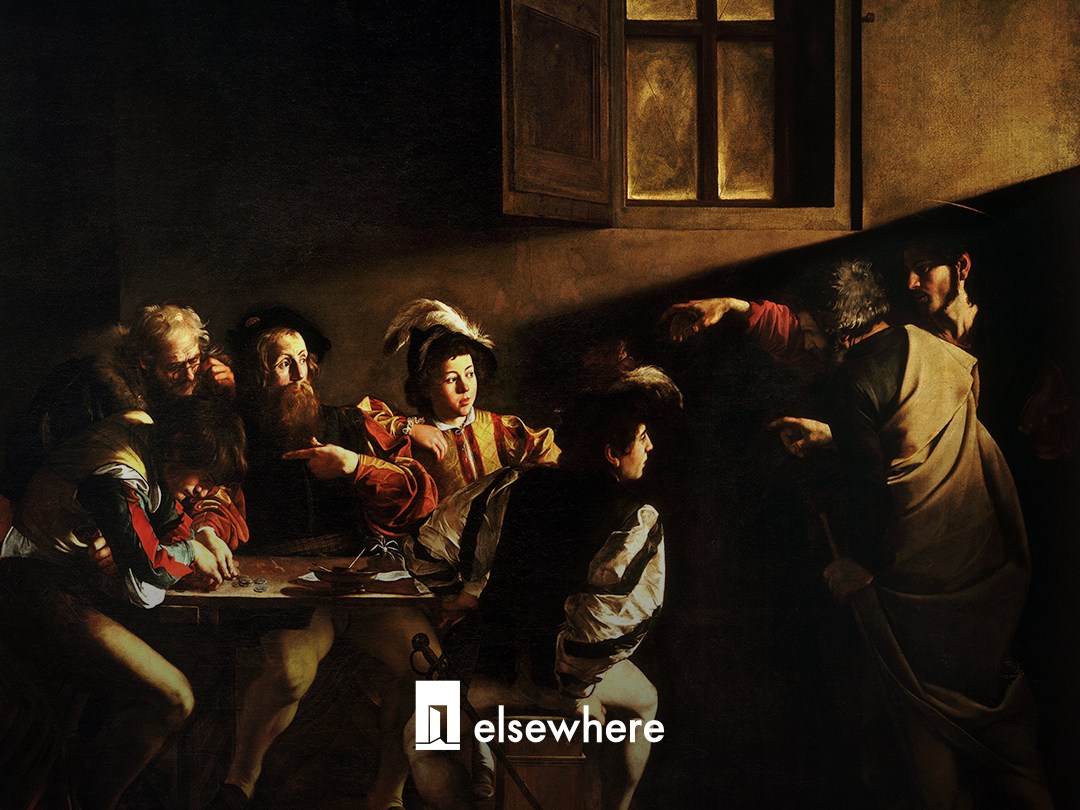
Cover image: Caravaggio, The Calling of Saint Matthew, 1599–1600, San Luigi dei Francesi