Wang Xinming: I'm China's Biggest LLM Wrapper, and I'm Not Ashamed of It at All丨elselier

He was about to lose his job, but he became one of the first people in China to get access to ChatGPT.
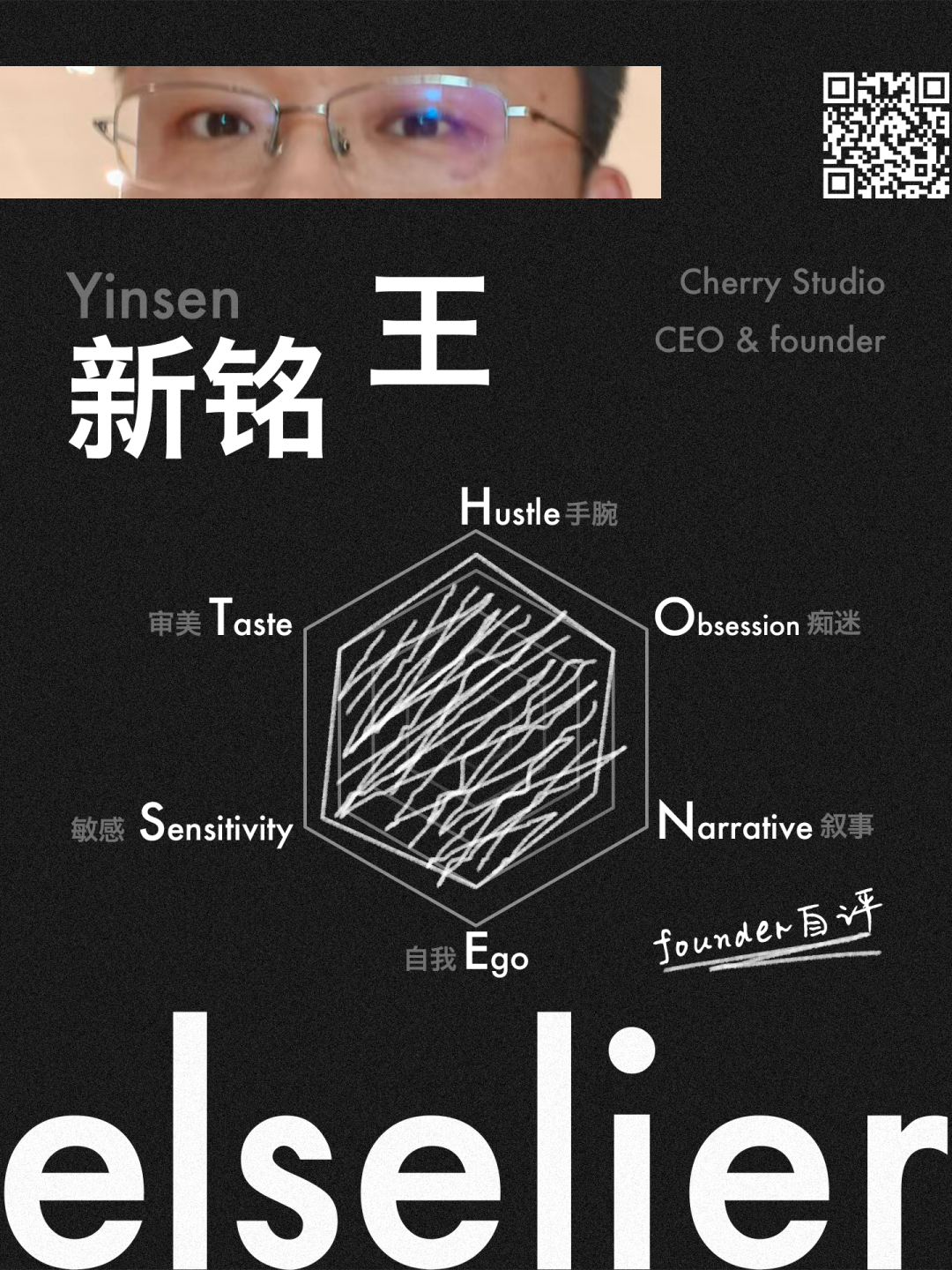
@Zhiyan Chen
1. Wang Xinming, who goes by Yinsen, was born in 1990 in Linyi, Shandong. He founded Cherry Studio in 2024 — a startup that began as a "wrapper" for large language models and evolved from a simple chatbot into an all-in-one AI workspace.
2. After OpenClaw went viral, Yinsen said his team did two things: enabled one-click deployment, and gave Cherry Studio's Agent autonomous mode.
3. Yinsen believes Claude Code marks the arrival of the "native era" for Agents. Its open underlying SDK gives it real ability to get things done — good news for him, since he's a tool-oriented product manager who has never used Douyin or Xiaohongshu.
4. He scoffs at teams claiming to have built Agents stronger than Claude Code: "Bullshit." His reasoning: a large model's capability is determined by underlying compute and data; an Agent's execution depends on deep ecosystem integration.
He argues that before foundation models achieve qualitative leaps, any claim to surpass native Agent capability at the interaction layer is essentially manufacturing hallucinations for users, violating common sense about how technology evolves.
5. Cherry Studio just closed a multi-million-dollar seed round led by 5Y Capital and Guanghe Venture Capital.
6. Yinsen initially met investors at Cherry Studio's first office in Nanxiang, Jiading District, Shanghai — a 50-square-meter space in an old factory building renting for 3,000 yuan a month. The highway ran right alongside it; when trucks and freight vehicles passed, the whole building shook. There weren't enough chairs, so co-founder Wang Qian brought old camping chairs from home to fill the gaps.
7. Cherry Studio was born from a simple kind of geek anxiety. In 2024, Yinsen was furious after his Claude accounts kept getting banned and his ChatGPT Plus subscription hit restrictions. Drawing on years of "product manager's intuition," he wanted to build a pure client-side wrapper that could pipe in APIs from every model.
8. Beyond Yinsen and Wang Qian, numerous developers contributed to Cherry Studio's development and iteration — including graduate students still in school. Yinsen reimbursed them $100 a month for model subscriptions, and even used Meituan's corporate account to order 30-yuan takeout for their late-night coding sessions. This model pushed Cherry Studio to an astonishing weekly release cadence.
9. He found Wang Qian on GitHub. When they started talking, they discovered they both lived in Nanxiang — their apartment complexes just 800 meters apart. That's why Cherry Studio's first two offices were both far from downtown Shanghai.
10. In that Nanxiang office, one investor clearly sensed that Cherry Studio, tucked away in the periphery, was lacking ambition. Just as this investor was earnestly telling Yinsen to "dream big," the screw on Yinsen's camping chair fell out as he straightened his back. The investor said: "See? You can't stay here."
Not long after, Cherry Studio moved to Xuhui West Bund — Shanghai's most intense AI battleground.
11. This isn't Yinsen's first time in the AI赛道. He worked as a software product manager at Yitu Technology, one of the "Four Little Dragons" of AI. The place was packed with PhDs from Tsinghua, SJTU, Fudan, Zhejiang. "I didn't even graduate from a tier-two university. I was probably Yitu's first hire with such a weak background."
He used to joke with colleagues: "If you've ended up at the same table as me, you should reflect on your life choices."
12. His time at Yitu let him see through the limitations of the previous generation of AI — surveillance and recognition. That era's AI was essentially a "person, vehicle, non-vehicle" identification system, structuring pedestrians, cars, and non-motorized vehicles as surveillance targets. It was fundamentally a tool with strong overtones of control and monitoring, not "intelligence" meant to liberate productivity and empower ordinary people.
13. So when he started Cherry Studio, "how to use AI to transform real productivity" became his central concern. This also shows in Cherry Studio's interest in B2B. Their existing enterprise clients came to them organically — including a sow breeding company looking to use AI to optimize its farming protocols.
14. Cherry Studio's approach to B2B going forward is a bit different too. "Sales" aren't on the company roster but scattered everywhere — he calls them "super individuals." Yinsen has observed that these super individuals need AI tools like Cherry Studio to maintain their "professionalism" and productivity. Through their evangelism, he wants to ride that momentum to achieve the lowest-cost commercial expansion possible.
15. "Underdog mentality" is something you strongly sense talking to Yinsen. But it has nothing to do with his less-than-elite educational background — it comes from his genuine faith in technology.
For instance, he rejects anything that puts "crutches" on AI. He wants Cherry Studio to be a small wooden plank that rises with the water level. "Humans already can't understand AI, so don't try to explain it — feel it."
16. Yinsen's career began as a "postal order student." In that tradition-bound environment, his fate was supposed to be sitting behind a post office counter with an iron rice bowl for life. He was the only formal employee among six people at his branch.
The daily routine: wearing his uniform to handle deposits and phone top-ups at the counter, then hauling fertilizer to tractors in the backyard, then coming back to fingerprint-authorize savings transactions for temporary workers.
17. Between leaving the post office and founding Cherry Studio, he had six stints as an employee — at PPTV, Ximalaya, ByteDance, Yitu Technology, and Black Shark Gaming Phone.
18. What changed his postal fate was buying a first-generation Xiaomi phone in 2011 with money borrowed from his father. He installed virtually every app he could find and sent product suggestions to some of the developers. One Shanghai company among them was impressed by his product sense, and his life took a turn.
The story didn't end there. Ten years later, when Lei Jun refunded that 1,999 yuan, he bought a Xiaomi air conditioner for his hometown.
19. In October 2022, six months after joining Black Shark, rumors of the company's impending collapse were everywhere. A major acquisition by a tech giant had fallen through, and Yinsen's time at Black Shark entered "garbage time." A company that once had 1,000 people was down to fewer than 100. He sat in an office so empty it echoed, surrounded by vacant desks, spending his days opening web pages and reading news.
On the first day of December, he saw news about ChatGPT and immediately bought a US phone number. A week later, after receiving the SIM card, he registered an account. "I was absolutely among the first people in China to use ChatGPT."
20. ChatGPT fulfilled everything Yinsen had imagined about AI. The first time he used it, he even suspected there was a "Silicon Valley foreigner who understood Chinese" sitting behind the screen.
21. Back in 2017, Yinsen wrote an essay titled The AI Revolution on his personal WeChat public account. He predicted AI would replace large amounts of mental labor and that social wealth would generate itself. But to this day, his old father in Shandong still asks him: can you just find a "proper job"?
「elsewhere」Commentary:
Yinsen and his investors both describe him as someone "not great at expressing himself." He gave himself a 3.5 on Narrative — the lowest score across all his self-assessments. But every vivid detail above came straight from his own mouth, so I'd say it deserves at least a 4.5.
After nearly three hours talking with Yinsen, he absolutely belongs to the category of founders who can tell stories — not stories to VCs, but stories to humans. So here's the question: someone who worked for over a decade before leaping into entrepreneurship — is Yinsen's ego large or small?
We're still looking for elseliers.
Cover image: Pieter II Brueghel, $2, c. 1615, Museum of Fine Arts Ghent