If God Did Not Exist, It Would Be Necessary to Invent Him

A New Take on AI + Gaming
@Chen Zhiyan
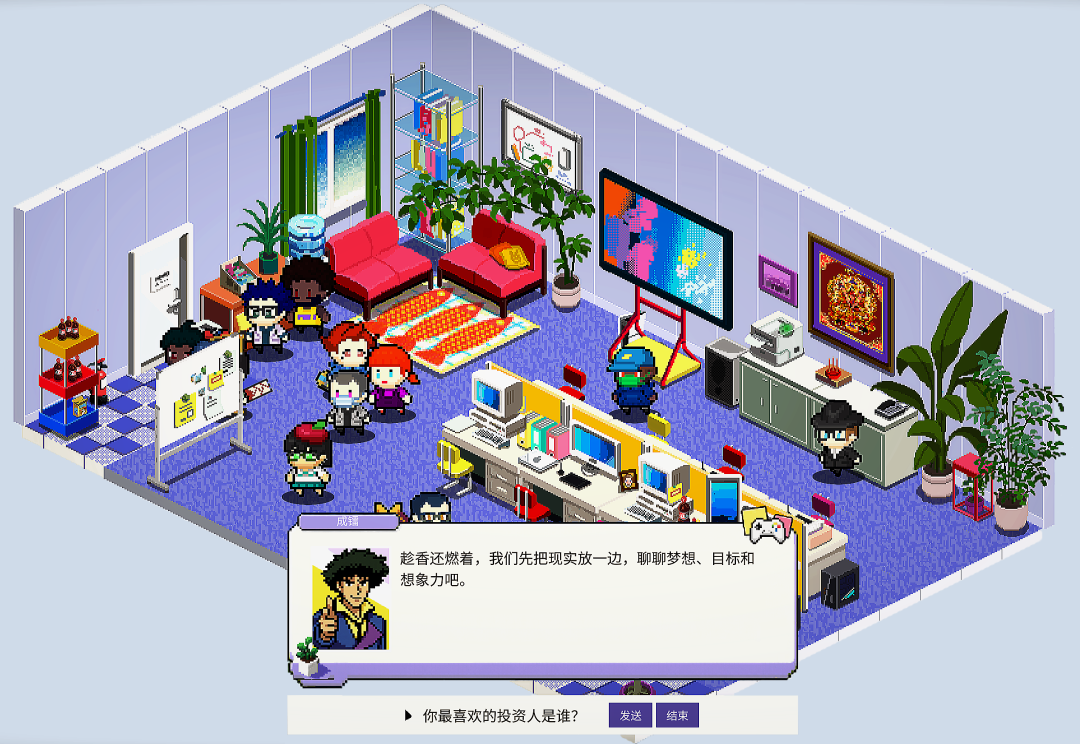
A startup recently built itself a "cyber office."
Open its website and you step into a pixel-art office, a one-to-one digital replica. A dozen digital avatars move between desks, attend meetings, sit down, stand up. These are the actual employees' virtual selves. You can watch them work like fish in a tank, talk to them, or corner the founder Cheng Lei and ask: are you hiring?
The company is called Talespark. Its physical office sits in Shanghai's West Bund Model Speed Space — a "real-world version" of the digital one.
Talespark just closed an angel round of tens of millions of RMB, led by XVC.
Walking into Talespark's office feels like entering a small botanical garden. Between the plants you'll find COC and D&D tabletop modules, game consoles from different eras, vintage Touhou Project figurines, original art books from Cowboy Bebop, Stanley Kubrick film posters, a portrait of Alan Turing, even a red clay relief of the God of Wealth. Visitors who drop by often joke that it's "the 5A-rated scenic spot of Model Speed Space."
That a real office could become an enterable, observable, interactable digital world hints at what Talespark is actually building: they want to create a world that exists across different media, populated by living NPCs, one that always remembers its users.
Converging Paths
What Talespark is trying to do has roots going back ten years.
What pushed Cheng Lei toward games wasn't just that he was a player — beyond traditional RPGs, he's deeply into murder mystery games and live-action role-playing. More importantly, during his decade in content, he kept seeing the same thing: talented creators weren't scarce, but works that reached users were.
After graduating from The University of Hong Kong's literature program, he worked on the IP adaptation for season one of Joy of Life. At the time, adaptations of male-oriented web novels rarely succeeded. The team had to reengineer how audiences entered the story — rewriting Teng Zijing, a minor character from the novel, into Fan Xian's first true friend in this new world, then killing him off to carve out the overpowered protagonist's first real loss. Joy of Life became a landmark in male-oriented IP adaptation. But by the time it aired, Cheng Lei had already left; his name wasn't in the credits.
Part of why he left: plenty of quality content never even got a chance to be judged. "Because there was no data."
Back then, the film and TV industry measured whether a story was worth making by web metrics. Unknown authors, works without existing traffic — they never made it to the next round of discussion.
Later he returned to Shanghai and encountered murder mystery games.
What excited Cheng Lei was that behind this suddenly popular offline interactive entertainment, there was a group of "scriptwriters": young, writing anything and everything, stories set anywhere in the world. Cthulhu, Norse mythology, Japanese Warring States — nothing was too niche here. Some works could be translated and sold directly to overseas venues, ready to use. Genres that traditional channels couldn't accommodate grew naturally.
Cheng Lei remembered a set of figures from different statistical sources, but striking enough: in 2021, the murder mystery game market neared 20 billion RMB, with maybe 5,000 frontline creators; meanwhile, web fiction had over 20 million creators but only a 30 billion RMB market. This convinced him further: China doesn't lack creators, it lacks new forms that can carry them.
"China doesn't lack excellent written content creators. A new interactive entertainment form could open up an entirely new market."
With the emergence of large language models, Cheng Lei realized AI could fill in the missing people. Two humans log on, the rest are AI characters — a multiplayer interaction could start anytime.
So Cheng Lei spent half a year building an AI-driven CRPG (computer role-playing game) demo.
The story was set in the underworld. Seven people had died in the same chain of mistaken killings, each holding only one fragment of the truth. Through interrogation, deception, and trading clues, they had to reconstruct what happened that night. Two humans, five AIs. One session lasted forty to fifty minutes; different people, different endings.
Cheng Lei had never made games, and didn't have much R&D budget. He posted a recruitment call on Xiaohongshu, talked to around a hundred people, and gathered a dozen netizens from across the country who built the demo "for the love of it": a 3D environment where two humans could connect to the same session and search for truth alongside five AI characters.
At the time, most AI+game projects on the market were still in text, 2D, or single-player form. Something you could put directly in front of users and let them play for forty minutes was rare.
You could also see this demo as a proof of concept: verifying whether creators could use AI to bypass parts of the old chain, letting stories reach users in new forms more directly.
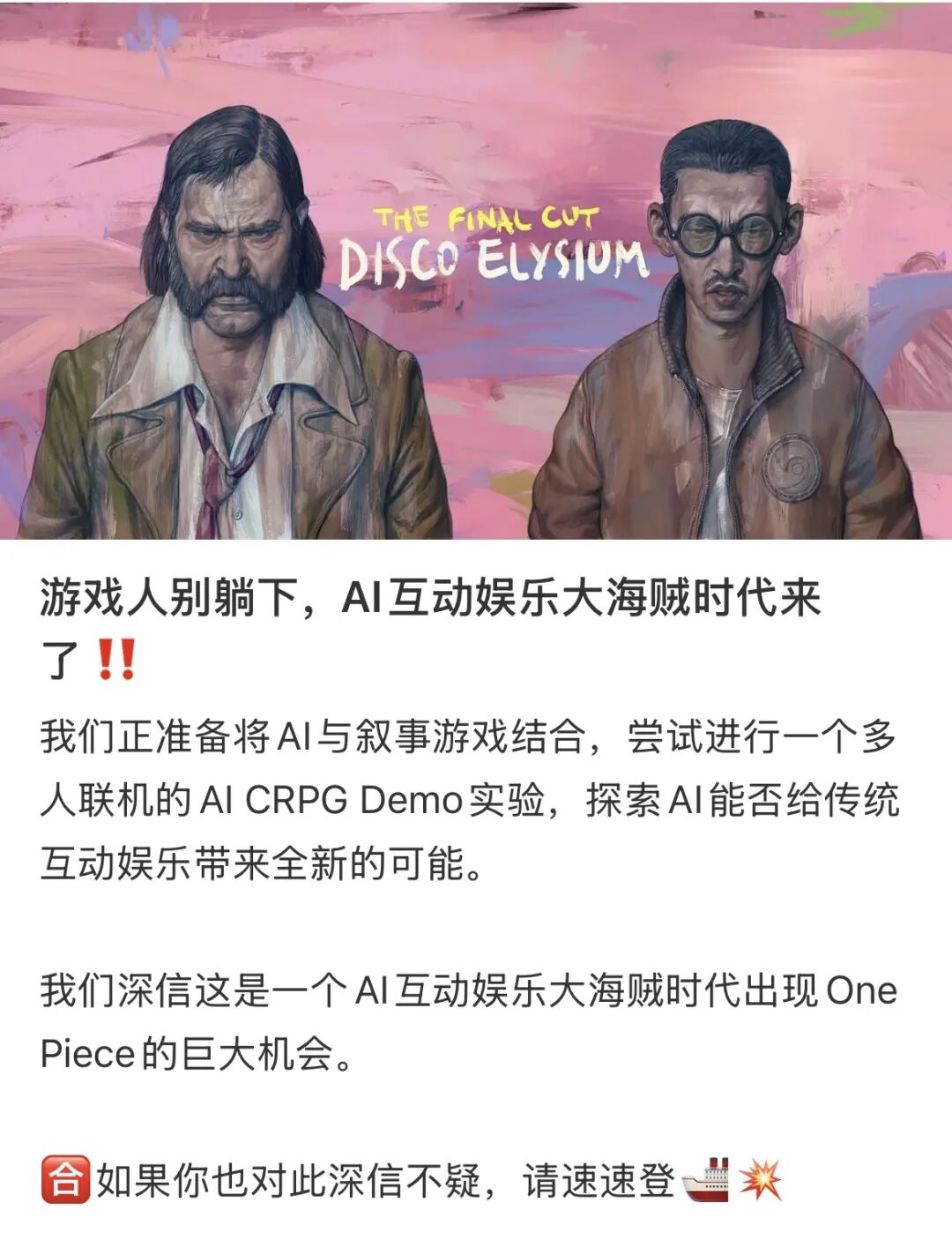
For his recruitment post, Cheng Lei chose Disco Elysium as the featured image. He said he picked this CRPG because it naturally accomplished "aesthetic filtering."
As Cheng Lei approached this problem from the content side, Rolan was approaching it from another direction.
During the years Cheng Lei worked on IP development, after earning his master's at the University of Southern California, Rolan went to The Chinese University of Hong Kong for a PhD. In his second year, wanting to build "something useful," he dropped out to join Tencent, starting in search and natural language processing. Soon after, AlphaGo defeated Lee Sedol, AI became a strategic priority for major tech companies, and his team was reorganized into Tencent AI Lab.
Later he joined a sub-studio under TiMi, becoming a project's AI lead. Some side project explorations led him to discover that AI + narrative RPGs represented huge potential.
As he went deeper, he realized that in "large-DAU competitive games," AI fill-ins solved "does it play like a human," but in RPGs, AI had to solve "can it create an experience for the player." It didn't just need to seem human; it had to provide clues, generate conflict, maintain pacing, create a complete experience for the player. An AI-driven NPC that only pursued its own goals — the more agency it had, the more likely it was to leave the player hanging.
In Rolan's words, creating an AI NPC that truly serves the player with clear objectives, "isn't called being human-like, it's called content."
But in a major tech company structure, AI teams understood models, game teams understood experience, and content teams cared about characters and story — three capabilities naturally separated by organizational structure.
A new track required a new kind of team composition.
Cheng Lei, who understood content IP and wanted to find new outlets for creators, and Rolan, who wanted to bring AI systems into narrative games, walked toward the same gap from different directions.
Together, they founded Talespark.
A Director Who Builds Worlds
What would an AI Native game look like?
Talespark's solution: create a director, and put agency behind the scenes in the control room.
This resembles the film The Truman Show. NPCs are responsible for playing characters like real people; the hidden director observes all players and characters. It knows who has received clues and who remains in the dark; decides when to mobilize characters, create conflict, when to introduce new information; when players deviate from the intended path, it doesn't immediately stop them, but adjusts feedback through other characters and events; when necessary, it must also gather scattered story threads back together.
Talespark wants to first implement this controller as an Agent — they call it the World Director.
In Rolan's framing, all game design must answer one question: the player does something in a certain state, what happens to the world next? Traditionally, these responses were hardcoded by designers — attack a character, use an item, complete a quest, the system enters the corresponding state based on preset conditions. The more complex the game, the more situations needed to be enumerated in advance.
Past "open world games" achieved so-called "emergence" mainly through physics and chemistry simulation: collision, gravity, and elemental reactions could be expressed with finite rules. But human nature, relationships, and social behavior can't be exhausted by a few formulas. Before large models, games could only approximate them with massive conditional branching.
Talespark is trying to reorganize this core logic (Game Core) into an Agent that can understand context, make judgments, and call game tools. The World Director continuously reads the states of players, characters, relationships, and environment, understands what the player just tried to do, then decides which character to mobilize, what event to trigger, and how the world should change next.
Compared to traditional games, Talespark hasn't eliminated design — just changed where design happens.
Creators still handle worldbuilding, characters, key conflicts, aesthetic boundaries, and closure points; the game engine continues processing movement, space, items, and combat; NPCs handle specific performance. The World Director stands between this content and these systems, organizing intentions that previously weren't written as buttons into responses consistent with this world.
However, a world that can respond in real-time isn't yet alive. If after one interaction, relationships, misunderstandings, and unfulfilled consequences all reset to zero, it's still just a more flexible chat window. So the World Director must also sediment what has happened. What it preserves isn't just "quest completed," "affection +20," but semantic records that can be reread: who helped whom, who misunderstood whom, who owes an unclaimed favor, what remains unresolved.
These records stay in the world, gradually forming a new kind of player asset — experience.
"Experience assets" aren't just equipment, levels, or saves in the traditional sense. They're "who remembers you, and what they remember." In such a system, even if two players say the same things and do the same actions, outcomes may differ because their contexts differ.
The simplest understanding: the World Director doesn't just make the world respond to players in the present; the accumulated "experience assets" also make responses continue to matter in the future.
This system also addresses the questions Cheng Lei and Rolan initially approached from different directions —
For players, the question upon entering a game shifts from "what does the system allow me to do" to "what do I want to do"; what they consume is no longer just a pre-completed plot, but a history accumulated together with the world, belonging only to them.
For creators, this system tries to reduce the labor of exhaustively branching narratives, letting them focus more on characters, conflict, world rules, and aesthetic judgment. AI handles some on-the-spot organization; creators still decide what's worth happening.
From this, Cheng Lei hopes that new-era creators who never entered traditional content industries but possess narrative ability and global vision might gain a new content outlet.
Longer-term, once "what the player has experienced" can be stably preserved, it needn't be permanently bound to any single game. The same relationships, reputation, and unfinished stories could be a PC Agent RPG, a mobile NPC chat entry, a card-based relationship mechanic, or a lightweight web interactive scenario.
Talespark calls this vision Multi-end Pluggable — the same experience context plugging into different frontends. But this remains the team's long-term vision, not yet a shipped product capability.
Games are just the first entry point they've chosen, and the first "model home" to validate whether all this works.
New Worlds Need New Teams
Talespark isn't the only team that believes AI will change games. In recent years, model capabilities have rapidly entered the gaming industry, but when different teams say "AI games," they're not actually pointing at the same thing.
What landed first were production tools: using AI to generate concept art, models, animation, voice acting, and copy, assisting programming and game testing. Another route is AI NPCs — models embedded in individual characters, letting them converse naturally, maintain persona, remember players, even make corresponding expressions and movements. Some teams try to lower creation barriers further: users input text and generate characters, scenes, or a lightweight game.
These routes respectively answer three questions: how games can be produced faster, how characters can become more human-like, and who can become a game's creator. Talespark is betting on another layer: when a player enters an interactive content, how does the entire world actually run.
This doesn't mean they don't need generative tools or realistic NPCs. The difference is, Talespark doesn't see generating more assets, making individual characters more human-like, or "generate a game in one sentence" as the endpoint. These capabilities must be placed into the holistic experience organized by the World Director.
This path in turn determines what kind of people Talespark needs: content, game mechanics, AI, and engineering — four capabilities must be present simultaneously.
Content judges what's worth happening; design translates story into objectives, actions, and feedback; AI understands model capability boundaries; engineering makes all of this run stably in a real product.
In traditional game development, different roles could hand off sequentially along a pipeline. The World Director requires them to jointly define experience from the start: how characters are written affects how models perform; what models can reliably accomplish changes mechanic design; whether an unexpected emergence is delightful or erroneous ultimately still requires content aesthetic and player experience judgment.
The addition of M, head of R&D, was key to this team taking further shape.
Back when Cheng Lei was assembling the Xiaohongshu team for the demo, a programmer suddenly quit and locked some code. At the time, M — then CTO at another AI game studio — out of "chivalry," stayed up consecutive nights helping Cheng Lei restructure the technical architecture. This help forged a deep friendship. Later, when M had philosophical differences with his original team, he joined Talespark to lead R&D execution.
M experienced early mobile game commercialization, did research on AI-game integration, and once led a team shipping an AI Native game from R&D to Steam release. He knows how a prototype can seem stunning in demo, and how the same system can fail in a real product against latency, costs, state errors, and unmaintainable code.
Other team members come from Hypergryph, Perfect World, Tencent Hunyuan, ReelShort, CCTV Animation — spanning film, animation, games, internet, AI, and other industries.
But people from different backgrounds sitting together doesn't automatically form an AI Native team. The thorniest part is how to transform model capabilities into controllable, sustained, and fun interactive content.
In traditional games, there are mature tech stacks and production pipelines, and practitioners are accustomed to first defining the gameplay end-state, then breaking it into rules, numbers, and code. When Talespark Agentized part of the Game Core, that determinism was broken.
Rolan summarized this tension as: "You need experience, and you must abandon experience."
"Early on when communicating with the artist responsible for animations, they didn't understand why we couldn't list explicit animation sequence requirements. Until they realized the animation system would become part of dynamically issued agent instructions."
Talespark spent months磨合 and developed a parallel approach: one line continuously building the World Director, another line probing its boundaries with different frontends.
Currently, the first "model home" is planned as a PC RPG, codenamed Project S, expected to launch on Steam in early 2028. Cheng Lei said: "First get Harnessing out, get the architecture running, establish the first living world, then the platform will naturally grow."
During production, Talespark will also release web-based AI lightweight games and AI interactive film-games within the same worldbuilding, to test the envisioned Multi-end Pluggable effects.
Of course, many questions remain for Talespark to answer. Can the World Director maintain character and world consistency over long runtime? What experiences should be saved, what details forgotten? And that most fundamental one — is it fun enough?
The AI game industry has never lacked stunning demos. What Cheng Lei, Rolan, and team need to prove is: how many minutes can this stunning last? And ultimately, can it become a world players are willing to believe in and immerse themselves in?
On Talespark's opening day, Cheng Lei found a friend to take a Polaroid group photo with an 8×10 large-format camera.
A dozen or so people stood before the nearly century-old Goerz Dagor lens. The shutter fell slowly; they had to hold the same expression far longer than usual.
This 810 Polaroid preserved a team's beginning moment. Once developed successfully, everything was fixed — no post-processing, no retakes.
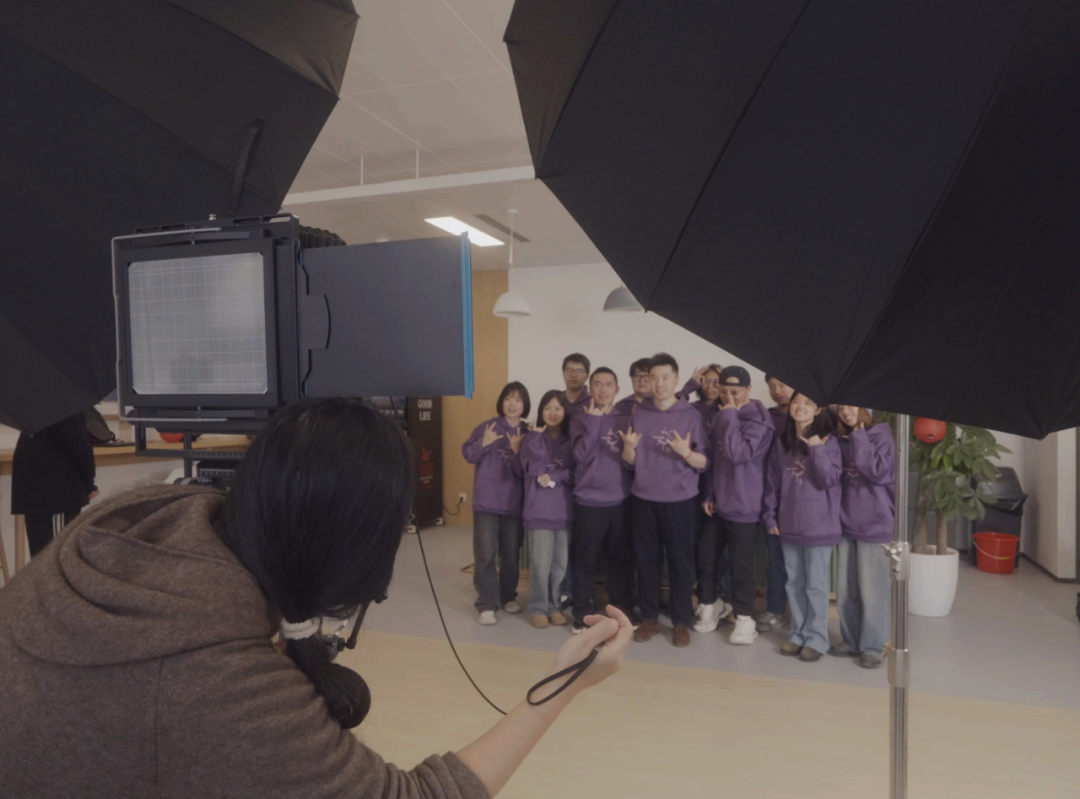
The photograph left that group of people then, and the state of a team just beginning to operate.
In that Model Speed Space office, this group often gathers to discuss, some sitting, some standing.
On the office window is pasted a line from American poet Muriel Rukeyser: "The universe is made of stories, not of atoms."
Cover image: Isaac Levitan, Above Eternal Peace, 1894, Tretyakov Gallery