I'm off to a portfolio company, bye.

We all have a bright future ahead of us.

@Zhiyan Chen
In China's primary market, almost no name stirs as much division as "Yutong Zhang":
Some investors clam up the moment she's mentioned, unwilling to say more; others speak of her with genuine admiration and no small envy. From what I've observed, the divide largely comes down to generational differences: GPs with ten or twenty years under their belt see her one way, younger investors another entirely.
Since joining Moonshot AI, she and the company have been through plenty of ups and downs. But it's now a company racing toward a $30 billion valuation. And everyone knows what role she's played in that.
If you ask who represents the new generation of idols in today's primary market, the two most widely cited names are probably Xi Cao and Yutong.
The two also represent two possible career paths. One is reaching the pinnacle along the traditional investor-to-GP track. The other is switching course mid-career to grow alongside a company moving at far greater velocity.
But which path moves faster? Everyone has their own answer.
I remember, starting roughly two years ago, entrepreneurs would often ask me during interviews: You know so many investors—could you help me find a Yutong Zhang?
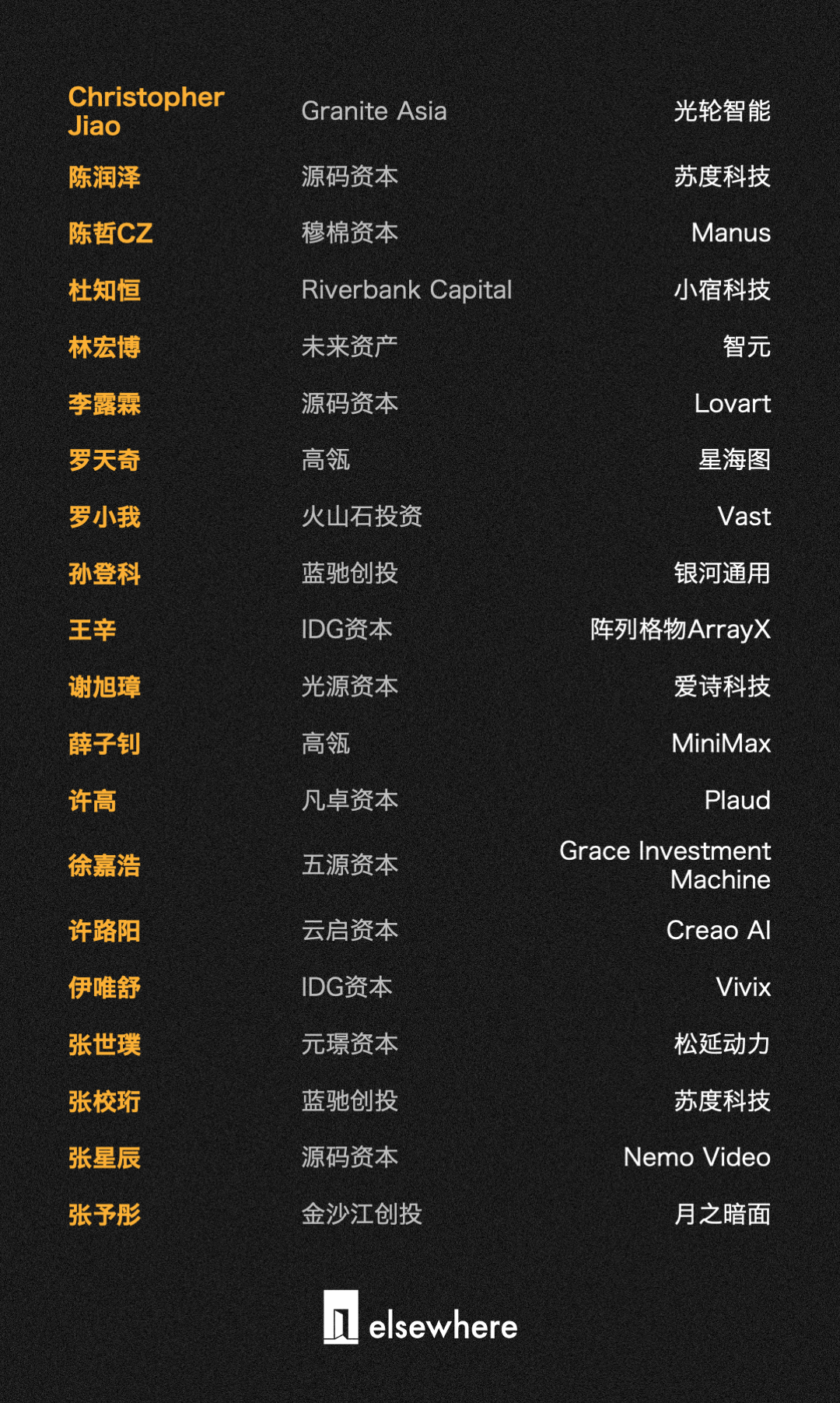
Over the past while, elsewhere has gathered cases of Chinese primary-market investors leaving funds to join startups since 2023, drawing from entrepreneurs, investors, financial advisors, headhunters, and other sources.
This is certainly not a complete list. Beyond what we've missed in our gathering, some people are in transitional periods and prefer to keep a low profile. But what's below is enough to sketch the outline: these investors' destinations cluster around two future industries, AI and embodied intelligence; the roles they take at startups are no longer limited to the familiar CFO or fundraising lead, but now include co-founder, CEO, and even outright founder, as in Gao Xu's case.
This also reflects a phase-specific issue for startups in this cycle: fundraising isn't just a peripheral capability—it's central to defining a company's survival speed, organizational capacity, and resource allocation efficiency.
In Silicon Valley, the more common pattern is founders who invest after proving themselves as entrepreneurs. Here, we see more of the reverse. I'm not sure what that contrast says, but it's an interesting difference worth noting.
One thing to emphasize: an investor joining a company doesn't necessarily mean it's heavily dependent on fundraising. From what I understand, for many who've made this move, fundraising is a small part of their role or not part of it at all—plenty take on specific business responsibilities.
So elsewhere is inclined to think what truly draws people is this: becoming a player in the game itself. Below is our incomplete list.
Listed alphabetically by surname; no ranking implied
Cover image: Thomas Eakins, $2, 1876, Metropolitan Museum of Art