Nine Young Investors at the Poker Table

Just a game, don't overthink it.
@Guo Yunxiao
What happens when you lock a room full of smart, restless young people together?
Last week, at the bar where "elsewhere" records video podcasts, we invited nine investors in their early twenties to a year-end gathering. They came from some of the most active VC funds in the market right now — also the cohort of young professionals rumored to be making moves at a remarkable clip.
But that evening, we didn't discuss any market intelligence or grand narratives. We played a simple game instead.
I'm fond of game theory games, so I designed a set of rules around information asymmetry. I was curious: what would happen if a group of brains accustomed to betting real money competed in The Genius: Rules of the Game — a Korean reality show from over a decade ago, and one of the most classic game theory setups in television history?
The core of our game tested three things: information gathering, strategy formulation, and decisive execution.
The rules were slightly complex:
Each player started with an identical set of chips: 2 red, 2 yellow, 2 blue, 2 green, 2 purple. Plus one random piece of information: 1/11th of that evening's scoring formula (two of elsewhere's partners also joined the game). Players needed to trade information and chips to maximize their final score.
Information exchanged hands quickly. Within half an hour, most players had developed a coherent strategy through mutual exchange. Several key pieces of information surfaced:
Red: 2 points. All red chips zero out if you hold more than 15 at settlement.
Yellow: 1 point. Stable positive asset.
Blue: 0 points. But provides a multiplier of (n+1)x.
Green: -1 point. When paired with yellow, that combined "synthetic asset" is worth 2 points.
Purple: -2 points. Only a monopolist can flip it to positive value.
Full collection: Holding chips of all colors grants an additional +10 points.
Some players broadcast that "purple chips are -2 points." Others shouted that "red will crash, hand them to me." Some steadily accumulated yellow-green pairs. Others bet their fortunes on blue's leverage. And some were merely half-present, watching with detached curiosity.
Before the reveal, let's look at how the players sized each other up. We borrowed from prediction market logic, adding a "predict the winner" layer.
Prediction: Bet on the raw-score champion. This was the only mechanism to recycle original chips and acquire white chips. White chips were worth 0.5 points, settled separately.
We'll substitute their real names with letters A through K.
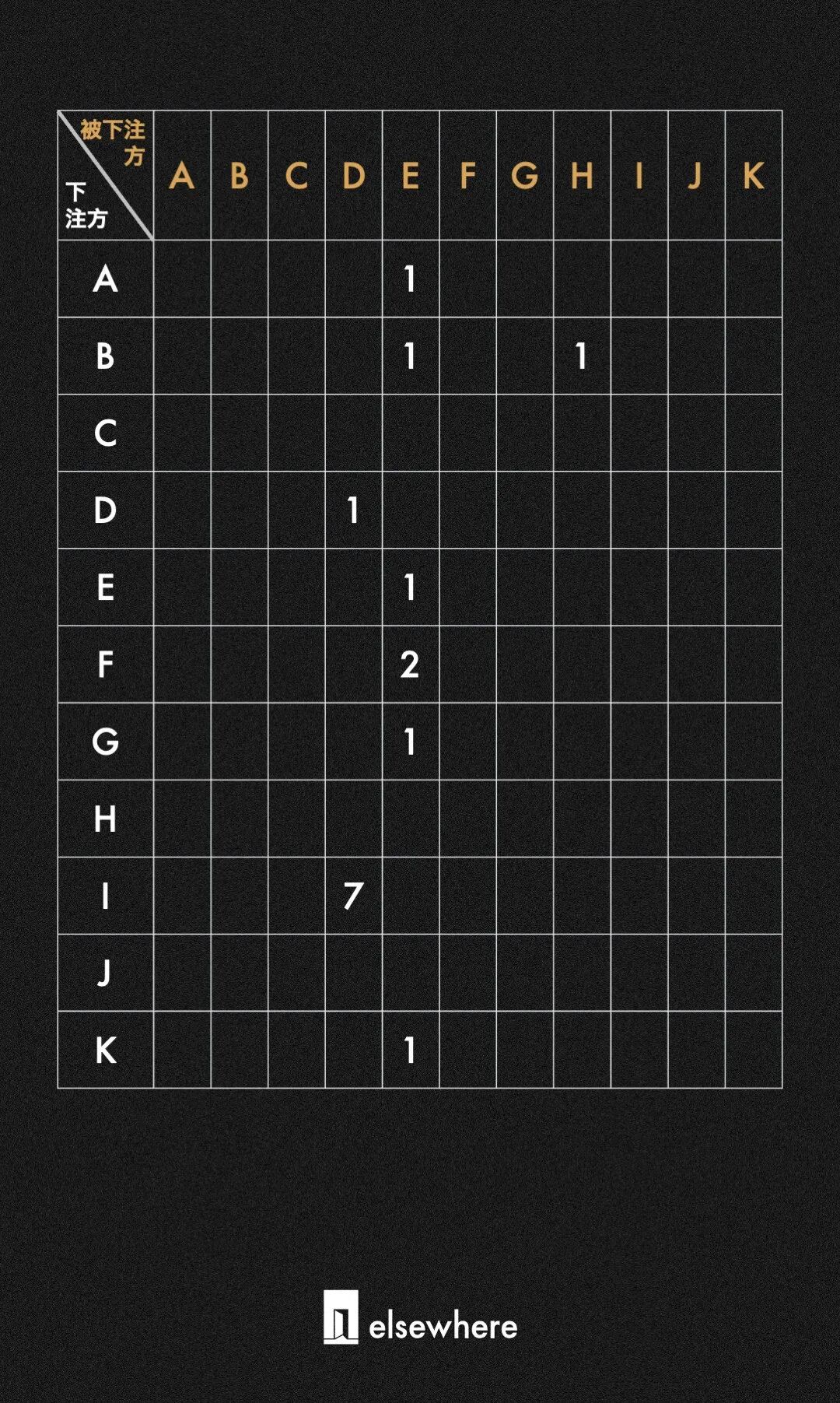
Here's the full play-by-play (potentially granular and digressive; feel free to skip ahead to our synthesis below):
D and E were the most favored players: D received 8 chips in bets, E received 7, with each having placed one chip on themselves. D's remaining chips all came from player I's all-in wager, while bets on E were widely distributed.
Because of transaction fees, this round recycled 25 chips total. Only 3 were red.
This meant 19 red chips remained on the table, destined to zero out. These concentrated heavily in players A and G. Even as red's collapse became near-certain public knowledge, neither released their grip until the final moment. The red-heavy strategy was the first to go bankrupt.
Next came a dominant strategy: yellow-green as a floor, blue for multiplication.
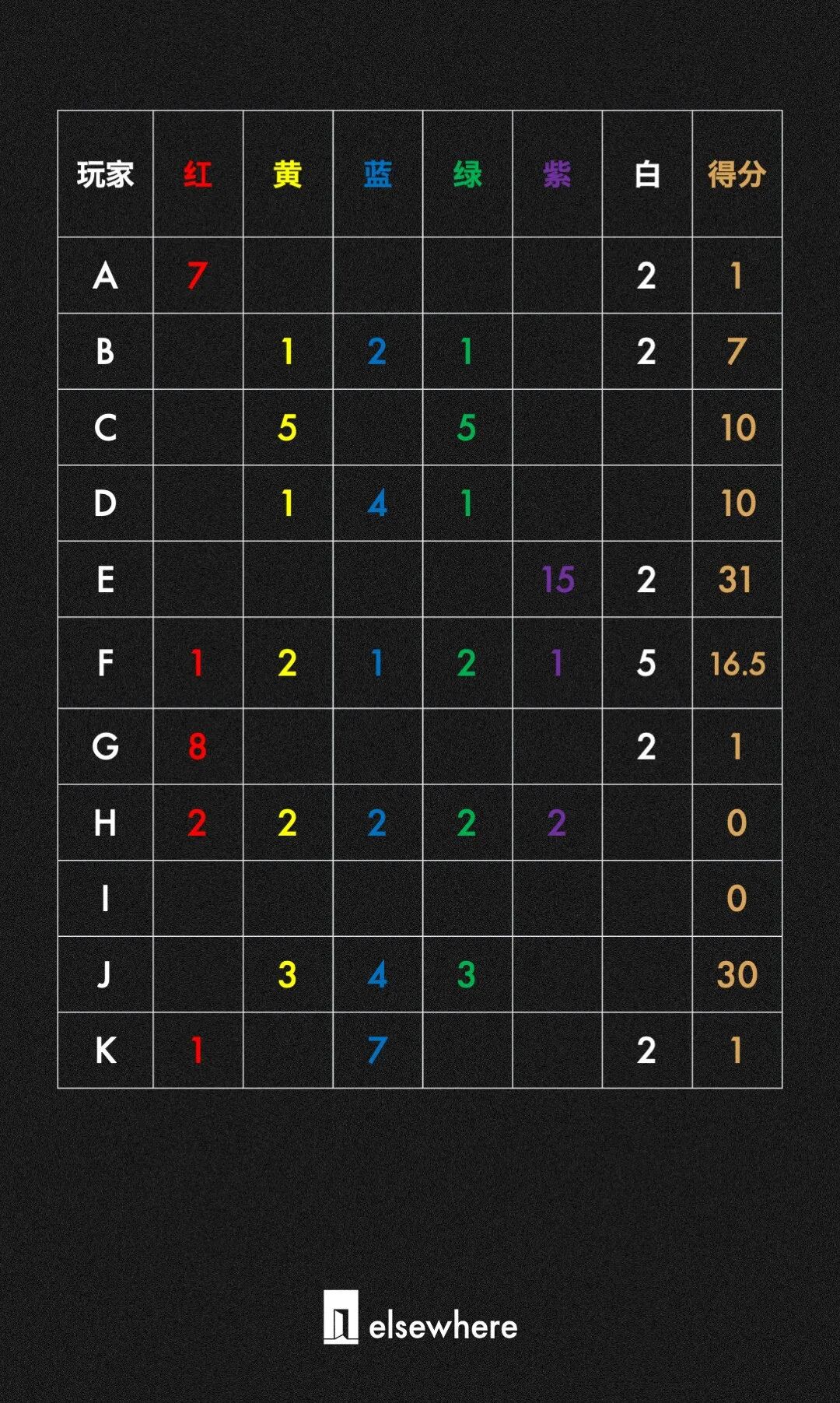
One prominent example was the well-favored D. He secured one yellow-green pair and collected four blue chips, yielding a raw score of 10 points. But this was far from first place. The 7 chips I had bet on him also evaporated.
J executed this strategy most thoroughly. He ended with three yellow-green pairs and four blue chips. High base times high multiplier: 30 points. This tied for first in raw score, but since he skipped the prediction market entirely, his score stopped there.
Several other players stood out: C held no blue chips whatsoever, but five yellow-green pairs for 10 points was still a respectable outcome. F was the sole player to achieve a full collection, earning the extra 10 points that secured him third place. H held position, "locked in" until the final moment. K accumulated extreme leverage, but his base consisted of a single red chip that might zero out.
In short: the market converged on three main strategies.
The majority chose the "yellow + green" combination amplified by blue's multiplier. Final results were decent for this path.
Two players attempted to hoard red chips for victory, but couldn't find a mutually satisfactory recycling arrangement, leaving their red chips worthless at settlement.
The ultimate champion: E. His strategy was purple monopoly. His initial information was "purple is -2 points," but he quickly located the other half of purple's rule: whoever holds the most sees their purple chips flip to +2 points. He persuaded the player holding this rule to sell him near-exclusive early access to it. He ended with 15 purple chips, raw score of 30 points, tied for first.
The single point that crowned him champion came from the prediction round: he bet on himself.
Here is the final chip combination record:
The game's appeal lies here: every player who made a move had to know themselves, know the others at the table, gather as much market-wide information as possible, rapidly form a strategy, then read the room and execute with conviction.
It bears some resemblance to the investment profession.
Going forward, "elsewhere" will host similar small-scale events on an irregular basis. Meet with us often, and an invitation may find you.
Cover image: Photograph