Sam Gao: I Got Past the Security Guard Downstairs at OpenAI | elselier
Studied civil engineering for undergrad and master's, now works in AI.
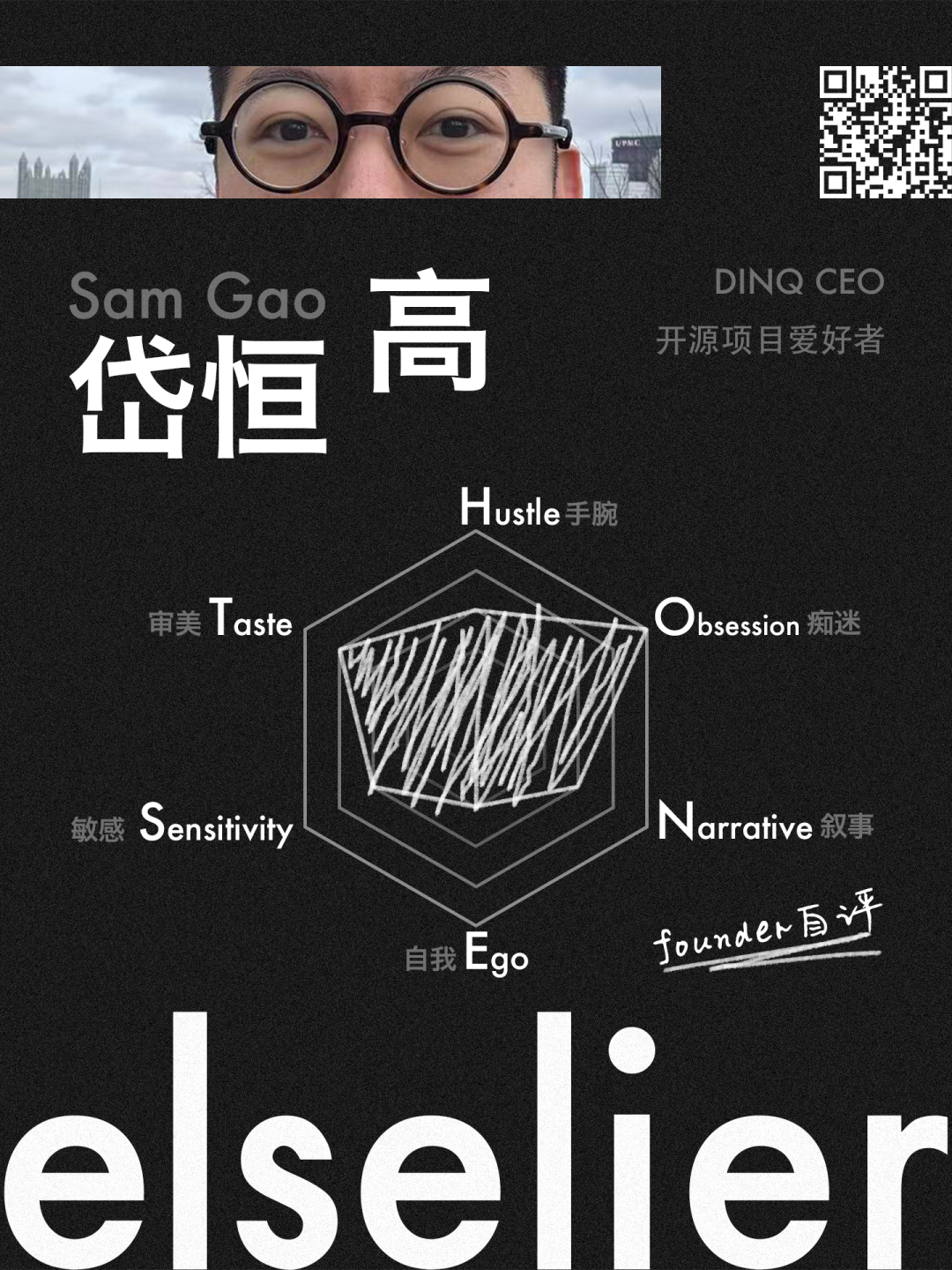
Wu Ruirui @Ruiruiwow__
1. Sam Gao is the co-founder of DINQ. Born in 1992 in Qinhuangdao, Hebei. INTP. Looks uncannily like Beijing folk singer Ma Di — a rougher version.
2. DINQ can be loosely described as LinkedIn for AI scientists and developers. The product idea came from a realization he had after OpenAI burst onto the scene:
The groundbreaking papers were all written by young people at OpenAI. They weren't all from elite schools; some had even dropped out. They were too young to have worked at big companies, let alone have fancy titles. And if you weren't technical (say, an HR person), it was hard to grasp what made them brilliant.
He realized that LinkedIn's logic of credentials and career history simply didn't apply to AI talent.
3. So DINQ differs from traditional recruiting platforms in a few key ways:
-
AI-native focus: A gap Sam understood as a technical person himself, but that LinkedIn and the like didn't grasp as deeply.
-
Merit over pedigree, because AI talent has objective metrics: top-tier conference publications and citations, GitHub stars and code contributions, whether your collaborators are established technical heavyweights.
-
Semantic AI-powered talent discovery: When an HR person types "Sora 2," DINQ knows to surface authors of papers on related technologies, rather than limiting results to those with literal "Sora 2" experience — unearthing hidden talent that keyword searches would miss.
4. Once he had the startup idea, he began reaching out to key AI researchers in China and Silicon Valley one by one, using decidedly unorthodox methods:
-
To win over OpenAI co-founder Durk Kingma, he hand-painted a portrait of the Dutch scientist featuring a windmill — Durk was so moved he wrote back, "Come to America and I'll buy you dinner."
-
Early last year in the Bay Area, he printed a stack of DINQ flyers and stood outside OpenAI's building at 550 Terry Francois Blvd. in San Francisco, approaching anyone who looked important.
Halfway through, he got cold. He told the security guard he'd poured his life savings into coming to America because he admired OpenAI so much, and just wanted to say a few words to the brilliant people inside. The guard was so moved he let him upstairs.
- Gradually he built a community of young AI scientists called Qingke AI, hosting offline events with researchers from OpenAI, xAI, Qwen, and Zhipu.
5. When pitching investors, Sam shared an observation: former Meta scientist Hugo Touvron is French, and was 29 when he published LLaMA as first author. A century earlier, three kilometers from Meta's French headquarters, another Hugo — the writer — had written his most important work, Notre-Dame de Paris, at age 29. The investor said, don't leave this afternoon. That evening he had his term sheet.
He admits he doesn't fully understand why this resonated. I suspect it's because of the exceptional people-matching — studying people and their relationships is his genuine passion.
6. Before 25, he was the stereotypical Chinese underperformer: couldn't sit still in class, spent most of his time gaming. At 25 he started learning AI and was immediately surprised: "This field is that easy to break into?"
Within two years, DeepFaceLab, where he served as lead algorithm engineer, was ranked #2 on GitHub's annual list of most popular open-source projects. He later joined Alibaba DAMO Academy, working on 3D digital humans and image/video generation.
7. Sam is the type who thrives especially at the beginning of a new cycle — with an instinct for grabbing what matters amid ambiguity, and the confidence to take unconventional paths. But in calcified eras and industries, he tends to get squeezed out.
He believes his smooth transition into coding was possible because AI flattened the barrier to foundational engineering skills, while his strength lies in zero-to-one creation.
8. From 18 to 25, he spent seven years on civil engineering, but doesn't consider it wasted time — he genuinely harbored dreams of becoming an architectural artist on par with Ma Yansong. The dream's collapse didn't devastate him, because he's skilled at forgetting: "Like an algorithm — the more you think about it, the more it reinforces. You forget, and it passes."
9. What if LinkedIn / Liepin and the like enter this space? He doesn't think selling to a major company would be so bad, because many AI companies essentially validate a new paradigm within a niche demand. When expanding into broader business scenarios, they'll inevitably run into big internet companies. Unless you find a battlefield where you can rapidly create distance, competing for the sake of competing doesn't make much sense — better to advance it from within a large company.
10. This is an outcome many young AI application founders needn't be ashamed to acknowledge. There's a saying that AI founders have nine lives, because the speed of getting results has accelerated. For investors, if you can buy cheap and sell well, that's not a bad dessert either?
The "elsewhere" aside:
His self-assessment and my assessment are almost complete opposites (but I'd still give the obsession a 5/5). Someone who knows to spin an American Dream narrative to an American security guard clearly has street smart / hustle.
The ego isn't small either — when I said his storytelling was mediocre, he cited Karen Hao as a counterexample. He can't unearth details like this Silicon Valley journalist did about Altman sitting on a soccer field when he was fired, but for the researchers he's targeting, that kind of granular reporting doesn't matter at all.
We are still searching for our next elselier.
Scan to fill out the questionnaire. Cover image: Courtesy of interviewee