Personal Agent is a very Mobile Internet kind of thing

The familiar phrases are all back.
@Chen Zhiyan
Lately, whenever I talk to people about Personal Agents, I get this nagging sense of déjà vu.
The conversation always starts with the same keywords: context, trust network, proactive, personalization. Half an hour in, it pivots to retention rates, user subsidies, burn rates, and what cut of each transaction is enough to sustain the business. Further down the line: will the giants build this themselves, will platforms open up, and can startups achieve escape velocity before the tech titans wake up.
DAU, subsidies, entry points, land grabs, user mindshare. The vocabulary of a decade ago is back.
For the past three years, primary-market discourse has been dominated by models. We've grown accustomed to debating the intellectual boundaries of models, and to evaluating AI application companies through the lens of "will the next generation of models eat them alive?"
Personal Agent might be a very internet kind of thing.
The US Is Going To C Too
The two most buzzed-about products in the US right now are Instinct and Muse — one from a startup, one from a major tech company. Their PR campaigns launched almost in lockstep.
My read: American investors are all racing to claim the narrative around AI to C.
Silicon Valley has long been a stranger to consumer-facing products. Early-stage investors rarely bet on them, and founders don't gravitate toward them. For the past couple of years, AI applications have had to justify themselves within problem spaces defined by model companies. The intelligence wasn't sufficient yet, so wait; then the next generation of models got stronger, and suddenly your business might get swallowed.
Personal Agent offers an alternative: as model costs drop and dependence on cutting-edge models lessens, user relationships, usage habits, and the position upstream of transactions can remain in the hands of application companies.
This resurrects the platform-economy imagination of the internet era.
Where do users' personal information and preferences accumulate? Who do they voice their needs to first for their next purchase, hotel booking, or travel arrangement? Whoever participates in intent capture gets to influence attention and transactions. This isn't about a few dozen dollars in monthly subscription fees — it touches distribution across people's entire life cycles.
The US Personal Agent race is moving remarkably fast, already carrying the scent of mobile-era warfare.
On September 20, Amazon blocked Muse's shopping functionality, accusing the "unauthorized AI agent" of obtaining and storing customer credentials — a claim Meta denied. It felt so familiar: Taobao blocking Baidu's web crawler, WeChat killing Taobao links.
Growth through subsidies, memes as ad spend, invite codes for viral loops, platform mutual blockades, cash-burning for market position, acquisitions as backstops. Strip away the "AI" label and this reads like a battle report from the platform wars of over a decade ago.
AI for the People
This frenzy isn't manufactured out of thin air. At this particular moment, AI products have genuinely undergone some shifts.
Muse's underlying model, Muse Spark, was released back in April. Meta itself admits that long-horizon task capabilities remain insufficient, and the new model was only unveiled yesterday. Reports indicate that in the two weeks before launch, internal employees were criticizing it as "a chatbot with more cumbersome operations and a worse underlying model."
Yet this product, disparaged internally, achieved 640,000 US mobile DAU — nearly triple ChatGPT's numbers in the same period.
Early rapid growth certainly doesn't prove long-term success. But it demonstrates at least one thing: model capability is no longer a prerequisite for users to give something a try.
This is what distinguishes Muse from previous AI products. It also made me realize that Personal Agent might break free from the "who's smartest" logic and open up an entirely new battlefield.
First, a common question: couldn't OpenClaw already do what Muse does?
True, much of what today's Personal Agents offer isn't appearing for the first time. Muse itself drew strong inspiration from OpenClaw. But "someone could already do this" and "ordinary people are willing to use it" may be separated by exactly one large company.
And for ordinary people, "Xiao Long Xia" remains fundamentally a geek toy.
One critical step Muse took was transforming self-hosted deployment and maintenance into cloud-hosted, register-and-go accessibility. Users don't need to become half-engineers before they can have an Agent that handles tasks for them.
Some might counter: Codex, Claude Code, and various office Agents no longer have deployment barriers either — so why haven't they gone mainstream?
For many scenarios that Personal Agents primarily promote, these coding agents can accomplish the same things, potentially even better when driven by frontier models. This is indeed one of the common critiques of Personal Agents. But it's a bit like having research scientists work as butlers — overkill for the task.
And perhaps the mindset differs. Mo Weishu, former TikTok product lead, told me that the core difference between Personal Agents and office agents lies in context: for Personal Agents, context isn't built around tasks but primarily around people.
Because AI office products were never designed around ordinary people's lives from day one. Office agents can build memory and context around projects and tasks, but how many "dedicated projects" does an ordinary person's daily life actually contain?
People's needs are trivial and continuous: changing flights, booking restaurants, canceling subscriptions, paying bills, replying to emails, checking insurance expirations. What these share: low cognitive value, high procedural friction, extreme fragmentation.
They may not merit opening a dedicated workspace, but you'd want something keeping an eye on them constantly.
This also shapes different interaction patterns. Office agents tend toward exhaustive output — the more they say, the less room for error and accountability. Personal Agents lean toward "humanized" everyday communication. As Today AI puts it, a good personal assistant must first learn to cut the fluff.
So we need to step outside the perspective of first-tier-city elite white-collar workers, tech KOLs, and AI enthusiasts to understand Personal Agent. Mo Weishu put it more directly on his own WeChat public account: don't build personal Agents, build people's Agents.
In China, stay-at-home mothers are already using Today AI to plan early education for their children. A friend building a startup in North America told me that Instinct's true breakout signal wasn't tech media coverage, but discussions emerging in Facebook mom groups and Nextdoor neighborhood communities. Of course, true mass adoption remains distant.
If Personal Agents can truly make private assistants and concierge services — previously affordable only to high earners — accessible to ordinary people at lower barriers, wouldn't this be a form of AI democratization?
The world isn't only within the Fifth Ring Road; there's a much larger outside. The company that took this logic to its extreme is Pinduoduo.
Familiar Battles
Humans always seek something for nothing. But wanting someone else to worry for you and needing a Personal Agent are different things.
Even if the demand is real, it won't necessarily be the same business. Some products pursue low prices at massive scale, finding revenue through transactions; others serve paying customers, going deep in select scenarios. This connects to the generalist versus vertical distinction, but isn't a one-to-one mapping.
A generalist assistant might better understand a person's family, budget, and habits; vertical services might be more capable of actually completing a task.
Whether Personal Agents succeed depends on two calculations: cost — is having AI handle tasks for you expensive? — and value — can AI do it better than you could yourself?
This wave of Personal Agents does have technical foundations. Computer Use lets models directly operate software without waiting for APIs to open up — screenshots, web structures, accessibility information, code tools, mixed and matched as appropriate. Continuously running cloud environments let tasks persist across conversations, advancing in the background even after the app is closed.
On the model side, for a considerable portion of everyday tasks, products don't need to call the most expensive model every time. From what I understand, several of the startups mentioned above are already doing post-training on their own models, driving costs down through scenario-specific training and workflow optimization.
But cheap tokens don't mean cheap task completion. How many model calls and retries does one task require? On OSWorld 2.0, a long-horizon benchmark averaging approximately 318 operation steps, Opus 5.5's strict completion rate is only 48.7%; in operational efficiency, OSWorld-Human measurements show agents still take three to four times as many steps as humans. Add in user explanation, waiting, confirmation, and correction time.
Rabbit founder Jesse Lyu once posed a characteristically pointed question: is it more convenient to have an Agent buy a case of Coke, or to tap twice and do it yourself?
In the Chinese market, this question becomes even sharper.
Many overseas agents切入 through email, web pages, and fragmented service workflows. China's payments, local lifestyle services, and shopping are already organized with considerable convenience by super apps. A product that saves three phone calls overseas doesn't necessarily translate when moved domestically.
After all, users have no obligation to complicate simple tasks just to experience advanced technology.
What Personal Agents truly promise is paving the road between human "intent" and "result." To achieve this, execution isn't the hard part.
As model capabilities grow and prices drop, "completing tasks" will inevitably become a commodity. The real difficulty lies in the middle layer: how to handle memory, how to understand intent behind expression, how to map intent to specific tasks, how to provide appropriate supply, how to execute efficiently and effectively with that supply.
And so you discover that once you view Personal Agent as a new entry point that "bypasses existing apps to directly fulfill user intent," the decisive factors in this AI to C battle all converge on old problems:
Who captures the entry point first; who builds out required supply faster; whether startups can squeeze into gaps in the giants' ecosystems; whether giants can overcome their own territorial instincts and innovator's dilemma; whether execution is effective and efficient; and whether that collaborative network between Agents will ever emerge.
In the mobile internet era, nearly all of these had direct counterparts.
Does this mean the giants that survived those battles hold overwhelming advantage? At present, it certainly seems so. This is why many believe ByteDance and Tencent appear best positioned.
At least for now, Personal Agent products that people can actually use in the domestic market remain scarce.
Of course, another view holds that if Personal Agents need to mobilize products and services from various parties, a neutral position may also matter. This seems to be the angle of some eager entrepreneurs. But neutrality is a stance, not a capability. Without access to information and task completion, objectivity won't get you scale.
An investor told me that startups competing in China's Personal Agent space need to seize users in an extremely narrow window, likely requiring hundreds of millions in reserve capital — soon perhaps even three to five hundred million dollars.
Did they mean valuation, or fundraising?
Neither, they said. "Cash in the bank to burn."
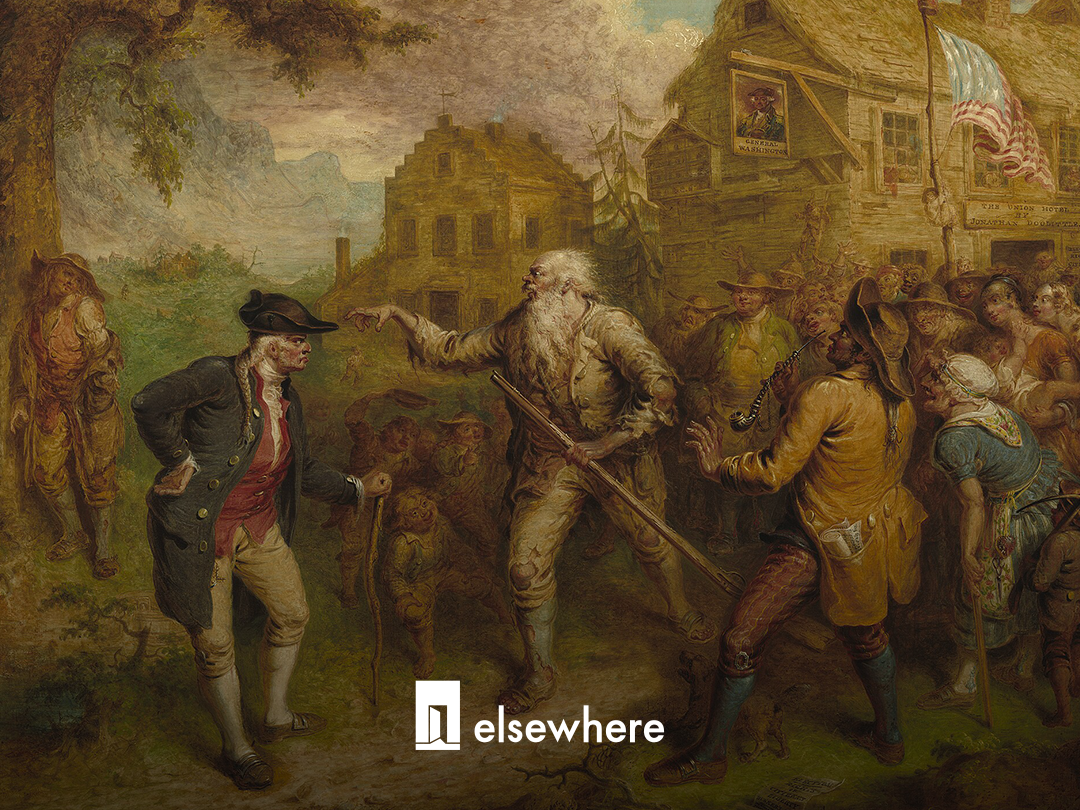
Cover image: John Quidor, The Return of Rip Van Winkle, 1849, National Gallery of Art, Washington