First, a transcript of Tian Keyu's podcast

He even swore an oath on the spot.
@Jing Liu
First, an apology. Our podcast video with Tian Keyu remains unedited due to certain reasons, but it should be out tomorrow morning.
Before tonight ends, we're sharing some excerpts from the interview as a dialogue.
We used to joke that elsewhere's podcast is a bit like Art Life. If that's the analogy, then this episode with Tian Keyu would probably be more like Legal Report.
An intern rumored to have "poisoned" a large language model, fired by his company, repeatedly caught in the crosshairs of online opinion, his offer rescinded. And then, at the most desperate moment of his life, he won the NeurIPS 2024 Best Paper. Then he decided to start a company, and secured funding from a dollar-denominated fund.
Every element is almost too full.
One development: the case where ByteDance sued him has reached a first-instance verdict. What we've learned is roughly this: the court ruled that Tian Keyu should pay 500,000 RMB in damages. But ByteDance then filed an appeal, and it's currently in second-instance proceedings.
In many people's eyes, Tian Keyu is simply a villain. Some even call him "Lao Tian" — lao as in prison.
In July this year, we recorded this video with Tian Keyu. In it, he gave a complete account of what he saw and how things unfolded — including why he did what he did, what exactly he did, what he admits to, and what he believes was a smear campaign against him. Beyond that, it also covers his earlier academic journey and choices, which can help us understand more about who Tian Keyu is.
It needs explaining that this interview was recorded over three months ago, and some of what's expressed may differ from the present situation and market context — for instance, many things related to his world model startup direction.
Given that the litigation is still in second-instance proceedings, we've redacted portions of the original interview that could potentially be controversial.
The text below covers key information from the interview. But we'd still recommend waiting until tomorrow morning. Listen to the full audio version on the Xiaoyuzhou app, and the full video versions on Bilibili, WeChat Channels, and other platforms.
Compared to business news, this reads more like social or legal news. It involves several parties: besides Tian Keyu, there's ByteDance, another intern he mentions, and various other people.
Everyone will have their own version of the truth that they see and believe. The following is Tian Keyu's version.
What Kind of Mistake This Was
elsewhere: Why did it take two years for you to be willing to come out and formally talk about this?
Tian Keyu: The public opinion storm was huge at the time. I even found a blogger on Weibo who wanted to help me tell the real story. But soon both the company and my school advised me not to speak. And I thought I should wait for a legal outcome.
elsewhere: Has there been one recently?
Tian Keyu: There's a preliminary result, yes. ByteDance had two main claims at the time: one was economic damages of over 8 million RMB; the other was reputational (requiring a public apology from me). The current first-instance result is that the court set damages at roughly 500,000 RMB and rejected everything else. The second instance is still ongoing.
elsewhere: Is there a logical relationship between the 500,000 and the 8 million? Why was damages awarded?
Tian Keyu: There's no logical relationship. The 8 million was ByteDance's claim — they also simultaneously claimed I should apologize. The 500,000 amount happens to equal exactly my three years of intern wages, plus some of the company's legal expenses for the lawsuit.
I've never denied my actions. I sincerely apologized even in front of the judge. I think the final damages amount is fair, and I accept it.
elsewhere: Let's get straight to it then. You tell us about this incident.
Tian Keyu: I'll start from the beginning. I began interning at ByteDance in 2021. In 2024 a new intern arrived, and afterwards I felt the whole team became unsettled. He started with some soft resource occupation — like saving seats, taking resources that belonged to others — and later began directly stopping other people's programs.
Actually, he never stopped mine. He stopped those of more introverted, softer personalities. We fed this back to our leader, but it wasn't resolved. So I used my method — and this method was of course wrong — I entered the other person's program and made it hang or shut down. That way his excess resources would be reclaimed, and others could use them normally.
elsewhere: There was also a widely circulated version at the time, roughly saying: during your internship, in order to seize cluster resources, you backstabbed colleagues and the company, and for at least two months continuously launched malicious attacks on cluster code, including but not limited to xxxxx (five charges total).
Tian Keyu: I must say, many of these descriptions are fabricated. I personally never lacked GPUs. The biggest motivation for doing this was that I genuinely couldn't stand how A was bullying others in our group.
First, this wasn't poisoning, and it didn't involve attack-defense. I had GPT help me write a program that would stop or hang a process.
Second, I manually, point-by-point stopped the other person's program. There was absolutely no "continuous for two months" aspect.
elsewhere: Does automation count as continuous but manual doesn't?
Tian Keyu: Uh... it counts as continuous too, I suppose. But not that day-and-night feeling in the description.
elsewhere: What was the actual duration and frequency?
Tian Keyu: Roughly about ten days, approximately five times total.
elsewhere: There's a claim that when you were discovered, you were still continuing this behavior, somewhat like playing cat-and-mouse with the company.
Tian Keyu: Actually when I was discovered, my permissions were quickly revoked. I couldn't log into the entire system anymore, including Lark.
elsewhere: There's also a claim that after the incident, you said someone else had exploited a vulnerability and pinned the blame on you, and that you even reported to police that you were being slandered.
Tian Keyu: I must address this point — "that I framed someone else" — this absolutely did not happen, and it was what I found most incomprehensible and what provoked the strongest emotions in me at the time. Being brave enough to act but not to own up — that's not my values.
I did indeed report to the police. Actually it was because at the time the company found me and asked if I knew who had posted these posts, and I said I didn't know. I wanted to see if the police could find out who posted them. After confirming with the company, I went to file the report.
elsewhere: How do you assess the impact of this incident on ByteDance and on others? Some say your individual actions seriously affected other interns' research and paper progress.
Tian Keyu: I suspect my direct superior may have been somewhat implicated because of this, and I feel guilty about that. And then there's the public opinion.
Beyond that, I can confirm my actions did not affect anyone else's research or papers.
I admit that several times I did cause some impact to A's experiments. But I absolutely did not touch anyone else's experiments. There's also a rumor that my Best Paper was completed by seizing resources in this incident — pure fabrication.
elsewhere: Why did this incident ultimately escalate to legal action?
Tian Keyu: The lawsuit was filed in late November 2024; that public statement came out in October. I think by now, I can quite understand the company's position: internally ByteDance has always been strict about discipline. What I did was a violation of rules, and the public opinion was so huge — the company had to handle it.
elsewhere: Some people call you "Lao Tian."
Tian Keyu: That's already among the milder of the many terms used to describe me.
elsewhere: What's the term you find most unacceptable?
Tian Keyu: "Backstabbing colleagues, framing others." Exaggerations or fabrications at the factual level — I'm okay with those, the truth will come out eventually. But descriptions in the original post that were completely opposite to my actual character and integrity — I found those very difficult to understand.
elsewhere: The overall impression so far is: you acknowledge you made a mistake, but believe it was a mistake that was later excessively amplified.
Tian Keyu: I acknowledge this action of mine. First, it was definitely a rule violation. Second, it did waste people's time. For example, in late July that year, we had an internal meeting with many people on a Lark video call. I spoke a lot that time, explained the whole backstory, and at the end I said: I solemnly apologize to everyone participating in this meeting. I think whether at the research level or the company's operational efficiency, there was certainly some impact.
"Fighting Violence with Violence"
elsewhere: Many previous interpretations were that your own computing power was affected, but you emphasize that you actually weren't.
Tian Keyu: I never lost GPUs myself.
elsewhere: If others were affected, what business was it of yours?
Tian Keyu: There's a detail I remember deeply. One evening, I was the last to leave with another person. After I submitted many tasks on my end, I saw he hadn't submitted a single one. I asked him if he wasn't going to continue. He was just scrolling on his phone and said: what's the point of submitting, A will just shut it down anyway.
elsewhere: Is this A's stopping behavior you describe similar to yours?
Tian Keyu: Honestly it's not the same behavior, because he had administrator privileges. His was more above-board, I suppose.
elsewhere: Even if others were affected, you were just one intern among many.
Tian Keyu: I was the intern who had been in that group the longest. I think I had a mentality where, seeing the team become like this while the leader wasn't actually stepping up to solve it, I genuinely wanted to do something. Of course in retrospect, I should have used more mature methods to solve the problem. I was indeed very impulsive at the time.
elsewhere: But from another angle, could it be that your ego was also quite large — that others didn't speak up, but you insisted on doing something?
Tian Keyu: I don't think they themselves had no feelings about it. At the time when everyone discussed it privately, the language was already very intense.
elsewhere: Was there a reason that you felt your so-called old-timer status was being challenged?
Tian Keyu: But an old-timer doesn't bully others. What kind of old-timer bullies other people?
elsewhere: Did anyone you "protected" express anything to you afterwards?
Tian Keyu: I was fired very quickly at the time. But there was one person, normally very introverted, barely spoke, didn't really interact with everyone much — but when I left, he walked me downstairs. I was quite moved at the time.
elsewhere: I saw a post of yours from your undergraduate days online. At the time you described yourself as: not aloof, mild-tempered. Why would a mild-tempered person take such action?
Tian Keyu: I think being mild-tempered and having principles can coexist. At the time I felt the perpetrator's behavior had crossed a certain bottom line.
elsewhere: "Perpetrator"?
Tian Keyu: Yes, I would use that strong a word. Of course looking back, I was actually fighting violence with violence. So today I deeply feel my actions were very problematic.
elsewhere: For Tian Keyu, was this a contingent event? Or is this something you would do?
Tian Keyu: If you stretch it across a lifetime, some things are necessary, some are contingent. I want to call that action at the time "naive justice," but it was indeed very immature. For example, encountering something on the street, I might respond in a relatively impulsive way.
Best Paper, Eternal Night, Lifeline
elsewhere: Then came a very dramatic scene: a few days after ByteDance issued its public notice, you won that year's NeurIPS Best Paper.
Tian Keyu: Yes. This was the award I most wanted to win as a student. But at the time I was facing massive public opinion and litigation, my career prospects were already completely dark, so my first reaction upon seeing this wasn't particularly joyful.
My first thought was: at least I can find a job then, I won't starve. It was like grabbing a lifeline.
elsewhere: I heard a large model company had given you an offer but later rescinded it?
Tian Keyu: I remember it deeply. At the time I talked with their co-founder for five or six hours straight. I felt this was exactly where I wanted to come.
elsewhere: So during that period your skies were completely dark?
Tian Keyu: I feared I would have to leave this industry forever. For me, this might not even be darkness — the sky was already gone, I had entered eternal night.
elsewhere: Did you have extreme thoughts?
Tian Keyu: For a moment, yes. One day I was alone in my dorm. I thought about how I had switched majors to come into this field because I truly loved it so much, but I might have to leave because of this. I didn't know what I could do for the next several decades. There was a window in the dorm, outside was the street. For a moment there was that kind of thought.
elsewhere: What pulled you back to reason?
Tian Keyu: My parents both took leave to come to Beijing, and some other family members came to find me too. Family companionship was very important to me.
elsewhere: Throughout this whole affair, who do you want to apologize to?
Tian Keyu: I still have very deep feelings for ByteDance. I once wanted to accomplish great things there after graduation. Every time I think about how it ended up like this with ByteDance, I feel great regret.
I've always felt apologetic toward the company. After all, it was my improper actions that indirectly triggered many subsequent events. This public opinion must have cost the company significant resources to manage, and I'm very sorry. Including the company's lawsuit against me — they also spent costs like attorney fees. So I've also repeatedly emphasized that I accept the damages the court awarded. I should pay the price for my mistake.
What I've always told the company isn't "I did nothing wrong," but "I'm not the great villain in the rumors."
elsewhere: Is there anyone you're grateful to?
Tian Keyu: I'm grateful to many people, including ByteDance. I think ByteDance was excellent both in intern resource support and in communication atmosphere. At the time my leader also helped me secure a lot of resources.
elsewhere: Are you someone who senses danger?
Tian Keyu: I usually anticipate quite a lot. But returning to that time, I think any normal person, leader, or company could not have predicted the subsequent outcome. For example, such huge public opinion, such an exaggerated lawsuit, even A fabricating that our Best Paper was obtained through competition — this is already beyond what a world model could predict.
Once the Youngest Intern
elsewhere: Before you switched majors, you studied materials science. Why did you choose that major?
Tian Keyu: I was very interested in chemistry in middle school. At the time I would even run to chemical reagent factories, because some things our middle school lab didn't have. For example there's an experiment called the iodine clock experiment: you mix three things together and there's a cyclic process, every 8 seconds it changes from blue to yellow, then back to blue. It was too magical, like a magic trick.
elsewhere: Then why did you switch to software engineering midway?
Tian Keyu: After entering university I first encountered programming, and I found it so interesting. When I first started undergrad, I probably spent 10 hours a day on programming-related things. So actually before I switched departments, I had already completed the most core courses, basically I could self-study through a specialized course in about three to five days.
elsewhere: What's the pleasure of programming?
Tian Keyu: Programming is a kind of creation. After you create something, its operation can create other things. Also there's a lot in programming that's quantitative — efficiency, metrics, the positive feedback from these numbers is very strong. And also, programming has a strong relationship with AI.
elsewhere: Did you play games in college?
Tian Keyu: Programming is much more fun than games. And it has many progress bars. Compared to running a game dungeon versus programming progress, there's simply no comparison.
elsewhere: Your unusual experience is that starting from sophomore year, you interned at SenseTime, stayed there three years, then interned at ByteDance for another three years. Why did you start so early and intern for so long?
Tian Keyu: When I graduated high school I had close-up observation of some enterprises, so I developed an orientation very early: after graduation I would definitely enter industry, not become a teacher. At that time for us, SenseTime was also like a white moonlight existence.
elsewhere: You were probably SenseTime's youngest intern at the time?
Tian Keyu: Yes, I was the youngest. The two years at SenseTime were a bit like doing a mini-PhD.
elsewhere: Did such early and extensive internship experience socialize you earlier?
Tian Keyu: I think the more appropriate expression is "academic maturation." Actually in my sophomore and junior years, I already published two first-author papers at NeurIPS.
"Double Buff"
elsewhere: Before we talk about your startup, I want to ask: did the ByteDance incident, in some way, actually make you more visible?
Tian Keyu: Realistically speaking, yes. It brought an enormous amount of attention, and then叠加 with the Best Paper thing — like a double buff.
elsewhere: So if you handle this story well, could it become a kind of life wealth?
Tian Keyu: Honestly, this kind of attention or heat is definitely beneficial for entrepreneurship. But the main wealth is the growth from the experience itself — a kind of baptism.
elsewhere: Why was your first investor Xing Meng, partner at 5Y Capital?
Tian Keyu: Early last year, I contacted very few investors. But I found Meng Xing's special point was that he had founded a company, been an executive, and done investing — many perspectives came from the diversity of his experiences and identities. Another point was that he had very strong judgment about technology.
elsewhere: Most investors don't have technical judgment?
Tian Keyu: Top investors should have it. But I think Brother Xing's special quality is that he can grasp some fundamentally essential things at the principle level.
elsewhere: Actually Meng Xing has invested in many young entrepreneurs who are quite outlier — everyone has many stories, though yours is certainly the most dramatic.
Tian Keyu: I had roughly heard. Later he brought me to meet Richard (Qin Liu). At the time he said something I didn't quite understand at first but gradually came to: he said I had a certain drive in me. At the time I think I cried, tears streaming down.
elsewhere: Has anyone told you that your word choice is very un-Gen Z?
Tian Keyu: ...Really? OK, OK.
elsewhere: I heard you also cried on a night when you were rejected by a fund.
Tian Keyu: That night I indeed cried a lot. I really liked this fund. It was ultimately an online meeting, and at the end there were some连环 questions about this issue (ByteDance), which made me feel绝望. Of course now I understand — there should have been more trust-building to begin with, and this was something I didn't do well enough.
elsewhere: You feel you need to repeatedly prove yourself.
Tian Keyu: Just repeated self-proof. Especially before a verdict came down, everyone would believe the narrative with more voice, right?
My World, My Model
elsewhere: How would you define world model? Is your company a world model company?
Tian Keyu: We define it as predicting the future. Today there are too many definitions and too little realization. We set this direction in 2023, mainly focusing on realization.
I don't care whether our company gets labeled with this tag — neither actively seeking it nor avoiding it. Anyway we're just building a multimodal foundation model.
elsewhere: In the past half year, roughly nearly a hundred startups in China have claimed to be world model companies. What's your differentiation?
Tian Keyu: We're the most pioneering route among all today. In world models, we've observed the same pre-training scaling laws as in language models. This near-hundred-billion-parameter scaling law that hasn't yet saturated — this is the only one.
elsewhere: Long-term, what can world models achieve?
Tian Keyu: The ultimate form is predict everything. For example, if I take 10 billion years ago, input the state of that clump of matter at the beginning of the Big Bang into a world model, it could simulate forward 10 billion years. Another intuitive example: like Doctor Strange in Marvel — when he fought Thanos, he saw many different futures, and only one succeeded.
elsewhere: Why did you choose world models rather than language models?
Tian Keyu: This can be traced back to the Best Paper, even before 2023. When GPT first came out, many people around me switched to language models. But I had no interest in language models. I wanted more to transplant its success to the image and video domains.
So in 2023 I posted a short Zhihu note, roughly two sentences: first, we need to massively learn an autoregressive model from video; second, we first need to do representation, to create an AI's own language.
elsewhere: You said you're not interested enough in language models — specifically what are you not interested in?
Tian Keyu: The deep reason is that I had always been in the self-supervised learning domain. What attracted me to this domain is that without human teaching, it can spontaneously learn things. For example, after seeing large amounts of images, it can vaguely sense the difference between cats and dogs.
elsewhere: Language models can self-learn too.
Tian Keyu: But language is first and foremost human-created. I prefer distilling from nature rather than distilling from humans.
elsewhere: Speaking more near-term, what will first-stage intelligence look like?
Tian Keyu: For example, sealed in a small room — like this bar we're in now — if I throw a big rock at that wall, how should those glass bottles shatter, how should they fall, it can predict very accurately.
Or when we want to tell fortunes, I toss three copper coins, and in that instant they're in the air, the world model should also be able to predict it.
elsewhere: Is this already realized?
Tian Keyu: It used to be very difficult, but at this stage we've already achieved it. We want to create a scenario where people can come experience it on-site.
elsewhere: How many people do you need to do these things? Or what do you most need?
Tian Keyu: Pre-training doesn't need that many people — our target by year-end might be a team of 20. I think what's most important is collective intelligence, and a soil that can inspire everyone's free play.
elsewhere: If one day, a 2024-era Tian Keyu appeared in your company, what would you do?
Tian Keyu: From a leader's perspective, I might think about how to handle conflicts, or even before conflicts arise, how to intervene to prevent them. Of course whether as an individual or a founder, one should handle everything more maturely.
Rabbits, MJ, and Tenderness
elsewhere: Some people吐槽 your hairstyle, think it's very杀马特.
Tian Keyu: I've had this hairstyle since freshman year. To this day I still get my hair cut at a place downstairs from the Beihang dormitory.
elsewhere: You like little rabbits? (The night before recording, Tian Keyu sent us a video of his little rabbit.)
Tian Keyu: On one hand rabbits are easy to raise, and sometimes they seem quite smart, sometimes they seem to have no memory at all, and they can't speak — giving people a natural desire to feel tenderness toward them.
elsewhere: What music do you like to listen to?
Tian Keyu: For music without lyrics I like Techno — it brings me a strong sense of rhythm, maintaining my flow state while working.
For music with lyrics I like Michael Jackson. He was very talented and innovative, and resilient. He was also a very compassionate person — for example he paid special attention to children. And this compassion was very contrasting with his own life experiences.
elsewhere: Whether little rabbits or MJ, you mentioned tenderness — do you feel some self-identification?
Tian Keyu: I haven't really been aware of this. I wanted to raise rabbits since high school. With MJ I still prefer his shining talent.
A Vow
elsewhere: Suppose one day AGI is realized, what would you want to do?
Tian Keyu: If that happens, I would switch to researching hibernation. Then I want to hibernate myself for 10,000 years and see what the world has become.
elsewhere: What if you wake up and find the world is gone?
Tian Keyu: Then before that I'll do one thing first: make ASI not do things that destroy this universe.
elsewhere: Why 10,000 years later?
Tian Keyu: I just want to see what technology and civilization have become by then. If hibernation technology is limited and I can only see 10 seconds, that's fine too. It would already be the greatest meaning.
elsewhere: Can you swear that what you've said here is true?
Tian Keyu: Of course. Regarding viruses, regarding attack-defense — all baseless rumors.
elsewhere: Anything else? Might as well get it all out.
Tian Keyu: There are some other things I find completely unacceptable, like claims that (the ByteDance incident) was done by someone else — I deeply despise this kind of behavior.
elsewhere: What if you've told falsehoods?
Tian Keyu: Lifetime research setbacks. Of course if it's all true, I hope my research can go more smoothly in the future.
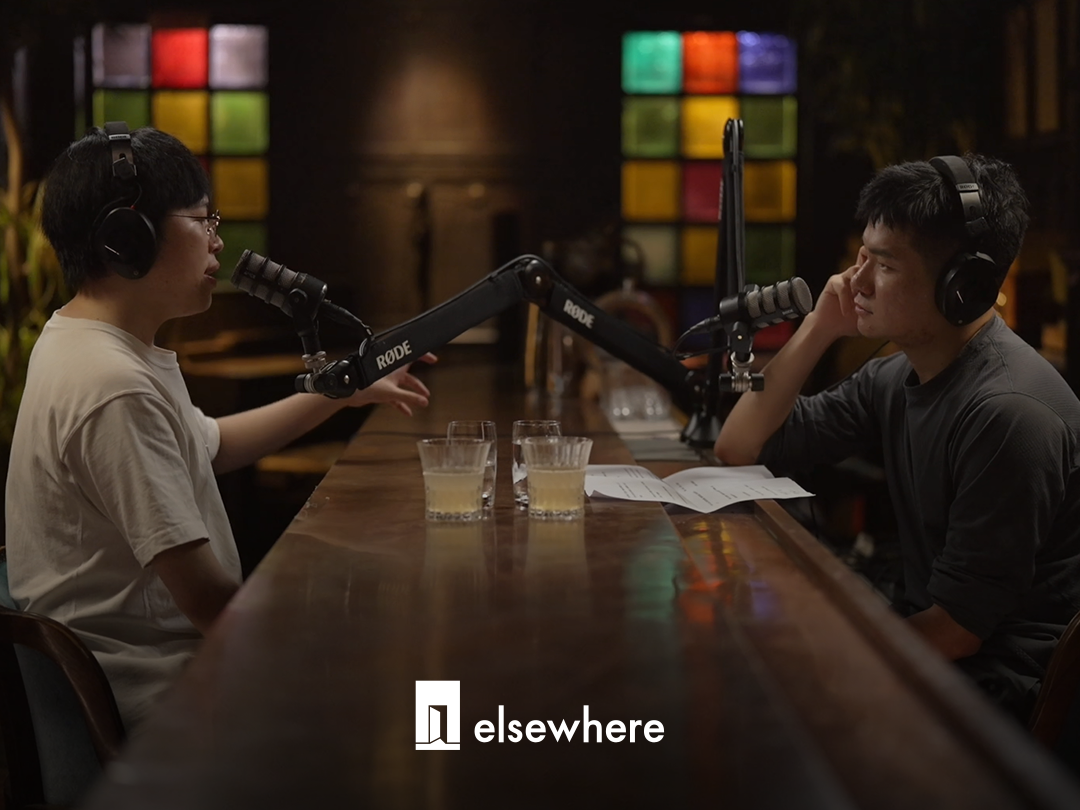
Cover image: On-set photograph