He Was Interrupted by a User: "Seede Is Great, but You Suck at Pitching" | elselier

"Talked for ages without actually explaining what makes the product good."
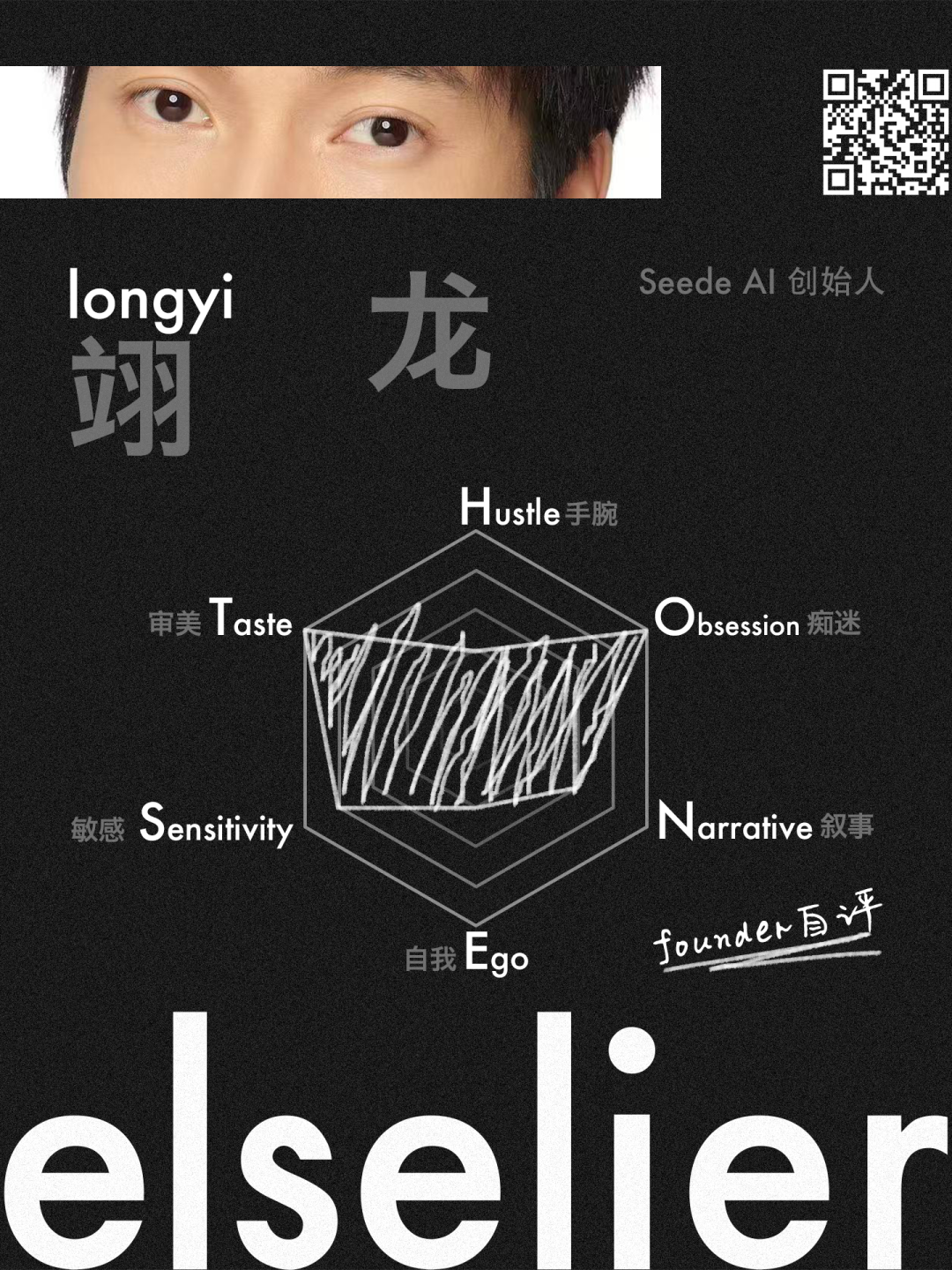
Wu Ruirui @Ruiruiwow__
1. Longyi is the founder of Seede AI (domestic version) and Veeso (international version), AI-powered design tools. Born in 1995 in Deyang, Sichuan. GitHub 10k-star developer. College dropout.
2. Seede uses AI for graphic design, but it shouldn't be compared to "Canva for the AI era." Canva's product logic is offering a bigger, better template library. Seede, by contrast, generates designs through code: user provides content — AI understands the structure — generates corresponding layout code — renders into an image.
3. Longyi has a core product philosophy: design is fundamentally structured information organization, and code is naturally suited to expressing structured, hierarchical, computable relationships — so Seede uses code to describe content structure. This gives Seede several advantages —
-
Strong content comprehension. Canva is very usable, but ordinary people still struggle with it. Why? Because users aren't really "drawing" posters — what they're missing isn't templates or sticker assets, but the ability to express content: knowing what's the headline, what's the body text, what's the price, and then laying it out visually. Seede first uses AI to understand the content, then uses AI coding to generate code and render the result — so novice users can create better posters.
-
Results are modifiable, by both humans and agents. Graphic design is a "one part creation, nine parts revision" endeavor — users absolutely need to be able to jump in and make changes. That's why text-to-image "gacha" modes don't work here. And in the future, more of this work will be done by agents, so Seede designed a new kernel that simultaneously provides humans with an infinite-canvas interactive interface and agents with a code-based interface. In Seede, every text color, every icon coordinate, every block spacing is an independently addressable data object — modifiable by both humans and agents.
-
Brand style can be locked in. Under this logic, a user's brand elements (primary colors, secondary colors, fonts, logos) become fixed context/code blocks that get reused repeatedly. Most of the time, enterprises need materials with consistent brand styling — but in traditional workflows, the design system lives in a designer's head or in Figma; change designers and you have to re-brief everything. One of marketing's chronic pain points.
-
In the future, Seede doesn't have to be just an image-and-text generation product. When code describes content structure, it can actually be rendered into any form: images, H5 pages, video, applications... As models get faster at generating multimodal content, Seede will be able to support real-time, interactive content generation. That's a very visible future.
4. At this point it's clear why Canva couldn't do this in the past — Seede is an AI-native product that could only be born from advances in AI capability. And it likely won't do this in the future either — last-generation design products have already established a business logic built on template monetization. New technology — new product — new business logic. They come as a package.
5. In his previous job, Longyi experienced the pain of not being AI-native. Before 2024, he was handling frontend tech at Dora, a no-code 3D website generation tool. "Such a good product and team" — but because it launched just slightly before the Gen AI era, with engineering assumptions built on no-code logic, the AI transition was agonizing. So when building Seede, that pain forced him to think more "model+" than "+model": build products for models, not slap AI as a plugin onto last-generation product forms.
6. Plenty of entrepreneurial thinking also came from Dora. It too followed a code-generates-design product logic. "The flexibility of a design tool depends on the granularity of its underlying data" — that insight came from this experience. He also discovered a need beyond high flexibility: masses of ordinary users don't need extreme freedom, but end-to-end "just handle it for me." Figma and Dora reach upward toward professionals — so there's room for design products that democratize downward.
7. Almost every AI software talks Day One Global, but Seede grew domestically without heavy marketing spend. Ninety percent of their users are in China, mainly targeting working professionals and small business owners, with a registration-to-payment rate several points above industry average. Traditional design products don't like this demographic — low ACV, fragmented. But Longyi believes this group comes with urgent needs and budgets, and in this era of social media saturation, anyone might need a poster. Because Seede's output is genuinely usable, their users don't stint on payment. With proper model configuration and tuning, you can serve this massive demand at low cost.
8. The Seede team has solid user insight. For example, they found that while users are fragmented, their needs cluster. They defined several fixed scenarios — long images, PPTs, Xiaohongshu graphics, e-commerce detail pages, self-media courses... — and optimized product and GTM to penetrate each, building organic traction across many scenarios.
9. Last night they launched their international product, Veeso. Longyi found that compared to domestic users wanting an "ox-horse liberation tool" [drudgery automator], international users care more about "you know what I mean" — whether you understand my style, whether you can produce the vibe I'm after. So Seede and Veeso differ in interaction design and how they communicate value.
10. Longyi's dropping out didn't come from rebellion or self-importance — he was simply pulled along by talent. Freshman year, he competed in cybersecurity with upperclassmen, winning provincial and national awards. Sophomore year, he taught himself development; six months later, he bought a standing-room-only ticket from Sichuan to Beijing, and at Juejin Community took over full-site R&D from the founder. An open-source project he wrote during this period hit 10k stars. He's the archetypal product-oriented founder, or the engineering student you'd meet on campus — lean, delicate, mild-mannered, no gift for empty formalities.
11. Last Saturday at the "elsewhere" AI Creation 101 finale, Seede — having been voted by users to second place — competed, and Longyi and co-founder Muji earnestly rehearsed a product pitch as manzai comedy. But neither obviously had performance talent; the scene was a bit awkward. One user who had rushed from Nanjing to Shanghai grabbed the mic: "These two talked forever without explaining what's great about the product — let me do it!"
"elsewhere" unofficial commentary:
I completely agree with his score. He's the most stable, normal founder I've met recently — not excessively "dream big," not pathologically in love with being small and beautiful; his thinking is rational, yet there's genuine passion underneath. Rarely makes entrepreneurship feel like it can be ordinary and happy. Sichuan really is a good place.
We are still actively seeking elseliers.

Scan QR code to fill out questionnaire. Cover image source: provided by interviewee.