Cambricon
寒武纪
elsewhere's corpus covers Cambricon (中科寒武纪) only lightly — it's an AI chip company, and the two direct references here are relational rather than a full profile. Per a 5Y Capital monthly, on October 15, 2025 Cambricon signed a strategic cooperation agreement with SenseTime focused on joint software-hardware optimization and building an open industry ecosystem . Earlier, a 暗涌Waves interview with Legend Capital's Song Chunyu cited Legend's four consecutive rounds of investment in Cambricon as the firm's root conviction in AI chips . Beyond that, elsewhere's material doesn't carry detail on its founding, products, or financials.
AI-generated — may contain errors, please verify.
Coverage
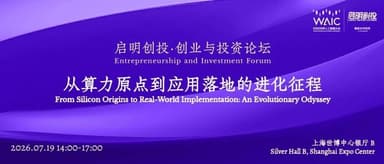
Guest Lineup Revealed | 2026 WAIC Qiming Venture Partners Entrepreneurship & Investment Forum: The Evolution from Computing Power Origin to Application Deployment
Decoding the Paradigm Shift in the Large Model Era: How the Industry Can Move Beyond Pure Parameter Chasing to Ruthless Exploration of Real-World Scenarios, Cost Efficiency, and Closed-Loop Business Models
OpenAI Designed a Chip in Just 9 Months — The AI Chip Game Enters Its Second Half | 5Y Research
Once inference workloads account for more than half of AI computing demand, NVIDIA will no longer be the only game in town for AI chips.
Qiming Venture Partners Portfolio Company Zhipu AI Open-Sources GLM-5: From Code to Engineering, the Best Open-Source Model for the Agentic Engineering Era
On the authoritative global Artificial Analysis benchmark, GLM-5 ranks fourth worldwide and first among open-source models.
Fangle Technology, Led by Jun Liang, Raises Over 500 Million Yuan in Multiple Funding Rounds to Forge New Path in AI Chips
Can architectural-level innovation open up a genuinely new path for China's AI computing industry?
Liang Jun's First Year at the Helm: Fangqing Tech Raises Over 500 Million RMB in Three Rounds Within Six Months
A star-studded lineup of shareholders quickly assembled.
Seeing Further Possibilities | 5Y News Monthly
The big news from last month.
Sorry, BlueRun Ventures Doesn't Want That Kind of Startup Camp | Buming 2024 Now Recruiting
You're Invited to Join a Different Kind of Startup Camp
Legend Capital's Song Chunyu: China's AI Decade — Missed Opportunities and Missteps
Will This AI Wave Repeat Yesterday's Story?
Under the GPT Boom: Anxiety and Breakthroughs in China's Chip Market | FreeS Fund
It's been nearly a year since the CHIPS Act took effect. How is China's chip industry doing?