Entrepreneurship Is a Permanent State of War: 11 CEOs on Human Nature, Strategy, and Responsibility | 2018 FreeS Fund CEO Annual Conference Recap

It takes more than perseverance — you need the ability to swim against the current.
Entrepreneurship is about opening up new worlds, and also about living in an arena. Once you begin, you are forever at war.
On January 19–20, 2018, in Shanghai, nearly a hundred CEOs from the FreeS Fund family gathered at the "2018 FreeS Fund CEO Annual Meeting" to reflect on the year they'd shared — 2017 — and set out together on the road ahead into 2018.
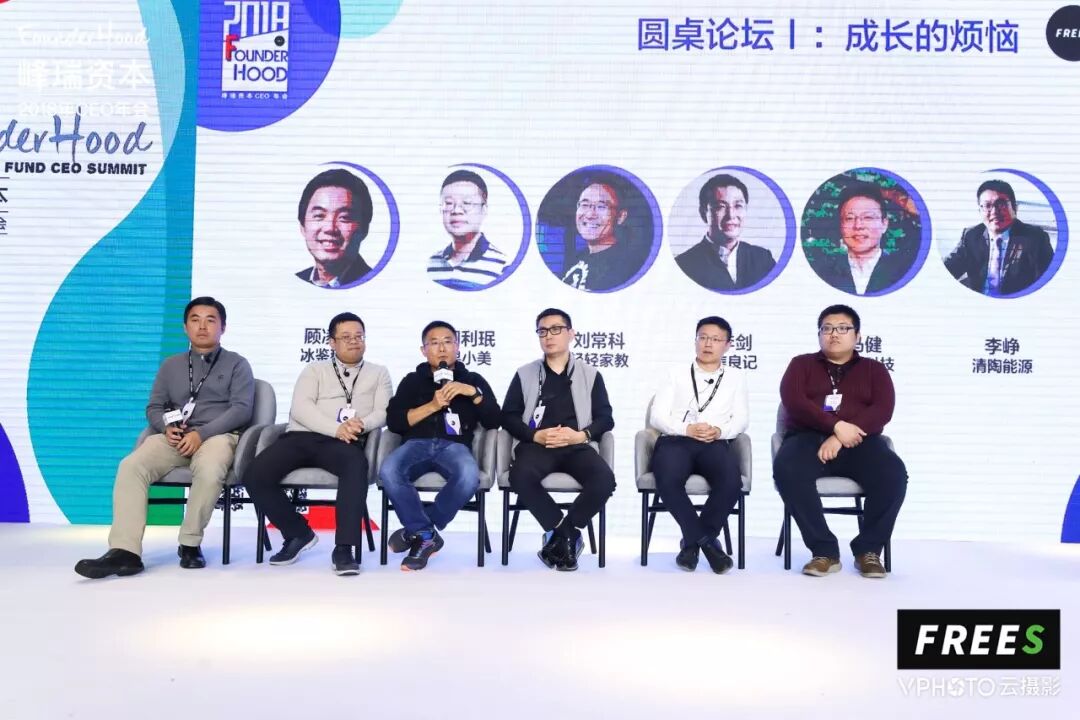
At two roundtable forums titled Growing Pains and The Brand Moat, eleven FreeS family CEOs shared the troubles, big and small, the confusion and struggle they'd encountered since starting their companies. They were sustained by some force and by certain ways of thinking that kept them going. As Howard Schultz, then global president of Starbucks, wrote in A Story of Dreams and Responsibility:
Compassion, empathy, humanity, and love — these words don't often appear in business school textbooks, yet they are the very foundation of building a company that thrives over the long term.
We've compiled their reflections into this piece. May you too walk the path of growth with courage, head held high.

1
What ups and downs have you experienced in entrepreneurship?
How did you keep going?
/ 01 /
Entrepreneurship is a marathon; maintain a steady pace

Changke Liu
Founder and CEO, Changingedu
Changke Liu was previously a founder of Only Education. In 2014, when Only Education merged with Xin Nanyang and went public, becoming China's first listed K12 education company, Liu resigned and co-founded Changingedu. Changingedu provides premium online and in-home one-on-one tutoring services nationwide, allowing children to receive professional instruction without leaving home — making the home itself a classroom children love.
Counting from when I founded Only Education in 1992, I've been in K12 tutoring for more than twenty years.
I once managed a team of three to four thousand people. After starting up, I initially had only five or six colleagues working alongside me; now we've grown to over a thousand. At first I wasn't used to it — I often felt a sense of powerlessness. Running is what sustained me. For years, I've gotten up at 5 a.m. every morning to run 10 kilometers. In the past two years, I've run more than 2,500 kilometers annually and competed in quite a few marathons. My best full-marathon finish is three hours and one minute, meeting the national second-tier athlete standard.
When I run, I can think about things with clarity. Running and entrepreneurship share much in common: the goal is clear, the process is lonely and full of problems, and you need a reasonable rhythm and long-term persistence. A marathon is 42.195 kilometers, and true masters keep their pace per kilometer within a five-second variance. Entrepreneurship is the same kind of marathon. In 2015, when industry subsidies were at their fiercest, we made the decision to stop subsidizing, outlasted our competitors until they collapsed, and then accelerated our expansion.
Changingedu is now present in 35 cities nationwide. Over three years, our "home classroom" has cumulatively provided over 5 million hours of in-home instruction to children from 150,000 families. In my eyes, a startup is like a child, and the CEO must accompany its employees in growing. Every week, I make sure to visit one city and talk with our local teams.
/ 02 /
Entrepreneurship is the biggest bet; balance greed and fear

Jian Li
Founder and Chairman, Xin La Dao Restaurant Group; CEO, Xinliangji
In 2007, Jian Li led Xin La Dao in building its first central kitchen, and subsequently established eight food factories, fully integrating the back-end supply chain. In 2014, Li began preparing a supply chain project, and in April 2016 launched Xinliangji. Xinliangji is a restaurant supply chain brand focused on standardized Chinese food hits.
People who build businesses tend to have a bit of a gambling streak. When I was young, I fell into the gambling trap and later paid for it with bankruptcy and depression. The lesson I learned: you basically can't win at gambling. Then I bet everything I had on entrepreneurship, and only then realized that entrepreneurship is the biggest, most exhilarating, longest-lasting bet there is. It can put you in a state of "all or nothing, every single day."
I've been through three startups. My two biggest takeaways:
First, I've learned to confront human nature head-on: greed and fear. When faced with temptation, we become greedy and want more; when challenged, we feel fear and want to give up. As CEOs, we continuously cultivate ourselves through the entrepreneurial process, gradually learning to balance greed and fear, and our minds grow stronger. When the company hits a rough patch, we can recover slightly faster than others and point the team in the right direction.
Second, I've learned to understand others. No one has it easy; everyone is fighting their own hard battle. In collaborations, I try to accommodate the interests of people at different levels, dimensions, and time horizons, aiming for win-win outcomes as much as possible.
In 2017, our revenue grew tenfold. That's good news, but it also brought major challenges: in 2018, how do we balance rapid growth with effective operations? Finding that equilibrium is what will allow the company to sustain itself and thrive.
For me personally, as a serial entrepreneur, I've grown accustomed to relatively fixed patterns of work, life, and travel — there's some path dependency. In the new year, I want to do something "out of character," to feel a bit younger.
/ 03 /
Entrepreneurship is a test of stamina and time;
increase your "floor area ratio"

Lingyun Gu
Founder, Chairman, and CEO, IceKredit
Lingyun Gu was previously co-founder and chief risk officer of Turbo Financial Group and founder of the modeling team at Zest Finance. He has participated in investment decisions for several well-known internet finance companies and serves as a director of A-share listed company Sinodata. IceKredit is a third-party independent credit platform based on machine learning and AI, dedicated to providing big data risk control services to financial institutions.
I research AI and big data, so I'll summarize my entrepreneurial experience in numbers.
First, entrepreneurship is something that demands physical stamina. I lived in the United States for 17 years and traveled back and forth constantly, averaging nearly 200,000 miles on international flights per year, plus 40,000 to 50,000 kilometers on domestic flights. When I was in good shape, I could sleep through the entire 13.5-hour flight from the US to China, or the 10.5-hour flight back. I can't do that anymore. Three years into entrepreneurship, I've gained weight, my memory has worsened, and I've developed some of the frustrations of aging.
Since starting up, I get up at 6 a.m. every day and go to bed at 1 a.m., replying to all work emails before sleeping, working seven days a week. I'm obsessive about time. If a company call is scheduled for 8:00 and someone dials in at 8:02, I'm not happy. This is certainly efficient, but over-scheduling has also left me with insufficient time for reflection and沉淀. Just as people look at green space and spacing between buildings when buying a home, startup CEOs need to increase the floor area ratio of their time and maintain a reasonable rhythm.
/ 04 /
Entrepreneurship requires focus; advance one step at a time

Jian Ma
CEO, XtalPi
Jian Ma was previously a visiting scholar at Japan's RIKEN and The Chinese University of Hong Kong, with extensive research experience in quantum information, quantum computing, and numerical simulation. He has led his core R&D team to successive technical breakthroughs and represented XtalPi in winning top prizes in multiple provincial and national competitions. XtalPi is a world-leading drug discovery company powered by computational innovation.
Three years into entrepreneurship, my biggest realization is the need to focus and pursue direct, simple thinking. In academia, I was more inclined to diverge, emphasizing breakthroughs through divergent thinking. But in entrepreneurship, only by digging deep in a vertical direction can you possibly lead the industry and survive the early stages.
Entrepreneurship is a long-term process; you must advance one step at a time, making R&D and innovation a sustainable way of life and work. Clarify the company's core long-term goals while keeping short-term development strategies nimble and agile. For XtalPi, 2016 was about R&D reserves, 2017 was about commercial breakthroughs, and 2018 will be about scaling and growth. For myself, I need to think about how to cultivate middle management and improve management capabilities. I believe that only by building a middle management team with strong growth capabilities and high initiative can company development be robust.
/ 05 /
Entrepreneurship exchanges effort for reward;
follow business logic

Zheng Li
Co-founder, General Manager, and CTO, Qingtao Energy
Zheng Li holds bachelor's, doctoral, and postdoctoral degrees in materials science and engineering from Tsinghua University, and was previously director of the Jiangsu Province Energy Composite Materials Engineering Technology Research Center. Qingtao Energy is a high-tech enterprise specializing in key materials and equipment for lithium-ion batteries, as well as R&D and industrialization of next-generation lithium battery technology.
I believe entrepreneurship must follow the underlying logic of business — exchange. I contribute labor, make the product you need, sell it to you, and receive the money that product deserves.
When I was still in school, I was certain I would eventually start a company and prepared accordingly. After graduating, I didn't stay on as a teacher or researcher. At first I had some adjustment difficulties — the company has over 200 employees, 106 of whom are frontline workers with an average education level of junior high school. Interacting with them requires different methods than dealing with people in academia, and I'm still learning. But I believe the fundamental principle of exchanging labor for reward doesn't change.
/ 06 /
Entrepreneurship is about doing things with the right people;
you need good partners

Limin Yan
Founder and CEO, GuoXiaomei
Limin Yan was previously general manager of Juhuasuan, with ten years of experience in internet product operations and e-commerce. He is experienced in building and managing large-scale e-commerce platforms, and specializes in supply chain integration, scaled operations, and marketing innovation. GuoXiaomei is dedicated to building China's largest office retail network, creating "unmanned convenience stores in offices" for enterprises.
This time around, I'm what you'd call a late-age entrepreneur. GuoXiaomei has only been around for 200-some days, so it's a bit early to be drawing conclusions. But one thing is certain: no matter how low the valley or how dramatic the rebound, the most critical factor in entrepreneurship is always who you're with and what support you can draw on.
2
What pitfalls must you stumble through to earn a good reputation?

/ 01 /
Put users first

Liaoyuan Zhang
Founder, Three Squirrels
In 2012, Liaoyuan Zhang founded Three Squirrels and became known as "Squirrel Dad."
There's no shortcut to building a brand. Three Squirrels has always held to one principle: whoever consumers believe is the brand, is the brand. From our earliest days until now, we've done three things right: we chose a good name — squirrels and nuts are tightly linked; we put squirrels anywhere we could on packaging and parcels; and we call consumers "master."
We use products as the vehicle, letting users build brand recognition through experience. New brands mustn't start off trying to seem "high-end" or talking a lot about ethos. All ethos is built on functionality — you first need to directly tell consumers why they should buy your product.
But building a brand is like being in a relationship: after winning consumers over with one move, you need to develop breadth to sustain the relationship. A brand's moat goes from nothing to something, and then from something back to nothing — eventually you must de-brand. I don't want people to only remember Three Squirrels as a seller of nuts and snacks; I want them to feel that Three Squirrels is simply good, that they can trust everything we make.
/ 02 /
Think through the top-level architecture

Jordan Luo
Chairman, Jordan&Judy
Jordan Luo has 14 years of experience in the creative lifestyle products industry. He led his team from a small factory to six factories across different categories, with over 3,000 employees, and is committed to promoting and selling products for eight major brands in global markets. Jordan&Judy is a fashionable lifestyle brand built on innovative design.
I'm a serial entrepreneur. I previously built a bag brand and made three consecutive mistakes: first, I didn't think through the importance of the brand from the start and didn't register the website, later spending $150,000 to buy back the domain; second, I once spent 6 million yuan to build a team in Germany, but communication was so difficult that I had to pull out; third, because I was determined to create a Chinese luxury bag brand, I priced high — averaging over 2,000 yuan per bag — and later couldn't move them on Tmall.
This time, building Jordan&Judy, I've realized that entrepreneurship must respect the essence of business, thinking through top-level architecture design from the smallest details before setting out. Many major international channel distribution brands I've encountered share this trait — Lock&Lock, America's OXO, Japan's IRIS OHYAMA — they all begin with a global perspective and international layout.
/ 03 /
Stay grounded and "embrace clumsiness"

Dami (Yumin Cao)
Founder and CEO, VPhoto
Dami (Yumin Cao) is a serial entrepreneur. In 2004, she founded WeCloud, an early domestic cloud computing project. From 2007 to 2011, she served as R&D finance director for Continental AG Asia-Pacific. She then worked at Siemens headquarters in Germany as a global executive. In 2015, Yumin Cao founded VPhoto. VPhoto is the world's first instant image sharing platform.
I come from a finance background, and my husband works in technology R&D. Neither of us understood branding at first, nor had we studied Trout (Jack Trout, top marketing strategist, who published Positioning in 1981). Our lengthy product introductions were once criticized by media as a failed case that "even our mothers couldn't understand." Later, through serving customers, many users actively helped us summarize and refine, and we gradually found our brand tone.
The character for "brand" (pin) is made of three mouths. For startups, word of mouth is the best brand. What we need to do is "embrace clumsiness" — steadily improve service quality and user experience, accumulating reputation. Word-of-mouth传播 is also the most cost-effective brand promotion, whether you're doing B2C or B2B.
/ 04 /
Build reputation through good products

Linfeng Yang
Co-founder and CEO, Onion Math
Linfeng Yang previously worked at Boston Consulting Group and Microsoft. He is co-founder of the Sunshine Bookstore Rural IT Education Initiative, long committed to driving educational innovation and equity through information technology. At the end of 2013, he co-founded Onion Math. Onion Math helps primary and secondary students independently learn coursework through carefully designed human-computer interaction courses, without needing a tutor.
Our company's three co-founders — two studied computer science, one studied education. None of us had any experience in branding, marketing, or sales. Though we firmly believed Onion Math's products aligned well with students' cognitive patterns and could genuinely help them learn from the heart, as a new brand with no知名度, no offline stores, and founders who didn't look like veteran experts, it was hard to immediately win parents' trust through branding alone.
So we initially focused on math as our entry point, emphasizing that we could make math interesting and get kids to learn proactively. These claims went against user认知 — most people believe math can't be fun — but users would also feel curious: since downloading a free app costs nothing, why not try? Then it was up to the product. After using it, users found it genuinely interesting and could see learning results, which built our early口碑 that spread organically.
Our content打磨 has always been slow — a single course video takes two months to produce. The early days were painful because we couldn't rapidly expand categories to reach users. With investors' support, we made it through, and the long-polished content确实 could move users. We've primarily built our brand through product.
/ 05 /
No step in entrepreneurship is wasted

Tony Tang
CEO, ZhiGuan
Tony Tang previously worked at Johnson & Johnson China, Wrigley China, and Procter & Gamble Guangzhou, handling marketing for brands including Johnson's Baby, Clairol, Pantene, and Rejoice. In 2015, he left P&G to found ZhiGuan. In its first year, ZhiGuan became China's #1 amino acid shampoo, with the goal of becoming the country's top natural and healthy personal care brand.
A good brand is just the tip of the "iceberg" that shows above water; what lies beneath is years of accumulated enterprise effort. Most well-known brands went through decades of摸索. Take Nike: its predecessor spent its first decade-plus as an importer of Japanese running shoes before becoming an independent sports brand. The now-famous slogan "Just Do It." wasn't introduced until 1988 — 25 years after the company's founding.
The personal care industry is a "red ocean." Generally speaking, in red-ocean battles, startups can only pick up scraps. But large companies sometimes carry heavy burdens when facing change: they're slower to meet new user demands. This leaves us precious time windows. Startups can quickly act to better satisfy consumer needs.
There are many twists and turns in entrepreneurship, but none of the steps we've taken have been wasted, because we can only take the second step after the first, and the third after the second.
Explore, Strive, Persist | 2018 FreeS CEO Annual Meeting Recap
New Retail Entrepreneurship: Speed and Competition, but Also Careful Cultivation | FreeS Free Talk