AI for Pharmaceutical Chemical Synthesis: Can Today's AI Match a Chemist with 10 Years of Experience?

AI for Science is becoming one of the hottest directions in the primary market.
AI for Science is becoming one of the hottest directions in the primary market.
At the end of July, the Politburo meeting emphasized "strengthening long-term and stable support for basic research." Combined with the earlier AI+ initiative, a very concrete question has been pushed to the forefront: How exactly can AI be applied to scientific research, and how can it genuinely improve efficiency and predictive power?
This week, the industry also saw major news. Moderna and Merck & Co. announced that their first personalized mRNA cancer vaccine, developed through their collaboration, achieved preliminary positive results in a Phase 3 melanoma trial. This vaccine benefited from AI during the neoantigen selection process, enabling researchers to simulate complex molecular interactions computationally rather than through endless wet-lab experiments.
For this edition of "Industry Watch," we spoke with Dr. Ning Xia, founder of Chemical.AI. With a PhD in organic chemistry, Xia has been on the "AI + chemistry" path for nearly 18 years, dating back to his participation in a startup in France in 2008. Over those 18 years, he has witnessed the industry grow from nothing, to the first wave of spotlight on AI drug discovery, through the three-year winter for biotech, and on to the second wave of AI drug discovery and the new AI4S trend after the GPT moment.
They discussed how the cross-disciplinary ability to "stand with one foot on each boat" developed, how black-box and white-box approaches respectively play out when technology hits the ground, acquisition offers that were turned down, and a very practical calculation: If AI is to replace chemistry professionals earning 20,000 yuan a month, how do the token costs pencil out?
Below is the edited conversation. For the full dialogue, please visit the Xiaoyuzhou app or Apple Podcast and search for "Gao Neng Liang."
Feng Li: Back around 2015–2016, we had been paying close attention to interdisciplinary innovation, especially the intersection of computer science with biopharma and chemistry. We invested in companies like XtalPi and METiS Pharmaceuticals. This industry has been around for over a decade now, and we've noticed two problems. First, it's difficult to find people who happen to "stand with one foot on each boat"—whose capabilities genuinely span two non-intersecting disciplines, like computer science and chemistry. Second, if someone does manage to stand on both boats, which boat ultimately matters more? Let's start with the first question: How did you, at a young age, connect chemistry and computer science, two subjects that seem completely unrelated?
Ning Xia: Mainly through interest. Programming is a discipline with very strong logical thinking; chemistry requires a lot of memorization and curiosity about nature. I happened to be interested in both. Later, by chance, I won awards in both competitions, so when it came time to choose a major, I was torn. An admissions officer from Tongji University told me something: "Computer science is a technique; chemistry is a profession." I chose chemistry, and in retrospect it was the right call. If I had studied computer science first and then tried to cross over into chemistry, the difficulty would have been much greater.
Feng Li: While studying chemistry, how did you keep your computer science skills from atrophying?
Ning Xia: I wrote code every day. Experiments during the day, code at night.
Feng Li: What were those programs related to back then?
Ning Xia: They were also AI-related. I was very curious whether human brain thinking patterns could be simulated with programs. I explored this a lot, but certainly without much success—if I had succeeded, I might be doing something else now. Later, the same pattern continued during my PhD abroad: experiments during the day, code at night, getting computer programs to simulate human judgment in scenarios like games and chess.
Feng Li: When you finished your PhD, did you struggle with whether to stay abroad or return to China?
Ning Xia: Things were still developing quite well abroad then; Europe hadn't reached its current state, so I stayed in France to participate in a startup. I was looking for a company that used computer technology to solve chemistry problems, but such positions were extremely rare. I was fortunate to find a company in Strasbourg, France. It actually hadn't been founded yet—their website had just gone up. I chatted with the founder and felt we were very aligned; they also wanted to use data to solve chemistry prediction problems.
Feng Li: How long did this period last?
Ning Xia: Seven years, from 2008 to 2015. The field was completely unhot then; no investors were looking at it whatsoever. It was entirely driven by personal ideals and interests. Moreover, there were none of the underlying AI technologies we have now, and no data. All the infrastructure had to be built from scratch.
Feng Li: Was the focus then also on using computers plus data to explore chemical synthesis pathways?
Ning Xia: Not yet. The first task was finding data, because we didn't even have data. We tried multiple approaches: using something like high-throughput experiments to generate data. There was no automation then; human experimenters could manually run hundreds or thousands of reactions in parallel, but that data volume was far from sufficient. We also tried extracting structured data from PhD theses, but the cost was too high and efficiency too low. Later we developed an electronic lab notebook, hoping that university professors would share data with us after using it, but this approach later ran into some commercial difficulties.
Feng Li: With these multiple obstacles, what happened to this company in the end?
Ning Xia: It was acquired by its parent company, which is now the largest CRO in France. We accumulated a great deal of underlying technology during that time. Much of our current underlying architecture was built up then.
Feng Li: You returned to China in 2015. I recall you first had a period helping a friend with their startup.
Ning Xia: Yes, the founder of Shanghai Wanghua Technology called me over. Chemical B2B e-commerce platforms were very hot then. Initially I was responsible for building the platform. Later we thought: Could we pursue the direction I had wanted to do before but hadn't—AI retrosynthesis? In 2016, we applied for the chemical.ai domain, the earliest globally to do so. Chemical.AI came later.
Feng Li: There's a small story here. While you were still at Wanghua, you developed a software that predicted the synthesis of compound A to compound B—what conditions to use, how many intermediate steps, what the final result would be, and even yield to some extent. WuXi AppTec's core business is chemical synthesis CRO. They put out a global call for who could do synthesis pathway prediction, with many companies participating. Dr. Xia hadn't founded Chemical.AI yet, so he went as an individual—and won first place.
Ning Xia: It was indeed quite fortuitous. That was 2016. We had connections with some WuXi executives, so I said I had this software and asked if they wanted to try it. He said sure, and we scheduled a time. When I arrived, I found many people there—a whole room of their executives. I did a live demonstration, running various molecules through it, and the results were excellent. So we had our earliest commercial cooperation with WuXi. Through this, I realized two things: first, the industry takes this very seriously; second, the technology had reached its first inflection point—previously there was no software that could do this well, and we were among the earliest to show them that it could be done. Today it has become a very general-purpose tool, but it took about six or seven years to get there.
Feng Li: There was no GPT then, and I assume no Transformer architecture either—at most convolutional neural networks from before that. In retrospect, how "AI" was the product at that stage?
Ning Xia: The concept of AI then was different from now. Initially we talked about machine learning, then deep neural networks, Transformer, and later large models—it kept evolving. But generally speaking, anything based on data for prediction is essentially a form of AI. Back then it was more traditional machine learning, plus a lot of cheminformatics—specifically studying how to write the logic of chemical reactions into algorithms.
Feng Li: Using AI for prediction raises a frequently discussed question: black box or white box? White box contains a lot of summarized human experience, rules, and formulas; black box is data in, a series of computations in the middle, results out. Autonomous driving faces this problem today. Back then, in the software that beat the big companies to meet WuXi AppTec's needs, how much was black box versus white box?
Ning Xia: The white box proportion was very large. For serious scientific software, if it's a black box, it's very difficult to build customer trust. Because it will periodically produce hallucinations or bugs, with potentially very serious consequences, and it's unexplainable. The biggest challenge is: you discover a problem, but don't know where it originates, so there's no way to improve it.
Feng Li: Right, it's hard to tune—after you fix A, it inexplicably changes B, C, and D at the same time, and you have no way to prevent B, C, and D from going in bad directions, let alone knowing what B, C, and D even are. We've looked at many AI for Science companies across materials, chemistry, and other directions. Biology is actually somewhat better because genomics provides underlying constraining rules. What about chemistry? Where do you think explainability stands today?
Ning Xia: In our system, explainability is very strong. All conclusions from large models or black-box models must be explained, verified, and constrained within our white-box models. Only then can we eliminate hallucinations and simultaneously know which of the ambiguous conclusions it produces are right and which are wrong. This is extremely important in scientific domains.
Feng Li: Programmatically, does it go through a black box layer first and then a white box, or are the two fused together?
Ning Xia: There's fairly strong fusion; the two proceed simultaneously.
Feng Li: When we first met Dr. Xia in 2018, he had just started Chemical.AI. The company's first milestone after founding was providing a not-insignificant software service to a globally famous MNC.
Ning Xia: We're very grateful that WuXi introduced us to one of its major clients. This client was building an AI drug discovery system, and the AI retrosynthesis portion was entirely entrusted to us—a collaboration worth over $1 million, with considerable difficulty. Through that collaboration, we truly achieved productization that could match these large clients' various requirements for security, speed, and quality. That was a very important starting point for us.
Feng Li: This is a problem many scientist-entrepreneurs face: they've produced very useful research results, but when it comes to real industrial closed-loop application, sometimes it's unusable, not user-friendly, or if the wrong people use it, there's resistance. How did you overcome these issues?
Ning Xia: These problems definitely exist. When your product first comes out, it's certainly not 90 points—maybe 60 or 70. We actually went through massive amounts of customer feedback, iteration, and optimization—which is why the white box is so important. If you're a black box, customers give feedback and you can't act on it, and they despair.
So we just kept improving, letting customers see the product continuously progressing. I looked at our requirements list; various customer suggestions probably number over a thousand now, and each one represents massive work to improve and correct.
This process is very important, but many people today, whether investors or industry observers, may overlook this—they think that as long as the model is good and the technology is good, you can instantly become the best globally. But I think often it's built through this kind of iteration.
Feng Li: Taking this single client as an example, in the first three years, were the departments and people using it relatively fixed, or did it expand across more and more departments?
Ning Xia: More and more. As clients use the product, they generate lots of ideas. They'll say, hey, wouldn't it be better if you did this feature this way? Or what if you connected that for me? That way we learn how clients actually use it in real scenarios — and usually the reality is different from what we imagined.

Feng Li: When companies use it internally, are the users mostly traditional chemists doing synthesis, or does it expand to people with different backgrounds across more stages of the R&D chain?
Ning Xia: Several stages use it. First, the molecular designers — their expertise isn't synthesis, they're more on the CADD (computer-aided drug design) or AIDD (AI drug design) side. But when designing molecules, they have to consider whether a molecule can be synthesized and how easily. That's where our tool comes in.
Then it reaches the medicinal chemistry department, where they use it to quickly design routes. Their need is speed — get the molecule fast, maybe just a few milligrams, cost isn't a concern.
At the clinical process scale-up stage, the requirement flips: I'm only making this one molecule, don't give me the easiest reaction, find me the lowest-cost one. Sometimes even if a reaction itself is risky, they'll use it because it reduces costs. Of course it can't be too dangerous — if scaling it up risks explosion, that's out.
Feng Li: I was "tortured" by chemistry as an undergrad — spent my grad school days exploring all kinds of synthetic routes. Going back 20-plus years, the norm for chemistry grad students was: the advisor points a direction, say from A to B, then the student searches literature, tries conditions, traverses through failures on their own. If this tool had existed then, how many problems could it have solved for a grad student?
Ning Xia: Probably all of a student's work could be done by AI now. The first thing AI replaces is likely this kind of entry-level intellectual labor.
Feng Li: So chemistry grad students would be like many programmers today — gradually being replaced, or perhaps able to do more creative work?
Ning Xia: Somewhat similar, but chemistry is more optimistic. There are far more tasks in chemistry — we have too many innovative materials to create, the space is large enough. Even if the proportion of work we do decreases, we can take on more projects.
Feng Li: So it's like everyone's bandwidth has increased.

Feng Li: Going back to 2020–2021, due to COVID and other factors, biotech hit a high point of capital market enthusiasm. At that time, Dr. Xia, you also faced a temptation: a large CRO made you more than one acquisition offer. Your company was still small then — a dozen or two dozen people. Looking back today, do you ever think you should have just sold?
Ning Xia: Not really. I'm a relatively idealistic entrepreneur. Even during the high cycle, I'd ask: is this funding actually helping me push this project, this vision forward? If not, maybe the funding isn't that useful. During industry downturns, when the funding environment is tough, as long as I feel my progress meets expectations, I consider that progress.
Feng Li: The high lasted a year and a half; the low, nearly three or three and a half years. What impact did these five years have on your company management and personal temperament?
Ning Xia: I came from a research background — initially not very skilled at management, corporate governance, or commercialization. The most important thing I learned is: you must grasp the essence of what you want to do, don't be swayed by highs or lows — that influence will lead you astray. If you change your core direction because capital markets are chasing something, and do something you don't even believe in, the long-term results won't be good.
Feng Li: AI today is undoubtedly in a high moment. For founders just starting AI companies with scientific backgrounds, what lessons or experiences can you share?
Ning Xia: Stick to what you believe is correct. Don't let capital's viewpoint completely lead you.

Feng Li: In 2022, biotech entered a downturn, but that year-end brought the "GPT moment." With these two events叠加, what changes did that bring to your product and model?
Ning Xia: It was a huge opportunity. In the vertical domain of AI chemistry synthesis, we can solve very specialized problems, but real work scenarios contain many generalized problems. A random example: a lab might not have a certain reactor, so this reaction can't be done — this isn't a specialized problem, but with our previous积累 we couldn't solve it. Now large models can handle this category of generalized problems well. Because large models think similarly to human experts, they can synthesize various objective factors to make judgments — this compensates for algorithms' shortcomings in considering all factors that affect conclusions. In other words, we gained the ability to use agents plus specialized tools to solve entire workflows.
Feng Li: With large models, were there major adjustments to product architecture?
Ning Xia: Vertical domain algorithms aren't directly affected, but the final product form delivered to clients is somewhat different. Previously our technology was presented to chemists as tools, and chemists used tools to solve problems; in the future, the product's user shifts from humans to agents, and the user interface gradually becomes APIs for agents. It's quite possible that humans only need to state objectives, then agents complete the entire work.
This agent will gradually familiarize itself with the work, it has memory, it keeps learning — eventually it may be like an employee at your company. After you teach it a few times, you don't need to teach it every time; you just assign it tasks and it goes to work.
Feng Li: Handing decision-making to agents — do users feel like they're missing key nodes that should be in the loop?
Ning Xia: Early on, yes. But later, as its delivery quality gets higher, even exceeding human efficiency and quality, people stop caring about that.
Feng Li: In the overall backend structure and system, has the ratio of black box to white box changed today?
Ning Xia: Not significantly so far, and white box is actually increasing. Because with large language models, they have very strong interpretability — for every decision they make, they'll explain why.
Feng Li: Setting aside model capabilities, what's driving the improvement in white box capabilities?
Ning Xia: The core is still information gained from years of continuous interaction and iteration with clients. In a serious scientific scenario, if you lack interpretability, commercial推广 is very difficult, because clients need to know how these conclusions were reached. So to make products increasingly better, you must become increasingly white box. This may be the hidden threshold for AI truly landing in business. While you can directly deliver products, I don't think you can completely remove the human factor yet — as long as humans are in this process, interpretability is necessary.
Feng Li: Perhaps now AI4S companies in various directions will all go through similar processes.

Feng Li: Combining today's AI capabilities and existing data, where do you think chemistry (including chemical synthesis) stands compared to biology applications like AlphaFold or genomics — what percentage is the former relative to the latter?
Ning Xia: Hard to compare with AlphaFold, but in the synthetic route design domain where we operate, AI has already achieved large-scale deployment.
Feng Li: In a not overly complex chemical synthesis process, say involving multi-step reactions with a few conditions, how capable is AI today?
Ning Xia: We've done evaluations internally and externally. The current conclusion: AI capability in chemical synthesis is roughly equivalent to a chemist with 10 years of experience. Basically any route a chemist can think of, AI can think of too — and AI typically averages 5 to 6 different strategies, while humans usually think of 1 to 2.
This is actually something clients are very satisfied with. Because clients always test with real cases — routes they might have spent one or two months designing, our product can run in 5 minutes, and can even suggest routes the client tried but ultimately didn't choose.
Feng Li: This is very similar to XtalPi's blind test with Pfizer around Thanksgiving 2016. Back then, almost no one in pharma believed AI could do crystal form prediction. Pfizer brought out three unpublished drug molecules that they already knew, invited different teams to predict crystal forms, and found XtalPi's predictions matched their experimental results. So you think chemical synthesis has reached a similar stage?
Ning Xia: Yes.
Feng Li: A small technical question: Can AI predict something completely new, something that hasn't appeared before — a synthetic path that experienced chemists wouldn't think of, but is feasible and more elegant?
Ning Xia: Yes, but with one limiting premise: it won't invent new reactions. All our AI innovation is based on existing data, because synthetic route innovation basically uses known reactions — it's just that this known reaction might be hidden in some corner of massive literature. If you don't see it, your route might be 10 steps; if you see it, it might become 3 or 4 steps.
AI can absorb more knowledge and search faster, so it has the ability to find reactions we normally can't see, making the entire path more elegant or lower cost. This is something we've already verified.

Feng Li: In the full chain of small-molecule-related biopharma R&D, where does AI-assisted retrosynthetic route design roughly sit?
Ning Xia: Whether it's AI drug discovery or AI materials discovery, R&D isn't fundamentally about simple molecular design — it's about iterating through multiple DMTA cycles. D is design, M is make, T is test, A is analyze. After analysis, you refine the approach and re-enter the cycle. Developing a drug typically takes 7 to 8 rounds; developing a material takes multiple rounds as well.
Within this cycle, each step has different efficiency. In the design phase, we can easily design hundreds, thousands, or even tens of thousands of molecules in a day. But in the synthesis phase, things get bottlenecked — a chemist synthesizes roughly 3 to 5 molecules per month, doing 2 to 3 reactions per day. That's the industry-standard pace. In testing, efficiency jumps back up because of high-throughput screening, where you can test hundreds of molecules for target affinity at once.
So if you really want to accelerate the DMTA cycle by orders of magnitude, you need to focus on improving synthesis efficiency. This is also the feedback we've gotten from customers: they care deeply about synthesis-side efficiency because that's where the entire R&D process gets stuck.
Feng Li: During the 2016–2020 wave of AI pharma enthusiasm, we encountered two types of founders. One came from an AI background, seeing AI application in biology as a promising direction. The other came from a biopharma background and gradually built up AI capabilities. If someone from a purely AI background were to enter your space today, what would be their biggest challenge?
Ning Xia: We've collaborated with some purely AI-background people, including university professors, and ultimately found one challenge: they don't understand the problems in our industry, or their understanding is wrong. But they don't tell us, so they keep experimenting down the wrong path. When results turn out poorly, they might blame it on data issues. I'm not saying they lack capability — just that industry know-how is extremely important.
I've noticed that AI-background people do have one strong suit: when data volume is large enough, they can offer good insights on training efficiency. However, data is precisely what our AI for Science field lacks most. You'll find that in many domains, hundred-million-scale datasets are rare; some fields only have hundreds, thousands, or tens of thousands of data points.
Feng Li: Over the past eight or nine years, the various types of data you've accumulated — literature, positive and negative feedback from real industrial scenarios, internal closed-loop experiments — how much has each contributed to model capability?
Ning Xia: It depends on the problem; different problems require different data. For retrosynthesis, we believe publicly available literature and patent data contribute the most, because what AI mainly learns is the reasoning approach for retrosynthesis.
Feng Li: To draw a simple analogy: the largest data source for today's large language models is the global public internet text dataset accumulated over 40-plus years. But in any scientific research domain today, even adding up all papers, the data is many orders of magnitude smaller. For you, what's the respective contribution of positive versus negative data to model improvement?
Ning Xia: I believe positive data — successful data — is very important at this stage; negative data will be very important in the future.
For this generation of agents or AI models, as long as they can reach human-level judgment and capability, they can already be commercialized at scale. At this stage, AI learns more from human positive data — cases where humans thought something would work and it actually succeeded. But in the future, if AI is to surpass experimentalists' cognition, it needs to predict reactions that humans think will work but actually won't. That's when negative data becomes important. That's the next step.

Feng Li: In your current application scenarios, do you need to call backend foundation models or use cloud tokens?
Ning Xia: The agents we're building do use them, and some data processing work does too. Current foundation models can score around 60 or 70 on some scientific problems. But we don't bear the cost, because our major clients have all deployed their own foundation models internally.
Feng Li: Let's assume what we can replace today is someone with a chemistry degree and 10 years of experience. At a Chinese chemistry CRO company, what's the typical compensation for such a person?
Ning Xia: Around 20,000 RMB per month.
Feng Li: So roughly 200,000 to 300,000 RMB annual salary. I'm asking because: aside from purchase costs, there's backend token consumption cost, and ultimately everyone has to do the math — does this replacement process actually save money, or not that much?
Ning Xia: Clients care deeply about this. They know foundation models can do a lot of work, but if it's too expensive, they won't use it. So a major part of our engineering work is helping clients save money — I can't call the foundation model arbitrarily; I only call the appropriate model when necessary, using minimal cost.
Feng Li: This is very important. Today there's an issue many people haven't paid much attention to yet: the biggest difference between AI and previous software is that every interaction and call has a cost, whereas traditional software and database interactions had virtually zero cost. So once people start focusing on cost, AI will most easily land in applications that replace scenarios with certain value — meaning the people it replaces need to be worth a certain amount of money.
Ning Xia: I'm relatively optimistic. I think prices will keep falling, possibly eventually becoming as low-cost as electricity, at which point people won't care as much.
Feng Li: That's very long-term.
Ning Xia: In the short to medium term, it depends more on agent-level optimization. For simple problems, we use free or self-deployed models; we reserve the best, most expensive resources and models for the most core and critical problems, ultimately reducing overall token consumption.
Feng Li: Because the payment model is changing — shifting from SaaS to agent — what changes do you think will happen?
Ning Xia: For a considerable period, it'll be a hybrid: both basic subscription SaaS and pay-per-call agents. Because some problems customers can solve well enough with SaaS, and they naturally won't want to pay more. For another category of problems that SaaS can't solve well and human solutions are too expensive, customers will be willing to try the agent model. Assuming we charge users the same amount, the major cost becomes token consumption, so cost reduction becomes a driver for us.

Feng Li: Among your current customers, what's the split between multinational companies and domestic enterprises?
Ning Xia: By count, we currently have more domestic customers. But by total payment amount, foreign customers now exceed domestic ones.
Feng Li: Today, Chinese pipeline-focused pharma companies are actively pursuing license-outs, which is why China's biopharma license-out value has surged this year. This will pressure pharma companies to increase pipeline R&D speed, breadth, and efficiency — faster, more numerous, and better. To achieve this, they'll likely go all-out to adopt more new efficiency tools. Have you felt this demand?
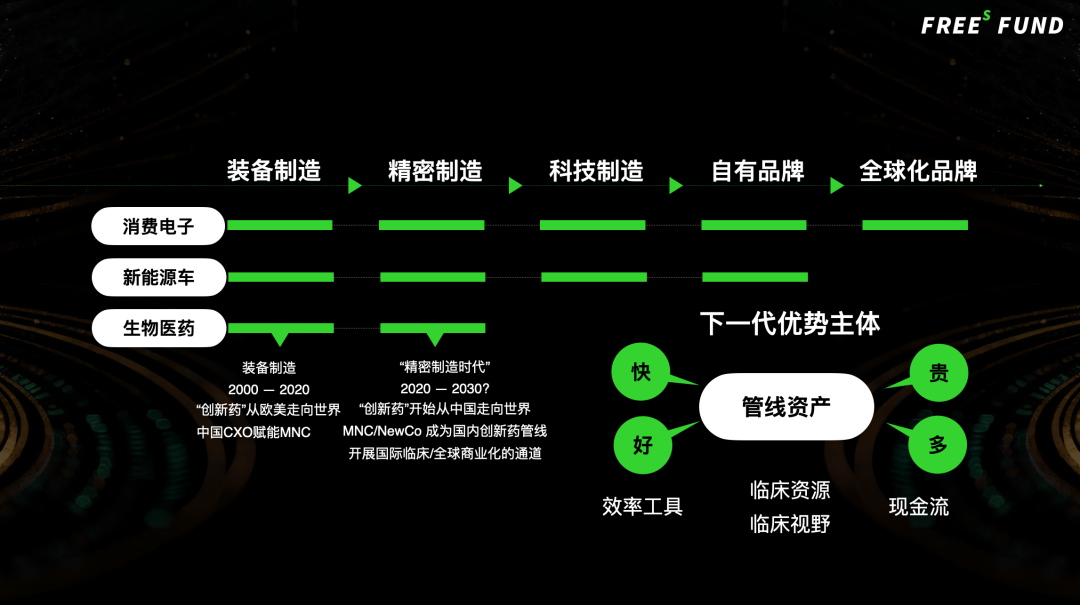
Ning Xia: We're already feeling some of it. The speed and efficiency of domestic new drug R&D already have considerable advantages compared to Europe and the US. But the reason I said foreign customers are still more numerous is that our main customers are large enterprises, and China still has relatively few such large MNCs.
Feng Li: This is similar to China's precision manufacturing industry from 2008 to 2012 — China's share in the Apple supply chain approached half, but Chinese companies' total profit share from manufacturing one iPhone was very small. Pharma is somewhat in that situation now.
Ning Xia: Right, demand is abroad, supply is domestic, and domestic supply-side growth has been very noticeable these past few years. Following this trend, looking ahead, it's not impossible to form a China-dominated "world pharmaceutical factory" model, similar to manufacturing.
However, I have another observation: India is also growing rapidly in drug R&D, not slower than China. This year, our Indian customers increased by over 30, including CROs, CDMOs (organizations providing integrated outsourcing services from R&D to production for pharmaceutical companies), and some drug makers. So I think India may have this opportunity too.

Feng Li: Today, some foreign foundation model companies are gradually pivoting toward AI for Science. How do you view Wisdom's opportunities and challenges in the coming years?
Ning Xia: First, it's an opportunity. Enhanced large model capabilities are very helpful for us, enabling us to build out the entire workflow.
Second, I think it's not easy for large model companies to come down and build vertical models. They may find it difficult to enter enterprises' specific scenarios and do service bit by bit. Many people also ask: can general-purpose models eventually do vertical capabilities directly, or even do them better? I think that's hard too. We've done extensive internal testing — general models can quickly reach 50 or 60 points in vertical domains, but going further is extremely difficult, basically not reaching usable levels. The main reason is that general models are fundamentally more text-based, whereas the vertical models we build are more like multimodal data.
And large language models are too general-purpose. If you want to build a vertical domain, the approach is still to assemble a small team, like a startup. But this "startup" doesn't have much so-called advantage — they can use large models, and so can we. So accumulation becomes more important, or rather, understanding of customer scenarios and deep ongoing collaboration with customers — that's what matters more.
Feng Li: Then what do you see as your challenges?
Ning Xia: The challenges are more about how we gradually deepen our moat. It's long-term grunt work, requiring continuous resource investment to build a deeper foundation, and ultimately collaborating with large models — large models solving what they're good at better, us solving what we can solve, with both sides combining and depending on each other.
Feng Li: Since AI for Science has become such a hot topic, you guys have gotten a lot of attention too. Of all the investors you've been talking to lately, what's the most common misconception?
Ning Xia: Probably two things.
First, some investors think we absolutely have to develop a novel drug or a new material for the market opportunity to be big enough. To me, that's an outcome, not a cause. The purpose of our AI synthesis work is to improve R&D efficiency in the DMTA cycle. The purpose of improving efficiency is to make drug and material discovery more effective — and only then does it become hugely advantageous to actually make drugs or materials.
Otherwise, if you're just doing it because you want to make a drug or a material, it's probably not that different from the traditional model — it becomes more about storytelling. I believe you have to solve the tooling efficiency problem first, and only then orient your ultimate goal toward creating completely innovative material molecules or drug molecules. That's a difference in how we think about it.
The second misconception is about market size. They look at the historical market for tool software and think it wasn't that large, and they struggle to imagine the market opportunity when tool software is combined with large models and agents. I think as long as new efficiency tools can complete end-to-end workflows that were previously impossible to finish, and deliver integrated results, the market opportunity becomes completely different.
Feng Li: If you shift to an agent-based model, will the flywheel effect be more pronounced than the traditional software model?
Ning Xia: It will be more pronounced, mainly in terms of efficiency.

Feng Li: Let's say someone with your exact background came in during the first half of 2026 to do exactly what you're doing. You've been at this for eight years. Looking back, where does your accumulated advantage lie?
Ning Xia: First, the entire technical system has been refined over eight years. That's an extremely long process requiring massive investment of energy and resources — time that a new entrant probably can't skip.
Second, from the customer's perspective, some market windows have already closed. For example, leading customers are already using mature products like ours and have established very deep partnerships with us. The cost of switching would be extremely high. We saw this back when we were doing electronic lab notebooks — once a customer has adopted a solution and done extensive customization, getting them to change is basically impossible. So I actually think the best window for starting a business in this space may have already passed.
Feng Li: That's an even harsher answer than my question. As a final wrap-up, anything else you'd like to share?
Ning Xia: AI for Science is a tremendous opportunity for this era. Though still very early, the trend feels almost inevitable. Ten years from now, will humans still be the ones primarily doing scientific research? I think the answer is most likely no — it'll mainly be AI.
Feng Li: This is also a very clear-cut opportunity for China, somewhat like the electric vehicle industry development plan that started being heavily promoted in 2012. We often talk about "corner overtaking" — but corner overtaking doesn't mean you build your own track. It means an industry-wide inflection point happens to emerge, and by combining various advantages, you get out ahead on that new path.
Today's AI for Science, broadly speaking, is about applying digital tools or AI models across various scientific research fields to solve efficiency problems in scientific breakthroughs and discovery. I often use this analogy: it's like when the microscope was invented — being able to see bacteria and cells led to broad advances in biomedicine. Today feels somewhat like that stage.