Has the Inflection Point for AI for Science Arrived?
Where will the next Nobel Prize emerge?
AI for Science (hereinafter referred to as AI4S) is evolving from a niche, non-consensus track into a focal point where top global capital and leading pharmaceutical companies are placing concentrated bets.
FreeS Fund has been systematically deploying in AI for Science. Following XtalPi's 2024 listing on the Hong Kong Stock Exchange as the "first AI drug discovery stock" — the company originally built its reputation on crystal structure calculations — METiS Pharmaceuticals, which focuses on AI-enabled drug delivery, successfully went public on the Hong Kong Stock Exchange on May 13 this year, becoming the world's first AI drug delivery stock and the first Hong Kong-listed AI large-molecule biopharma company.
Recently, at the Shanghai Caohejing Development Zone, Shanghai SDIC Pioneer Fund, FreeS Fund, and the Caohejing AI Accelerator co-hosted a thematic salon focused on "AI for Science (AI4S)" technological progress and industrial opportunities. Seasoned experts and investors from frontier fields including biomedicine, new materials, and cellular engineering engaged in an in-depth discussion on "how AI is rewriting the scientific research paradigm."
Following five keynote speeches, the roundtable was moderated by He Miao, Deputy General Manager of Shanghai SDIC Pioneer Fund. On stage were three scientist-CEOs from FreeS portfolio companies: Wenbin Zhang of Tuoyin Technology, Tiangang Liu of Hesheng Technology, Xin Li of Baiyao Technology, and Rui Ma, Partner at FreeS Fund.
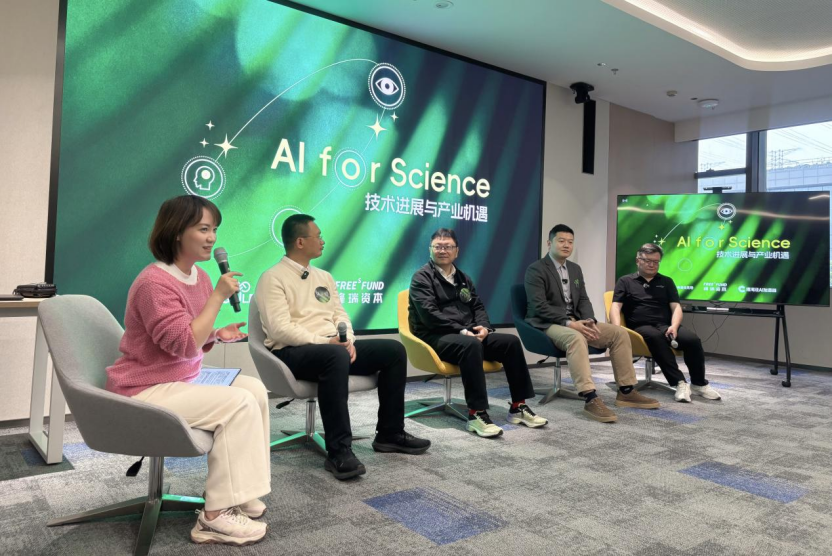
Group photo of roundtable guests. Photo source: on-site photography.
The roundtable covered these topics:
- AI drug discovery is actually producing drugs now, but where exactly is the next inflection point? Could AI virtual cells be the next AlphaFold moment?
- For scientists becoming CEOs, the hardest part isn't technology — it's "the ability to let go"?
- How do you align the digital and physical worlds? How do you hire people who can outperform the CEO themselves?
- On long-cycle, high-barrier tracks like AI4S, what kind of capital and what kind of post-investment support do entrepreneurs actually want?
- Where will the next Nobel Prize land first? A blockbuster natural molecule, or an AI stronger than Albert Einstein?
Below is the edited transcript of the conversation.
Interactive Giveaway
What do you think about the future of AI4S? Share your thoughts in the comments. By 17:00 on June 26, 2026, the two most thoughtful commenters will each receive a book recommendation from Feng Li.

What Exactly Is the AI4S Inflection Point?
He Miao: Before we dive in, please briefly introduce yourselves.
Wenbin Zhang: I trained in organic chemistry, did my PhD in polymer science at the University of Akron, then postdoctoral work at Caltech in David Tirrell and Frances Arnold's labs, where I started working on biological macromolecules. I returned to Peking University in 2013 to work on topological proteins, and later founded Tuoyin Technology with my team to commercialize this work.
Tiangang Liu: Our company, Hesheng Technology, focuses on natural products. The flavors you taste, the floral scents you smell, the colors you see, the functional ingredients in personal care products, animal nutrition in agriculture, plant protection and pest control, and small-molecule natural drugs — all fall within the scope of natural products. The company grew out of technology transfer from Wuhan University.
Xin Li: I'm from Baiyao Technology, and I'm also affiliated with the Institute of Zoology at the Chinese Academy of Sciences and the Beijing Institute of Stem Cell and Regenerative Medicine. Before returning to China, I was at MIT. My research spans stem cells and developmental regenerative medicine, epigenetics, aging, and disease — it looks broad, but the underlying core question is quite consistent: the intermediate layer between life's central dogma, the information encoded in sequences, and macroscopic phenotypes.
Rui Ma: I'm Rui Ma from FreeS Fund. I do a lot of early-stage investing in interdisciplinary fields. AI drug discovery and AI for science are key focus areas for us, and all three people on stage today are from our portfolio. I'll also share our firm's perspective on the AI4S field shortly.
He Miao: The fact that we're all sitting here already shows we're bullish on AI4S. So my first question: what was the moment you first engaged with AI, what role has it played in your R&D, and do you believe we've now reached the golden moment for AI4S commercialization?
Wenbin Zhang: I used to work on synthetic polymers — a system with very imprecise structures. Switching to proteins felt like leaping from the Stone Age into the Information Age. The sequence is determined, and after folding, every atom's position is determined, yet the evolutionary possibilities are virtually limitless.
When I first started designing topological proteins, my students and I would sit in the office for over ten hours at a stretch, wrestling with wire models. But after 2018, with the emergence of structure prediction, language models, and generative models, the entire workflow suddenly became much more controllable — now even undergraduates in the lab can pick it up quickly. So is AI4S the future? Without question, and the second half will move very fast.
It's just that we're not taking the usual path. Proteins in nature are all linear structures because the ribosome's template-driven polymerization mechanism can only produce linear chains — but this isn't a necessary constraint. If we open up the backbone and turn it into rings, knots, lassos, or catenanes, it's like opening up an entirely new "sequence universe" for proteins. Nature has evolved for billions of years, yet there are only about 1,300 naturally occurring protein backbone scaffolds. We've directly expanded that number to the 10⁴ level, and with generative models we can push it further to 10⁵. The significance isn't in the quantity — it's that we can use more stable, patent-bypassing new scaffolds to "redo" the same functions. This is the core of what we'll expand on later.
Tiangang Liu: Scientific and industrial progress is often driven by lazy people. Diligent people will stay up for days to finish experiments, but there are always those who don't want to work that hard and start looking for easier ways.
He Miao (laughing): Professor Liu, are you the lazy one?
Tiangang Liu: I wouldn't put it that way. But AI allows us to extract patterns that were previously accumulated through experience and replace large-scale brute-force experiments. Once you see that, you actively embrace it.
For our industry, the significance of the inflection point is even greater. Humanity spent over a century identifying 400,000 natural products from nature, of which about 4,000 are in active use — a 1% success rate. But we've only studied 10% of Earth's species; the potential natural products could be 4 million, or even 40 million. In the past, finding natural products meant scouring heaven and earth. Japanese microbiologist Satoshi Ōmura brought back a handful of soil from a golf course and isolated avermectin from it, which won him the 2015 Nobel Prize in Physiology or Medicine. Pfizer's first patented compound, terramycin, discovered in 1949, came from the same approach. But that paradigm has reached its end. Big pharma has shut down their natural products divisions. It's not that there's nothing left — it's that the old methods can't find them anymore.
So we changed paradigms: using deep learning to predict silent genes from genomic data, then high-throughput gene synthesis to have industrial chassis cells "remotely extract" the molecules. This may be the last great land rush on Earth.
Xin Li: I work in cell biology and stem cells. When iPS (induced pluripotent stem cells) emerged in 2006, there was a surge of enthusiasm for using stem cells in regenerative medicine, but that promise has never been fulfilled. Stem cell pipeline development, differentiation, and optimization are all too slow, relying on manual experience and various inducers through trial and error.
Around 2010, people started using gene regulatory networks to predict cell states, but the ceiling was low. It wasn't until AlphaFold in 2018 that we realized deep neural networks' powerful ability to fit complex systems, and we began wondering: could we use AI to directly simulate continuous changes in cell states? But at the time, neither data volume nor algorithms were sufficient. By 2022, we figured out how to do this with self-supervised training. The moment it worked was exhilarating — then we realized we weren't the only smart people in the world; three teams were working on this simultaneously. In academia, this later became known as "AI virtual cells."
2023 was the inaugural year of virtual cells. That year, for the first time, the academic community combined massive single-cell-resolution transcriptomic data with Transformer self-supervised architectures, producing four models: Geneformer, scGPT, scFoundation, and our team's GeneCompass. By December 2024, "AI virtual cell" was formally proposed as a term; 2025 has seen dual explosive growth in industry and academia. We've now accumulated nearly 600 million single-cell data points, covering virtually all human cell types. Our model placed second globally and first domestically in the virtual cell challenge. Cells are the next AlphaFold moment we're waiting for.
We're deeply convicted about this. It's a foundational revolution, qualitatively different in capability and imaginative scope from past work at the single-molecule level.
Rui Ma: About ten years ago, FreeS invested in XtalPi and Bluepha — one in AI drug discovery, one in synthetic biology. From then on, we got used to looking at biology through an AI lens. But to be honest, AI drug discovery was criticized for four or five years — everyone felt it only solved marginal efficiency gains, and only in one segment. More critically, it hadn't produced any actual drugs.
We're optimistic because we've witnessed firsthand how technology iterates and ascends dimension by dimension. And through these companies' development, we discovered that what really matters isn't just technology — it's the founders' faith in AI. They jumped in when everyone else was skeptical, and were rewarded by capital and markets. XtalPi is the archetypal example. METiS Pharmaceuticals, of course, is too.
Today, I see at least five signals of an inflection point.
First, multiple AI drug discovery companies have reached IPO. XtalPi, Insilico Medicine, and METiS are all listed in Hong Kong — the so-called "Three Little Dragons of AI Drug Discovery."
Second, more and more actual drugs are being produced by AI.
Third, a wave of next-generation models has emerged in the past two to three years: AlphaFold 3, RFdiffusion, ChAI. Previous achievements were built on older, earlier models. The new models open up vastly greater imaginative space.
Fourth, multinational pharmaceutical companies are making major investments, binding themselves to model companies. Eli Lilly and Company gave ChAI tens of millions of dollars, opening up 150 years of their data.
Fifth, the paradigm for data collection has shifted from manual experiments to agents plus automated high-throughput. In short, AI drug discovery has evolved from a research tool to a producer of real drugs, from concept to cash flow.
Based on these, I'm extremely optimistic about AI4S over the next five years.
He Miao: It's clear FreeS is a firm with conviction in AI4S. I'd like to push further: among all frontier industries like AI + materials, quantum mechanics, and controlled nuclear fusion, where will the first true commercial closed loop actually emerge?
Rui Ma: My judgment is that it will happen first in fields that already had decent data foundations and have been experimenting with AI. For example, biomanufacturing, brain-computer interfaces, and AI virtual cells. Actually, what you're fundamentally asking, He, is where new data will come from in the future. Wherever new data can grow steadily, there is potential for grounded applications.
These three directions are actually the same framework underneath. AI's own progress doesn't directly represent productivity. Real productivity comes from AI's penetration into various industries. AI first diffuses into physics, chemistry, materials, biology — completing 0-to-1 scientific innovation within them; these innovations then combine with industrial demand to complete 1-to-100 scale-up.
Biomanufacturing, brain science, and AI virtual cells will be the next few closed loops because they're all already positioned in the middle of this chain. An American company used generative AI to improve battery watt-hours per kilogram by 50% in two weeks — a metric that had advanced less than 1% annually over the past 150 years. In brain science, a company we invested in, NeuroXess, has achieved excellent efficacy in treatment-resistant depression and Parkinson's disease, and has identified new targets. In nuclear fusion, plasma prediction, control, and design are virtually impossible without AI; future reactor design will require AI too.
Based on these, I'm extremely optimistic about AI4S over the next five years.
What Is the Biggest Challenge in Entrepreneurship?
He Miao: My next question is for the three professors. You've all done substantial work not just in research but in commercialization. Scientists inevitably face many challenges in entrepreneurship — technology transfer, team building, business models. Could you share your journeys?
Xin Li: I think the biggest challenge is the shift in identity. Before leaving academia, we tend to think from a technical perspective, feeling that capability boundaries are what matter most. But entering industry, you realize it's a more comprehensive performance. You need the technology itself, but also market feedback — and the market includes both capital partners and customers. My biggest takeaway from the entire process is that what it really tests is your ability to learn quickly. Every aspect is new, and you have to try them all. So that's the fundamental challenge.
Tiangang Liu: I've had quite a bit of experience bridging with business. During my postdoc, I was in the US during the earliest wave of synthetic biology's rise. I watched these companies rise and fall, and after returning to China, I invested in some startups, so I'd seen quite a bit. Looking back now, I think the biggest challenge is the ability to abandon — that is, the ability to subtract.
Identity shifts, team building, sales — professors can do all of these well if they want to; they just didn't know how before. But what's truly difficult is something else. Before, you'd never refuse anyone who came to you for help. You were capable, you could get things done. But was all that effort worth it? At this stage, the biggest challenge is finding a higher-growth track.
Take several of our current products as examples. In the myocardial infarction space, we've developed a compound codenamed HS-88. Colchicine has long been a potential candidate for MI treatment, but its safety window is too narrow. Our compound HS-88 showed much better safety than colchicine even before structural modification, with better efficacy too. In mosquito repellency, we've produced artemisia alcohol, effective against mosquitoes and ticks at 50 ppm concentration — tested and proven even in Xinjiang's Beiwan, where there are 11,700 mosquitoes per cubic meter. In fragrance molecules, we've made nootkatone, using large models to predict molecular scents and then synthesizing derivatives to create next-generation perfume replacement molecules. These three products serve completely different customer bases in pharmaceuticals, agrochemicals, and personal care respectively.
Wenbin Zhang: Product selection is indeed extremely challenging. It requires not just technical understanding but market and business model acumen. I strongly agree with what Professor Liu just said: you must decide not just what to do, but what not to do.
When we first built our technology platform, I was full of ambition. Proteins, as the executors of life functions, seemed capable of almost anything — drugs, materials, catalysts. But when it came to actual implementation, reality tells you there are strong competitors on every path. Where is the product that best fits you and maximizes your strengths? At this point, the most brutal yet most important demand on founders is upgrading your "academic taste" into dual sensitivity to both science and business. This is a massive challenge.
Our solution to this challenge was to clearly divide our product pipeline into short, medium, and long-term phases. The first to achieve commercial closed loop is "enzymes" — from fine chemicals and pharmaceutical intermediates to PET plastic-degrading enzymes, all now with repeat customers. The second layer is large-molecule drugs, the market with the greatest imaginative space; we're taking existing protein drugs and making topological versions to enhance stability and reduce immunogenicity. The third layer is complex soft matter, like dye-based liquid crystals — our most long-term direction, more of a "training ground" for testing our AI's generalization capabilities.
What Is the Next Threshold to Cross?
He Miao: How do you allocate your time and energy across so many domains — science, commercialization, AI crossovers? And in your respective directions, what are the key technical breakthroughs needed next? Is it just accumulating more data and closing the wet-dry experimental loop, or are there other technical hurdles?
Wenbin Zhang: Time balance is genuinely challenging for me. I'm an extremely curious, almost greedily learning person. But this creates enormous pressure — there's never enough time.
In the end, I found the solution must return to strategy: companies need strategy, and so does personal development. The scarcest human asset is often not wealth but attention and focus. So I'm now working hard to lock my energy onto the most core priorities, pushing everything else forward through full delegation and team collaboration. In scientific research, one person with one outstanding strength can punch through a single point; but in business, even the longest long board can't beat a system. This is inevitably a team victory.
On the next breakthrough, I believe the core bottleneck for AI for science落地 is accelerating the alignment and integration between the digital virtual world and the physical real world. Our TopoEvolver platform is designed specifically to address this massive challenge. It's different from traditional high-throughput automated experiments. Its "throughput" is flexible, elastic, and intelligent. It can autonomously read literature like a scientist, design different experimental workflows, and even independently judge at what point in time to combine which AI models to tackle a specific concrete problem.
He Miao: Let me push further. In your presentation, you mentioned that protein structure prediction is already a red ocean. Compared to traditional protein prediction, what concrete gains does your topological design actually deliver?
Wenbin Zhang: Traditional protein structure prediction leans toward understanding "what a protein is." Our topology technology rewrites the entire backbone from the ground up. For the same function, we can make it run on a more stable new scaffold. This is a system completely focused on enhancing function.
Traditional linear proteins typically face an enormous conformational space, but our topological structures can reshape this space, "framing" it near the functional conformation. When conformational space is concentrated, function naturally improves, and so does evolvability.
In other words, the previous wave of structure prediction could be called the "first half" of protein research; the second half will definitely be about function — who can control it and how to enhance it. We and traditional linear proteins are on completely different paths. They make internal variations on the existing scaffolds nature provided, competing with each other; we completely jumped out to open a new track, with infinite possibilities because topological types are essentially infinite.
Tiangang Liu: In time allocation, everyone has a focus at any given period; you can't truly advance on all fronts simultaneously. The hardest next step for us is organizational building. In the early stage, we relied on scientific and technological sophistication, plus our own hands-on involvement, to carve open market entry; but to replicate from 1 to 100, you can't rely solely on the original team. You need subsequent organizational structure building — whether you can attract and cultivate people who can outperform you.
Xin Li: Our field is very new. AI virtual cells have only existed as a term for two years. Before that, computational biology used partial differential equations for cell simulation, but very few people use today's AI algorithms for simulation. So I spend the most time on team building, especially cross-functional teams. How do AI-native talents — originally from autonomous driving, from general computer vision — match with life science backgrounds, especially cell biology? And that's not all; you also need to find application scenarios, and from drug development to clinic is another very long process.
When external talent isn't enough, you cultivate internally. We have a mechanism where people are mandatorily brought together in a physical space for brainstorming, melding the most cutting-edge academic techniques with industrial needs.
The biggest bottleneck for the entire field is still figuring out the optimal applications for AI for science. The technology is so new that currently, the pharmaceutical path has many segments and many possible directions, but energy is limited, so we're also doing subtraction.
What Kind of Capital Do Entrepreneurs Want?
He Miao: As an investment platform representing the Shanghai municipal government, we'd also like to talk with Ma and the scientists. Shanghai, including state-owned capital platforms, now treats AI for science as a strategic priority. So what are your expectations for the government side, the investment institution side? In terms of infrastructure, environment building, talent recruitment — over the past two years we've done quite a bit in computing subsidies and special talent recruitment policies. Specifically for the AI for science direction, we'd like to hear your thoughts on what we can do going forward.
Rui Ma: First, more capital is needed to support AI for science entrepreneurs — this very much needs SDIC's support. Second, AI for science already has consensus in Shanghai, but overall it's still a non-consensus track. After money comes in, how to allocate it toward non-consensus directions is crucial.
Tiangang Liu: First, there needs to be heavy capital. Our company's customers directly face large foreign companies, so we feel this very acutely. The real competition is between China and the US. Compared to the US, most original models come out there first, and we're doing follow-on innovation. In this landscape, there are now some excellent seed-stage companies on tracks that others haven't yet started, doing meaningful things. They should be resolutely supported with greater investment, to build these seed players into star companies.
Xin Li: First is resource integration. Capital is one aspect; more important is the upstream-downstream对接 ecosystem chain, where government guidance can play to its strengths. Second, focus on biopharmaceuticals. The key for AI for science is end-to-end — whether your final product, your final output, can actually reach populations, can reach patients. How to string together final outcomes across such a long chain requires coordination with front-end resource integration. So downstream market cultivation — such as drug reimbursement policy, acceleration policies during drug development — are also directions to pursue together.
Wenbin Zhang: AI for science currently faces a fairly significant industrial delivery problem. But I believe this difficulty is often genuinely not due to inadequate technology, but to poor problem selection. Before product立项 and launch, teams may not have communicated sufficiently with industry, or the team is entirely scientists lacking someone with industrial sense and business understanding. The result is a lack of reliable assessment of real costs and whether a problem is truly a刚性需求. So if there could be some "personalized" coaching in this area, more connections to industrial resources, especially linking overseas industrial circles and resources, plus help with talent recruitment — that would be enormously helpful.
Where Will the Next Nobel Prize Appear?
He Miao: Shanghai is promoting AI for science to drive the evolution of the entire scientific research paradigm. The 2024 Nobel Prize went to the AlphaFold team. We hope this wave of cultivation can produce new Nobel laureates in China. So please make bold predictions: where might the next Nobel Prize be?
Tiangang Liu: Let's look at history. China's only Nobel Prize in the natural sciences went to artemisinin, a small molecule. Tu Youyou's name itself comes from the Book of Songs line "Youyou deer cry, eating the wild artemisia." Nobel Prizes generally fall into two categories: major technological or model breakthroughs, like gene editing or AlphaFold; or truly problem-solving drugs or molecules, like artemisinin. You need a molecule with massive industrial scale and desperate unmet need to reach that level. So probabilistically speaking, if we can rapidly find a blockbuster from what nature has evolved, there might be a chance.
Wenbin Zhang: From a fundamental principles perspective, it seems the major directions were largely "exhausted" in the last century. Today's scientific breakthroughs more often grow from these most底层 principles into discoveries with particularly large impact, solving certain long-standing specific problems. As Professor Liu just said, it could be an era-defining drug, or it could be a disruptive technology. Nuclear fusion is one such possibility; a new drug is another. The greatest value AI can provide here is dramatically accelerating the speed at which these possibilities "surface." It will break existing R&D cycles, making emergences that were once distant into realities we can witness with our own eyes.
Xin Li: The answer varies depending on granularity. Life sciences cover a very broad surface among important natural science questions, from macro to micro with many layers, and high-impact achievements are possible at every scale, so there will be relatively many Nobel points in this field. In other disciplines, quantum directions are also possible. What AI for science can truly do is accelerate our ability to see hidden corners that are currently unseen and undeduced. Exactly which point will explode is hard to predict in advance. Life itself is a complex network; every level, dimension, and scale is possible. Our work on virtual cells is essentially trying to string these hierarchies together, finding truly important targets from a systems perspective.
He Miao: The virtual cell field is a technology integrator. Progress at the molecular and protein levels likely needs to come first.
Rui Ma: We're still proving ourselves every single day — that we can make drugs, can produce molecules, can use AI virtual cells to make specific predictions — because the field as a whole remains non-consensus. But if I were to make a bold prediction, I believe that without AI for science, AI cannot reach superintelligence. There must be an intermediate stage where AI for science surpasses human scientists at a certain level. DeepMind founder Demis Hassabis has said they want to build an AI stronger than Albert Einstein. This might also be a Nobel direction. In the future, AI for science may have a broader concept. This path differs from our daily emphasis on "steadily making molecules," but it's worth anticipating.
Interactive Giveaway
What do you think about the future of AI4S? Share your thoughts in the comments. By 17:00 on June 26, 2026, the two most thoughtful commenters will each receive a book recommendation from Feng Li.

