When Robots Start Running Experiments, AI for Science Hits an Inflection Point | A Conversation with Wenzhao Lian of Yuanluo Technology

Where Will Robots Converge Next?


This past August has been an eventful month for the robotics industry: the World Robot Conference (WRC) and the Humanoid Robot Games were held in Beijing back-to-back, and Unitree debuted on the STAR Market. Before the buzz could even die down, the National Development and Reform Commission weighed in with a warning to "prevent blind bandwagoning and herd behavior." Between the hype and the caution, one question has become urgent: where exactly does this industry stand right now?
We've brought back a returning guest: Wenzhao Lian, founder of Yuanluo Technology. When he spoke with Feng Li two years ago, the robotics track hadn't yet caught fire, and his term "intuitive physics" was still obscure; today, it goes by the name "world model" and has become the hottest startup direction. Back then, he used the "impossible triangle" to describe the difficulty of deploying robots and stated his preference: among reliability, generalization, and speed, he chose not to obsess over speed and instead prioritize the first two. Now, Yuanluo is beginning to deliver proof of application in that direction.
Lian has an unusual résumé: after earning his PhD at Duke University, he went from the Silicon Valley AGI startup Vicarious, to Intrinsic — the robotics project at Google X — and then to the humanoid robotics company Figure. In 2023, he returned to China to found Yuanluo Technology, skipping the demos of folding clothes and pouring coffee to instead dive into generalized laboratory settings, using long-sequence, high-flexibility, high-precision scientific experimental tasks as a training ground for robots. He also serves as a professor at the School of Artificial Intelligence, Shanghai Jiao Tong University.
This conversation starts with the on-the-ground feel of this year's WRC, moves through the real demand for robotics going global, the converging direction of world models, and the actual progress in embodied AI hardware and software over the past two years, and lands on a warming thesis: when AI transforms the paradigm of scientific discovery, the bottleneck shifts to wet lab experiments — and robots may be the physical interface that closes the "dry-wet loop."
Below is the full transcript. We hope it offers fresh perspectives and insights. You can also find the complete interview on the Xiaoyuzhou app or Apple Podcasts by searching for and subscribing to Gao Neng Liang.



Feng Li: The robotics industry has been hot for two years now, and this week Unitree just went public. Though its performance since has been volatile, it's a landmark event either way. Combined with the World Robot Conference happening in Beijing right now, we've brought back a CEO guest who recorded with us over two years ago: Wenzhao Lian. Wenzhao, please briefly introduce yourself and Yuanluo Technology.
Wenzhao Lian: We're an AI robotics startup. We build hardware platforms — humanoid robots, and now increasingly diverse hardware architectures. At the same time, we're investing more and more on the brain algorithm model side, pushing an object-centric physical-native model to continuously improve robot reliability and generalization.
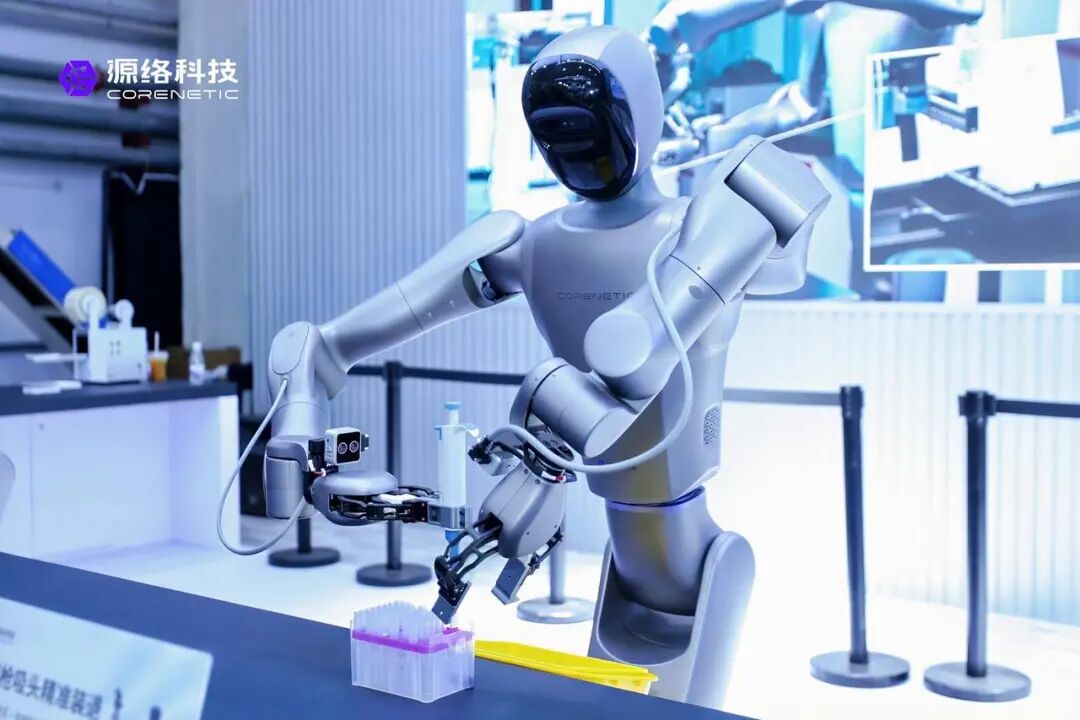
Our entry point is AI for Science. We've selected a broad category of tasks in generalized laboratory settings as our training ground and proving ground. We've deployed robots in collaboration with companies like MGI and research institutions like the Chinese Academy of Sciences, demonstrating that in this toughest examination hall, robots can already achieve many high-flexibility, high-precision skills.
I myself lead R&D and operations at Yuanluo while also serving as a professor at the School of Artificial Intelligence, Shanghai Jiao Tong University, where I advise students exploring the technical frontiers of embodied intelligence. Before returning to China, I had three work experiences: first at the Silicon Valley AGI startup Vicarious, working on brain-inspired neural networks and deploying robots in logistics scenarios for clients like the US Postal Service; then at Google X participating in early robotics projects, which later became Intrinsic — funnily enough, it was merged back into Google earlier this year — working on a robot operating system, essentially Android for robots; and in 2023, I joined Figure, where I built some of the earliest data collection pipelines and imitation learning frameworks.
Feng Li: That's a lot to unpack. Let's return to the simplest, most practical question: comparing across the board, what was your impression of this year's WRC?
Wenzhao Lian: The exhibition hall keeps getting bigger, with players exploring scenarios across every industry: moving boxes, sorting, industrial assembly, cooking, serving tea and water. Hundreds of companies are running what look like hundreds of parallel experiments — which shows the industry hasn't reached consensus yet, and approaches remain diverse: some use end-to-end pure pre-programming, some rely on vision-language-action models, others on generative world models... This is a good thing. It proves the industry ceiling is high, and people's expectations for the future of robots are high.
But how to deliver on those expectations is worth thinking about — how to get robots from demo to genuinely usable productivity. Compared to last year, the capabilities different companies demonstrated were actually quite similar — folding clothes, folding boxes, moving boxes, grasping objects — but this year there's a clear shift toward "scenario-ization." Everyone's emphasizing scenarios, landing standards, industrial value. Before, it was more "demonstrative": the robot would perform a short task, show a small capability, and that was it.
Bipedal dancing was still a big draw this year; emotional value is real value too. But I'm more focused on the manipulation layer: it's clearly migrating from capability demonstration toward reliability as an industry goal.
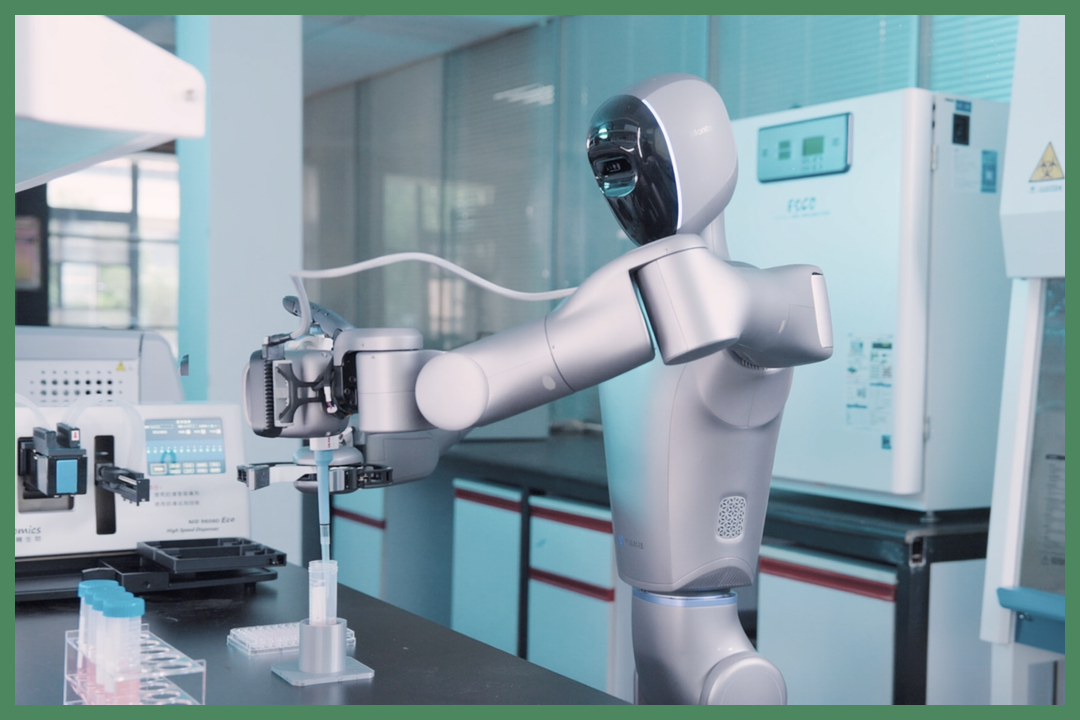
This was Yuanluo's second time exhibiting. We still anchor our R&D in long-sequence, high-flexibility, high-precision operations in the life sciences domain. We demonstrated cytology experiments, including long-sequence workflows like cytotoxicity assays — handling pipettes, liquids, test tubes, centrifuges, and various instruments — requiring both flexibility and precision, both intelligence and reliability.

Feng Li: Some reports said there were unusually many foreigners at this WRC. What was your sense?
Wenzhao Lian: Indeed, non-Chinese faces were noticeably more numerous: Europeans, Japanese and Koreans, plus people from the Middle East and Southeast Asia. Some were here for business, hoping to introduce Chinese-made intelligent robots to their local markets; others wanted to start their own robotics companies and came to observe and learn. Overseas, there's absolute recognition of China's robotics R&D and manufacturing capabilities. We're becoming the de facto global center for robotics.
Feng Li: Among these international visitors, how many came with concrete business needs looking for solutions, versus just sightseeing?
Wenzhao Lian: More of the former, or at least substantive collaboration attempts — such as acting as integrators or distributors to sell locally. The willingness is quite high.
Feng Li: In your limited sample, how much of this demand is feasible, and how much remains beyond current robot capabilities?
Wenzhao Lian: From a capability standpoint, the vast majority can be done, provided sufficient cost. What they raise are mostly quite conventional requests: machine tool loading and unloading, bicycle assembly (not sure why they want to make bicycles locally — they should just buy from China), supermarket services, pharmaceutical companies... People have genuine needs. If these demands were in China, we could definitely do them. But overseas it's harder: local engineer counts are lower than in China, coordination costs are higher, and geopolitical factors need consideration.
Feng Li: Assuming capabilities can largely address them, how many are cost-coverable?
Wenzhao Lian: At small initial volumes, definitely all of them. To truly scale up, it comes back to whether you can do it reliably. If you're just pushing one specific machine, pricing is negotiable. But eventually you need to form standards and then scale, and this requires robots to prove they're reliable.
What counts as reliable? If a robot runs at a location for one day, will the customer voluntarily power it up the next day? If they're willing to power it up, costs can be covered and willingness to pay is strong. If they don't power it up the next day — say, "we won't turn it on without an engineer present" — costs are definitely high. So there's a filtering process; it's dynamic.
Also, the confidence the industry has projected in the past has created somewhat inflated market expectations — people often bring a very complex workflow and say, this should be easy for you. But high expectations are also good; the demand pool is larger, so you can filter.
Feng Li: It seems robotics internationalization could become a potential addition to China's new export portfolio, though volumes are still small for now.

Feng Li: When we recorded the last episode a little over two years ago, you brought up a term that wasn't getting much attention at the time — "intuitive physics." Put simply, it's the human ability to know how to grasp objects, what posture and force to use when interacting with things, plus commonsense physical understanding. Starting around late last year, the hottest robotics startup direction became world models, physical models — though definitions vary widely, the gist is enabling robots to understand this physics-laden world and interact with it. We've invested in several such companies; their valuations have risen very quickly. Since you were already thinking about "intuitive physics" two years ago, how do you view where world models stand today in terms of development stage and solutions?

Wenzhao Lian: What robots need to do boils down to two problems: knowing where to move, and how to get there safely and reliably. Motion falls into two broad categories: moving from point A to point B in free space; and contact-based interaction — moving something from A to B, where this A-to-B isn't just spatial but also about state change. Another question is: how to determine where my point B is, what the goal is.
Whether it's the visual-language-action models (VLAs) or world models that the industry had been pushing, the aim was to understand commonsense, and the approach was collecting massive amounts of data. VLA collects data and does a regression: directly deciding where to move based on observed quantities. It's actually a shortcut that bypasses understanding and directly generates actions. But later people found problems — it's overfit, and generalization isn't as good as imagined.
As an aside, my students now often say "generalization" too — if something can still be grasped when shifted 0.5 centimeters to the left, they call that generalization. I've never thought that counts. In rushing toward VLA, people actually lowered the standard.
Gradually everyone recognized this problem and turned back to world models: using neural networks, Transformers to extract features, making decisions without discarding world-understanding information — not just generating actions but understanding the developmental patterns of objective objects. But past world models were often still pixel-to-pixel.
Feng Li: From pixel to pixel.
Wenzhao Lian: Every pixel had to be predicted, reconstructed. This is actually counter to intuitive physics — the model expends enormous representational capacity on reconstruction and recovery. We've been practicing an "object-centric" approach: not over-modeling minor details that don't need attention; but some important details that previous visual world models lacked, we deliberately focus on — like force. Force is a modality that's quite critical.
Force as a modality is interesting: visually, if you change angle, the information you get may not have much to do with your own body; but force is something your body exerts on the environment, completely dependent on yourself. The harder you push, the greater the feedback — it's tightly coupled with action. The world dynamics model we're developing first models raw image and action inputs, then simultaneously predicts future images and forces, while comparing predicted results against actually measured forces after actions are applied.
Feng Li: Closing the loop, creating feedback.
Wenzhao Lian: Can't just do feedforward. I predict what force I'll feel, and predict my action; the action is applied to the environment, and I sense a new force; this new force is compared against the predicted force, feeding back to correct prediction capability. Once this closed loop forms, as data increases, the intuitive patterns of robot-object interaction can be understood increasingly well, with estimation errors shrinking.
Feng Li: These directions certainly haven't converged today, and the concepts have shifted several times — VLA, VLM, world models, and so on. From your perspective, representing only your personal view: in the next one or two steps, where might people converge in terms of modeling and understanding the world?
Wenzhao Lian: Need to work backward from the ultimate goals: first, zero-shot or few-shot generalization — thrown into a new environment, with one demonstration or even zero demonstrations, it can move, understand tasks, and execute; second, absolute safety, knowing its own boundaries, able to handle anomalies too. That is: generalizable and reliable. Working backward from there: need the most data-efficient approaches, and also the ability to evaluate uncertainty boundaries of outputs, ensuring autonomous safety. Should proceed along these two lines.
Regarding improving data efficiency, people are trying various approaches. One is making data collection cheaper, such as egocentric (first-person perspective) video data — Feng Li, you probably still remember when we discussed our company's embodied approach in 2023, we were already collecting large amounts.
Another is making the information density extracted from data higher and closer to intuitive physics, such as object-centric rather than pixel-by-pixel, and implicitly deriving 3D from 2D or multi-view 2D, since 3D is a more essential understanding of the environment.
Another dimension is safety: past datasets were typically vision-dominated or even vision-only; now the industry is also collecting force and even tactile data, making tactile gloves, various sensors. We're also exploring fusing vision, force, and touch, and have built our own data collection pipeline. This is also a fairly notable trend.

Feng Li: Returning to China's robotics industry. Over the past two to three years, what's been the state and pace of progress on the soft side — algorithms — and the hard side — hardware like motors, joints, and hand control?
Wenzhao Lian: Hardware appears to be developing less quickly, but the substantive engineering progress has been rapid; on the software side, the demos people see are very impressive and changing very fast, but stretched over a longer time horizon, the progress may not be as fast as imagined.
On hardware, many will say that what was shown at WRC two or three years ago were these collaborative arms, humanoid robots, and it's still these today, joints may still be harmonic drives or planetary gear reducers. But behind the scenes, supply chain, design, system integration have developed much faster than imagined, cost reduction goes without saying.
Another aspect is reliability: what we've done ourselves, absolute positioning accuracy can already approach that of traditional industrial robots, which was hard to imagine two years ago. Hardware iteration speed has even approached software iteration curves. This owes to massive national investment and the industry's flourishing, making upstream machining, electronics, and sensor industries very mature, the ecosystem increasingly better, with protocols and standards gradually forming. Progress is somewhat faster than people's gut feeling.
On the model and algorithm side, there are many new results, whether pure end-to-end VLA or world model-based, showing increasingly strong capabilities. But looking past the demos to the essence, the R&D paradigm hasn't been particularly disrupted. You could say we're still "copying the homework of large language models."
Feng Li: Right.
Wenzhao Lian: I'm more hoping to find a different paradigm: language is fundamentally one dimension, token space is discrete, observation space and prediction space are consistent — language is a very special problem; but robot input space is so vast — force, touch, its own joints, even environmental states invisible to visual observation, whether water is full or empty, whether appliances are on or off, all need to be fused in, while output space is just the robot's own control. It's fundamentally not the same problem as large language models, yet we're still pushing it the LLM way. Stretched over time, the training and inference paradigm for robot models needs more thought.
Feng Li: I'm not from a technical background, but let me try a simple summary. Language predicts tokens; between words it's "logical relations," not absolute zero or one — in other words, a sentence can be expressed many ways, though there are some simple constraints. But robots involve physical relations: you can't pass your hand through a table, it faces very strict physical and environmental constraints, many of which are zero or one with no 0.1 or 0.3 in between. Given this difference between robots and language, how much is it ultimately possible to borrow from large language model capabilities and architecture, and how much will differ from language models?
Wenzhao Lian: Quite a difficult question. I fully agree with this summary: large language models essentially learn logical relations, with simpler constraints and larger solution spaces. But the physical world has more constraints, encompassing logical problems plus physical and geometric ones on top. Geometry relates to kinematics: how many degrees a joint moves, how many centimeters the end of a rod correspondingly moves; physics relates to dynamics: how much force is applied, how far something is pushed, what the friction is; logic also includes task-level aspects, like how many steps to put an elephant in a refrigerator. So there's logic, physics, geometry — robotics is a higher-dimensional, more complex problem.
To give embodied AI an informal definition: under many constraints, how to change the state of target objects. It often has precise solutions — you either did it or you didn't; language can be ambiguous.
If we agree embodied AI is a harder problem, we can certainly borrow much from large language models, such as the next-token-prediction paradigm of learning associations between past and future, using association to approximate causality. But these alone aren't enough, because text has no concept of time, while physics has a temporal dimension, and geometry has many constraints. Adding causality, constraints, and temporal dimensions is essential.

Feng Li: Returning to Source Network itself. Two and a half years ago when determining application scenarios, people were still doing demos like folding clothes or pouring coffee; you chose a somewhat different, relatively harder direction. How did you think about this?
Wenzhao Lian: Last time we discussed the "impossible triangle": generality, reliability, and speed — you can't have all three simultaneously, so which do you sacrifice? Our choice was: speed isn't pursued to extremes, just needs to meet threshold; generality doesn't mean solving ten thousand things from the start, but rather solving dozens of things within one real scenario first.
Based on this assumption, we looked for scenarios that robots could "reach with a little stretch," that could land within a foreseeable timeframe, but without wanting the scenario to cap our ceiling or pull us toward shortsighted technical paths.
So we chose hard scenarios: long sequences, testing logical capability; high precision, testing understanding of geometry and physics; and simultaneously high flexibility, differentiating from past industrial automation. I wanted to drive our technical R&D in the hardest examination hall — if we can do well here, the future path to ten thousand household tasks will certainly be solvable.
Meanwhile, from the industry itself, it had to be real demand: biotech, chemistry, environmental science, materials science, biomedicine — these industries genuinely need such intelligent agents for physical operations. For scientists and PhD students doing experiments, a major pain point is irreproducibility.
Even when protocols are written out, "mix A, B, C, D at 25 degrees," one person's understanding is take them out of the 4-degree fridge for an hour, really reach 25 degrees then mix; another understands it as in a 25-degree environment, take out and mix directly, even though A is still actually 4 degrees; after pouring A they remember they need C, run back to the fridge, and reaction conditions naturally differ. There are many such details, not to mention possibly sneezing during the experiment.
The saying in drug R&D goes "ten years, a billion dollars, ten percent success rate" — that's still a massive pain point. Robots are naturally better at this than humans: every step executed faithfully at fine granularity, done the same way today as tomorrow, every condition and parameter logged, so reliability goes up.
Another point: lab R&D depends on instruments, and instruments depend on human operators. People work nine to five; when people aren't working, instruments sit idle, utilization maybe only 30 or 40 percent, and instruments are often expensive, so the R&D timeline gets stretched out indefinitely. In computing and AI, we can run a huge batch of experiments in parallel; if robots serve as lab assistants, stringing instruments together and mobilizing them, both quality and throughput improve — not to mention some dangerous experiments that simply aren't suitable for humans.
AI is already pushing us humans rapidly toward "eating well and being lazy" — it's already helping us think. Robots should be able to help us "not having to do much" fairly quickly. If R&D methods in science can undergo a meaningful transformation, another human pursuit — "immortality" — should also come within reach sooner.
Feng Li: When I was in school, biology, chemistry, environmental science, and materials science were "trap majors." Today they've all become hot directions. Some recent good news: the other day, Moderna, which made the mRNA vaccine, got significant results from Phase 3 trials for a personalized cancer vaccine — that's a big breakthrough, and the news mentioned AI was used in screening. There was also an article saying: if AI changes the paradigm of scientific discovery, the biggest bottleneck becomes wet lab experiments, because only wet labs can match discovery efficiency, providing enough data fast enough and clean enough to validate and iterate. That reminded me of the pain of doing chemistry experiments in grad school — every time was slightly different. So today, to what extent can robots actually solve problems in the experimental phase? What difficult technical nodes have you overcome?
Wenzhao Lian: What we've built over the past two-plus years covers at least common experimental workflows, including handling liquid, solid, powder, or granular samples, and operating common instruments like centrifuges and PCR machines. We break experimental workflows down into corresponding skills. Now over 80% of common workflows can be replicated, and some parts already achieve small closed loops.
It's like PIs, even PhD students, can finally enjoy themselves — they have a research assistant: send one command, the robot schedules the relevant elements in the lab to complete a local closed loop, export results, and they decide next steps based on those results.
So we're at the stage of assisting researchers, not replacing scientists — analogous to L2 autonomous driving on the highway. Someone wants to run a set of experiments at 6 p.m. before leaving work, doesn't need to come back at 2 a.m. to change media, the robot handles it, ensuring the results are ready to read when they arrive at 9 a.m. the next morning. Our robots have already achieved this capability.
Digital AI already solves "generation" very well, proposing hypotheses and possible workflows in enormous search spaces. But as more workflows get proposed, you can't verify them one by one with human-wave tactics. There's a huge gap here — people often talk about the robot sim-to-real gap, but this is more like a "generation-to-validation" gap, meaning the absence of experiments.
We've been providing a physical interface to close this gap: digital AI leverages this data, our physical API can be scheduled, and the whole loop closes. Now we're gradually validating with many customers and beginning to scale.
Feng Li: I roughly understand what you can do. When you were walking around WRC, did you see companies in similar directions? If there were few, what's hard about what you're doing?
Wenzhao Lian: The venue was huge, I walked fast, I felt there wasn't much information, a lot of it was similar. At least within what I could see, in the AI for Science domain doing high-precision, high-flexibility work, we're fairly unique.
Feng Li: Interjection: From what you've already achieved in precision, how much does intelligence versus hardware each contribute?
Wenzhao Lian: Hardware improvement is the guarantee of the floor — you must reach a certain capability to even attempt these problems. When we first started, we bought robotic arms externally, and the precision wasn't there; our self-developed ones also shook badly in the very beginning, but now we've reached the level. Only at this level can you reach the ceiling that software models bring — that is, at what cost you can train a model to quickly learn pipetting, operating centrifuges.
Our current state is fairly healthy: the floor is relatively stable, the ceiling has reached deployable, deliverable levels; of course we'll keep raising the ceiling, reducing the sample size needed for new tasks, even achieving true zero-shot generalization.
Feng Li: Besides precision, what other challenges have you overcome in the past two years?
Wenzhao Lian: Another is generalization — we call it high flexibility ourselves. In experimental workflows, the physical state of objects, such as whether something is tightened, whether it's plugged in, whether colors are aligned — for this kind of minute state estimation, and feedback control based on state, all need to be overcome. Precision solves "if you know where to go, you can definitely get there"; this part guides "where to go next" — this requires massive data collection and cleaning, and we've also adjusted our training architecture a lot.
Feng Li: Do you already have proof in application?
Wenzhao Lian: We've been working closely with MGI and the Chinese Academy of Sciences since early on, putting capabilities into real workflows during R&D to validate. For example, simple cell culture, toxicity testing — these already run in real customer environments.
Feng Li: How many possible scenarios, industry directions, could use what you have today?
Wenzhao Lian: Not rigorously speaking, we could do anything, but the required investment differs. The hardware has reached the point where it can support these applications, but some applications have very special requirements. For example: after dinner at home, putting leftovers in the fridge requires tearing plastic wrap to seal them — that's a real demand we actually received. We could force ourselves to do it, but it would really be forcing it, with many challenges in real-time decision-making and perception.
Feng Li: Tearing plastic wrap is probably too hard for robots — hard just from the perception side, both highly transparent and highly reflective, also thin, tears with one pull, and high force requirements.
Wenzhao Lian: If there's really a need, we can definitely do it, can build specialized equipment to solve it. But for now we're expanding outward from our own capabilities as the center; a demand like this is a single point, and we hope to gradually broaden our coverage.
Feng Li: Today, what kind of commercial partners do you most hope to work with? What kind of business environment and conditions do they need, where would they use you, such that they can afford it, can use it and use it well, and you can also deliver?
Wenzhao Lian: We actively hope to collaborate with biology, chemistry, environmental science, materials science, inspection and testing, including analysis, materials, and pharmaceutical disciplines. The advantage of robots is they can be compatible with all previously heterogeneous instruments, old and new, without requiring any interfaces.
To use an imperfect analogy: humans are the best API, able to schedule all interfaces, and our intelligent robots provide exactly such an interface. Whatever the lab looked like in the past, it can be easily embedded into existing workflows with very light retrofitting, even zero cost.
The value we bring, on one hand, is closing the loop on scientific experimental workflows, avoiding the uncertainty and efficiency problems that human participation brings. The greater value is that once robots start closing loops, this data naturally becomes standardized, trustworthy, forming a new physical foundation for AI in science.
Analogous to GPUs: having them isn't just about solving matrix calculations however many times faster, but about doing things previously unimaginable, like large-scale processing of images, video, language. When robots enter labs broadly, it's not just about replacing human operation; the environmental digitization, standardization, and reproducibility they bring can unlock experiments that were previously too daunting to design. So we're very willing to work with enterprises and research institutions that want to do wet-dry closed loops, preserving and aggregating wet lab data to feed back into dry lab iteration, spiraling upward, designing experimental topologies that are different in both scale and hypothesis.
Feng Li: Besides world models, another direction that's been very hot since Q2 this year is AI for Science. But in the projects we've looked at, more are still using AI models to solve scientific problems — this fire hasn't quite reached "how to make wet labs more AI-driven." From your feel, has the fire reached you yet?
Wenzhao Lian: We're seeing some signs. Basic science requires long-term investment before output appears, and robots can definitely play a role. In the past, digital AI read papers, read literature, read experimental reports, learning from what humans already knew — this has boundaries.
The next step naturally requires AI to explore unknown boundaries, doing things humans don't know: designing what new information to obtain, deriving new hypotheses from new information, iterating. It's like giving AI creativity, or less rigorously, giving AI curiosity. This will inevitably happen, requiring some time and investment, and some forward-looking institutions are already starting to push it.
Feng Li: Among potential users you contact, do people with AI for Science backgrounds and people traditionally doing biology, chemistry, environmental science, materials science experiments have the same acceptance of you?
Wenzhao Lian: These two groups aren't actually that separate — they're mixed. Traditional biology, chemistry, environmental science, materials science disciplines are moving toward AI integration; people purely from AI coming to do AI4S have higher sensitivity to data, their first reaction being whether data can accumulate and cycle. Both groups are relatively open, embracing new ways to advance wet lab experiments.
Feng Li: How sensitive are people to cost?
Wenzhao Lian: The most basic calculation is easy — cost reduction and efficiency gains: does one person's labor pencil out. People generally also accept whether instrument utilization and experimental throughput really improve. What hasn't been widely accepted yet, but may be accepted later, is whether AI can propose better hypotheses and complete better closed loops after experimental quality improves. This is unknown, but may be where the greatest value lies in the future.
Feng Li: By next year's WRC, for Yuanluo, what are your bigger expectations, what changes might you have by then?
Wenzhao Lian: Setting a milestone for next year, we certainly hope the physical AI and AI for Science foundation truly embeds into many partners. We now have an "Origin Plan," hoping to build an ecosystem together with institutions and enterprises in the AI for science industry, a place where everyone can share physical skills and data, and within permitted scope, increase the rate at which ecosystem enterprises and research units produce new results.
In the past two years, especially last year, there have been more and more examples of Chinese biopharma license-outs. We hope to accelerate this process — not just in pharmaceuticals, but in materials and other industries, I hope to see change.
Feng Li: To wrap up, from team talent to industry partners to upstream and downstream of the supply chain — what are your hopes across all these directions?
Wenzhao Lian: Source Network has always been a company that's optimistic long-term, pragmatic short-term. Since founding, we've built up our own hardware platforms, models, and data — our floor is already quite solid and high. At the same time, we're raising our ceiling: improving generality and generalization while maintaining reliability.
On one hand, we hope to partner with others in the industry — whether in AI for science or other sectors. We're already working with companies in agriculture, fine chemicals, and manufacturing, applying our high-precision, high-flexibility capabilities to more industries.
On the other hand, if you're a researcher who's passionate about technology-driven real-world deployment, who wants to grind away at making robots create value in actual scenarios — we'd love to hear from you. Come join Source Network.