AI for Science: AI's First Step Into the Physical World

AI has brought a new technological revolution, but it is not yet synonymous with productivity itself.


In recent years, when we talked about AI, we mostly talked about chatbots, coding, agents, and robots. But the biggest productivity opportunity in this wave of AI may not be on screens — it may be in the physical world of atoms and molecules.
AI for Science (hereafter AI4S), put simply, means using AI to assist scientific research and amplify research capabilities. For instance, having AI learn the knowledge and laws of physics, chemistry, and biology to compute and design things at the atomic and molecular level — proteins, drugs, and new materials. It is AI's first stop into the physical world.
In October 2024, the Nobel Prize in Chemistry was awarded to the developers of protein design and AlphaFold2, and AI4S reached an inflection point in the paradigm of scientific research. Looking back two years later, the change has come faster than most anticipated: two years ago, AI-driven drug discovery was still often dismissed with "you can't actually make drugs"; today, XtalPi, Insilico Medicine, and METiS Pharmaceuticals have gone public on the Hong Kong Stock Exchange one after another, AI-designed drugs have entered Phase III clinical trials, multinationals like Eli Lilly and Company, Pfizer, and GSK are spending heavily to lock in AI-native companies with proprietary model capabilities, and antibodies can even be computed "zero-shot."
We continue to track technological developments in the AI4S space. If you're a founder or practitioner in this field, feel free to reach out to the author Rui Ma at marui@freesvc.com.


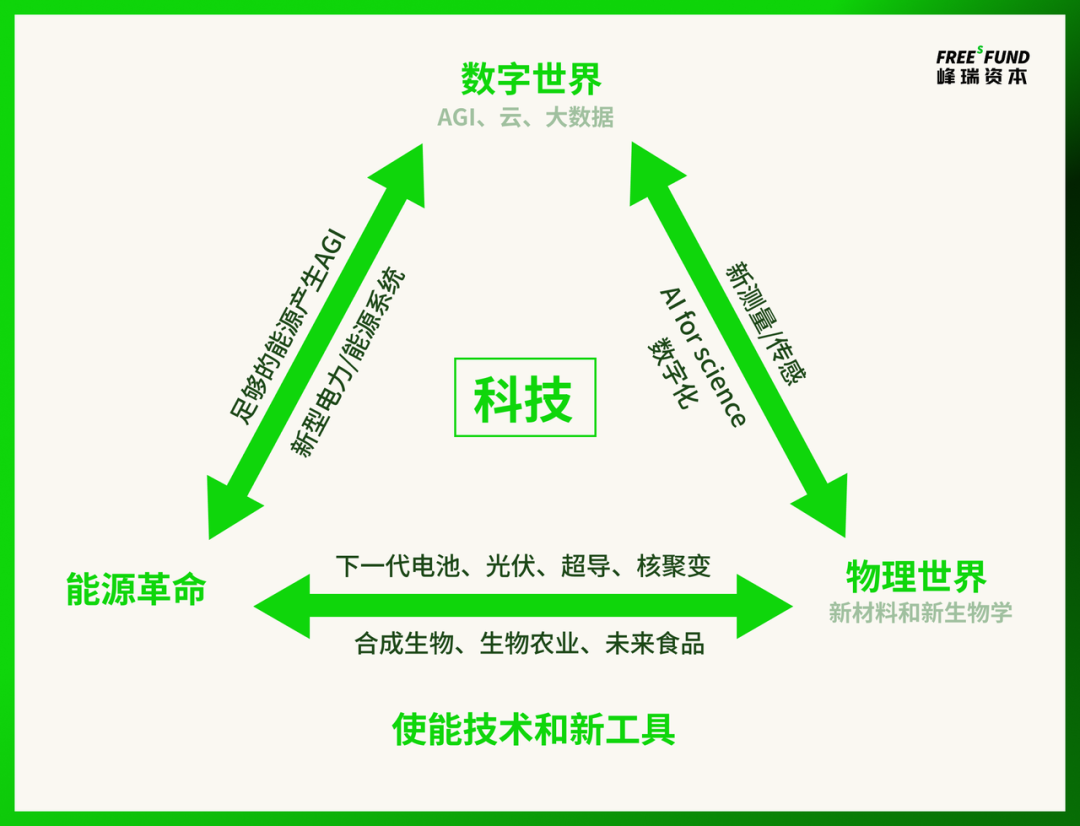


When Jensen Huang lays out NVIDIA's strategy, he often references a full-stack AI industry layer cake, or the "AI five-layer cake": from bottom to top, energy, chips, infrastructure, models, and applications. Comparing China and the United States across these five layers:
-
Energy: China has the advantage. In 2025, China's electricity generation is roughly 2.3x that of the United States, giving it a clear edge in total energy supply.
-
Chips: The United States leads, China is closing the gap. On advanced process nodes (below 7nm), China still trails the United States, but if you look at chip manufacturing capacity overall, China is catching up.
-
Infrastructure: China holds the overall advantage. Whether it's hard infrastructure like power grids, energy storage, and transformers, or soft foundations like internet and AI infrastructure, China has a solid industrial base.
-
Models: The most cutting-edge models are still in the United States, but the gap is narrowing, and China leads in open-source models.
-
Applications: This is where the China-US AI competition will be won or lost. AI applications span agents, Embodied Artificial Intelligence, AI4S, and AI across industries. The United States has taken an early lead — programming agents have already hit scale: Anthropic's Claude Code reached $1 billion in annualized revenue within six months of launch; Cursor also broke $1 billion in annualized revenue in 2025. China has a shot at catching up from behind. Tencent, Alibaba, ByteDance, and other giants are injecting competitiveness into the application layer, and China's strong industrial chains provide fertile soil for AI deployment.

Historically, the gap between a technology's invention and its widespread application that genuinely boosts productivity is often ten to several decades. Electricity was invented in the late 19th century, but the real productivity explosion came after 1900 and continued through the 1940s.
Looking at US total factor productivity (TFP — growth driven by technological progress beyond capital and labor inputs) makes this even clearer. Eli Dourado of the Astera Institute points out that from 1947 to 1972, US TFP grew at roughly 2.1% annually; since the Mobile Internet era began in 2005, it's been about 0.17%. The core reason: innovation over the past two decades has been largely confined to the digital world, while the previous wave of innovation happened in the physical world. The productivity gains from electricity, trains, and automobiles far exceeded those from computers and the internet.
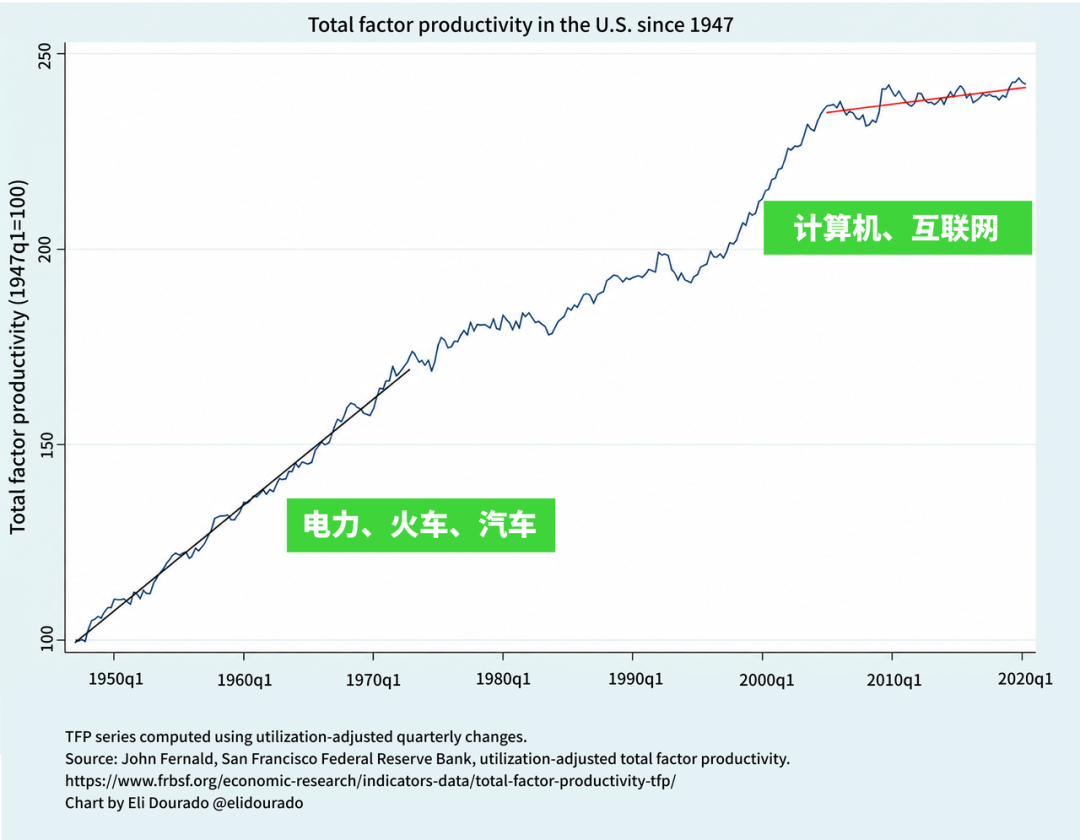
US total factor productivity (TFP) trends since 1947
But those two decades accomplished one critical thing: digitizing all kinds of human-related data — human language, text, images, video, and behaviors like search. This is precisely the data foundation for today's large models.
AI is unquestionably the biggest technological breakthrough of this tech revolution, arguably comparable to electricity itself. But based on current data, the comprehensive productivity boost has yet to arrive — large-scale application deployment is still in its early stages. The greatest productivity gains may not be in the digital world at all, but at the intersection of AI, biology, materials, and energy — where the digital and physical worlds converge.

AI's development depends on three elements: data, compute, and algorithms (models). Today, large language models have nearly exhausted available text data, and the pace of iteration is slowing. To keep moving forward, it needs three new weapons:
-
New models: Jensen Huang also emphasized in his long piece on the "five-layer cake" that models must understand not just language, but biology, chemistry, physics, and the physical world itself. He believes models are already showing strong product-market fit in programming, robotics, digital biology, and drug discovery. Physical AI is becoming more important than ever. Whether it's microscopic AI4S, 3D reconstruction models, or world models, these are all critical next steps. New models may require new architectures.
-
New data: New data is the fresh fuel for further model iteration. We need physical-world data — 3D Gaussian splatting, depth data, interaction data in 3D space, spatial intelligence, embodied manipulation, and molecular interactions in biopharma. We also need human-related data, which may come from new sensors and smart hardware. And we need neuroscience data — after all, several major breakthroughs in AI history were inspired by neuroscience. As brain-computer interfaces and neuroscience advance further, they will generate large amounts of high-quality usable data.
-
New compute: New models and new data place higher demands on compute. Behind NVIDIA's surpassing of Intel lies the story of GPUs (graphics processing units), with their parallel computing advantages, gradually replacing CPUs (central processing units) as the mainstream compute architecture in the AI era. And when Jensen Huang starts talking about GPU-QPU (quantum processing unit) synergy, quantum computing is being looked to as the next generation of compute. In October 2025, NVIDIA released NVQLink, enabling direct connection between quantum processors and GPU supercomputers.

Many people assume AI only delivers efficiency gains and can't become a core driver of a discipline. But we're seeing AI capabilities accelerate outward into fundamental science. ARK Invest's Big Ideas 2026 calls AI the "central engine," pulling robotics, energy storage, multi-omics, and other innovation platforms along with it. In other words, AI is like a tornado, sweeping up surrounding innovations and industries. Here are four examples.
Protein structure prediction. Feed in a protein sequence, and AlphaFold2 returns its 3D structure — with accuracy matching experimental methods for the first time. Before this, humanity spent roughly sixty years experimentally resolving about 200,000 protein structures. The AlphaFold database delivered approximately 200 million predicted structures in 2022. This work earned the 2024 Nobel Prize in Chemistry. In protein structure prediction, AI is already the primary driver.
Battery materials. Over the past 150 years, from lead-acid to lithium-ion batteries, energy density improved only about fivefold — less than 1% annually, painfully slow. U.S. battery materials company Feon Energy used EDGE, a generative AI-based molecular design platform, to design electrolyte molecules from scratch in two weeks. With its electrolyte, lithium metal batteries exceed 400 Wh/kg, roughly 50% higher than current lithium-ion cells. Its other fast-charging lithium-ion electrolyte supports 6C charging. According to Stanford University's Office of Technology Licensing, Feon trained AI prediction models on battery formulation and performance data, compressing electrolyte R&D cycles from over a year to three or four months. On one side: annual progress under 2%. On the other: dramatically shortened development cycles. AI is becoming a critical driver in materials design too.
Biomanufacturing. Biomanufacturing operates at ambient temperature under green conditions. Its biggest advantages are environmental friendliness and high yield. Simply put, yield is how much of your input raw material becomes your target product: a 20-step chemical reaction often yields less than 1%; a 20-step biological route can achieve 80% or higher. But biomanufacturing's challenge lies in designing routes and pathways. The ATLAS of Biochemistry database catalogs over 130,000 theoretically feasible metabolic engineering reactions, yet the vast majority had never been reported in living organisms. Using AI to design metabolic pathways represents the biggest variable in biomanufacturing's future.
Future healthcare. U.S. company Tempus aggregates and aligns patients' multimodal data — clinical records, molecular biology, imaging — then analyzes it with generative AI, delivering insights to pharmaceutical and diagnostic companies. In 2025, Tempus reported full-year revenue of approximately $1.3 billion, up roughly 83% year-over-year (including the acquisition of genetic testing company Ambry). That same year, it signed data collaboration agreements with over 70 mid-to-large pharmaceutical companies. In the first half of 2026, revenue reached $731 million, up about 28% year-over-year, and the company raised its full-year revenue guidance to approximately $1.6 billion.

String these examples together, and you get our read on how AI drives productivity leaps: at the foundation, advances in AI and large models themselves; spilling over into mathematics, physics, chemistry, materials science, biology — this is AI4S; moving upward, influencing materials design, protein design, superconducting materials, and next-generation chips; further up, catalyzing biomanufacturing, AI-driven drug discovery, quantum computing, nuclear fusion, brain-computer interfaces, and Embodied Artificial Intelligence as industries of the future; finally, amplifying strategic emerging industries like biomedicine, new energy, new materials, and aerospace.
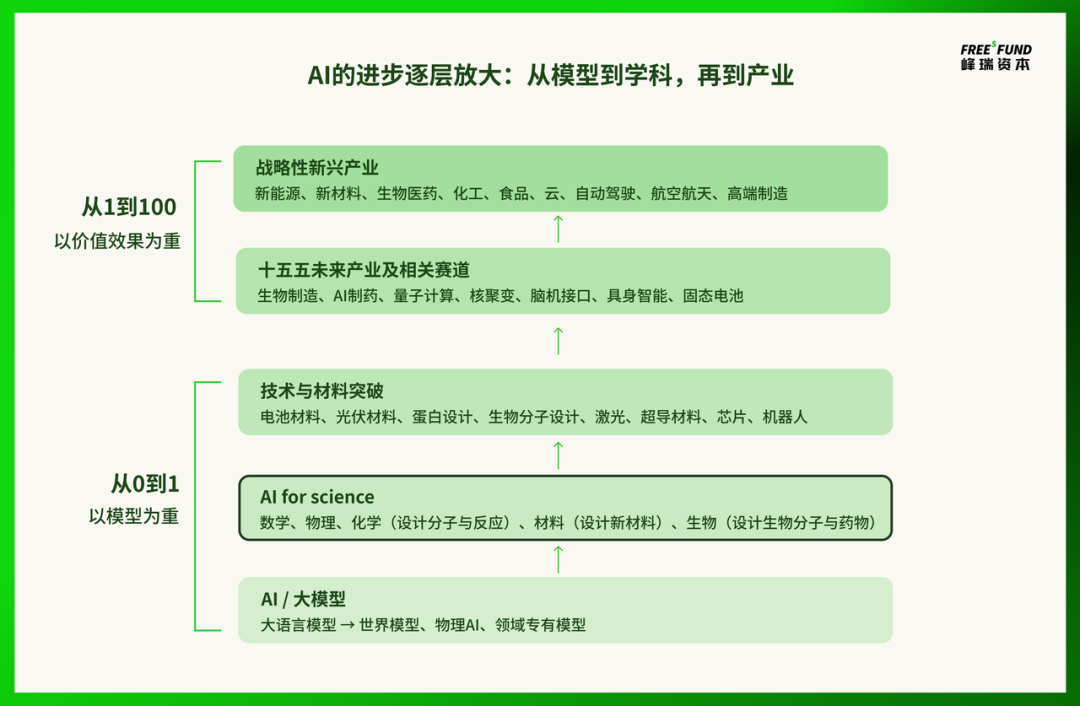
AI Cascade Amplification — Five Layers, Two Stages
AI4S sits at the critical node in this chain: it translates large model advances into foundational innovations across disciplines, which then cascade upward through the industrial chain.
This process unfolds in two steps. Step one, 0 to 1, model-centric: AI spills over into other disciplines through AI4S, completing 0-to-1 breakthroughs in underlying technology — this is the focal point of U.S.-China competition. Step two, 1 to 100, value-centric: combining these underlying innovations with China's strong industrial chains to achieve the integration of technological and industrial innovation. This is where China's long-term innovation opportunity lies.

AI4S studies atoms, molecules, and other microscopic particles and their interactions. It is the most important bridge between the digital and physical worlds: previously we could only compute and design inside computers; with AI4S, design results become actual atoms and molecules in the physical world.
Atoms and molecules matter because they constitute the foundation of the physical world. Carbon atoms arranged in flat hexagons form the graphite in your pencil; stack them in a 3D structure and you get diamond. Carbon plus hydrogen, oxygen, nitrogen, and phosphorus arranged in a double helix becomes DNA, the basis of life. Lithium, manganese, cobalt, nickel, and oxygen spaced in specific arrangements make up the cathode material in EV ternary lithium batteries.
Pick elements from the periodic table, assemble them into molecules, and if we know a molecule's structure and dynamics, we know its function and effect. What AI4S does is follow the chain from sequence (molecular composition) → structure → dynamics → function, computing what a molecule can do.
The difficulty lies in computation. Traditional methods use molecular simulation, but face the "curse of dimensionality": as atom or molecule counts grow, computational complexity rises exponentially. For example, fully ab initio molecular dynamics simulations (using only fundamental quantum mechanical equations without empirical parameters) scale roughly with the cube of atom count.
DeepWise's approach: perform precise first-principles calculations on only select systems, have AI learn these precise values; next time, instead of computing all atoms or molecules from scratch, call the AI directly, reducing computation to linear scaling with atom count. The result is both accurate and fast: empirical force field speed with quantum mechanical precision. This is the core principle of AI4S.
There's also a more intuitive framing: AI is a "guessing machine" with powerful output but frequent errors; the Science part uses scientific validation to filter out garbage and keep what actually works. Generate with AI, validate with science.
AI4S aims to empower fundamental scientific research with AI. In mathematics, it can rigorously verify proofs; in physics, it bridges quantum mechanics and classical coarse-grained models, connecting models across scales — solve the physics problem, and you can precisely calculate energy, laying groundwork for molecular design; on this foundation, chemistry can use AI to design chemical molecules and reactions, biology can use AI to design biomolecules and even drugs, and materials science can use AI to discover new materials. To some extent, AI4S is a kind of physical AI, or a world model for the microscopic world. This is its significance.


Over the past two and a half years, we've seen the "Hong Kong-listed AI pharma trio" — XtalPi, Insilico Medicine, and METiS Pharmaceuticals — go public in succession, marking capital market acceptance of the leading AI pharma 1.0 companies. Moreover, two years ago, the most common criticism of AI pharma was "can't actually make drugs." Now, the evidence is ample: AI-designed drugs have entered Phase III trials, and commanded high prices.
-
FreeS Fund portfolio company METiS Pharmaceuticals' self-developed MTS-004 orally disintegrating tablet announced in October 2025 that its Phase III trial met primary endpoints, reportedly China's first AI-enabled formulation new drug to complete Phase III. In June 2026, METiS granted Boulevard Bio global exclusive rights to trispecific T-cell engager (TCE) MTS-128, with total deal value of $1.6 billion. On October 19, 2026, METiS signed an $1.1 billion strategic partnership with Eli Lilly and Company to explore using AI to unlock next-generation tissue- and cell-targeting LNP delivery technology, accelerating drug delivery to patients.
-
FreeS Fund portfolio company XtalPi's R&D paradigm of "AI design — agent orchestration — robotic experimental validation — data feedback — model optimization" is being adopted by an increasing number of pharmaceutical and materials companies. In August 2025, it reached a pipeline collaboration with U.S. company DoveTree valued at approximately $6 billion total. In November 2025, its wholly-owned subsidiary Ailux entered an AI bispecific antibody R&D partnership with Eli Lilly and Company worth up to $345 million. In June 2026, it reached another collaboration with a globally renowned pharmaceutical company for GPCR-targeted oral small-molecule drugs with potential total value exceeding $400 million. In 2026, it also delivered automated experimental systems to Eli Lilly and Company and BASF. In September, its self-developed drug KQTD-126 was submitted to the U.S. FDA for clinical trial application.
-
Insilico Medicine's TNIK inhibitor for idiopathic pulmonary fibrosis (IPF) published positive Phase IIa results in Nature Medicine in June 2025, a representative case of AI-discovered target plus generative AI-designed molecule. In September 2026, its China-initiated Phase III trial dosed its first patient. Insilico's business development deals (Fosun, Eli Lilly and Company, Sanofi, Qilu, Servier, Menarini, etc.) total over $3 billion plus HK$2 billion; as pipelines advance, milestone payments will continue to materialize.
-
Helixon (overseas entity: Earendil Labs) uses AI for bispecific antibodies: in April 2025, it licensed two bispecifics to Sanofi for $1.845 billion total; in January 2026, it reached a discovery collaboration with Sanofi with potential total value of $2.56 billion; in March 2026, it completed a $787 million financing round. Its commercial performance is impressive.
-
Generate: Biomedicines went public on Nasdaq in February 2026, raising $400 million. Its AI-deeply-optimized anti-TSLP antibody GB-0895 (for severe asthma) shows roughly 20-fold improved affinity and enables dosing every six months. It has entered Phase III. Notably, the journey from molecular synthesis to Phase III took only about four years.
So AI drug discovery has indeed produced clinical-stage assets, and business development deals are continuously generating cash flow for AI pharma companies. While much of the previous generation's output involved fine-tuning known druggable molecules, the modeling tools now in pharma's hands have advanced significantly further.

The frontier models that have emerged in the past year or two have not yet been widely adopted by pharmaceutical companies. Our assessment is that they will see scaled deployment in the next 1–2 years. Whoever can first "translate" these modeling advances into drugs and commercial value will seize the initiative. This, in our view, is the most valuable information right now.
Technically, there are three core approaches:
-
The protein design approach represented by David Baker: Over the past five years, the Baker lab has shifted protein design from physics-based computation to AI-based design entirely, with success rates improving at least tenfold. Representative models include RFdiffusion, RFdiffusion3, and RFD4.
-
The AlphaFold series from DeepMind: From Nobel Prize-winning AlphaFold2 to AlphaFold3 covering all biomolecules, to the next-generation model with stronger generalization capabilities, AI has moved from computing proteins only to covering all biomolecules including small molecules, and predicting molecular interactions.
-
The large model approach from EvolutionaryScale: From prediction-only to design and generation.

The AlphaFold series applies the two biggest algorithmic innovations in mainstream AI — Transformer and Diffusion — to biological data. AlphaFold2 used Transformer to predict protein structures; AlphaFold3 replaced the structure-generation module with a diffusion module and became a "full-atom" model: no longer distinguishing between proteins, peptides, or small molecules, only recognizing atomic coordinates.
Based on AlphaFold3, DeepMind founded Isomorphic Labs, dedicated to drug R&D. In March 2025, it completed its first external financing round of $600 million; previously it signed collaborations with Eli Lilly and Novartis totaling approximately $3 billion. This demonstrates that models are productive forces.
But problems followed. Due to commercial interests, AlphaFold3 was not open-sourced as thoroughly as AlphaFold2: in November 2024, only the code was open-sourced, while model parameters required application and were restricted to non-commercial use. So if one wants to compete with Isomorphic, the first step is to reproduce AlphaFold3.
There are already numerous reproducers: Chai-1, MIT's Boltz-1, ByteDance's Protenix and SeedFold, among others. IntelliGen AI, which FreeS Fund led the angel round for, released IntelliFold 2 in February 2026, surpassing AlphaFold3's main metrics on the FoldBench benchmark. Its antibody-antigen prediction success rate was 58.2%, compared to AlphaFold3's 47.9% — more than 10 percentage points higher.
Currently, AlphaFold3 has already iterated to its next generation. It is not called AlphaFold 4, but rather IsoDDE, released by Isomorphic Labs in February 2026, and it is no longer open-sourced.
IsoDDE achieves success rates more than double those of AlphaFold3 on test samples with low similarity to the training set; on high-precision antibody-antigen prediction, it is 2.3 times AlphaFold3 and 19.8 times Boltz-2. More critically, its affinity prediction surpasses FEP (free energy perturbation), which is one of the highest-precision methods in decades of physics-based CADD (computer-aided drug design) computation.
AI has once again surpassed the best capabilities based on first principles, and at far lower computational cost. We believe it has the potential to disrupt the small-molecule drug R&D paradigm.

RFdiffusion draws on the diffusion model from AI image generation: adding noise to an image until it becomes random noise; then denoising step by step to produce a recognizable image. By having AI learn the noise-adding and denoising process, it can "draw" images from noise. The same applies to proteins — learn to denoise, and you can generate diverse protein structures from noise, with constraints added to guide generation.
The Baker lab fine-tuned the structure prediction model RoseTTAFold into RFdiffusion (published in Nature in 2023). Previously, each design task often required testing hundreds or thousands of proteins; with RFdiffusion, sometimes only a dozen or so need to be tested to find a hit. The model has been used to design binding proteins against multiple targets, with some designs achieving nanomolar affinity and specific optimized cases reaching picomolar levels (lower values mean stronger binding; nanomolar is generally considered druggable).
In September 2025, RFdiffusion3 pushed further: inspired by AlphaFold3, it changed the modeling unit from amino acids to atoms. This means designers can exercise atomic-level control, such as specifying whether a particular atom forms a hydrogen bond. It is also approximately 10 times faster than the previous generation.
Based on this technology from the Baker lab, Marc Tessier-Lavigne — former chief scientific officer at Genentech and former president of Stanford University — founded Xaira Therapeutics. When the company formally launched in April 2024, it announced investment commitments exceeding $1 billion. This ranks among the largest U.S. biotech venture financings since 2010.

The speed at which AI has penetrated the antibody modality has also far exceeded expectations. The one thing AlphaFold2 couldn't solve well was antibodies: antibodies are newly generated by the immune system, with no evolutionary history to reference, so MSA (multiple sequence alignment) couldn't help. But by 2026, antibodies can basically be generated by AI models "zero-shot" — that is, without existing antibody data for that specific target, the model calculates it directly.
The first to achieve this was Chai-2, released by Chai Discovery in June 2025. Previous computational methods had hit rates below 0.1%, still relying heavily on experimental screening. Chai-2 tested 52 targets, with no more than 20 designs tested per target, and hits appeared in the first round for half the targets, with binding affinities in the hundreds of picomolar to nanomolar range; the overall hit rate was approximately 16%, roughly 100 times that of previous methods. Even difficult targets like TNFα yielded antibodies from Chai-2.
Subsequently, Xaira Therapeutics, Nabla Bio, Latent Labs, and others have also produced zero-shot generation results for entirely novel antibodies, with binding affinities generally reaching picomolar or even nanomolar levels and design success rates of 20%–50%, further validating the technical reliability of AI-generated antibodies.
Antibody R&D is a market of approximately $300 billion. In the future, antibody discovery may no longer require immunizing animals or phage display — computation alone may suffice. We believe this will disrupt the antibody R&D paradigm.
This is also corroborated by upstream industry chains. In the era of AI-designed antibodies: first calculate the antibody sequence, then ask gene synthesis companies to synthesize the DNA, and put it into cells to "produce" the antibody for validation. So demand for DNA synthesis should increase, with the most orders coming from companies doing AI antibodies.
Our research confirms this: Twist Bioscience delivered approximately 938,000 genes in fiscal 2025, up about 22% year-over-year; GenScript's integrated protein expression service revenue grew 50% in 2025, with orders flowing from gene synthesis to its protein expression platform up 160% year-over-year, which the company attributed to continued growth in demand driven by AI-driven drug development and multi-antibody drug development.

In early 2026, leading pharmaceutical companies successively locked in partnerships with a cohort of AI-native companies possessing proprietary foundation model capabilities.
On January 8, Pfizer with Boltz and GSK with Noetik announced collaborations on the same day.
Boltz will train proprietary models based on Pfizer's private data, building exclusive next-generation biomolecular AI models and workflows for Pfizer, thereby accelerating and optimizing Pfizer's preclinical drug discovery decisions.
GSK, meanwhile, obtained a non-exclusive license to Noetik's OCTO-VC virtual cell foundation model for non-small cell lung cancer and colorectal cancer. GSK committed to $50 million in upfront and near-term milestone payments for this five-year deal, with subsequent annual subscription fees required to maintain model access. This is regarded in the industry as an early large-scale case of "biological foundation models licensed like software."
In the same week, Eli Lilly and Chai also announced a collaboration. Similar to the Pfizer-Boltz model, Eli Lilly and Chai are jointly training a Lilly-exclusive model based on Lilly's historical private data, with reports indicating Lilly pays tens of millions of dollars annually for this.
This is not a pilot program — it is writing AI directly into the R&D system. The logic of such collaborations is clear: the companies with the strongest model capabilities help the companies with the most industry data train a large model that belongs exclusively to the latter. In this way, century-old pharmaceutical companies suddenly find themselves at the forefront of the AI wave; combined with their data moats, once they also master model capabilities, they can remain at the leading edge.
That same collaboration logic continued over the following two weeks, and in even more diverse forms: on January 12, NVIDIA and Eli Lilly and Company announced a joint AI innovation lab with up to $1 billion in investment over five years; on January 13, AstraZeneca acquired Modella AI, a company working on multimodal foundation models for oncology; a week later, Isomorphic Labs reached a cross-modal, multi-target research partnership with Johnson & Johnson.
The momentum is still accelerating. According to DealForma data, licensing deal value in AI target and drug discovery reached $47.1 billion in the first half of 2026 alone, already surpassing the $44.6 billion total for all of 2025. In July 2026, Novartis partnered with Chai for antibody discovery, after which Chai closed a $400 million Series C at a $3.8 billion valuation; in October, AstraZeneca announced another partnership with insitro, with a total potential value of approximately $1.5 billion.

RNA is another modality being profoundly reshaped by AI.
Raina Biosciences, which FreeS Fund led at the angel round, published a paper in Science in August 2025: its generative AI platform uses Transformer to learn RNA sequences without any manually set rules, and the generated mRNA sequences improved in vitro luciferase expression by 41-fold. This means AI can directly produce full-length mRNA sequences with high expression, high stability, and low immunogenicity — without any wet-lab experiments.
Another major challenge for new modalities is delivery: how to precisely send drugs to specific tissues in the body, such as the spleen but not the liver. The mainstream approach is to load an antibody or ligand onto the surface of lipid nanoparticles for "navigation" — targeted lipid nanoparticles (tLNP) — which turns delivery design back into a problem of antibody and protein design.
Capstan Therapeutics, which uses tLNP to generate CAR-T cells in vivo, was acquired by Abbvie in June 2025 for up to $2.1 billion; METiS Pharmaceuticals, a FreeS Fund portfolio company, is also making solid progress in metabolic and autoimmune pipelines using its own screened LNPs plus targeting ligands.

Viewing the evolution of biological models through the framework of "sequence → structure → function":
At the sequence level, large models learn DNA, RNA, and protein sequences, represented by Evo 2, GEMORNA, and ESM3;
The structure level is most critical, because structure connects sequence on one side and function on the other. The foundation models of biology sit at this layer, with attention shifting from proteins themselves toward interactions, and granularity moving from amino acids toward all-atom resolution;
At the function level, compared to sequence and structure, current functional data is the scarcest, and small models are mostly used now. In the future, quantum computing will likely be needed to solve this.
Notably, sequence-structure co-design — discrete diffusion for sequence plus continuous diffusion for structure — is being increasingly adopted.
At the application level, proteins are the most thoroughly solved by AI; antibodies were the first inflection point; peptides, cyclic peptides, molecular glues, TCEs, RNA, and other high-value or novel drug modalities are current hotspots; the final fortress is small molecules, because their chemical space is enormous, they are difficult to synthesize, and their small size demands high precision to calculate accurately.
AI drug development has now reached a point where companies can be categorized by generation: first-generation companies were commercially very successful, though not at the cutting edge in either drugs or AI; second-generation companies have many drug candidates, but are not AI-native; third-generation companies are truly AI-native, built on the most advanced models. If the previous generation could produce 5 drugs, AI-native companies have the opportunity to produce 50 or more.

The AI drug development discussed above is currently the most advanced AI4S track. We believe its success will spill over into AI + materials, AI + chemistry, AI + neuroscience, AI + quantum, AI + fusion, AI + biomanufacturing, and other fields. AI + materials is hot right now; AI + quantum, AI + neuroscience, and AI + fusion have not yet received widespread attention.

AI + materials is now one of the hottest investment areas in the primary market.
In November 2025, the U.S. President signed an executive order launching the "Genesis Mission," elevating AI-driven scientific discovery to a national strategic priority; NVIDIA, Microsoft, Amazon, and others subsequently became partners of the U.S. Department of Energy.
The United States and United Kingdom already have several companies that have raised substantial funding: Periodic Labs secured a $300 million seed round in September 2025; Lila Sciences has raised approximately $550 million in total; CuspAI completed a $100 million Series A in September 2025; Radical AI, which builds "self-driving" materials laboratories, raised $55 million in July 2025; Orbital Industries, founded by a former DeepMind researcher, closed a $50 million Series B in May 2026. In this direction, China also has companies including DeepWise (founded 2018) and Deep Principle (founded 2024).
These companies use AI to design high-value materials: coolants and photoresists needed for computing equipment, electrolytes and lithium replenishment agents needed by the energy industry, superconducting, fusion, and fission materials for future energy, and MOF (metal-organic framework) materials needed for carbon neutrality. The 2025 Nobel Prize in Chemistry was awarded to pioneers in the MOF field, underscoring its importance.
Here we introduce two milestone works:
-
DeepMind's AI-driven materials discovery platform GNoME (Graph Networks for Materials Exploration), released in 2023. It uses graph neural networks to represent crystal structures, density functional theory (DFT, a relatively high-precision quantum mechanical calculation) to verify stability, and active learning to decide which structures go to DFT and which are judged by AI. In a short time, it discovered approximately 2.2 million stable crystals, expanding humanity's known stable materials by an order of magnitude; through iterative refinement, prediction hit rate improved from under 6% to over 80%. Among these, 528 were promising lithium-ion conductors.
-
In January 2025, Microsoft published a paper in Nature on MatterGen, regarded as a paradigm-level breakthrough in AI materials generation. Like protein design, it uses diffusion models: adding noise to stable materials, then learning to denoise — given an elemental composition, it generates the corresponding stable material. Its power lies in generalization: 61% of its generated materials are entirely novel structures, and it can generate extreme-performance materials such as those with bulk modulus exceeding 400 GPa. MatterGen for materials generation, Stable Diffusion for image generation, and RFdiffusion for protein generation share fundamentally the same underlying approach, just applied in different domains.
GNoME is somewhat like AlphaFold for materials: it connects a material's molecular composition to whether that composition's structure can stably exist. MatterGen is somewhat like RFdiffusion: a powerful materials generation tool that takes molecular composition as input and outputs material structure. When we find that materials now has excellent generative AI, validation algorithms become increasingly important: can a structure formed by a given molecular composition stably exist? Under a given structure, what properties will a material have?
These important works have also spawned a wave of entrepreneurial teams and companies.
Former members of OpenAI, the GNoME team, and the MatterGen team founded Periodic Labs, which raised $300 million in September 2025, using generative AI to design high-temperature superconductors and next-generation semiconductor materials.
Placed in the broader AI4S landscape, this may seem like a small entry point, but a generation of materials innovation often brings a generation of industry: for example, the key to making fusion reactors smaller lies in using high-temperature superconducting materials. Periodic Labs emphasizes agents and agent-driven automated laboratories: agents lead continuous iterative experiments and data collection, forming data flywheels to train materials foundation models.
Similar to Periodic Labs, Lila Sciences' mission is to build "scientific superintelligence." It uses agents plus high-throughput experiments to design molecules for life sciences, chemistry, and materials, including antibodies, small molecules, catalysts, semiconductors, and superconducting materials. This company was incubated by Flagship Pioneering, the same U.S. biotech incubator that spawned Moderna, and has reportedly raised approximately $550 million in total.
Using Periodic Labs and Lila Sciences as benchmarks, there are also many AI + materials companies in China worth watching.
Automated laboratories already have early prototypes.
A-Lab is an autonomous laboratory system developed through collaboration between UC Berkeley and Lawrence Berkeley National Laboratory, allowing robots and AI to automatically complete materials synthesis experiments without human intervention. In 17 days of continuous experiments, A-Lab synthesized 36 out of 57 target inorganic compounds, a 63% success rate.

In the past, designing a new material often took ten years. Today, the combination of embodied robots, automated laboratories, and AI agents promises to transform materials discovery research methods and optimize the process.

No matter how powerful foundation models become, they sometimes cannot solve simple math and chemistry problems, because they lack specialized knowledge.
ChemCrow, a large-model agent framework for chemical R&D, was developed jointly by research teams at EPFL in Switzerland and the University of Rochester in the United States. Built on GPT-4, ChemCrow integrates 18 expert-designed chemistry tools covering chemical synthesis, literature retrieval, and experiment scheduling, and can connect to automated laboratories — outperforming the base model alone by a wide margin.
In chemistry, productivity gains may well come from combining foundation models with vertical chemistry tools.


Often, the problem isn't formulating the equations — it's solving them once you have them. Many physical principles are simply too difficult to apply directly, while data-driven approaches face insufficient data. This is precisely where AI4S proves its worth.
Take DeepWise and the AI for Science Institute, Beijing as examples. They have been using AI to connect physical models across different scales: from the microscopic level — Schrödinger equations, density functional theory, molecular dynamics, coarse-grained molecular dynamics — to the mesoscopic level with Boltzmann equations, and on to the macroscopic level with continuum mechanics and turbulence models. In practical applications, this covers simulations ranging from rockets and engines to flexible materials, geology, power battery design, and semiconductors.

Human understanding of the brain continues to deepen, and frontier technologies like AI are accelerating this process. Neuralink's brain-computer interface system, for instance, relies on AI as a core component of its operation. But the more imaginative possibility is forming a truly complete closed loop: read the brain — understand the signals — intervene and regulate — observe feedback.
Tracing this loop, FreeS Fund's investment portfolio in this direction happens to fall on different segments.
Kunmai Medical focuses on "reading the brain." Its core technology is magnetoencephalography (MEG), which detects the magnetic fields produced by neural activity to more clearly reflect dynamic changes in brain function, enabling precise neural decoding and neural regulation.
Qiongding Medical takes a non-invasive approach to "regulating the brain." Without opening the skull, it uses temporal interference (TI) stimulation to deliver regulatory signals deep into the brain, precisely modulating specific nuclei to treat Parkinson's disease, essential tremor, and other conditions.
NeuroXess connects "reading the brain" with "regulating the brain." It uses functional MRI (fMRI) to conduct about 20 minutes of measurement per individual, then spends 5–10 hours on personalized brain functional parcellation to identify each person's specific stimulation targets, followed by transcranial magnetic stimulation (TMS) to treat brain disorders. Company data shows its productized prototype achieved an 81.2% efficacy rate among 75 depression patients.
More importantly, "data + AI" also helped discover a new target for Parkinson's disease. Previously, treatment targets were all in the deep brain (such as the thalamus); now a new cortical target has been identified. After two weeks of TMS treatment, the new target group achieved a 55.6% efficacy rate, compared to just 22.2% for the traditional motor cortex target group — more than doubling the effectiveness. This study was published in Nature in February 2026.

AI is also penetrating the quantum domain.
SandboxAQ, a US company working at the intersection of AI and quantum, spun out from Alphabet in 2022 and raised over $450 million in April 2025. Its philosophy aligns closely with Jensen Huang's: you can't have only large language models; you also need "Large Quantitative Models" (LQMs) trained on physics, chemistry, and biology, with applications spanning biopharma, materials science, finance, and defense.
AI and quantum excel at different things.
AI is good at processing massive amounts of data; quantum computing excels at "small data, large combination" problems — like seating 300 wedding guests, or calculating the energy of a 500-atom many-body system. Quantum computing is essentially equivalent to solving Schrödinger equations, and it can generate large volumes of high-quality synthetic data rivaling the real world, providing data for physical AI. In turn, AI and GPUs can help quantum computing with error correction, decoding, and pre/post-processing; if the quantum-suitable portions of GPU computation are handed off to QPUs, AI's energy consumption could potentially be reduced.
Therefore, we believe the combination of AI and quantum may be the next solution for many AI4S problems. In June 2025, Jensen Huang stated at GTC Paris that "quantum computing is reaching an inflection point." Just five months earlier, he had said that a "genuinely useful" quantum computer arriving in 15 years would be early, 30 years would be late, and "if you said 20 years, a lot of us would believe it."

AI also plays a crucial role in nuclear fusion.
As the core technology behind the "artificial sun," the tokamak represents the most mature and commercially proximate mainstream approach in global controlled nuclear fusion. However, many experts note that without AI-assisted prediction and control, stable tokamak operation would be nearly impossible. AI can not only design the overall reactor structure but also predict, design, and control plasma behavior.
Let's look at progress in this direction. In 2022, DeepMind collaborated with the EPFL Swiss Plasma Center, using deep reinforcement learning to control plasma position, current, and shape in the Swiss TCV tokamak, with related research published in Nature. In October 2025, DeepMind announced a partnership with Commonwealth Fusion Systems (CFS) to apply its open-source plasma simulator TORAX to simulation, testing, and optimization of SPARC operating scenarios.
Overall, in the fusion field, AI is a significant variable. At the same time, fusion is also the energy guarantee for future AI development.

Life can not only be understood but also designed. Biomanufacturing is a discipline about making things. Its core is the "cell factory" — a self-replicating, design-to-manufacture strain that transforms human designs into desired substances through cellular processes.
Synthetic biology aims to make biology as designable as chips, but this is extraordinarily difficult because biological systems are too complex, human understanding of biological systems and evolution remains far from adequate, and exploration of chemico-biological space is still lacking.
AI and computing help to some extent, but the more complex the biological system, the harder prediction becomes. According to literature reviews, prediction accuracy is roughly 80% at the DNA/RNA level, about 50% at the protein level, only about 10% after stringing components together into genetic circuits, and merely qualitative at the whole-cell level.
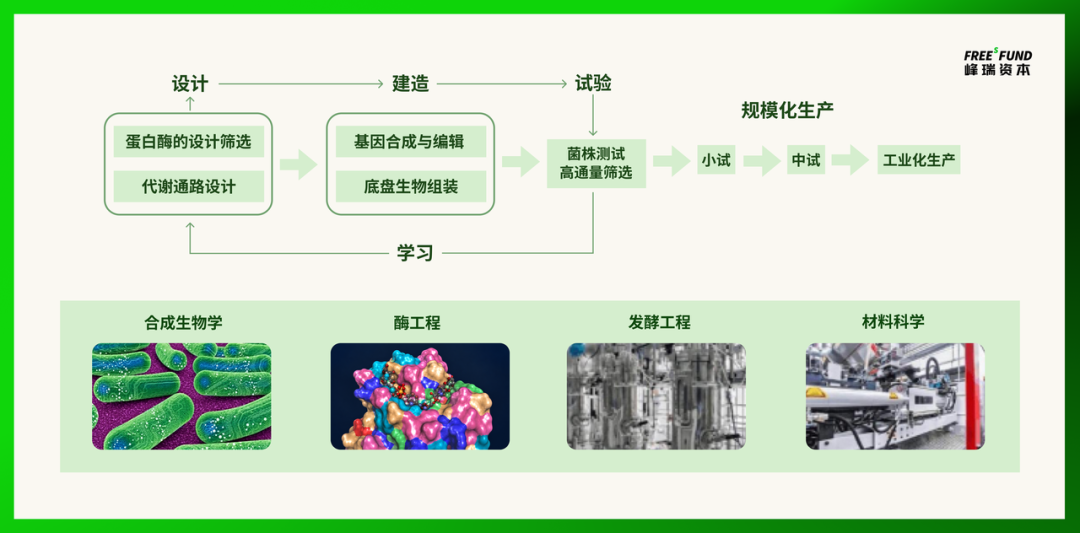
As AI foundation model capabilities continue to strengthen, and with breakthrough AI4S advances like the AlphaFold series dramatically improving prediction accuracy for biomolecular interactions, AI + synthetic biology is becoming one of the most closely watched directions.
From discovery to design to manufacturing, AI is pushing biomanufacturing from "experience-driven" toward "data and model-driven."
In novel substance discovery, human-explorable space is limited; AI can guide the way, predicting gene clusters and compounds, and exploring molecules with entirely new functions.
In enzyme and component design, AI can drive enzyme design and evolution.
In sensor design, because biomanufacturing has long lacked high-throughput characterization data, good sensors can precisely help collect data, aiding the design of proteins that bind to specific metabolites.
In metabolic pathway design, metabolic networks resemble subway maps; AI can plan how substrates can be more efficiently converted into products, and where pathways are blocked, design key enzymes to open them up.
And in fermentation process control: AI can predict and control fermentation processes based on real-time parameters, such as identifying poorly performing batches early in fermentation to cut losses in time.

Over the past two decades, innovation moved from the atomic world to the digital world. In the next decade, innovation will bring AI back to the atomic world, and AI for Science is the starting point of this journey.
Growing evidence shows that AI4S is on the verge of breakthrough. We are about to enter a new R&D paradigm driven by data, small-sample or even zero-sample generation, and end-to-end optimization. As an early-stage investment institution, we hope to invest in more AI-native AI4S companies over the next ten years. Looking ahead, we have five predictions.
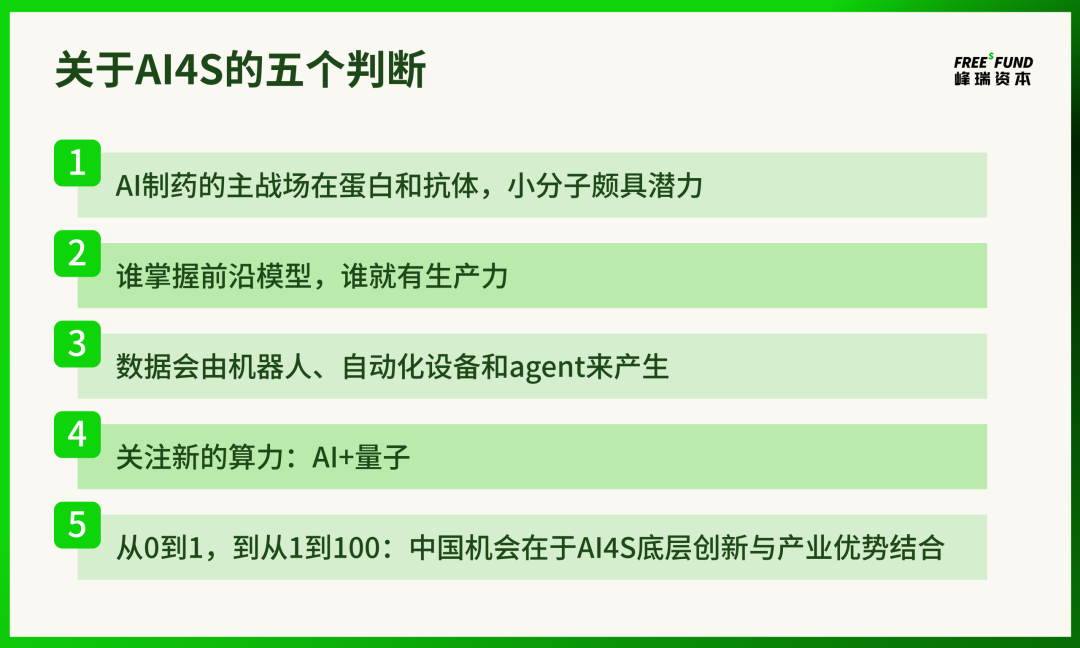
1. The main battlefield for AI drug discovery is in proteins and antibodies; small molecules hold considerable potential
AI drug discovery is a critical application area for AGI. The key is to leverage spillover technologies effectively, stay grounded in execution, and deliver real drugs and quality molecules.
While AlphaFold3 and next-generation models keep pushing the boundaries, AI-native small-molecule design remains difficult, and small-molecule synthesis is still a bottleneck. Unlike proteins or antibodies — where knowing the sequence and synthesizing the gene is enough for expression — small molecules don't have that straightforward path. So the current main battlefield is still proteins and antibodies. High-value molecular modalities like antibodies, cyclic peptides, polypeptides, and ternary complexes will be important directions for practical application.
That said, AI + drug development demands extraordinary hybrid capabilities from teams. You need deep expertise in both modeling and pharmacology. The most emblematic examples are David Baker's team and DeepMind.
2. Whoever controls frontier models controls productivity
From Isomorphic to Xaira to Generate, every frontier model is backed by a phenomenon-level company and massive capital. These models haven't yet been widely adopted by pharmaceutical companies, but large-scale application will take shape in the next one to two years. Meanwhile, AlphaFold3 is semi-open source and next-generation models are closed — the most important biological foundation models have already become a chokepoint. Teams that can reproduce and surpass AlphaFold3, and AI-native companies that can translate the latest models into actual drugs, are of particular interest to us.
3. Data will be generated by robots, automation equipment, and agents
Datafication varies widely across industries. Biology benefits from sequencing technologies and is relatively data-rich. AI + materials, nuclear fusion, Embodied Artificial Intelligence, and brain science all face a "data wall"; quantum technology sits somewhere in between. Over the next decade, datafication across industries will be a critical task. The key sources of data will be embodied robots + automated labs + AI agents — Periodic Labs and Lila Sciences are already on this path.
4. Watch new compute: AI + quantum
The standard for evaluating new compute is whether it can generate synthetic data comparable to real-world data. Quantum computing could ultimately solve AI's data problem and become next-generation compute; quantum simulation may be the first area where quantum computing finds practical application. Of course, general-purpose fault-tolerant quantum computing still needs considerable time to mature.
5. From 0 to 1, and from 1 to 100: China's opportunity lies in combining AI4S foundational innovation with industrial strengths
Foundational 0-to-1 innovation may be the focal point of US-China competition, but China's greatest opportunity is in 1-to-100. The success of AI drug discovery will spill over into materials, fusion, quantum, brain-computer interfaces, bio-manufacturing, and other fields — which happen to be the "future industries" of the 15th Five-Year Plan: bio-manufacturing, brain-computer interfaces, and Embodied Artificial Intelligence are important application directions for AI; nuclear fusion is the future energy guarantee for AI; quantum computing could supplement AI compute. There's no doubt that China has solid industrial foundations in fermentation capacity, manufacturing capability, power electronics, and superconducting material production. Whoever can connect the foundational innovations brought by AI4S with these strong industries will win the next decade.