Non-Invasive Brain-Computer Interface Startups: How to 'Read' and 'Write' the Brain, and How to Commercialize It

Where are the real pain points in this crowded sector that every major player is rushing into? And who's actually paying the bill?

Over the past three years, brain-computer interfaces (BCIs) have moved from science fiction into reality.
In May 2023, Elon Musk's Neuralink received FDA approval for clinical trials. Since then, it has demonstrated advances in motor control at multiple press events — patients using their minds to control mice, wheelchairs, and other devices. Tech giants like Meta and Amazon have entered the space in various ways. Meanwhile, a research team in Lausanne has used BCI therapy to help a paraplegic patient walk again.
In China, BCI-related clinical trials are advancing rapidly, and brain-computer interfaces have been listed as a future industry in the country's 15th Five-Year Plan.
Amid all this excitement, public expectations have been ratcheted up layer by layer: mind-controlled typing, dream interpretation, even digital immortality...
Yet BCIs still need to answer two fundamental questions: Can we read the brain? And can we intervene in it accurately? What dominates clinical use right now, in fact, are non-invasive approaches that don't require implanting electrodes into the brain at all.
In this industry deep dive, Da Xie, Investment VP at FreeS Fund, sits down with two founders working on non-invasive BCI: Jingwei Sheng, founder and CEO of Kunmai Medical, and Long Li, founder and CEO of Qiongdong Technology.

They share a lot in common: both came from university labs, did brief stints in research after their PhDs, and entered the BCI space before it became hot. Where they differ is in focus — one emphasizes "reading" the brain, the other "writing" to it. Sheng holds a PhD in medical physics from Peking University. With a physics background, he uses quantum sensing technology to build helium-free magnetoencephalography (MEG) systems that capture the brain's magnetic signals from outside the skull. Li earned his PhD in biomedical engineering from Xi'an Jiaotong University. His team specializes in Temporal Interference (TI) stimulation — using external electrodes to non-invasively target deep brain nuclei through wave interference, as an alternative to traditional invasive deep brain stimulation that requires craniotomy.
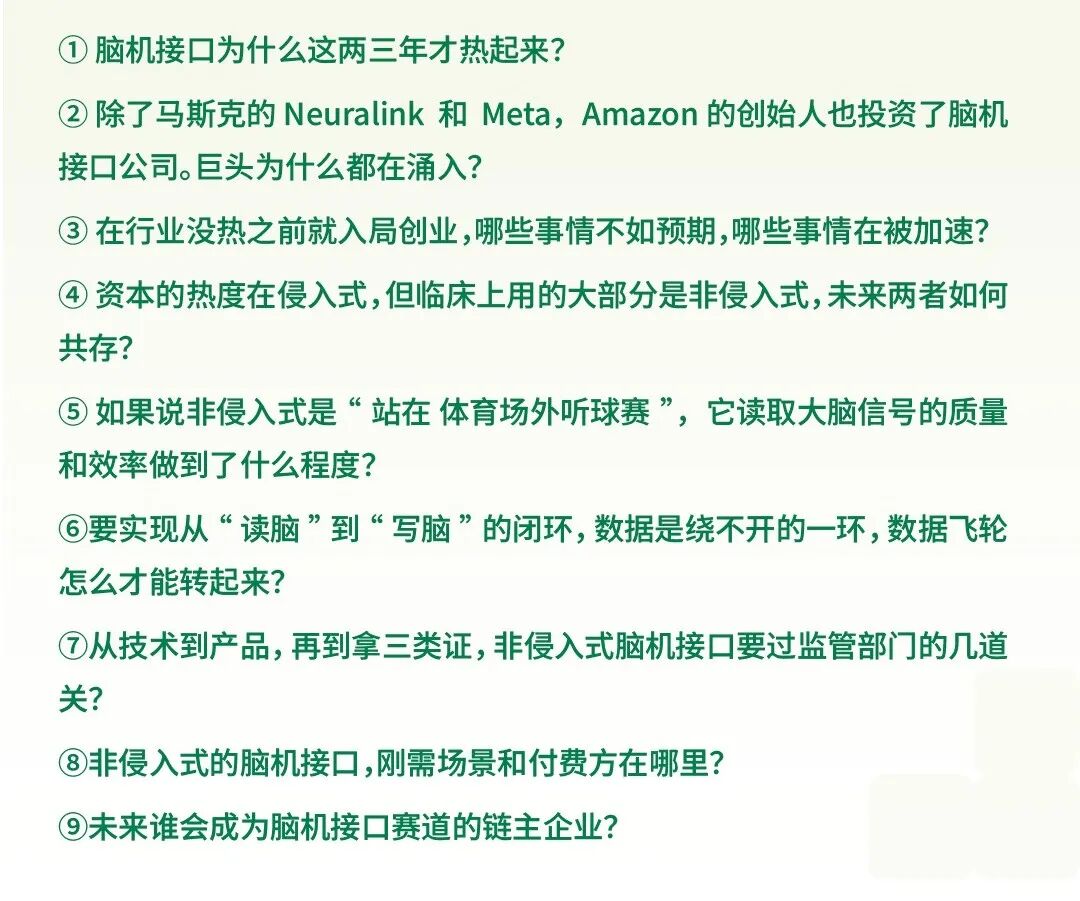
In this conversation, they cover the following topics:
Below is the full transcript. We hope it offers fresh perspectives and insights. You can also find the complete interview on Xiaoyuzhou or Apple Podcasts by searching for and subscribing to "Gao Neng Liang."




Da Xie: FreeS Fund has been following neuroscience for many years. We invested in NeuroXess in 2019, and in Kunmai Medical and Qiongdong Technology in 2022. Let's start with introductions.
Jingwei Sheng: I'm Jingwei Sheng, founder and CEO of Kunmai Medical. After completing my PhD in medical physics at Peking University, I had a brief transition period in research before starting the company. Kunmai detects the magnetic fields produced by neural activity — what's called magnetoencephalography or MEG — to reconstruct and image neural signals.
We want to overcome the skull's barrier to electrical signals and obtain higher-fidelity information non-invasively, more clearly reflecting the brain's dynamics and functional changes. We use a type of quantum sensor called OPM that achieves highly precise magnetic detection without relying on liquid helium. We've already installed systems at several hospitals and universities.
Long Li: I'm Long Li, founder and CEO of Qiongdong Technology. My path is quite similar to Dr. Sheng's. I did my PhD in biomedical engineering at Xi'an Jiaotong University, then worked in research for a while. In 2019, I founded the company based on Temporal Interference (TI) stimulation technology that our institute had been exploring.
We're trying to solve the problems of existing neuromodulation technologies: "can't reach deep enough, can't target accurately, can't deliver good results." TI uses two high-frequency waves that interfere with each other. Along their propagation path, they don't affect neurons in the superficial and middle layers of the brain — only the specific targeted nucleus. It's essentially "hitting a bull across the mountain," activating the brain without direct contact. Because its clinical effects closely resemble those of deep brain stimulation, TI has been called a "non-invasive pacemaker for the brain." It now has clear applications in Parkinson's disease, essential tremor, and certain psychiatric conditions.
Da Xie: Brain-computer interfaces only really heated up after Neuralink got FDA approval in 2023. That's when people started realizing it wasn't just a sci-fi concept anymore. Both of you entered the space before this milestone. Why did you start companies then?
Long Li: At that time, BCIs weren't clinically accepted yet. What we saw was the need to treat disease. Our team had previously worked on invasive deep brain stimulation (DBS). There are roughly 1.8 million Parkinson's patients in China, but less than 1% ultimately get the implant — it's barely over 1% even in recent years. There are two core reasons: first, many people find the safety risks of invasive procedures unacceptable; second, cost — a single invasive implant is extremely expensive, with out-of-pocket expenses typically between 100,000 and 300,000 RMB. Around 2016 or 2017, we discovered that TI could achieve functions similar to DBS, and we saw enormous potential.
Jingwei Sheng: Like Dr. Li, I'm an entrepreneur who came out of a university lab. I have a certain obsession and fascination with the technology I work on. In 2013, when I was still a PhD student, our lab had just acquired an MRI machine. I was the first subject to undergo functional brain imaging on it. Seeing my own brain "light up" as I moved my hand — I still feel excited about it more than a decade later.
Our core motivations for starting the company were, first, a breakthrough in underlying technology: the physics community had developed new quantum magnetic detection technologies that don't require liquid helium and are more sensitive, and these were gradually becoming engineerable. The other was the industry backdrop. I've seen many MEG results, but I was still incredibly moved when our Chinese team's own detector first picked up my brain's magnetic signals.

Da Xie: Over the past five years, what has progressed slower than you expected, and what has been accelerated?
Long Li: Engineering can iterate very quickly in the lab, but BCIs represent a deep integration of engineering and clinical practice. Considering safety and ethics, overall iteration isn't that fast, and data can only be accumulated case by case. Human brain structures are similar, but individual variation still exists — targets and closed-loop modulation parameters all need fine-tuning. When you only have one or two thousand cases, even for the same disease, every new patient feels like a fresh challenge. It's only when you accumulate over 10,000 cases that you can summarize patterns, form a relatively generalizable template, and then roll it out to other clinical centers.
Jingwei Sheng: If we use product approval and obtaining registration certificates as milestones, progress has been smooth. This mainly benefits from China's mature manufacturing supply chain, abundant clinical resources, and the regulatory system's supportive attitude toward innovation. What's been more difficult is that I didn't know how hard selling equipment would be before starting the company. Getting doctors to adopt a new technology and then scaling its use objectively takes time. A good product doesn't necessarily sell itself. This has been a major challenge for me and my team since getting our registration certificate and starting commercialization two years ago.
Da Xie: Over these five years, the BCI sector has generated many hotspots. Which ones have produced irreversible qualitative change, and which are still works in progress?
Long Li: The hardest part these past two years has been market education. The grand vision for BCIs is future use in healthy people, but the initial stage must be about treating disease. Ultimately, it will be classified as a heavily regulated medical device — you can't be too aggressive, but you can't be too conservative either. Product refinement must deliver clear benefits to both doctors and patients. Technical iteration isn't about endlessly adding channels from 16 to 32 to 64. We've even had to "step back." Our earliest precision was around three to four millimeters, with over twenty channels, but doctors didn't like it — fitting and calibration took half an hour, with a queue of outpatients waiting behind. Patients couldn't tolerate it either: twenty minutes of treatment, but half an hour just to put the device on. Now we use 4 or 6 channels. Though precision is lower, fitting time is under five minutes. It depends on the scenario — more precise and deeper isn't always better.
Jingwei Sheng: I think technology has developed almost linearly; there haven't been major discontinuities in these five years. The biggest push has come from Musk's Neuralink. Some of their experiments — we initially thought they were not a big deal, similar papers had been published in labs long ago. It was a bit like old news being reheated. But more determined, better-funded people pushed it one step further, moving BCIs toward a direction the public was willing to believe in. The real qualitative changes are in certain cases — like the Lausanne research team enabling a paraplegic patient to walk again from zero through closed-loop BCI therapy. That's an irreversible shift in public perception.

Da Xie: Besides Neuralink, giants like Meta and Amazon's founder have also invested in BCI companies. Why are all these tech giants pouring in?
Jingwei Sheng: I'll offer some speculation. The giants may not be pursuing brain exploration as an end in itself, but rather positioning around their core businesses. Musk has his dream of colonizing Mars and is also building robots. If robots are to serve humans, robots need brains, and the link between humans and embodied intelligence may also require BCIs. Meta, meanwhile, probably wants to build neural keyboards, neural interfaces — new interaction modalities.
Long Li: I'll answer from a more down-to-earth perspective. Brain-computer interfaces, in the short term, represent a proposition that cannot be falsified — at least not as quickly as the early metaverse was. The ultimate question BCI seeks to answer is: What is consciousness? If consciousness is solved, can I live forever? Do I even need to colonize Mars then? Can consciousness be copied, can it be stored? The imaginative space is enormous, and since it can't be disproven in the short term, it has value. This isn't a dismissal — many useful technologies and companies will be born along the way.
Jingwei Sheng: This is precisely something slightly missing in Chinese industry: leaders who can inspire more ambitious visions. People often ask, when will BCIs achieve digital immortality? My answer is, it's as far away as — or as close as — humans colonizing Mars. Musk wants to colonize Mars; his first step is commercial spaceflight. Digital immortality may be distant, but that doesn't prevent us from first addressing brain cognition and the treatment of brain diseases.

Da Xie: People often say non-invasive approaches are more acceptable to patients and easier to commercialize. But there's a vivid analogy: non-invasive is like listening to a game from outside the stadium — inherently noisy, with lots of information loss. What level of quality and efficiency have non-invasive brain signal reading reached?
Jingwei Sheng: Whether invasive or non-invasive, both measure neural activity through sound, light, electricity, and magnetism. The most direct approach is observing neuronal firing through electroencephalography (EEG), which has over 100 years of history. Despite the skull being a major barrier, it remains the most widely used non-invasive acquisition technology. Magnetoencephalography (MEG) and EEG share the same origin — fundamentally, both observe electrical activity. But the magnetic permeability of bone, cerebrospinal fluid, and other tissues is nearly identical, so the brain's magnetic signals propagate almost in straight lines like radar, with much higher fidelity.
Something that got considerable attention around mid-year was the Meta AI team training Spanish-speaking subjects to type using MEG, achieving accuracy close to 80% — approaching the level of many invasive implants for language reconstruction. This is a very positive signal: without opening the brain, with data and AI, some scenarios can approach invasive-level brain decoding.
Da Xie: But the brain signals we collect and what people see or think are fundamentally different things. Can we equate the two?
Jingwei Sheng: At least not yet, but that's the direction the entire industry is working toward. Coming from a physics background, I learned in cognitive science courses that there are three elements: brain, behavior, and mind. Psychologists conducting behavioral experiments measure behavior; today we use instruments to measure the brain. Both are essentially using measured signals to infer mental states. I believe the current opportunity lies in artificial intelligence. There is inherently some functional relationship between the brain and the mind. As data utilization efficiency and models improve, since we can measure the brain, I believe we can measure the mind to some extent.
Long Li: My perspective is different — we're users of brain-reading technology, and our demands are very high. For example, to obtain a Class III medical device certificate, we need to explain to the National Medical Products Administration how non-invasive technology reaches a specific nucleus in the brain. At that point, we need to use invasive brain interfaces. We've basically bought every kind of brain interface electrode available domestically and internationally.
Da Xie: Power users.
Long Li: Exactly. Invasive signal quality is certainly better, but it's more suitable for animal experiments or patients who are already undergoing craniotomy. It's very difficult to apply to the vast majority of our patients in the short term.
I'm also optimistic about AI's development these past two years. When I was doing my PhD, I programmed in MATLAB, using fixed formulas to "fit" the brain. AI operates on completely different logic now. We can set achievable goals — for instance, simply requiring that a patient's brain activity approaches that of a normal person after treatment, without worrying about what they're thinking. With existing AI technology, this could be realized within two to three years.

Da Xie: Capital enthusiasm is focused on invasive approaches, but most clinical use is non-invasive — some statistics say 85% are non-invasive products, with perhaps less than 10% actually implanted in the brain. Doctors I've interviewed also say the pool of patients willing to accept craniotomy risks is limited. How will the two coexist in the future?
Jingwei Sheng: Invasive and non-invasive aren't in conflict — their use cases don't overlap much. We do non-invasive, but I consider invasive approaches the most valuable data for validating brain functions, especially individual-specific functions. However, the invasive population is quite narrow: those requiring craniotomy, or severely disabled patients with high-level paraplegia, ALS, and similar conditions. For widespread psychiatric conditions, craniotomy is almost never ethically permissible, leaving only non-invasive options.
One major advantage of non-invasive approaches is data accessibility, accumulability, and whole-brain coverage. Invasive approaches that want to see finely and precisely necessarily can't see comprehensively — even tens of thousands of electrodes only cover specific regions. Yet many higher-order brain behaviors involve nearly whole-brain coordination. Fully mining whole-brain data, then using invasive representative recordings to validate and learn from — that's the opportunity for non-invasive.
Long Li: I also don't think there's a route competition. For the same disease, users can choose surgery, or they can choose non-invasive with 80% efficacy if they find the risks too high. That's their right.
Like Dr. Xie's analogy: when a goal is scored, people outside the stadium know too, from the cheers. Inside the stadium, you can see whether it went to the upper left or upper right corner. If you just want to know whether there was a goal, outside is enough. If you want to know who scored and how, inside matters. The costs differ too — outside is free, but you have to buy a ticket to get in.
The two will also complement each other. Non-invasive will collect data from more diverse people, while invasive can accumulate thousands of hours on a single individual. Brain science research may need thousands or tens of thousands of people, each with thousands of hours — invasive approaches can hardly achieve this at present. Can invasive's fine-grained recordings be generalized through non-invasive methods? I don't know. Perhaps AI will accelerate this. Precisely because it's uncertain, this is the most interesting era.
Da Xie: This also reflects the different approaches of Neuralink and Precision: one is long-term individual implantation, recording thousands of hours of brain signals from one person; the other implants during the surgical window of patients who must undergo craniotomy, removing electrodes afterward, emphasizing coverage of more individuals.

Da Xie: TI as a therapy can be divided into three stages: first, hitting the target — actually stimulating the intended brain region; second, neurons genuinely responding to the electric field; third, behavioral improvement in the disease. Where has TI reached?
Long Li: That's exactly what the National Medical Products Administration is asking us. For hitting the target, we can prove we've reached specific nuclei using craniotomized monkeys or craniotomized patients. Next, we need to prove that reaching it actually produces an effect. We can't answer this with non-invasive methods alone, so we use invasive electrodes to observe neuronal firing after TI stimulation.
Modulation must demonstrate very significant clinical effects to be recognized. The key is finding the right indication. If a disease can be treated with ultrasound, electricity, or magnetism with similar efficacy, ultimately it comes down to who has lower costs. If sound and magnetism both score 60, but electricity can achieve 90, electricity gains pricing power for that indication. This matters more than simply debating whose technology is better.
Beyond treating disease, there's also demand from healthy people — it's about how to find it. I'm a deep participant in weight loss myself. I've tried Semaglutide, Tirzepatide, all of them. The effects are obvious, but I can't stick with it: the side effect is nausea, other interests are suppressed, and I feel a bit emo overall. I wonder if there's a lower-cost approach, like regulating the brain to lose weight.
Da Xie: Essentially moving from treating clinical disease toward functional enhancement for the general public. In our early evaluation of neuromodulation, we valued non-invasive safety, high precision, and whole-brain multi-target combined modulation. Now there's more of a turn toward pragmatic, clinically grounded directions like closed-loop detection-modulation and personalized targets. Is this driven by hype, or has technology accumulation reached this point?
Long Li: I think technology has gradually evolved to this stage. Before TI and ultrasound, the mainstream modulation technology was transcranial magnetic stimulation — it didn't reach deep enough or accurately enough, but it already solved many clinical problems, with thousands of units shipped annually. For example, some parents would take their children for this kind of modulation before high school or college entrance exams to relieve anxiety and tension — maybe with 60% efficacy. Now with deeper, more precise technology, plus the ability to collect personalized data to pinpoint which nucleus is involved in anxiety, effects might reach 90%. Both 60 and 90 are valid approaches.
Da Xie: But the flip side of personalization is regulation — medical authorities require certain fixed, defined elements in a therapy.
Long Li: There isn't yet a true non-invasive Class III BCI certificate, precisely because it requires demonstrating closed-loop implementation through BCI methods with superior efficacy. This is inherently difficult. Previous modulation or medication, to use an exaggerated analogy, was like dropping a nuclear bomb — flattening the entire city, with obvious effects. Closed-loop is like precision guidance, accurately destroying one building. The difficulty is that compared to current efficacy, precision guidance isn't necessarily better than dropping a nuclear bomb. Yet to get approval, new therapies must be superior to, or at least equivalent to, existing therapies. This is also what we've been communicating back and forth with regulators about.

Da Xie: Invasive approaches have a constantly reinforced commercial logic: patient demand is extremely rigid (severe paralysis, ALS), and they're willing to bear the risks and costs. Does non-invasive have truly irreplaceable,刚需 scenarios?
Jingwei Sheng: Unclear scenarios may be non-invasive's current weakness: it seems capable of everything, yet not quite irreplaceable for anything. What can be stated clearly is that anything limited by craniotomy requirements is a non-invasive scenario, especially diagnosis, intervention, and assessment for psychiatric conditions. But heavy regulation limits its application scope, because any medical device explicitly targeting a specific psychiatric condition, even if non-invasive, requires Class III registration. At the other extreme are thousands of consumer-grade headbands on the market — just one or two dry electrodes, worn like a tightening spell, seemingly endowed with miraculous powers, when they're really semi-entertainment at best. So the industry found a middle ground: medical yet serious, which has heated up the traditional rehabilitation sector. But whether rehabilitation effects come from the BCI or from concurrent traditional rehabilitation still needs to be clarified.
Long Li: From technology to commercial closed-loop, progress actually benefits from mutual reinforcement across different fields. Take depression as an example. Previously there were only drugs (the so-called "six golden flowers"). Doctors would do a scale assessment, prescribe medication, and that was it — no need for fine-grained brain functional imaging. With modulation approaches like ultrasound and TI, structural and functional imaging data are needed for precise targeting. And modulation can't work without acquisition — you wouldn't even know where to target or how to get there. Now psychiatric specialty hospitals and hospital psychosomatic departments are equipped with MEG, MRI, and EEG devices.
Da Xie: How have paying customers changed over these five years?
Long Li: Qiongdong's paying customer profile has changed noticeably: earliest were university research users, then research users at top hospitals, and now genuine hospital department purchases. Today's paying customers have returned to the most basic commercial logic: they must solve efficacy problems for patients, reduce labor costs for hospitals, and the equipment must generate returns and profits after purchase. For medical insurance, it should also offer better cost control than continuous medication or surgery.
Jingwei Sheng: Our paying customers are still mostly large B-end clients, because MEG is major medical equipment, very expensive.
Long Li: Our two companies' devices are used jointly in hospitals, and Qiongdong is also gradually becoming a paying party. Obtaining a Class III certificate requires massive data — say, 2,000 people, each with over 3 hours of MEG data. Buying my own MEG machine and recruiting people to collect data is neither economical nor efficient. It's better to collaborate with hospitals at the compliant, de-identified data level, or pay platforms like Kunmai that do the "infrastructure." As long as we can prove our effects are superior to non-closed-loop modulation and obtain the Class III certificate, the returns will be substantial. We're already collaborating with EEG large-model companies and hospitals with substantial MRI data.

Da Xie: As more individual patients receive BCI implants, this brings more data, better models, and improved product effects, which in turn wins more patients. How much of this data flywheel has been validated, and where do challenges remain?
Jingwei Sheng: Theoretically it's very smooth, but it doesn't work yet in practice. First, compared to natural language, brain data is still scarce. Second, standardization is insufficient — data from different modalities and sources vary enormously. Brain data is very noisy. Some have put it rather sharply: garbage in, garbage out — sheer volume isn't enough. The next opportunity is using AI large models to effectively mine data and make it more usable. So the flywheel will spin, but the prerequisites are sufficient accumulation, data standardization, and obtaining large amounts of clean data.
How to obtain cleaner data is itself the industry's most fundamental opportunity. Doing medical device hardware alone faces increasingly severe constraints. This forces us to think about how to transform from a medical device company into a solutions company, building moats around data and models.
Long Li: Qiongdong is a beneficiary of the data flywheel. Leading in hardware devices alone offers limited moats — perhaps in 3 or 5 years, because China's supply chain replication and iteration capabilities are very strong. So these past few years, we haven't focused solely on revenue. If customers are willing to give us their data, we can concede some commercial interests, because data will become increasingly important.
Da Xie: However, there's no industry-recognized model architecture yet that can adapt to different modalities of brain data. On one hand, BCIs are very hot; on the other, our understanding of the brain is still in early stages. So BCI commercialization has mainly concentrated on motor rehabilitation. Previous language BCIs actually decoded the motor commands for speech production — essentially still motor decoding. To expand to sensation, consciousness, logical reasoning, and other higher cognitive functions, are existing models and algorithms sufficient?
Jingwei Sheng: Rationally speaking, everything is challenging. From measuring the brain to computing the brain, the gaps are data and, based on computational neuroscience, modeling and abstraction. In discussions with computational neuroscientists, I've heard an interesting perspective: the human mind is not as complex as imagined. Excellent psychological counselors don't need particularly advanced tools — they can guide people to solve problems through conversation. Through abstraction, higher cognition might be transformable into approximate classification problems. There's hope here, but how long this path extends is unknown. Moreover, inferring higher cognition requires seeing comprehensively, not too finely — which is precisely non-invasive's advantage.
Da Xie: Modulation can be understood as perturbation of brain states. Can we build a transfer model from state A to state B?
Long Li: That's what we want to do. We're also working with ultrasound ourselves, wanting to know how data perturbations differ when TI and ultrasound hit the same nucleus. We're conducting a project with 1,000 people, 1,000 hours each, with perturbation methods including sound, light, electricity, and magnetism. We expect to have all data in 8 to 9 months. Preliminary pilot experiments already show clear differences between perturbed and unperturbed states; whether different methods differ will only be known after completion.
As for consciousness, I can only answer very intuitively: it may be a quantitative change leading to qualitative change, reaching some node where — bang — it's solved, rather than following a meticulous plan step by step to the endpoint. My optimism comes from my belief; my pessimism comes from the data I've collected.

Da Xie: If a complete closed loop of "read brain — understand signal — intervene — observe feedback" truly forms in the future, who will ultimately capture the value?
Long Li: I don't quite agree that one company or one link will become the chain master. Follow it through, and countless points will be considered chokepoints — like chips, where every link is a value anchor. For example, this is a barrel; any short stave limits how much water it can hold. The future BCI track may involve diversified competition — some doing flashy tech, some doing grounded applications. Only when all staves meet standards will the node of widespread application arrive.
Jingwei Sheng: It's too early to discuss this. In the endgame, it depends on who can truly achieve closed-loop. But at this stage, the protagonists are companies controlling data entry points and possessing advanced sensors and electrodes.
Da Xie: In the BCI direction, how will the China-US landscape shape up? Where does China have advantages?
Long Li: We've conducted clinical trials both domestically and internationally. Although serious medicine faces heavy regulation, domestic support for brain-computer interfaces is relatively strong. In China, opening a new indication or validating a new target can complete ethics review in two to three months; in the UK or California, it takes at least two years. This means operating in China can yield more data two years earlier than in the US, and with iteration speed on top, the advantage is clear.
Jingwei Sheng: I agree. China has advantages in clinical resources, data output, and supply chain. When we first started, some components had to be hand-built; later the supply chain was developed by industry growth. The US advantage lies in the most original ideas, original technologies. People still habitually say "I'm China's Neuralink" — this shows we're still following concepts first proposed by the US. We need to explore more diverse innovation.
Da Xie: To add one point, comparing China-US patents: the US emphasizes basic brain science and upstream materials, chips, and algorithms; China emphasizes validation and application, with strengths in mid-to-downstream and clinical resources. We should consolidate our strengths and produce clinical results as soon as possible.

Da Xie: Finally, a question for both of you: If we record another episode in 3 years, what development would make you feel the industry has truly passed an important phase?
Long Li: Non-invasive BCIs have now reached the threshold of commercialization. I'm very much looking forward to, within three years, the first BCI company going public domestically, and the first medical insurance reimbursement case for non-invasive BCI.
Jingwei Sheng: The scenario I'd rather see is: a doctor in a department spontaneously writing a BCI-related test order, not for research or IIT trial purposes. I believe this is the true sign of BCI landing and benefiting the masses. Perhaps in three years, "brain-computer interface" won't be such a fashionable term — the hype may even decline. But whether called brain science or brain-computer interface, humanity's exploration of the brain and quest for solutions to brain diseases are eternal subjects.
I also hope that in the future, BCIs won't only be popular in rehabilitation departments, not only be motor BCIs — these aren't people's most beautiful expectations for BCIs. Beyond motor rehabilitation, enabling BCIs to intervene in and treat psychiatric conditions, to parse and apply higher human cognition — this is the shared mission of all companies in our industry.