What Are Investors Worried About After AI's Hottest Six Months?

If the AI industry starts "deflating," which category of companies will be the first to get repriced?
Recently, the AI sector in secondary markets has been on a rollercoaster — chips, memory, and optical interconnects have all taken turns swinging up and down. Meta has revised its 2026 capex guidance upward again, pulling the question of how long and how fast AI infrastructure spending will continue back into the spotlight.
Money keeps pouring into compute, storage, and data centers, and the market is already asking: Has AI infrastructure hit a cyclical peak? How much longer can this boom run? At the same time, embodied intelligence, world models, agents, tokens, and hardware shifts from cloud to edge to endpoint are all unfolding in parallel.
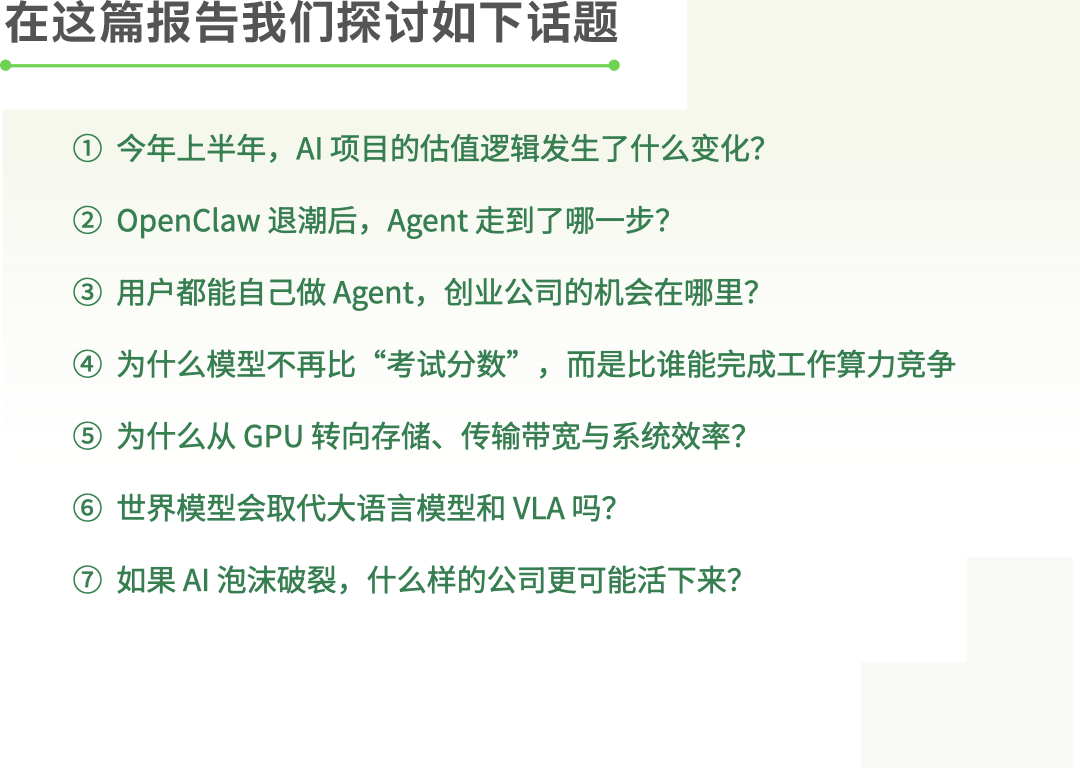
With 2026 more than halfway through, FreeS Fund tech investors Pengqi Liu and Qianhang Yan sat down to review the past six months: Why do project valuations change week to week? What remains after the OpenClaw hype faded? Why did world models explode all at once? What does "power in, tokens out" mean for the compute arms race? And if a bubble burst is inevitable, which companies will still have seats at the table?
We've compiled excerpts from their conversation. For the full discussion, search for "Gao Neng Liang" on the Xiaoyuzhou app or Apple Podcasts.

We continue to track technological developments in the agent space. If you're a founder or practitioner in this field, feel free to reach out to the authors: Pengqi Liu (pengqi@freesvc.com) and Qianhang Yan (qianhang@freesvc.com).





Pengqi Liu: Looking back from mid-2026, AI's evolution hasn't slowed one bit. From OpenClaw and world models to storage and optical interconnects, to Zhipu AI's market cap breaking a trillion Hong Kong dollars — the hotspots have come in waves, all compressed into the same six months. Today we'll walk through them in order and see what's actually been happening behind the scenes.
First question for you, Yan — roughly how many projects did you look at in the first half of the year?
Qianhang Yan: About 200 to 300, with AI-related projects making up roughly 150 to 200 of those.
Pengqi Liu: My sense is about the same. If you had to describe the first half in a few keywords, what would you pick?
Qianhang Yan: The first is FOMO. Hot areas suddenly produce floods of people and projects you've never seen before, with valuations climbing fast. Many investors force themselves to look at everything: Did we invest today? How much? Should we be putting in more?
The second is structural divergence. A handful of hot sectors are seeing active fundraising, while most others remain cool. The same pattern holds in public markets — tech stocks have done well, but names outside the spotlight have been tepid or even down.
The third is valuation front-loading. In early-stage investing, there used to be relatively clear expectations around what milestone matched what valuation. Consensus would form, a deliverable would be completed, and then the valuation would step up. Now heat and FOMO have broken much of that experience — a $1 billion valuation can appear almost overnight.
Pengqi Liu: Some projects see their valuations shift in a single week, and in extreme cases there are three funding rounds happening simultaneously — one closing, one in term sheet discussions, and another already finalizing terms. Does this market make you anxious as an investor?
Qianhang Yan: It would be unrealistic to say no. But what makes me more anxious isn't missing out on a particular project — it's how fast AI itself is changing. Every day brings new models, new buzzwords, new ideas. You see a news item a few days late and can't help wondering: Have I already been left behind?
Pengqi Liu: Some investments are value-oriented, others opportunity-driven — you have to separate them out and not let market sentiment make decisions for you. Setting aside valuations and FOMO for a moment, what genuinely new things actually grew in the first half?
Qianhang Yan: Let me start with research-driven entrepreneurship. There's been a lot of discussion in the United States recently around a concept called NeoLab — using commercial company structures to tackle long-term research problems. Quite a few such companies emerged in the first half. People are no longer just asking "is this a professor founding a company?" but rather looking at whether research can run faster inside a company than under the old organizational model.
Looking at AI applications and AI hardware, people are also returning to the product itself. After Manus appeared, the market briefly FOMO'd on agents; then Insta360 sparked renewed attention on AI hardware. After chasing a round of hotspots, everyone still has to come back to finding people who can actually define products.
AI coding has also expanded entrepreneurship beyond algorithm researchers and engineers. Lawyers, designers, product managers, even homemakers — anyone can potentially use coding tools to build something.
Pengqi Liu: It used to be common to say technical founders were "walking around with a hammer looking for nails." Now it's a bit like the nails are starting companies themselves, and the hammer has become a universal tool.

Pengqi Liu: OpenClaw was probably one of the most closely watched events of the first half. From the nationwide "lobster farming" frenzy and Mac mini shortages to model companies and IM platforms launching their own agents, the heat has gradually cooled. Open source brought it to the masses overnight, but security and experience issues surfaced alongside. After the noise, what did it actually leave behind?
Qianhang Yan: OpenClaw let many ordinary people deploy an agent themselves for the first time, download skills, and gradually tune it through natural conversation into something they wanted. It's more like an Agent OS — not just a tool for completing a single task.
I have a friend who runs beauty content on social media and wanted to pivot into tech content. She used OpenClaw to build several workflows that collect tech information directionally and form a content production pipeline. Coding, presentations, e-commerce, and internal enterprise workflows — plenty of people are already using it stably. After the wave subsided, there was foam, volatility, and noise, but blow away the beer foam and what's underneath is the real brew.
Pengqi Liu: Recently there's been renewed emphasis on Harness Engineering. As large models shift from chat tools to task executors, what becomes more important?
Qianhang Yan: An agent has to make decisions in an environment, execute tasks, and adjust based on results — the whole loop has to actually turn. The model is just the "brain" inside. Harness Engineering builds out the surrounding environment and feedback pathways so the model can run through workflows on its own, rather than having every step hard-coded in advance by humans.
Pengqi Liu: This also connects to data flywheels. Traditional internet personalization came from accumulating user data — could agents become the vehicle for forming data flywheels and personalized experiences?
Qianhang Yan: What chatbots leave behind is mainly linguistic context. What agents leave behind is task trajectories: how they judged, how they executed, what tools they called, whether they actually got the thing done. These trajectories can be used for agent RL. Vertical-scenario data may not flow back to foundation model companies at all — and that could become the moat for agent startups.
Pengqi Liu: Seen this way, whoever captures users' task trajectories has more leverage. There are roughly three types of players on the field now: model companies, IM and workplace platforms, and local hardware. Who do you favor?
Qianhang Yan: They're doing different things. Model companies are suited for general tasks like search, deep research, and coding. Workplace platforms have existing files, documents, and business processes. Local hardware is more about privacy. But whether the "lobster machine" is a viable product path is still a question mark. The Mac mini was what people scrambled for most at the start, and after the hype died down, the Mac mini was also what sold most on Idle Fish.
Local hardware also has a problem: who owns the data? Say a company's core architect uses an agent — of course they want the best model, but if their architectural designs and task trajectories get taken by the model company for training, that's a major risk for them. The conflict many users face is: I want to use the best model, but I won't accept handing my data over to it. How do you see the tradeoff between privacy and model capability?
Pengqi Liu: Based on past experience, most consumer users will prioritize efficiency and experience first. But pro consumers and enterprise are different — technical documentation, product designs, business data are core assets. The opportunity may lie here: letting enterprises use the best models while keeping local data, permissions, and security under control.
Qianhang Yan: Pengqi and I both looked at SaaS and fintech years ago, and we have a love-hate relationship with large enterprise customers: big budgets, but complex demands and heavy service requirements. Now we have FDEs (Frontier Deployment Engineers) too — people who understand both models and business, deployed on-site to help customers implement. How will AI serving large enterprises differ from SaaS and fintech?
Pengqi Liu: Large enterprises have big budgets and high expectations. The old problems remain: scope expansion without price increases, high customization costs. Customers also ask — if open-source models exist, why pay more for AI services? Once AI actually penetrates enterprise infrastructure, data security, privacy, and system integration all need handling. Then there's hallucination. If AI is used in core functions like risk control, and errors cause losses, who bears responsibility — the model vendor, the enterprise, or the employee? That boundary hasn't been clearly drawn yet. Whoever solves these problems gets the opportunity.

Pengqi Liu: Over the past six months, has the pace of large model capability improvement accelerated or slowed?
Qianhang Yan: If you're looking for leapfrog innovations like the o1 reasoning architecture, there hasn't been one for a while. But models' ability to perform real tasks keeps improving. We used to evaluate them on math tests and knowledge benchmarks — like making a model take exams. Now we look at SWE-bench (software engineering benchmark), Computer Use, and Agent Benchmark — testing whether it can fix bugs, orchestrate tools, and complete long-horizon tasks. Models have moved from the examination hall to the workplace.
Pengqi Liu: Like a student graduating from school into society. Knowledge reserves may be largely formed; the real test is how much capability they can apply at work. Which company has stood out most in this round?
Qianhang Yan: I'd pick Anthropic. It bet heavily on coding early on, and that decision looks crucial in retrospect. It recognized sooner than others that models can't just compete on test scores — they need to execute tasks. After Claude 3.5 launched, the AI coding experience improved noticeably; tools like Cursor got better and better; better tools attracted more users, whose feedback looped back into the model, and the flywheel started spinning.
Another reason is its rapid revenue growth. Anthropic's disclosed annualized revenue has climbed quickly this year, and people are starting to ask: if it goes public, what scale of company would it be? Improvements in inference cost and profitability are also causing many to re-evaluate it.
Pengqi Liu: Sounds like it chose a market that looks vertical but is actually large enough, and penetrated that user base deeply first. Better than spreading thin without clear leadership in any direction.
Qianhang Yan: I wouldn't really call coding a vertical. Coding inherently involves human logic, reasoning, and decision-making — turning an algorithm into a running application. Going deep on coding trains reasoning, associative thinking, and chain-of-decision capabilities alongside it. That's why people find Claude rigorous and intelligent to use.
Some models are creative but unreliable. Anthropic cut in through coding and agents, with real tasks feeding back to train the model. It's a bit like "the unity of knowledge and action" — it put knowing and doing into the same loop earlier than others.
This year Anthropic launched Fable 5 and Mythos 5. Fable 5 was opened to general users; Mythos 5 had narrower access. Both models were temporarily suspended and later restored. What's your take on the discussions around these restrictions?
Pengqi Liu: There's already plenty of online commentary, but perhaps not many people have used them in depth yet. From my brief look, they're indeed strong on context length, adaptive recursive thinking, and integration with agent capabilities. As for the so-called "ban," I suspect there's some smoke and mirrors, some scarcity marketing involved. Whether they're actually powerful enough to become tools of competition between nations remains to be seen.
Qianhang Yan: Looking back at domestic models, what's the biggest change in the past six months?
Pengqi Liu: Zhipu AI is a very typical example. It's also pushing toward coding, making its own attempts at architecture and long-horizon task training. We've also heard the team is incorporating process rewards and other methods to improve model capability. Domestic teams keep experimenting — architecture, algorithms, model capabilities, none of it has stopped.
The data piece is being filled in too. Distillation alone hits its ceiling quickly. After model companies raised more money, beyond buying compute and hiring, they're also willing to spend on high-quality data.
DeepSeek is worth watching too. After releasing its model, it went quiet for a while but kept building. A notable change this year is that it's become more open on fundraising and domestic compute partnerships than before.
I understand it needs valuation and equity incentives to retain talent, and wants deeper partnerships with domestic compute vendors. This isn't just about improving its own model — it's also about driving the whole industrial ecosystem.
Qianhang Yan: When DeepSeek first emerged, most domestic model companies had funding on the order of a few billion RMB. At that scale, a research lab backed by a quant fund could still compete. From last year to this year, the tech giants started pouring in heavy investment — Alibaba, Xiaomi are spending big; after going public, MiniMax and Zhipu AI no longer have just a few billion RMB in hand. If DeepSeek continues operating as before, it's essentially choosing to increase its own difficulty.
But DeepSeek's style hasn't changed much. All its choices still revolve around one thing: making better large models, rather than pursuing short-term commercialization first.
Pengqi Liu: After covering domestic model companies, let's look at the China-US gap. Is it widening or narrowing?
Qianhang Yan: On turbo and general standard models, the gap is indeed shrinking. In 2022 people thought catching up would be hard; in 2023 and 2024 they were still saying one to two years behind; this year the feeling might be just a few months. Recently Zhipu AI co-founder Jie Tang had an exchange on X with Elon Musk. Musk said Chinese large models might not reach frontier levels until Q1 2027; Tang replied, "Not that long."
The gap that's harder to close short-term remains infrastructure and compute. The United States has larger compute clusters and can run more experiments in parallel; China is better at doing more with less, catching up quickly through algorithmic and engineering efficiency.
Pengqi Liu: Right. More machines mean more experiments running simultaneously, and more room to explore model architectures. Domestic capabilities in data have strengthened compared to before, and data's contribution to model progress is rising too. Looking at turbo and lightweight models, we do have advantages in efficiency and cost.
Qianhang Yan: Chinese models are also getting more visibility. MiniMax's models are supported by OpenClaw; at NVIDIA's March GTC, both Moonshot AI and MiniMax were mentioned in the agenda and related talks. Across turbo, standard, and general tiers, we're catching up fast.
Video generation is more interesting — domestic voices are actually louder here. After Seedance's release, the market briefly circulated that its ARR had reached $2 billion, though Volcano Engine later indicated that externally reported revenue figures were generally inflated. Overseas, besides Google Veo 3.0 maintaining attention, Sora's market buzz has diminished considerably from its launch. On video models, domestic players actually look stronger.
Pengqi Liu: Because video generation consumes a lot of tokens, and cost and efficiency per token get magnified. Domestic vendors can use architectural design and more efficient compute utilization to bring costs down to levels users will accept.
Going further, we can't avoid AI infrastructure. Model vendors keep raising capex, token consumption is rising, and compute costs will eventually become a bottleneck. What changes are you seeing in infrastructure?
Qianhang Yan: People are no longer just asking "is there enough compute," but whether the whole system can run smoothly. Beyond "compute," you have to look at "storage" and "transmission." Suppose you have ten thousand compute nodes — if results can't reach the next node in time, other nodes just wait. Like hiring ten thousand assembly line workers but materials arrive too slowly, so some are always idle.
That's why optical interconnect, HBM (high-bandwidth memory), DRAM (dynamic random-access memory), and SSD (solid-state drive) are becoming increasingly important. Abstract the whole system, and it's really one thing: "power in, tokens out." How to convert electricity and operating expenditure into more tokens requires joint optimization across chips, storage, networking, liquid cooling, and software.
Pengqi Liu: Looking at infrastructure can't just focus on cloud. The device side covers phones, watches, earbuds — devices around you; the edge side can be NAS (network-attached storage), all-in-one machines, or enterprise internal equipment; cloud then provides large-scale compute. Simple tasks go on-device, personal and enterprise private data stays at the edge, complex programming and long-horizon reasoning go to cloud.
Qianhang Yan: Cloud has sucked up massive resources short-term, while the device side has to deliver functionality with less compute and lower cost. For startups, constraints like this hide opportunities.

Pengqi Liu: In the first half of 2026, "world model" suddenly became a buzzword. Embodied intelligence, video generation, gaming, physics simulation — all are talking about it. My understanding is that a world model doesn't necessarily correspond to one specific model; it's more like: given an external intervention on the world, predict what happens next.
By this definition, couldn't Newton's laws also be understood as a kind of world model? Dr. Yan, how do you understand world models? What's their relationship with VLA (vision-language-action models), video generation models, and large language models?
Qianhang Yan: World models aren't actually new — they've always existed in reinforcement learning. Now we can see several approaches: video models generating the next frame, 3D world models building interactive spaces, JEPA (Joint Embedding Predictive Architecture) abstracting the world into latent space representations, and WAM (World Action Model) connecting world models with action policy.
Pengqi Liu: Language is highly abstract information, but the real world also has vision, touch, and spatial relationships. I feel world models are more like innate human capabilities, while language models are more like acquired learning. They iterate differently, but together shape human intelligence. Do you agree? What relationship will world models and LLMs form in the future?
Qianhang Yan: I also lean toward them being complementary. Language and the five senses — including vision, hearing, touch, and smell — are all ways humans interact with the world. Large language models first solved intelligence at the language level; naturally we continue exploring AI's understanding and prediction of the physical world.
Liu Pengqi: Why did world models explode specifically in the first half of this year?
Qianhang Yan: First, video models matured — the generated results look increasingly real. 3D representation technology also advanced, from Mesh to point clouds to NeRF and 3D Gaussian Splatting. Startup teams now have the technical foundation to generate and manipulate 3D worlds. Plus, with open-source video models, many ideas can be validated quickly.
Liu Pengqi: But both world models and embodied intelligence lack data containing physical information. The industry often talks about a data pyramid: the base is internet video and synthetic data, the middle is first-person data with multimodal information, and the top is real robot teleoperation data. How do we solve this bottleneck?
Qianhang Yan: We don't lack ordinary video data; what we lack is data that encodes physical states and laws. There are three types: first, real sensor collection; second, physics simulation and digital twins; third, inferring contact and force states from video. Real data is best but most expensive. Ultimately, we need to combine all three into a gradient system.
Let's talk about something lighter. If world models start showing clear commercial progress, which scenarios do you think consumers will feel first — gaming, content consumption, or embodied intelligence, which has been discussed so much lately?
Liu Pengqi: My guess is gaming and content consumption. These scenarios don't demand absolute accuracy; they just need to fool the human eye. Embodied intelligence operates in the real world, with higher requirements for data, success rates, and safety.
Qianhang Yan: If world models can really be used in games, I'd quite look forward to no longer seeing all kinds of bizarre clipping and bugs.
Liu Pengqi: Moving from content consumption to embodied intelligence, what changes has the world model brought to this industry? Some people now think VLA will be replaced by world models. Is that true?
Qianhang Yan: I don't think so. When people play tennis, facing an unfamiliar shot, they might first imagine how to return it; but with a fast incoming ball, professional athletes rely on bodily instinct to react directly. World models are more like "think first, then act"; VLA is more like directly outputting actions based on visual input. The two can complement each other.
Liu Pengqi: There's also an "impossible triangle" for embodied intelligence deployment: long-horizon complex tasks, high success rates, and cross-scenario generalization — currently hard to satisfy simultaneously. Tactile sensing is also crucial. If a robot can reconstruct the approximate 3D shape of an object using only tactile sensors on its hand, that indicates a fairly high level of capability.
Qianhang Yan: We saw a very intuitive case. A simple two-finger gripper costing just one or two hundred yuan, plus a tactile sensor forming a force control loop, can pick up tofu without crushing it. But how to adapt tactile sensing for models is still very early stage.

Liu Pengqi: Besides the hottest areas like Agent, world models, and embodied intelligence, what other directions do you think deserve entrepreneurs' special attention?
Qianhang Yan: One direction I've been most interested in recently is the broader AI for Science. Break down the research process — from asking questions, literature review, to experimentation, analysis, and validation — and see which steps can be handed to AI, and whether research speed can be accelerated. It goes a layer beyond AlphaFold, which people were familiar with a few years ago.
Liu Pengqi: A bit like turning research itself into a reorganizable pipeline.
Qianhang Yan: Exactly. This year we've already seen quite a bit of auto-research work, though mostly still limited to certain fields. What's more worth watching next is whether it can enter more disciplines and greatly accelerate scientific innovation. Another example relates to world models we discussed earlier. Traditional physics simulation often relies on partial differential equation solving at its foundation. A painful problem in simulation used to be: if you want accuracy, it's slow; if you want speed, it's inaccurate. Now people are starting to use AI and neural operators to replace part of the PDE solving. If it can truly be both fast and accurate, that's solid progress.
Something I've found particularly interesting recently is social science. Previously, social science research lacked efficient experimentation and simulation mechanisms: either treating real society as an experimental environment for large-scale surveys, or small-scale sampling. Can AI now provide new simulation methods for social science,切入 some of these steps, and accelerate research? This suddenly opens up the AI for Science concept — it's no longer just AI for materials, AI for biotech.
Another direction is AI hardware. China has mature hardware supply chains, a batch of very smart young founders and product managers, plus increasingly good AI infrastructure. They can quickly turn ideas into products. What I'm more looking forward to is whether some unexpected things will randomly grow out of this soil.
Liu Pengqi: AI hardware isn't just about providing a function to users — it's also closely connected to world models. The internet has already accumulated massive amounts of digitized data, but how humans interact with the physical world — including behavioral data, vital signs data, EEG data — is still very scarce. In the future, this hardware may carry computing power, AI software, and various sensors, gradually understanding us through use, then providing services in return.
Startups still need to think clearly: are you making a data collector, or a data hub? If it can also bring in user information from other scenarios, there's much more it can do.
Liu Pengqi: Finally, let's talk about capital markets. This year, Unitree has already received IPO registration approval for the STAR Market and entered the issuance stage. After Zhipu AI and MiniMax listed earlier this year, their stock prices experienced fluctuations and even began to diverge. Moonshot AI, DeepSeek, and StepFun completed large financing rounds in succession. How do you view this wave of AI company listings? How will it affect the primary market?
Qianhang Yan: From a primary market investor's perspective, everyone making money is of course a good thing. For these foundation model companies, going public is also a capitalization realization: their ecosystem position already has阶段性 proof, and they need to fight longer battles ahead, requiring more ammunition.
These companies have long-term value, but in the short term they need to continuously burn money on research. Capital markets give them the conditions to keep investing. OpenAI and Anthropic are similar. You can't fully value them using traditional PE frameworks; people care more about what ecosystem position they can ultimately occupy. When internet companies first went public, people didn't just look at whether they were profitable right now either.
Liu Pengqi: But in this round of AI, everyone admits there's a bubble. After more giants go public, will the bubble burst?
Qianhang Yan: It's hard to predict when the bubble will burst. Anyone can say bubbles eventually burst, but that's a correct yet useless statement. In the short term, listings may add another wave of FOMO to the primary market; but the secondary market反馈 fast — if business performance is poor, or research progress can't support expectations, stock prices will reflect that quickly. If leading companies perform well, the primary market still has room; if they can't sustain it, that will反过来压低 primary market valuations. Then people will recalculate: if secondary market valuations can't hold, why is the primary market still so expensive, or even with first-secondary market inversion — shouldn't we calm down? The valuations that rose quickly in the first half of this year may also face a period of cooling.
Liu Pengqi: We really can't guess which day it'll burst. Then let me rephrase: assuming the bubble starts to burst, what happens? Which companies are more likely to survive, or even become truly good companies?
Qianhang Yan: The mentality in a bubble is a lot like stock trading — everyone thinks their pick will hit the limit up tomorrow. When markets cool, money flows to better assets. For research-driven directions like world models and embodied intelligence models, companies need to continuously deliver key milestones and maintain their position in the industry. Relying only on demos and storytelling, without real output, makes it hard to raise money later.
For companies focused on落地, it ultimately comes down to whether the business model is stable and orders are real. Whether they can withstand shocks determines whether they survive.
Liu Pengqi: I actually think a bubble bursting isn't necessarily all bad. Whether for software, large models, or embodied intelligence, upstream computing power and infrastructure costs may come down. Many projects can't落地 now because they're stuck on capital expenditures and costs. If users can afford it,落地 will actually accelerate.
Qianhang Yan: Right, and for the primary market, listing isn't the endpoint either. When real exits happen, stock prices still need to return to reasonable value — the secondary market reacts quickly.
Liu Pengqi: Finally, if you had to bet on one variable for the second half of the year, what would you choose?
Qianhang Yan: I'd watch for real data flywheels. Whether in embodied intelligence or Agent, whoever can keep data and usage feedback continuously circulating, or help others build this mechanism, has opportunity — even being a "pick and shovel" player works.
Liu Pengqi: My judgment is similar. The second half should see more projects that can落地 and generate revenue. When the bubble bursts is hard to guess, but technology can't skip cycles and go straight to AGI — there will definitely be fluctuations in between. Whether you can落地 during fluctuations, whether you can get revenue, financing, or data, determines whether a company can build阶段性 advantages and have the opportunity to participate in the next round of competition.