What Are Young People Overseas Thinking About? A Conversation with Yale University and UPenn Students on AI, Bubbles and Cycles, Robots, and the Future of Energy

The surging wave of AI — where will it carry us?

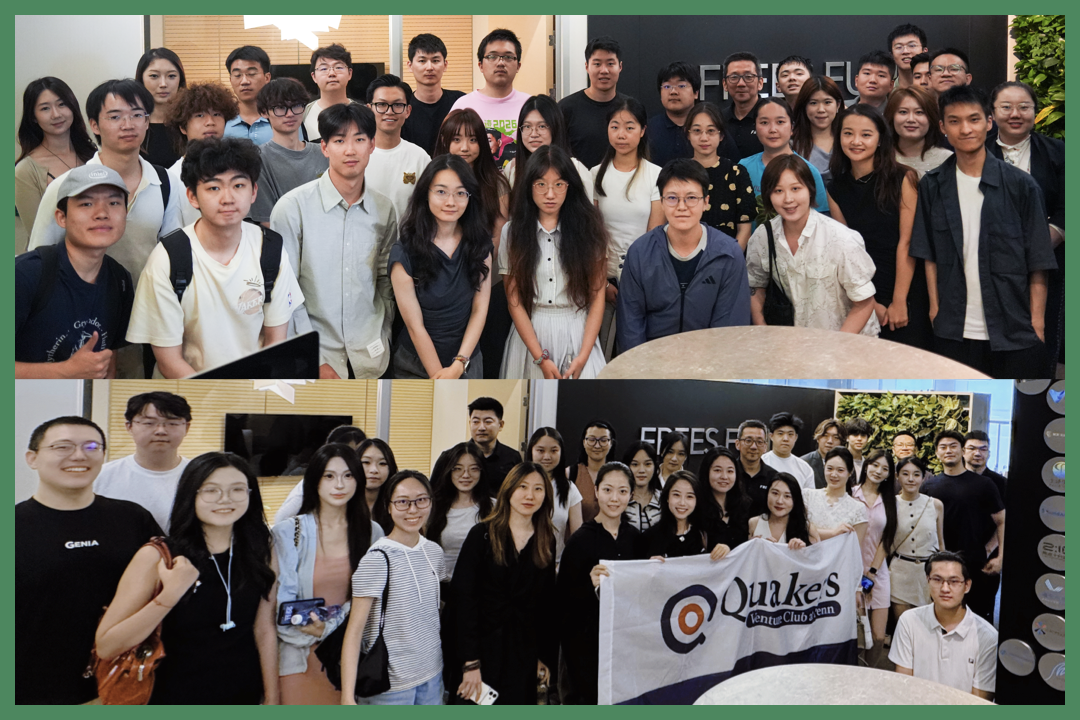

This summer, the Yale University venture club and the University of Pennsylvania venture club each brought a group to visit FreeS Fund. Feng Li and our investment team spent a morning with each of these two groups of young people interested in venture capital.
These exchanges have been going on for a few years now, and we enjoy them. More than half of the founders we've backed have studied or worked overseas, and we want to meet and support more overseas Chinese returning home to start companies, as early as possible.
Each visit follows a simple format: everyone sits in a circle, does a quick round of introductions, and then the conversation begins. The topics range freely — from the macro environment to AI, energy, biotech, going global, and why people decide to start companies in the first place.
Looking at both sessions together, we found that young people based overseas share many of the same questions: Where is technology heading? What opportunities remain in China and the United States respectively? Which industries are worth building a startup in? Where should they place their bets for the future?
We picked some of the most representative questions and, keeping the original Q&A format as much as possible, are sharing them here.

There are no standard answers to these questions. We're simply laying out what we've seen across companies, industries, and cycles, in the hope of offering one way of looking at things.


In early-stage investing, we basically follow the technology cycle downward. When a new technology first emerges, we look for different kinds of zero-to-one opportunities, and what we evaluate is the technology itself. In the second stage, we look for what the technology is most likely to change and where the biggest shifts will happen. Further along, after the bubble deflates, we look for scenarios where the technology is genuinely useful — for who can turn it into real efficiency and commercial value. What you're actually investing in at each stage is not the same thing.
So there's one thing that matters enormously in early-stage investing: identify the change. Have you actually found a truly big change? If it's a small one, it can't support many new companies. There's a saying in investing: you'd rather squat next to a gold mine and casually pick up a couple of nuggets than bend over picking up pennies on the road. Some people also say early-stage investing is all about betting on people — that's 100 percent correct, no argument. But when everyone is betting on people, who makes money mainly comes down to who bets on the right big change. A company's success is roughly 60 to 70 percent determined by market beta, and the remaining 30 to 40 percent by its own alpha: beta determines how large your base for growth is, while alpha determines whether you survive within your category and where you rank. If you start a company in a category with fairly linear growth and intense competition, you might fight with everything you have just to get 1 percent ahead of others — and that 1 percent can easily be erased by big companies with advantages in capital, talent, channels, and supply chains. A startup's opportunity usually comes from a sudden, dramatic shift in an industry: the rules of competition change, past advantages get repriced, and that's when small companies are more likely to find their footing.

The moments truly worth seizing for a startup are often when an industry suddenly turns a corner. Take cars: if the industry had kept developing along the path of the internal combustion engine, it would have been very hard for Chinese companies to catch up with the century of engineering accumulated by BMW and Mercedes-Benz. But once the shift from combustion engines to electric motors happened, the industry turned a corner, the old accumulation mattered much less, and China's capabilities in electric motors, manufacturing, and hardware supply chains could step in — the competitive landscape changed. Phones going from feature phones to smartphones, biopharma moving from small-molecule drugs to large-molecule drugs, and then to gene and cell therapy, AlphaFold, and AI for Science — these are all similar corners. So when evaluating startup opportunities, the most important question isn't "is this industry big enough," but whether it's turning a corner. As long as the corner is big enough, even giants struggle to turn with it, and new companies get their chance. But for investors, seeing the corner isn't enough — there's also a timing problem. We want to be a bit ahead of the market, able to judge what is about to happen rather than only what has already happened. Slightly ahead of time, but not too early — waiting ten or twenty years for the payoff doesn't work either. Translated into investment terms: you should invest before it gets hot, but not just because it isn't hot — you dare to invest because you know why it will get hot later. So most of our investments start by judging where the change is, and then judging roughly when it will happen. If a direction is already hot, it usually means consensus has formed; if absolutely nobody is paying attention, that doesn't automatically make it worth investing in either. The truly hard part is finding, before consensus forms, the change that is already happening but not yet fully priced in. Of course, early-stage investing also has a random element: sometimes a founder is working on something we hadn't reasoned our way to, but if the person is great and the idea is interesting, we're willing to give it a shot.

If you're just looking at the person, it might be a bit different from what some people expect. For us, the most important thing is: why is he doing this. Investors usually see the change first and then go looking for companies; founders are different. They often intuitively sense an opportunity in a field they know well, or they come to believe in a future most people today don't believe in yet, and that's why they decide to do it. They perceive the change through experience rather than deducing it. That's also why the original motivation matters. Following the trend isn't necessarily a bad way to start a company — every wave has its late movers who come out late but are exceptionally good at assembling resources, and they can succeed too. It's just that for investors, trend-followers are harder to pick. What we'd rather see is this: among everyone doing the same thing, he's the one who wants to do it the most — and not because everyone else is doing it. Why does this matter? Because starting a company is fundamentally a long-distance race. Almost everyone who succeeds in the end goes through several periods of utter despair along the way: the company is about to die, there's no way forward in sight, or brutal trade-offs have to be made. If the reason you set out isn't firm enough, it's very easy to compromise at some stage — or just call it quits. Second comes intelligence and fit between ability and the task. People who actually build companies do need to be smart, but they don't need to be the very smartest — top 15 percent is fine, not necessarily top 1 percent. Equally important is whether their abilities match the problem — whether their past training and experience help with what they're doing now. If you've spent your whole career on chips and suddenly switch to drug development, the difficulty is enormous. Third is temperament and judgment. People who get things done neither tune out all advice nor take everything everyone says at face value. They can listen, but they judge for themselves how much to adopt. So in order, I look at three things: why they're starting a company, whether their abilities match the problem, and whether they have an open mind without blindly following. Very often, the big roads truly worth taking are not crowded; it's the side paths that are full of noise and people. Who we're looking for are the people who, based on their own judgment, started walking before the crowd rushed over.

If something is called a bubble, it will burst — no exceptions. But a bursting bubble isn't necessarily a bad thing. While the bubble is still inflated, everyone focuses on the story; after it bursts, people finally focus on applications, on who can actually make money with the technology, on who can genuinely collect revenue from consumers or enterprises. The internet is the classic example. After the bubble burst, looking back, much of the business logic that listed companies talked about at the time — online shopping, digital social networking, online services — did eventually come true. It's just that the companies that made it happen weren't necessarily the ones that created the bubble. Major technologies inherently go through many cycles: during the innovation phase, the market amplifies imagination and creates hype — which is, in effect, rewarding technological innovation; after the bubble bursts, the noise gets filtered out, the market starts looking at who can actually put the technology to use, and that drives the development of applications. So if you believe this round of the AI bubble is nearing its end, the investment logic should change accordingly: invest more in companies that can use AI to land real applications and make money, rather than companies that just keep telling AI stories.

A simple way to judge is to assume that in the future, every token has to be accounted for: whoever creates more value from using a token than the token costs is who can truly afford AI. Large models are not quite like search engines. Behind a search engine is a static database — a query comes in, gets retrieved, and is presented. With a large model, every time you ask something, the question has to go into the model and be computed again to generate an answer. Even if the model is frozen and only doing inference, every interaction requires computation, so every interaction has a cost. On the consumer side, people haven't felt this yet because someone is subsidizing it behind the scenes. Once the subsidies shrink and every token has to be paid for, user behavior will definitely change: today you naturally use AI as a search engine, but if you had to pay for every query, would you still ask it everything? Some of that demand will surely disappear. The key question then becomes: what kinds of needs are worth paying for? Either make the cost of using AI so low that users don't feel it, or make the functional value clearly higher than the token fee. For high-value tasks like finance, where a model can quickly do what would otherwise take you tens of minutes or hours, people are mostly willing to pay. But if it's just completing a very low-value action, even cheap tokens can feel like a burden. In B2B scenarios, I'm more optimistic about a few types of companies where the basic conditions are already in place: they already have accumulated data (a proprietary moat), they already have customers (no need to rebuild an entire sales motion), and they already have digitized business workflows. When AI is added on top of that, it can directly show up as cost reduction or efficiency gains — that's when it actually gets used. Further out, there's another change coming. Over the past few years, everyone has been competing on what foundation models can do, how many parameters they have, and how fast their capability boundaries expand. As the capability gaps between models start to narrow, tokens increasingly resemble standardized cloud services, intelligence itself becomes increasingly commoditized, and what really differentiates players will be who can deliver good-enough intelligence at a lower cost.

We started treating Embodied Artificial Intelligence as an investment theme about three years ago. One important judgment at the time was this: if a new technology happens to require integration with a complex hardware supply chain before it can become a new tech product, China usually has the advantage. Look at past examples: drones require flight control, image transmission, sensors, and precision manufacturing; smart vehicles involve batteries, whole-vehicle manufacturing, millimeter-wave radar, lidar, vision sensors, AI chips, and more. Robotics fits the same logic, which is why we decided to invest: it's the kind of thing China has accumulated strength in, is good at, and has repeatedly proven it can lead globally. As for the American narrative of "robots building robots," you still have to come back to the basics: you need to have robots first. The challenge facing robotics today is not whether you can build a humanoid — it's that many of the control and decision-making problems in real-world deployment haven't been solved. Making a demo is not the same as actually being able to do work. World models, generating high-dimensional data — these all essentially point to the same thing: today's robots are not yet intelligent enough. Suppose the current wave of robotics hype starts to cool. Every company will then have to answer a more practical question: how does my robot make money? Once making money is required, robots must enter real-world scenarios — and only by surviving in commercial settings will the technology enter its next round of iteration. At that point, the focus of competition becomes: who has more applications, more scenarios, more data, and lower costs. Put all these factors together, and China's advantage is clear. In the second half of the Embodied Artificial Intelligence race, competition is no longer just about who builds a robot first — it's about who can get robots into enough real-world scenarios, and use data and cost advantages to keep pushing the technology forward.

New energy is definitely no longer at the zero-to-one stage, but AI has pushed the energy question back to a very important position. When I used to talk about energy, I'd use a framework of "energy sources and energy converters": throughout history, whenever a country gained strong command of a new energy source and a new energy converter, it could transform that country's industrial capacity and international competitiveness. To put it figuratively: the horse is both an energy user and a converter, and it was one of the key tools of the ancient powers of the Eurasian continent; the United Kingdom achieved productivity leadership for a time through coal and the steam engine; and an important stretch of American industrial advantage came from oil and the internal combustion engine. Looking forward from today, there are mainly two paths. One is to keep improving our ability to harness solar energy — including wind, solar, and hydro — where the corresponding converters are electric motors and the power grid. Essentially, it's all about collecting, converting, and using energy more efficiently. The other, longer path is controlled nuclear fusion, which amounts to humanity building its own sun. My judgment is that technological development has an order to it: we probably need to first learn to make better use of the sun before we can become the sun. That's not to say controlled fusion isn't important — it's that the first path likely still has a great deal left to be done.

Let's first look at what competitive capabilities Chinese companies have actually built at home. Over the past period, competition in many industries has been brutal — prices pushed extremely low, profits not necessarily great — but out of that grind came supply chains, product iteration speed, and organizational efficiency. Not making money domestically, forging efficiency through the grind, and then profiting overseas — this may be a starting point for understanding why so many Chinese companies are going global today. Going global roughly splits into two directions. One category is new technologies or mid-to-high-value-add new species that Chinese competition has already produced — things like AI hardware, new energy vehicles, and smart hardware — which have a chance to go straight into developed markets. The other category is traditional products of medium value-add whose core competitiveness comes from extreme supply-chain efficiency; these are better suited to emerging markets at a development stage at or below China's, such as ASEAN or Belt and Road markets. Here's an observation that surprised me a bit. I had assumed that with domestic prices already ground down this far, companies would have to sell even cheaper in lower-purchasing-power Southeast Asia. But feedback from some companies says otherwise — some consumer goods that are utterly ordinary in China are instead seen as branded goods in Southeast Asia. It's a bit like China from 2003 to 2010: back then, many foreign brands sold at a premium over local products in China, and consumers were still willing to "stretch to buy them." Now some Chinese brands in emerging markets are in the same position. So going global can't be approached with blanket questions like "is there a market overseas" or "should we go to Europe and the US or Southeast Asia." The more important question to answer first is: what capability have you actually forged in domestic competition? If it's technology and product innovation, you have a shot at more mature markets; if it's extreme supply-chain efficiency, you'll have an edge in emerging markets.

Let me not answer "should you come back" directly just yet. From the perspective of China-US cross-border investment, the two sides have already been through several phases: the tech war and trade war started roughly in 2017–2018, and the decoupling moved quickly in the early years. More people returned to China in 2021; from the second half of 2022 to early 2024, more chose not to return; and since 2024–2025, the number returning has risen again. But we can't just look at short-term flows of people — we still need to look first at what is happening in technology and industry themselves. Technological development throughout history has roughly gone through three stages: the original innovation cycle, from zero to one; then people start projecting application-side imagination onto it, thinking about what it might ultimately change the most; and finally it gradually becomes ubiquitous, generating massive numbers of applications across industries. Take this round of AI: from late 2022 to early 2025, both the Chinese and American markets were most focused on foundation models — a classic zero-to-one phase. In the application-imagination phase, differences emerged between the two sides. The United States has a high degree of industrial digitization, so it naturally moved toward various kinds of agents — from coding agents to agents across digitalized scenarios. China has a longer manufacturing and hardware supply chain, so large models more readily combine with chips and sensors, hardware, and Embodied Artificial Intelligence. That's not to say the US has no robots or China has no agents — just that the applications most likely to grow out of each side are different. The third stage hasn't truly arrived yet — today, apart from coding and a small number of highly digitized companies, most industries haven't yet put AI into actual production at scale. So where should young people overseas go? It's hard to answer purely in terms of "China or the United States." You still have to look at which stage of the technology cycle the thing you want to do sits in, where the industry is heading next, and in which industrial environment your abilities are more likely to create value.