Why We Remain Bullish on the AI + Hardware + Global Expansion Track

In the cross-border expansion space, there's a fascinating "disconnect" between micro-level intuition and macro-level data.

In the going-global arena, there's a fascinating "disconnect" playing out between micro-level intuition and macro-level data.
Venture capital attention has been almost entirely monopolized by Embodied Artificial Intelligence. AI + hardware is starting to get tagged as "nobody's looking anymore," and globalization itself seems to have been forgotten by the hype cycle.
Yet the macro picture tells a completely different story. According to customs data, China's goods trade exports reached 14.73 trillion yuan in the first half of 2026, up 13.4% year-over-year — marking 11 consecutive quarters of positive growth. What's particularly notable is that AI technology is becoming a significant variable reshaping export structure and beginning to drive growth.
This isn't just about scale. It's about a leap in momentum. As an early-stage fund that has consistently backed going-global ventures, FreeS Fund is seeing new stories and new species emerge in this space — smart fitness equipment replacing traditional iron-pumping, intelligent instruments that let beginners experience the joy of music within minutes, AI pet robots offering personalized companionship and daily interaction, medical devices that apply semiconductor thin-film technology to breath ketone monitoring, 3D Gaussian cameras that can authentically record and reconstruct three-dimensional space...
Recently, Shen Ying, Executive Director at FreeS Fund, sat down with Ebrun Think Tank to share her perspective from the early-stage investing lens on new trends in going-global, the imagination unlocked by AI, the underlying logic of going-global investment, and the profile of next-generation global brands.
We hope this offers fresh angles for thinking. If you're a founder or professional in the consumer hardware space, you're welcome to reach out to the author Shen Ying directly at shenying@freesvc.com.


Ebrun Think Tank: FreeS Fund is one of the few institutions that started betting on going-global very early. How has going-global investment evolved, and what stage are we at now?
Shen Ying: Our earliest going-global investments were over a decade ago — that wave built on China's labor cost and supply chain advantages. Apparel, small commodities, that kind of seller-based model. Back then, Chinese brands barely had presence overseas; it was mostly sellers or Chinese supply chain output.
That phase lasted about five years before leveling up. Large numbers of Chinese engineers and entrepreneurs began leveraging their technical mastery of industries to hunt for opportunities — starting from technology to carve into new verticals. Take action cameras, for example. Thrilling moments in extreme sports are nearly impossible to capture with ordinary cameras. Some teams seized on this less competitive scenario and built brands from there.
Later this kind of innovation blossomed everywhere: from sports and outdoor fitness to pets, smart music, and then heavier sectors like medical devices. The overarching trend has been toward deeper technical moats and directions that demand more consumer trust.
In recent years, we've deployed more heavily in technology-driven going-global projects — smart hardware, consumer healthcare. Teams driven by technological innovation to go global are a key focus for our current investment.
Our conviction is that going-global is an irreversible trend. It's not measured in decades — it's an extremely long-term process that will continue for decades to come. The globalization of Chinese brands is going to be a spectacular journey.


Ebrun Think Tank: What stages do you primarily invest in for going-global, and what do you look for in projects?
Shen Ying: We concentrate on angel through Series A — the startup stage.
First priority is always the people: the quality and accumulated experience of the founder and core team, plus how well the nature of the vertical fits with going-global. On top of that, we look at product, technology, and overall market trends.
We often talk internally about timing — investing in the right thing at the right time. Ten years ago, apparel and small commodities was the right bet. Now you probably need to bet on new categories. Even if it's the same category, what you invest in might be completely different.
On team background, we want teams that definitely possess technical moats, while ideally also having capabilities in areas like marketing. We lean more toward tech + product, because there's still distance from technology to product — both need to be present.
Ebrun Think Tank: Do you focus on specific sub-verticals? Do you have requirements on market size?
Shen Ying: We care more about the ability to build unique moats and create value in a specific domain, rather than purely chasing absolute market scale. Of course, it can't be too small or too niche — like serving only a certain age group's extremely narrow demand, where the ceiling might be limited. But we don't treat large markets as a hard prerequisite. The scale of autos or smartphones isn't mandatory.
Some mid-sized or even smaller niche directions, including zero-to-one new categories, we consider solid investment opportunities. Take Shokz's bone conduction headphones — ten years ago the category was tiny. Insta360's action cameras, DJI's drones — these all created new categories from scratch. That's what we love most.
Even in the most niche vertical, add up the global market and it usually exceeds our internal threshold. So we look more at incrementality rather than defining the future by current market size.

Ebrun Think Tank: You mentioned FreeS has deployed in more technology-driven projects. What specific technologies?
Shen Ying: A few examples. One is the smart fitness brand Speediance. Strength training is an ancient industry — traditionally it relies on iron plates to generate physical weight. The Speediance team replaced iron plates with motors, iterating on the traditional approach to strength fitness, achieving digitization, and now layering on AI.
Another is a smart instrument vertical we've backed, using intelligent technology to reconstruct guitars and drum kits. Traditional instruments produce sound through resonance chambers. They reengineered the entire foundation — sensors plus underlying technology generate the music. It's essentially redesigning the guitar from the inside out. Even someone who can't play at all can pick up a guitar and play a song within minutes, dramatically lowering the barrier to learning instruments.
Recently we also invested in a consumer healthcare project applying semiconductor thin-film technology to medical monitoring. Take breath ketone detection — ketones exist in blood, urine, and breath. Previously you needed blood or urine tests, which had high barriers and were inconvenient. Now, through a simple breath blow, you can get results approaching the gold standard of blood testing, tracking your fat-burning efficiency anytime.
Ebrun Think Tank: Are there more general technology iteration opportunities?
Shen Ying: Take the entire auto industry — from motors to LiDAR, sensors, to intelligent driving systems. Such a massive industry drives a series of supply chain upgrades across society. The iteration of its motors, sensors, LiDAR and other technologies spills over into other domains, like the smartification of home appliances.
A few of the largest industries in consumer — their industrial iterations often produce enormous uplift for the entire consumer landscape. So we look at which consumer micro-scenarios these technologies can be applied to.
Ebrun Think Tank: Many institutions now expect profits even for early-stage projects. Do you focus heavily on revenue/profit metrics and exit pathways?
Shen Ying: For early stage, we generally don't require companies to prove themselves on revenue or profit dimensions — that's a post-investment expectation, not a pre-investment criterion. But generating revenue and profit early is a significant plus.
We look at whether a project is ultimately a business-type opportunity or a venture-type opportunity. We definitely want to invest in venture-type opportunities — ones that need substantial imaginative exit space.
If a vertical can form a leading brand and grow rapidly, that's a venture-type opportunity. If the vertical itself is decentralized and fragmented, forming small fiefdoms, it leans more business-type.

Ebrun Think Tank: What buzzwords and going-global hot spots have you been hearing in the capital markets this year?
Shen Ying: Mainly AI, then Embodied Artificial Intelligence, world models, and further out — quantum, commercial aerospace, and so on.
On the going-global front, one hot spot is the maker economy. 3D printing, laser engraving, plus Tufting and various maker directions are all buzzing. Another is fitness — cardio, strength training, HYROX is also huge this year. Overall, going-global has become an all-encompassing mega-direction. It's no longer concentrated in a few verticals like before, but blooming everywhere and thriving.
Ebrun Think Tank: In your view, what kind of companies have the potential to become next-generation global brands? What key hurdles must they clear?
Shen Ying: Chinese going-global companies are already very strong — GMV and sales growth is explosive, some going from zero to billions in just a few years. But frankly, on the brand dimension, they're still very young. Compared to European and American brands with decades or centuries of history, they're still in very early days.
There's no shortcut to brand building — it still requires time to accumulate. Brands that truly befriend time, accompany consumers over the long run, and continuously create value can earn recognition globally. Only after surviving long enough and crossing multiple cycles can you say you've proven brand capability.
Ebrun Think Tank: How do you see AI changing Chinese companies' going-global efforts? Which AI + going-global intersection areas deserve focused attention?
Shen Ying: AI has already become an essential productivity tool and infrastructure. Whether it's organizational management, market research, marketing and ad placement, or customer service — everyone's using AI. Previously it was hardware plus software; now every software layer needs an AI overlay, collecting data to build vertical models, then forming AI Agent services.
AI will definitely become table stakes eventually. But from the perspective of new entry points and new ecosystems, the truly disruptive opportunity hasn't arrived yet. Becoming a genuine new entry point requires hardware plus AI technology to form a deep moat, and the technology is still evolving at breakneck speed. As hardware collects increasing data across large verticals, AI capabilities will improve rapidly. Every vertical in consumer goods is a data entry point. More data plus AI integration will create enormous value.
Ebrun Think Tank: Going-global faces a complex international environment — geopolitics, legal systems, data sovereignty, cultural differences, and multiple variables. In your decision-making, what risk indicators do you focus on?
Shen Ying: With the world situation so volatile, we're more cautious about projects targeting single developing-country markets. Many developing countries face challenges around political stability and financial system risk exposure — we weigh these heavily.
Against this backdrop, founders choosing multi-region, multi-country deployment to diversify risk is a reasonable approach. Compared to developing countries and regions, developed markets like Europe and the US have relatively better institutional frameworks and safety. Being focused on just Europe or just the US as a single market is usually not a major concern.

FreeS Fund has long been deeply rooted in the going-global space, and continues to be bullish on the structural value investment opportunities of Chinese brands in global markets. We firmly believe that "going-global is an extremely long-term process that will continue for decades to come."
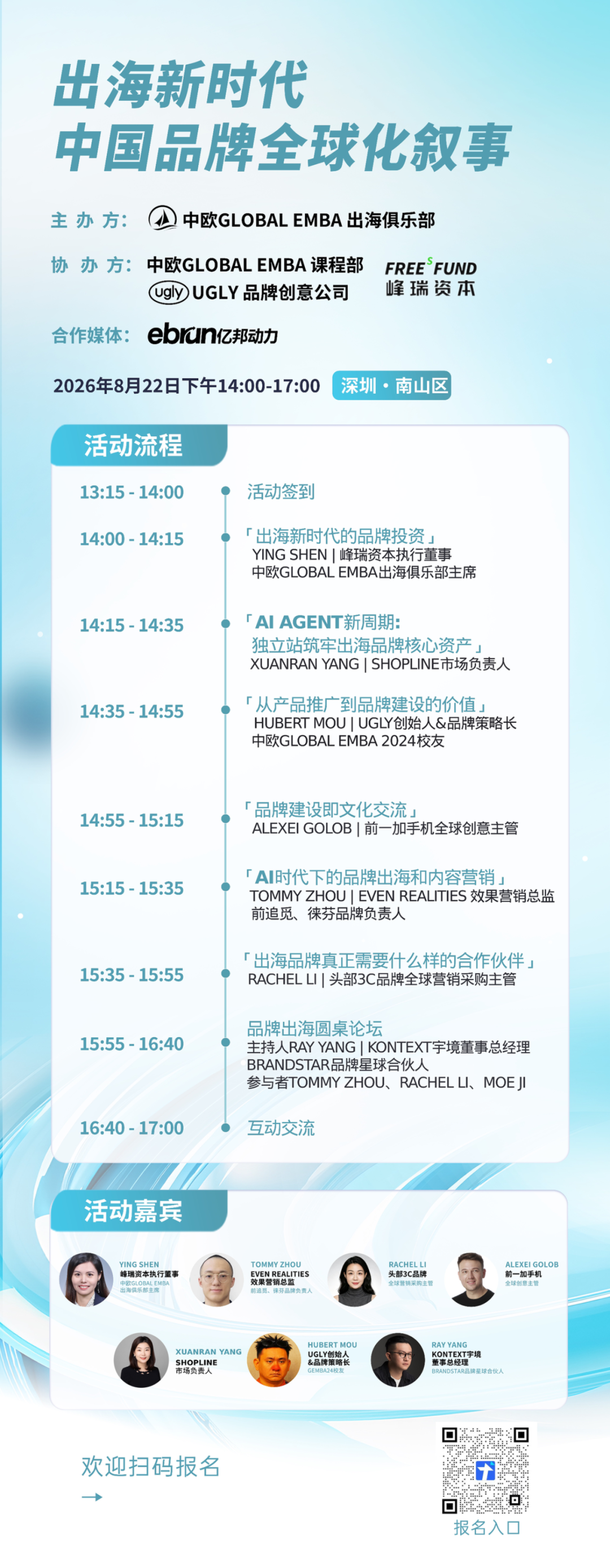
On the afternoon of August 22, FreeS Fund, as a co-organizer, will join with the CEIBS GLOBAL EMBA Going-Global Club to host an offline event in Nanshan, Shenzhen focused on "The Narrative of Chinese Brands Going Global." That afternoon, FreeS Fund Executive Director Shen Ying will deliver a keynote on "Brand Investment in the New Era of Going-Global." We sincerely invite friends following the going-global track to gather in Shenzhen for in-person exchange.