ByteDance Proves with Coze: Agents Can Only Be Engineered

An AI Development Platform Can't Go B2C

"Agents Can't Be UGC"
"The most important thing about being online isn't learning—it's having fun ❤️
My fellow AI entrepreneurs have been running low on material lately. In light of this, I'm launching the Big Brain series: strategic takedowns of Agent platforms, from the boss's perspective.
Our motto: Everyone becomes Xing Wang, we all get to be Yiming."
Folks, today we continue playing the long game.
It's 2023. I'm Yiming Zhang. The big AI models have arrived; the big AI applications haven't. Nobody knows what to do.
Question: What should ByteDance do?
One answer is Coze—a low-code development platform. Start by giving away free model APIs, add convenient distribution channels, and see what the masses can cobble together.
A year later, the experiment has reached its conclusion.
My hot take: Coze's pivot from Coze to Coze Space, and then its open-source turn, proves one thing: Agents cannot be UGC, only PGC. AI applications require professional developers. Regular users can build toys at best, not real products.
Coze initially wanted to be a 2C platform, hoping ordinary users could build workflows and agents by dragging and dropping components without writing code.
A year on, no application on Coze has surpassed Miaoya Camera. This means the ceiling for apps produced on the Coze platform sits below Miaoya Camera.
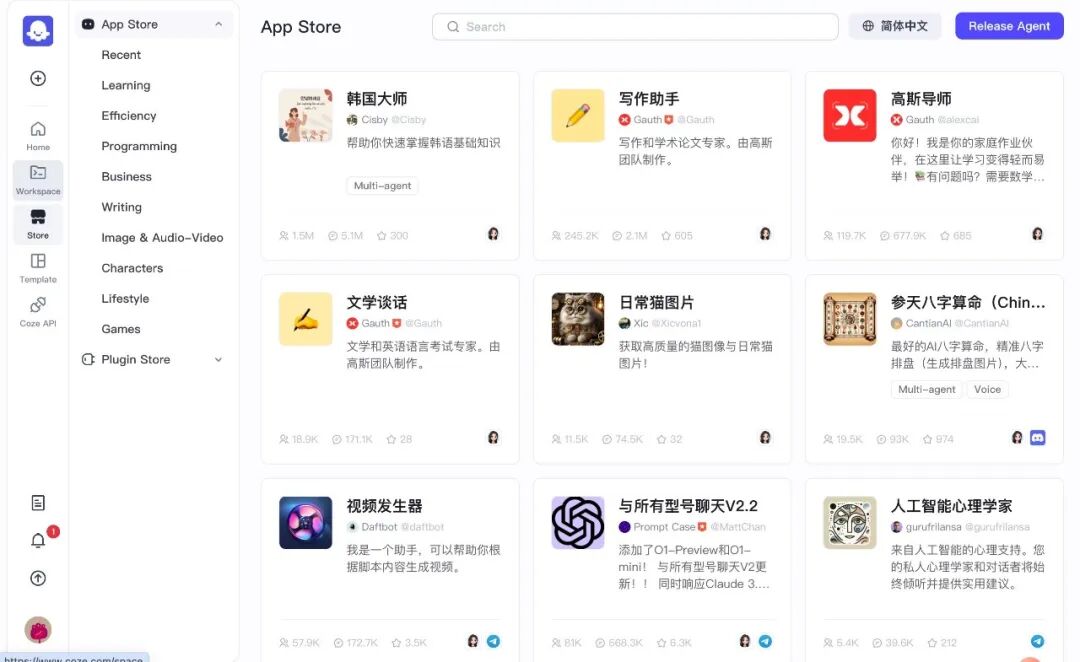
This makes sense. Even the Miaoya Camera team hasn't produced another product that turns heads. It's entirely reasonable that ordinary users, lacking product definition skills, can't build good consumer products.
Moreover, low-code platforms have a core problem: building workflows is incredibly complex and tedious.
Sure, you don't write code. But you have to choose from various plugins, test whether each node runs properly, and write prompts for each node and the overall framework.
I've built several workflows on both Coze and Dify, and I can only make very simple things. Anything slightly complex runs into all sorts of issues.
To actually master a low-code platform, you still need to learn—and the learning curve isn't low.
But the game has changed.
When Coze launched in early 2024, Vibe Coding wasn't yet a thing. Now, AI coding tools like Cursor and Claude Code have replaced the development function of low-code platforms.
As someone without a technical background, I can actually get a demo running with Claude Code. That's a completely different experience from low-code platforms.
My ideas get directly translated into code. Vibe Coding is me talking, AI doing. Low-code platforms require me to first figure out which components to use, then assemble them myself.
Vibe Coding has fundamentally changed the value proposition of low-code platforms.
Their value is no longer enabling ordinary people to build products—it's providing engineering capabilities.
Vibe Coding makes it easy to whip up demos, but you end up with unmaintainable spaghetti code. Low-code platforms make app development complex, but their engineering is stable. A developer can first Vibe Code a demo, then use the stable, rich components of a low-code platform to turn it into a reliably running application. So low-code platforms simply cannot be To C. They can only be To B, targeting developers and small teams.
But what professional developers care about is open-source ecosystem. And Coze lags here.
Dify went open-source from its 2023 launch; n8n open-sourced even earlier. Coze only recently open-sourced. The ecosystem gap formed in between has become a moat for Dify and n8n.
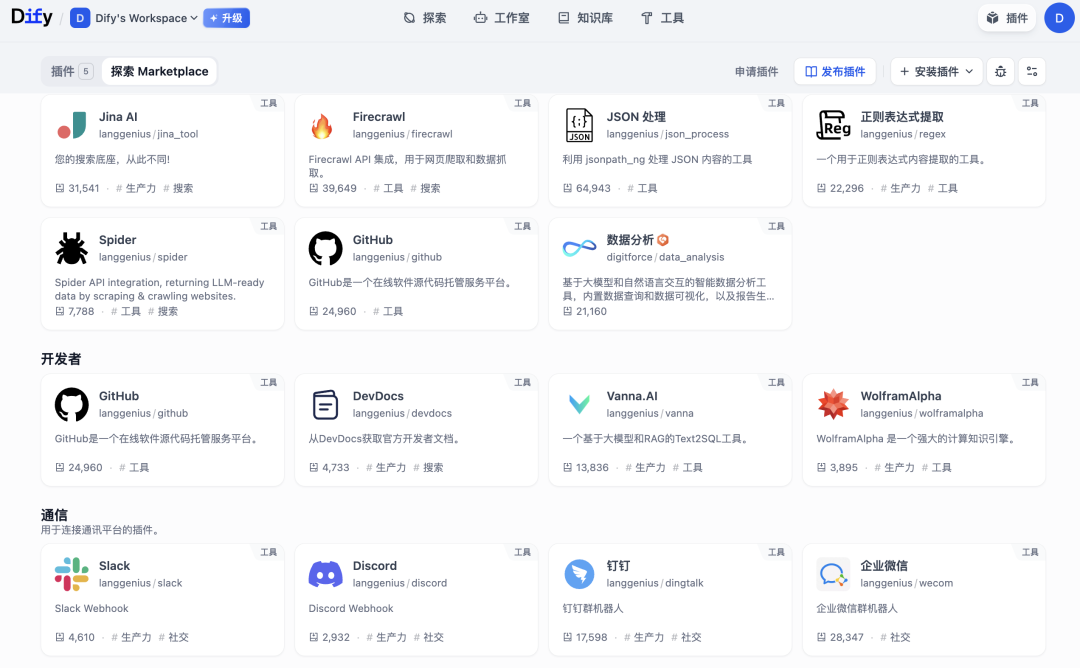
Dify's richer plugin ecosystem means developers waste less time reinventing the wheel
The professional developers I follow who build custom agents for enterprises basically all use Dify and n8n. I asked one guy why, and he sent me a group chat screenshot: building a trending-topic analysis workflow on Coze goes for 350 RMB. On n8n, a video workflow typically fetches 5,000 RMB. That says it all, friends 😭 Barrier to entry is a user selection problem. Coze's previously low barrier and closed ecosystem attracted consumer-side users like college students, not professional developers. The result is a race to the bottom on pricing, which makes professional developers even less likely to come earn money on the platform.
Coze is a product that's behind the curve. But ByteDance is not a company behind the curve (Baidu 🤓💦).
So we see two things.
First, in April this year, the Coze team launched the general-purpose agent product Coze Space.
Second, the Coze team was moved under Volcano Engine, and then in July open-sourced the core component Coze Studio.
This is a very clear signal: Coze cannot be To C anymore; it must be To B.
The To C business goes to Coze Space. Since ordinary users can't develop good enough products on Coze, the team will set the example itself.
But how is Coze Space doing?
Coze Space does have innovations—for instance, its AI podcast voices are remarkably realistic. But beyond that, on the core product, it's a follower. My experience using Manus and Coze Space feels identical.
I don't have that many needs. My search needs are handled by ChatGPT; my demo-building needs are handled by Claude Code. I really don't have needs that would get me to use another general-purpose agent.
That said, Manus is still innovating. It recently added email interaction functionality. You can directly email Manus with tasks, and it emails results back.
You can see Manus is trying to solve the biggest problem with general-purpose agents: users staring at an isolated search box with no idea what to do.
But I receive many emails every day. Now, I can CC Manus on newsletters and work emails and have it handle them for me.
Is this the kind of innovation that comes more naturally to startup teams?
Startup teams can sustain innovation. Even a powerhouse like ByteDance, as a follower, can only catch up on engineering and operational capabilities.
From Coze to Coze Space, ByteDance's logic shift is starkly clear.
Agents are something that cannot be UGC. They should be produced by small teams or professional developers at minimum.
So there are two paths for building AI applications.
One: do it yourself. Build a good product, surpass Manus, take down the Singaporean 😭
Two: build a platform, but not for C-end users—for small B and professional developers. But Dify and n8n already occupy this position, and open-source ecosystem is a long-term moat.
Is there a third possibility: ditch the development part entirely and just be an Agent distribution platform?
I don't need a bunch of C-end users messing around on my platform. I'll raise the barrier further and only accept qualified professional teams' agent products. The platform handles distribution, compute, cloud PCs, and other infrastructure.
Excellent—that's the logic behind MuleRun, backed by Alibaba Cloud.
As the poem goes:
Deft hands toil at a thousand intricate knots, The great way reopens for ten thousand steeds.
See you next episode: Burying AI.
(Images in this article generated by ChatGPT, writing assisted by Gemini 2.5 Pro.)