Agents Are Taobao and WeChat's Opportunity, Not Startups'

An agent is just a tool — it lacks connection.

"Agent Not Connected"
A lot of people look down on the chat box, seeing it as a played-out, outdated interaction pattern.
But I'm different. I'm a Sichuan native. The virtue of us country folk is pragmatism — we don't waste time on theory, we just use what works.
The problem with current Agent products is that their infinite canvases, whiteboards, and editors are too niche. The vast majority of users can only handle one input field. I type my request, you give me results. That's enough.
This very simple principle means the Agent opportunity doesn't belong to startups trying to invent new interactions. It belongs to mature apps like Taobao and WeChat that already have an input field.
What the frontend shows users is just a simple search box. All the complex technology — decomposing requests, calling up memory — should happen in the backend. You can stack multiple agents back there, but users only need one search box.
Taobao's recently launched AI search box is exactly this idea. The thinking is right, but the execution is still rough.
In the Taobao search interface, you can switch to "AI Universal Search." Ask a question, and it generates a long-winded response just like any chain-of-thought model. The only difference is that certain keywords in the answer are linked to product pages via RAG.
For example, I voice-input: "I want to buy shoes, retro-style sneakers, not too thick a sole, overall clean and simple."
The AI generates a lengthy response that takes five screen scrolls to get through. It highlights three sneaker recommendations. Click each subheading, and a search interface for that subheading pops up. Below each subheading, there's also "View more products" — also a search interface.
This approach does zero optimization for the shopping scenario. Users still have to read through a long response; the choice burden hasn't really decreased.
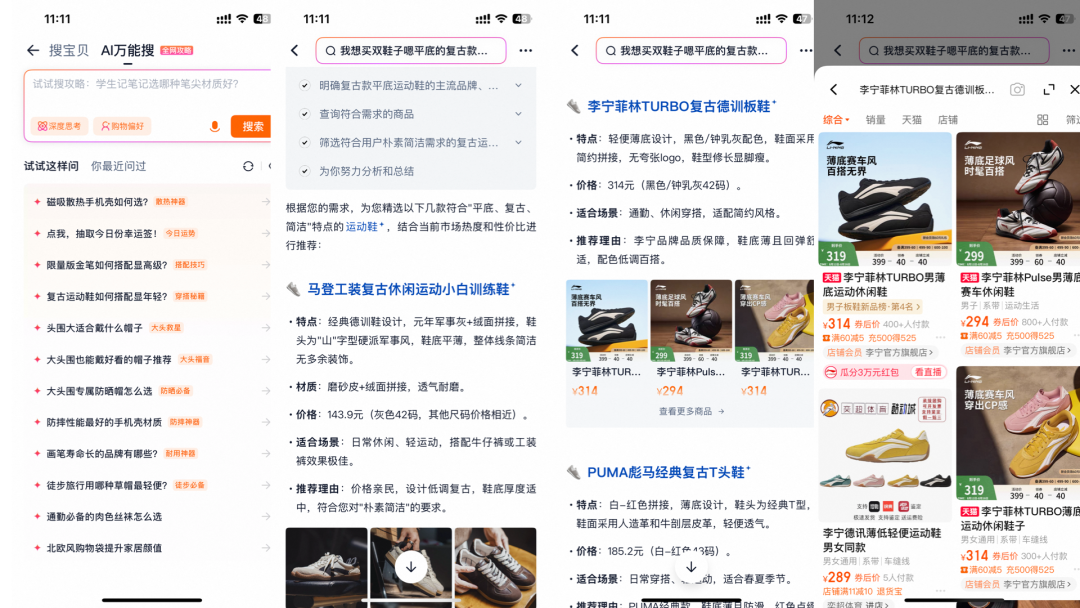
Using AI to match information more precisely — this thinking is correct. Taobao's AI search can also pull my shopping preferences, and the sneakers it ultimately recommended were indeed in a style I like.
But Taobao's AI-generated recommendations are too long.
When AI recommendations get too long, they defeat the purpose of AI recommendations. Faced with a sea of products, users need precise recommendations, not more information.
The cause isn't hard to guess. Indecision.
Stick with the traditional approach, where users infinitely scroll through a two-column product feed? Or have AI give a concise answer recommending just two or three results?
It's an either-or relationship. If users get precise results through AI and place orders directly, they won't go back to scrolling the feed. This directly undermines the current e-commerce model.
It's normal that Taobao is temporarily torn. But the super-box approach is definitely correct.
I'm increasingly convinced that Agent is an opportunity for giants, not startups.
The essence of Agent is component, not entry point. Standalone Agent products can only create demand; they can't solve users' existing demand, and they can't retain users.
Users need a super-box that more accurately solves their needs, not several standalone Agent tools.
To put it more fundamentally, Agent is a technical concept — it's large model + prompt and function calling.
Real platform-level apps provide relationships, connections. Search engines connect you to information, Douyin connects you to short video feeds, WeChat connects you to friends' messages.
Standalone Agent products are just tools with no connection. They can deliver you a pile of half-baked 4399 mini-games, or a crude Meitu-style photo editor. But they don't connect people to anything valuable and continuous.
Of course, the Vibe Coding community wants to do connection. Their story is that users will use AI to create massive amounts of frontend work, and the community becomes the connection platform for these works. The problem is, the vast majority of people have no such need. Frontends generated by large model fitting are nowhere near as entertaining as real-shot videos of Northeastern influencer Yu Jie.
So Agent products can't tell a platform-level entry point story. Agent is a component; its value lies in integration into super platforms.
My most-used AI product is Toki, a schedule management tool. You can send voice memos, or directly send screenshots of WeChat chats about making plans, and it automatically recognizes and sets calendar reminders.
But this is obviously something WeChat could do. WeChat adding a Toki-like Agent that automatically sets calendar reminders based on chat messages — no need to cross apps at all.
Quark follows this approach, specifically training a health vertical model. But the user interaction doesn't change at all. When users input health and medical questions, the super-box simply dispatches the vertical model to answer.
However complex the backend technical architecture, however many sub-agents — users don't care. What users need is a simple input field and a more accurate result.
Standalone Agent products only have two paths: become a sub-Agent of a platform, or abandon platform fantasies and build a tool that can make money.
For mature platform-level apps, on the other hand, Agent can bring more imagination.
Startup life is brutal 😭
(Article illustrations generated by ChatGPT o3, with writing assistance from Gemini 2.5 Pro.)