Quark Built a Health-Focused LLM Using an Agent-Based Approach

Data-Technology-Product: A Closed-Loop Product Mindset

"Data–Technology–Product Closed Loop"
The product that's impressed me most lately is Quark's health-focused large language model.
We've all heard the vertical LLM pitch ad nauseam — base model plus knowledge base. But how do you push further, getting the model to learn how professionals actually think and produce more accurate outputs?
Quark's solution gave me a lot to think about.
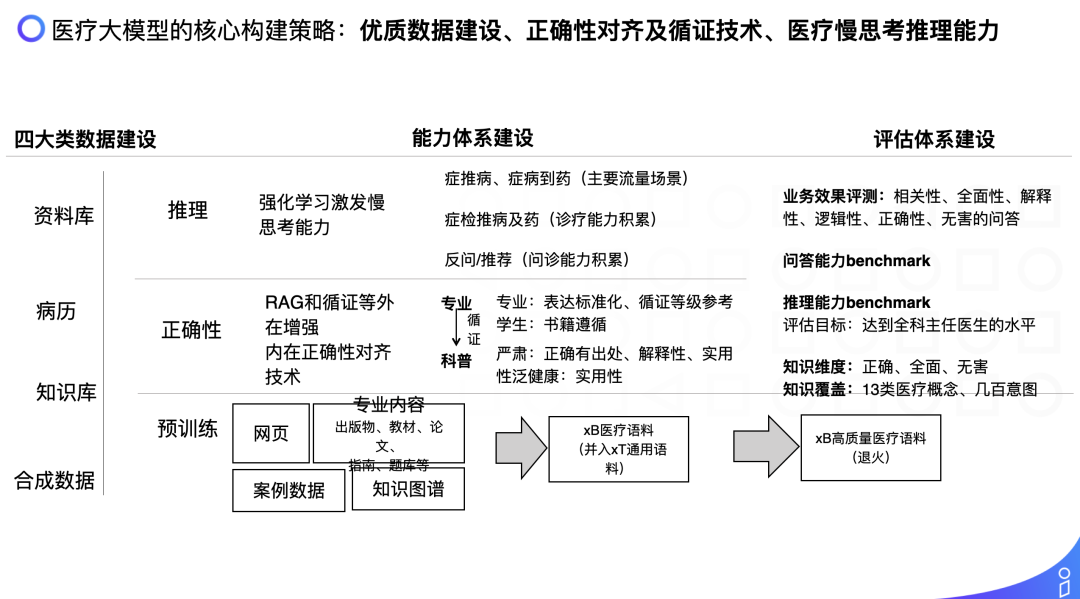
Quark's approach is to have the model directly generate chains of thought that mirror how doctors think.
During post-training, they fed the model massive amounts of data containing doctors' complete reasoning processes, so that its chain of thought naturally aligns with clinical thinking.
This is what Quark calls "slow thinking" for its health model. The AI analyzes step by step, makes a preliminary diagnosis, conducts differential diagnosis, and synthesizes a conclusion — rather than spotting a symptom keyword and immediately fitting it to the most correlated disease.
The exam results speak for themselves: this month, the Quark Health Model passed attending physician-level written tests across 12 core medical disciplines. On pure diagnostic tasks, Quark is now on par with senior attending physicians.
Quark's technical philosophy is to train AI to think like a doctor, not merely to know medical facts.
At the foundation of this approach lies bespoke medical data.
Specifically, Quark curated thousands of cold-start data samples containing doctors' reasoning processes. Each sample includes not just patient symptoms and diagnosis, but crucially, a detailed record of how the doctor analyzed, ruled out alternatives, and arrived at the conclusion step by step.
The data Quark feeds its model is essentially doctors' chains of thought.
So when Quark uses this data during post-training, what the model learns shifts fundamentally.
It's no longer learning isolated knowledge points, but the complete reasoning path of a real doctor facing a complex case — from analyzing medical history, to preliminary diagnosis, to differential diagnosis.
The current version of the Quark Health Model runs on Qwen 2.5. Qwen 2.5 itself isn't a slow-thinking reasoning model built for inference. Yet by training it with data of doctors' thinking to generate chains of thought, Quark created the model's "slow thinking" reasoning capability. This approach to building vertical models genuinely impressed me.
During actual user queries — the model inference process — Quark also replicates doctor thinking.
Quark built an "evidence-based medicine" knowledge base, organizing vast amounts of medical texts, papers, and clinical guidelines into four tiers (A, B, C, D) ranked by reliability of evidence.
Quark calls this process "thinking while searching." The model looks up literature at the appropriate evidence tier to support its judgments as needed.
So every answer users see is backed by authoritative original sources. This minimizes hallucination and makes results trustworthy and traceable.
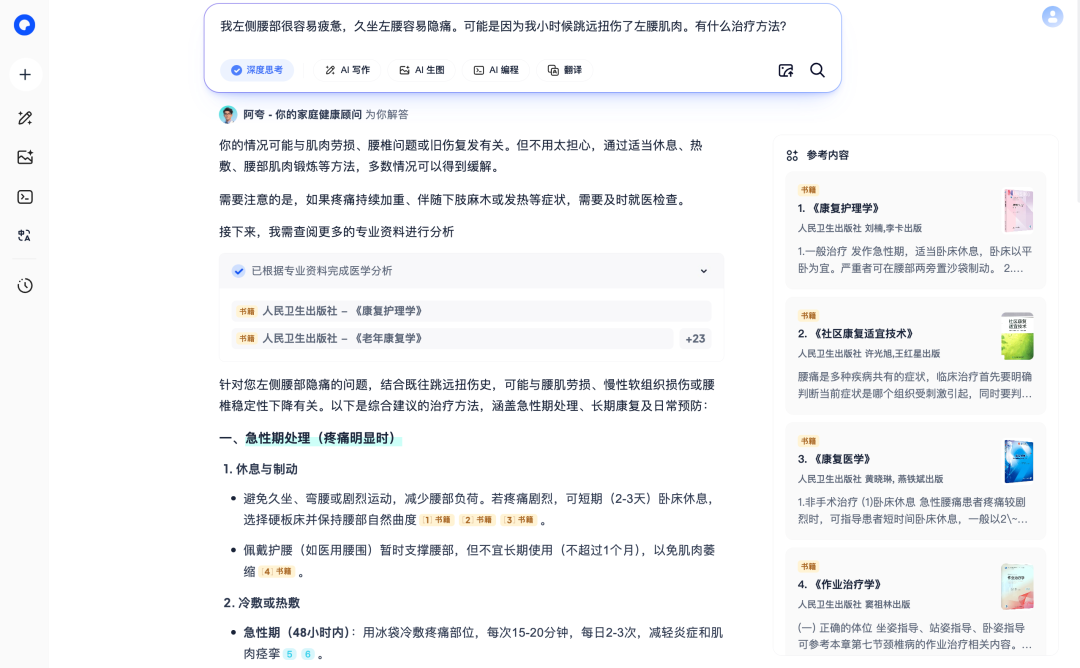
After listening to the Quark health algorithm and operations leads, I couldn't help asking: what is Quark Health's core competency, really?
I think one piece is data capability. Quark built a massive in-house data production pipeline. An internal team of professional physicians directs the operation, steering 400+ experts at associate chief physician level or above from tertiary hospitals for review. They've produced structured real-case data and complex task data containing doctors' reasoning processes.
Quark's medical knowledge base spans 60,000 textbooks and guidelines, tens of millions of Chinese and English-language papers, and over 200,000 drug labels.
This level of investment and tightly coordinated engineering is genuinely a moat that only a major tech company can build — hard for others to replicate.
Quark's most core capability, I believe, is product craft.
Quark's product architecture actually resembles today's popular Agent products — a main Agent handles orchestration and general tasks, with multiple domain-specific sub-Agents below for particular jobs.
The Quark Health Model serves as a "sub-Agent" for Quark's "Super Box."
Though Quark doesn't use this terminology itself, this vertical model has undergone SFT and reinforcement learning, and excels at tool calling — clearly more Agent-like than most products on the market calling themselves Agents.
The search box is a "main Agent," the universal entry point for all tasks. When it determines a query falls in the health domain, it invokes the health model "sub-Agent" to handle it.
This "sub-Agent" possesses complete chain-of-thought and tool-calling capabilities. It independently executes complex reasoning tasks and returns accurate results to the user.
A remarkably elegant closed loop of technology and product.
Quark's numbers: 20 million users search for health topics on Quark monthly, and half of all medical students in China use Quark to look up materials and prepare for exams.
The Quark Health Model sidesteps the previous generation of internet healthcare's trap — heavy operations, hard to monetize — by staying out of diagnosis and treatment entirely, only providing more professional, accurate search information.
What struck me most throughout this research is how seamlessly Quark connects the three links of data, technology, and product.
Take any single point in isolation and it's not that dazzling. Post-training on an open-source model — plenty of people do that. RAG calling a knowledge base — nothing new.
But stitching these pieces together into a tightly closed product experience — that's Quark's real core competency.
No ads. No near-term commercialization pressure. No distortion from chasing revenue. That's rare discipline for an app with hundreds of millions in monthly active users, and it enables pure product focus.
At its core, the Quark Health Model is a story of using new technology (large models / chain-of-thought reasoning) and grunt work (high-quality data) to re-solve an old problem.
That old problem is information asymmetry in healthcare and chaotic search results.
Now, in the AI era, Quark is retelling this story with a unified product philosophy of "data-technology-product" as one.