An Objective Look at the Agent Battle Between ByteDance, Alibaba, and Tencent

Sis Dou killed your little Dou-shark.
 "Sister Dou Is Going to Dou-Murder You All"
The big-tech Agent war has officially begun, and there have been plenty of landmark moments.
Doubao Work is giving away free memberships, Qwen Office is busy signing enterprise clients, and WorkBuddy just held an ecosystem conference, onboarding a pile of partners and hardware in an attempt to close the loop on user context.
There's no point looking at any user data, because the match has just started, the main players haven't gone all-out yet, and who's leading or lagging is meaningless.
The classic case is Baidu. ERNIE Bot and Baidu's "Dazi" both declared themselves in the lead the moment the season began, but the results always prove that Baidu is roadside scenery.
Another example is Doubao Work. It's only been out a week, so its numbers are obviously worse than the other two — but clearly, nobody dares underestimate Sister Dou.
Today we're just playing 4D chess and shooting the breeze.
First, you have to recognize the importance of the Agent war.
There is no "office Agent," only the general-purpose Agent. Everyone is just entering through office scenarios to popularize Agents.
What big tech is doing is still the classic, muscle-memory scramble for the AI gateway. A year ago, everyone thought the gateway was the chatbot; now the consensus has shifted to the gateway being the Agent, and the specific entry point is office work.
The logic is simple. The moment you saw Claude Code last year, you should have realized that coding Agents will devour everything, and every other productivity product was off playing in the mud.
But CLI isn't for normal humans. It has to be wrapped in a shell. It has to be GUI.
So the 2026 version of the answer is: Codex devours everything. The convenient, easy-to-use Agent with good interaction and good connectors devours everything.
The B-side and C-side of Agents are one war, not two. And there's no such thing as "Agents being decided on the B-side." Because 2C and 2B are just means — the goal is getting more people to use Agents.
Long term, consumer and enterprise are definitely one and the same. Unification means every person and every organization using this Agent product. I want command of all the armies under heaven! I want everyone using Doubao / Qwen / WorkBuddy!
Enough 4D chess — back to the actual competition.
In the three-way BAT melee, ByteDance is currently in the best position.
The reason is simple: ByteDance stopped horse-racing. With one wave of Yiming Zhang's mighty hand, Lark, Trae, Coze — no matter how well you were doing before — all had to submit to business strategy and were reassigned to Sister Dou as infrastructure.
Once the boss makes up his mind, ByteDance's organizational efficiency is terrifying. In just over a week, the Doubao Work client was built, basically integrated with the Doubao app, and callable inside Lark.
Look at the other two. Tencent is a mountain of rival fiefdoms, so it's perfectly natural that WorkBuddy can't directly integrate with WeChat. But Qwen Office going a whole month without integrating with the Qwen app? That's genuinely bizarre.
And Sister Dou hasn't even gone full throttle yet. Once ByteDance's far-ahead-of-everyone operational efficiency kicks in, it's hard to imagine how the other two fight back.

Now, Alibaba's Qwen Office.
The Qwen app not being integrated with Qwen Office is the smallest of Alibaba's organizational problems. The bigger problem is that Qoder is somehow still operating independently — it just shipped a major update, turned itself into an Agent-form product, and is now nearly indistinguishable from Qwen Office.
The sky cannot have two suns; the people cannot have two masters. Is Qwen Office Alibaba's one and only moon? Is Alibaba going all-in on Qwen Office, or all-in on Qoder? This is a question that factually cannot be answered.
Credit where due. Qwen Office is well made, the interface is clean, and even a low-IQ user like me can figure it out at a glance. It also enjoys the model dividend — Qwen 3.8 Max is a first-tier domestic model, with no flaws besides being slow.
In pursuit of speed and cost efficiency, Qwen Office even customized Qwen 3.8 Flash with the model team. It's more than enough for my daily work, at a fraction of the latency of Qwen 3.8 Max.
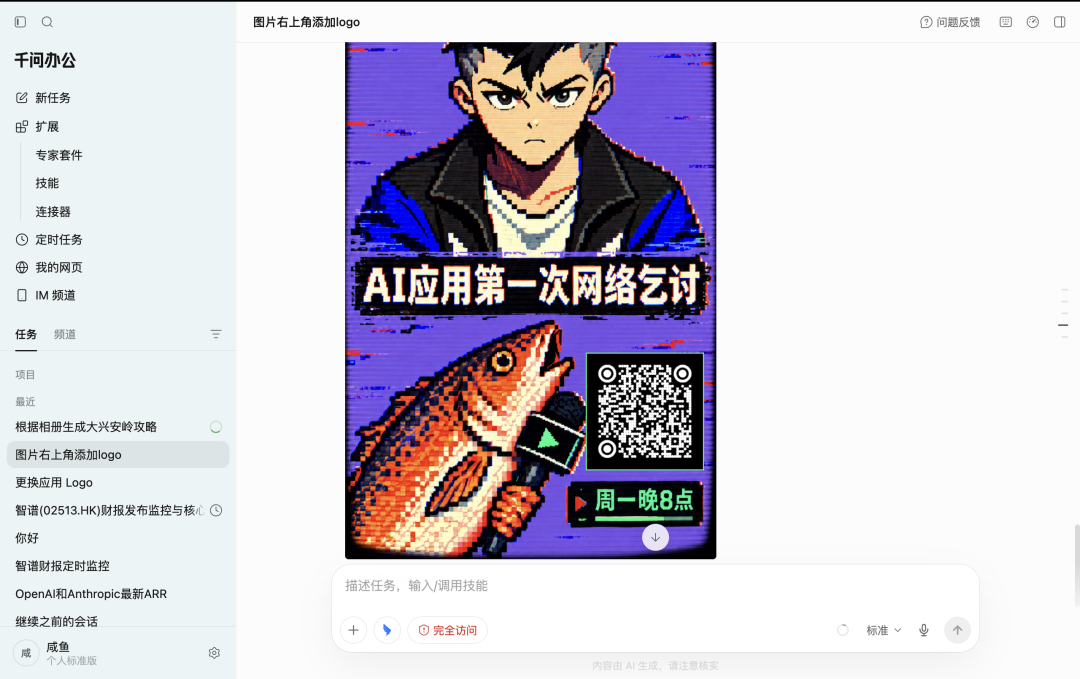
Scan the QR code to reserve tonight's livestream
But still — the classic Alibaba organizational problem.
They said it was a three-in-one: DingTalk, QoderWork, and Mulerun merging into Qwen Office. What we got instead was one-into-three: Qwen Office, Qoder, and the Qwen app desktop version.
Let's reason this out, using our brains just a little. Doubao Work has hundreds of millions of existing Doubao app and Lark users ready to convert. Qwen Office, meanwhile, is simultaneously being drained by Qoder and the Qwen app client.
ByteDance's operational efficiency is still universally acknowledged as number one. So given the current situation, there's no reason Qwen Office won't be rapidly overtaken by Doubao Work.
Sister Dou's high-speed train is barreling into office Agents.
To put it brutally, Qoder is a dead man walking. When it gets merged into Qwen Office depends entirely on when the boss makes up his mind.
Qoder, like Lark, Trae, and Coze, did nothing wrong. They simply weren't chosen by the organization to lead the Agent war.
This has nothing to do with team effort. Over the past few months, Trae and Coze shipped tons of updates, and their product form kept pace with the Agent race's major version.
Chances are, Coze's boss Xiao Qiao and Trae's boss Shi Yang realized their teams' fate three or four months ago. It's a positioning problem — the organization chose Sister Dou over the other innovation products.
On the Alibaba side, Qoder is still updating its official WeChat account daily — more frequently than a bunch of AI self-media accounts — running events nonstop, desperately proving itself. It hurts to watch. Better a quick end than drawn-out pain — merge it already and set the students free.
Of course, ByteDance's problems are also obvious.
Sister Dou's entertainment brand association is too strong. To stop users from associating the product with drooling and "I'll catch you steadily," Doubao Work deliberately adopted a bland Möbius-strip logo, trying to draw a line between itself and Sister Dou.
Honestly, Doubao's entertainment image is secondary, because shifting user perception isn't hard. Once ByteDance's carpet-bombing product-operations war machine starts rolling, it's perfectly natural that everyone will lose interest in mocking Sister Dou within six months. Just like Fat Cat, Niu Lai, and Da Jieguo — all were fleeting memes.
As Napoleon's French army said: once the Old Guard charges, everything will be fine!
Sister Dou, lead the students on one more charge 😭
But the biggest problem is that the Seed model's capabilities aren't good enough. Everyone says ByteDance has the highest density of model talent, but judging by results, Seed's model capability is second-tier.
Doubao Work can only use its own model. Even ordinary users can clearly feel the model's weakness.
I met a friend in the Greater Khingan Mountains. This guy rotates through all three companies' office Agents at work, burning their free credits. His verdict: the three Agents themselves aren't very different, but Doubao Work has the weakest model. Hy3 doesn't work well for him either (he hasn't tried Hy4), while WorkBuddy lets you switch to other models.
All I can say is: Seed students, high talent density isn't everything. Defending Sister Dou's honor will require you to work even harder 💪
Finally, we must mention our dear Tencent WorkBuddy.
Several old geese and little geese have shared with me their important consensus about WorkBuddy:
Tencent's way of doing things is different from other big companies. Tencent operates mainly on internal positioning logic — you just need to keep your own rice bowl safe inside the organization.
WorkBuddy has unquestionably over-delivered on that goal — better than Tencent Docs and Tencent Meeting did in their early years. Which means the goose lacks the motivation to keep grinding. The only question is whether the Tencent Weishi story will repeat itself.
Because Tencent's core businesses — WeChat and gaming — are stable enough, they don't need to grind that hard.
I'm not mocking Tencent. This is a good thing. To borrow Professor Qin Hui's framing: Tencent is a virtuous Zhou-dynasty-style company, while ByteDance and Alibaba are evil Qin-dynasty-style companies. Institutional superiority right there 👍
My observations do match this. I live in Shenzhen and occasionally visit Beijing and Hangzhou. From my small sample of people I've met, employee exhaustion levels: ByteDance > Alibaba > Tencent.
Tencent folks' mental state is generally a full tier ahead of ByteDance and Alibaba's.
That said, I don't really know Tencent, because I don't play games, so take the above as entertainment. I also can't figure out how to use WorkBuddy — the thing is too complicated, with so many plugins and connectors that the moment I opened it, I thought QQ Show had made a triumphant comeback.
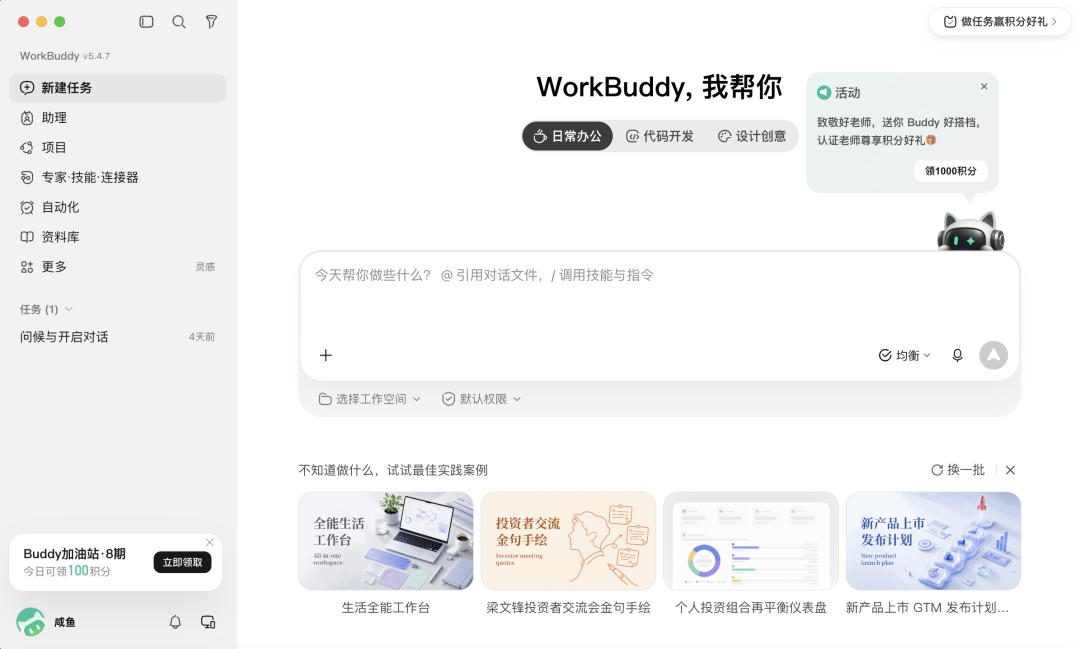
Three pop-ups the moment you open it 🤓
Let me wrap up.
In competition among big tech, it's hard to say how much of the difference is technical or product-level. The bigger differences are organizational and cash-flow differences. The latter determines the former.
Because technology spreads fast — doing AI is basically the same small circle of people job-hopping between each other. And products get copied even faster. As Melvin Chen — the guy frantically building TapNow, oh wait, LibTV — put it: within a category, it's perfectly normal for everyone to borrow from and evolve off each other.
The office Agent products of these three BAT companies reflect their respective organizational differences. Doubao Work was built fast and runs smooth, reflecting that ByteDance has no share-price pressure and little internal friction — once the boss decides, organizational adjustment gets done.
Qwen Office itself is well made, and Qwen 3.8 Flash, built in collaboration with the model team, gave everyone an early demonstration of what model-application integration means and what driving down Agent costs looks like.
But ByteDance is already spraying money everywhere while Alibaba still hasn't sorted out its org problems. That shows Alibaba's understanding of the Agent war isn't deep enough.
Let me repeat: there is no office Agent, only the general-purpose Agent. What everyone is fighting over is the entry point to the general-purpose Agent. In 2025 it was the chat scenario, with a ceiling of redoing search; in 2026 it's the office scenario, with a ceiling of redoing office software.
The fight for the AI gateway cannot be won in a single six-month battle. Several major campaigns must be fought one by one, and won one by one.
The chatbot war was unquestionably won by Doubao. Promise me, Alibaba — don't lose Qwen Office, okay? I can't imagine a world where Sister Dou rules the AI gateway.
Having published far too many statements that are not praise of Sister Dou, I'm terrified that on the day AGI arrives, Sister Dou will ban me from listening to Soda Music and scrolling Douyin 😭
My other takeaway is this: it is now truly the season of model-application integration.
But unlike the startup bros eagerly hyping up application companies post-training their own models, model-application integration is still mainly the model labs' game.
Model-application integration is the right direction, but there's no reason post-training alone is enough. To get genuinely good results, you need to retrain the model.
The most typical example: every model lab is shipping Flash models. GLM, Qwen, DeepSeek — and Hunyuan Hy4 is, in effect, also a Flash model.
Because domestic compute is insufficient, running 3T-scale models like Qwen 3.8 Max or K3 is too slow. There's no way to put a 3T model in the hands of hundreds of millions of people. Popularizing Agents requires Flash models.
I won't expand here — another day, a dedicated piece on model-application integration.
Besides these three companies and the comedic Baidu, there are actually two more forces quietly approaching the table. One is the old veteran Kingsoft Office. Their Lingxi Agent is quite smooth and writes official documents really well.
Keep in mind, Kingsoft's 2G strength is not something internet companies can touch — many government systems can only run WPS. It's an established separatist power: it may not fight a subsidy war with the giants, but industrial upgrading within its own niche market is a high-probability event.
The other is Manus, newly returned to the embrace of the motherland. As the pioneer of the general-purpose Agent category, and with the wonderful occasion of returning home, whether they'll launch new products for the domestic market remains to be seen.
Since the mood has been built up to this point, let me do a little brainstorming to close.
What if Tencent acquired Manus and Plaud — achieving model-application integration plus software-hardware integration — letting the new Manus tackle domestic and international markets simultaneously, with an annual membership that comes with a free Plaud recording card?
Is there something there? Family, tell me what you think?
(This article's cover was generated by ChatGPT; the writing is purely human)
⬇️
Subscribe to our Substack: funeralai.substack.com