AI 3D Companies Stuck in a Race to the Bottom

The Kernel Isn't Being Stubborn
"No Hard Feelings at the Core"
Finally getting to 3D.
I used to think this industry was completely useless for consumers, until GPT Astra started manipulating Blender for 3D work, turning zero-demand 3D modeling into a fashion statement.
So Moonshot AI quickly followed Silicon Valley's lead — first adding Tripo integration on Kimi Work, then optimizing 3D capabilities for K3.1 Pro. Their promotional video hyped it to the moon, but real-world testing showed it's barely usable.
Here's what a founder friend of mine got after letting K3.1 Pro run for an hour before losing patience and telling it to stop:
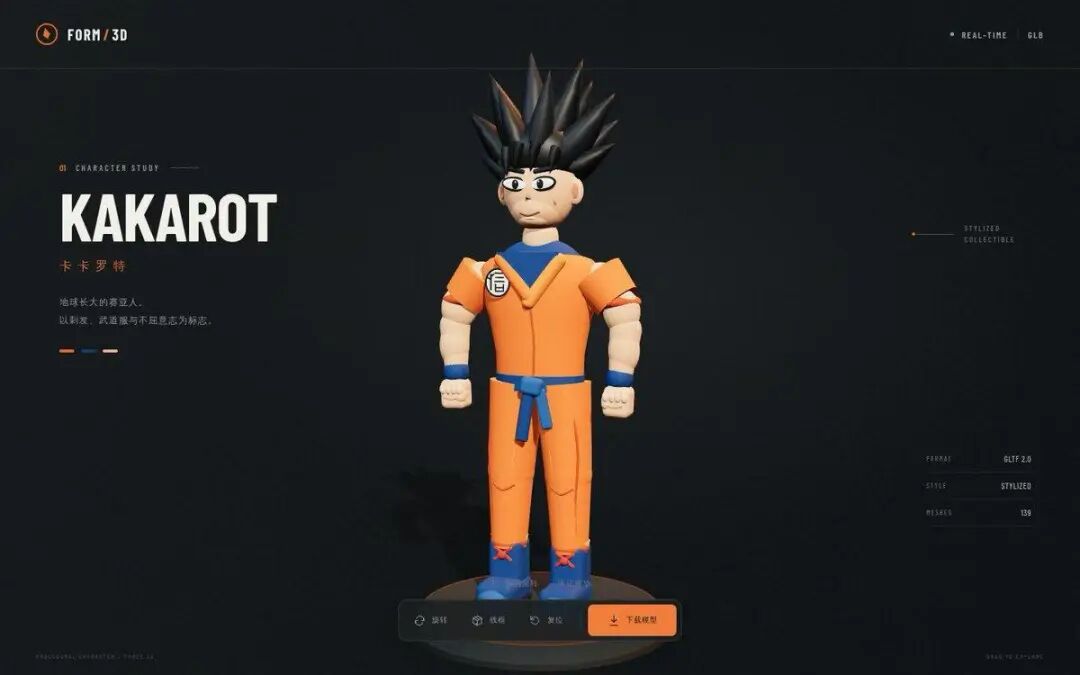
At this rate, given current unemployment in architecture, they could just hire a backend team of modelers pretending to be a 3D foundation model.
But I digress. Today's topic is these 3D model companies that have been bouncing around for a while.
They are: Tripo, first to ride the world model wave, loaded with state capital and aiming for a Hong Kong IPO;
Meshy, first to try relocating to the US but failed their H1B application and came back, claiming they'll make their own games;
And Yingmo (影眸), whose core tech team is still pursuing PhDs while the battlefield is already burning.
Some might ask why I'm not covering Alex Ren's Hi3D or Wang Shimu's Seele. My take: both are basically nonexistent, not worth separate discussion.
First question: do 3D foundation models have independent value? My answer: technically yes.
If GPT cracks 3D, then Tripo, Meshy, and Yingmo can pivot to becoming data vendors, directly producing 3D data for domestic foundation models;
If it doesn't crack it, then 3D models keep grinding away at gaming and manufacturing.
So what's the actual difference in 3D model quality among Tripo, Meshy, and Yingmo? Let's look at how they attack each other.
Yes, both Tripo and Meshy have dedicated competitor comparison pages.
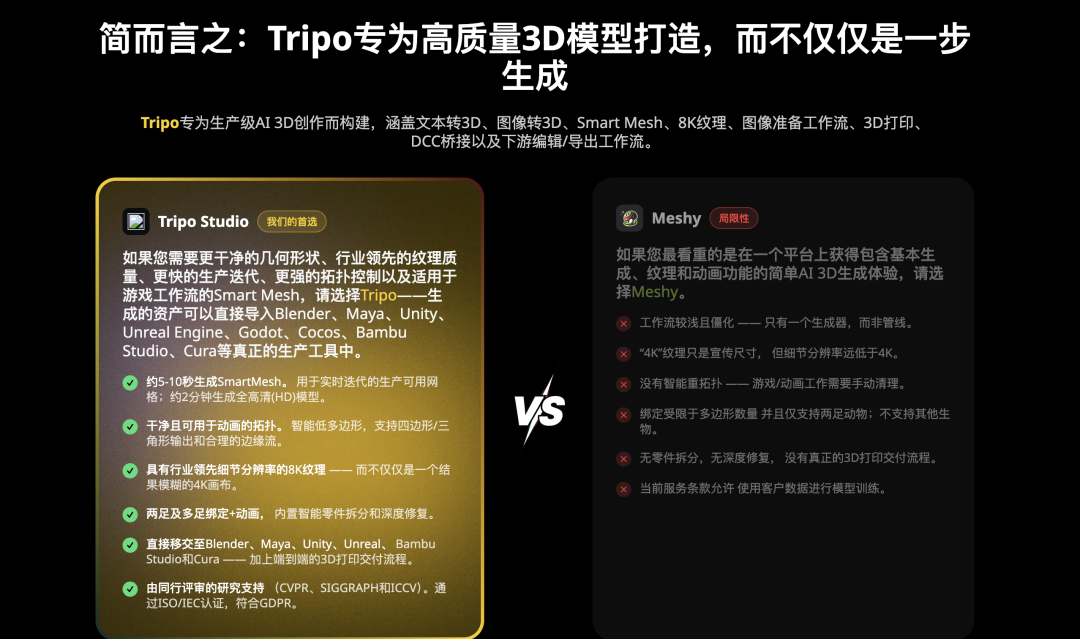
And Tripo is the most aggressive of the three:
"If you need cleaner geometry, industry-leading texture quality, faster production iteration, stronger topology control, and Smart Mesh for game workflows, choose Tripo;
If what you value most is a simple AI 3D generation experience with basic generation, texturing, and animation features on one platform, choose Meshy."
It also lists six specific weaknesses of Meshy:
Shallow and rigid workflow — only one generator, not a pipeline;
4K textures are just marketing size, actual detail resolution is far below 4K;
No smart retopology — game/animation work requires manual cleanup;
Rigging limited by polygon count and only supports bipeds; no other creatures;
No part splitting, no deep repair, no real 3D print delivery workflow;
Current terms of service allow using customer data for model training.
Everything else aside, what does "allow using customer data for model training" mean?
Meshy's response: "Whether data is used for training depends on how you purchase: if you sign an Order, your contractually won't be used for model training; in self-serve plans (any tier), Meshy may use anonymized data to improve its models, and you can opt out at any time."
So yeah, they do use it for training.
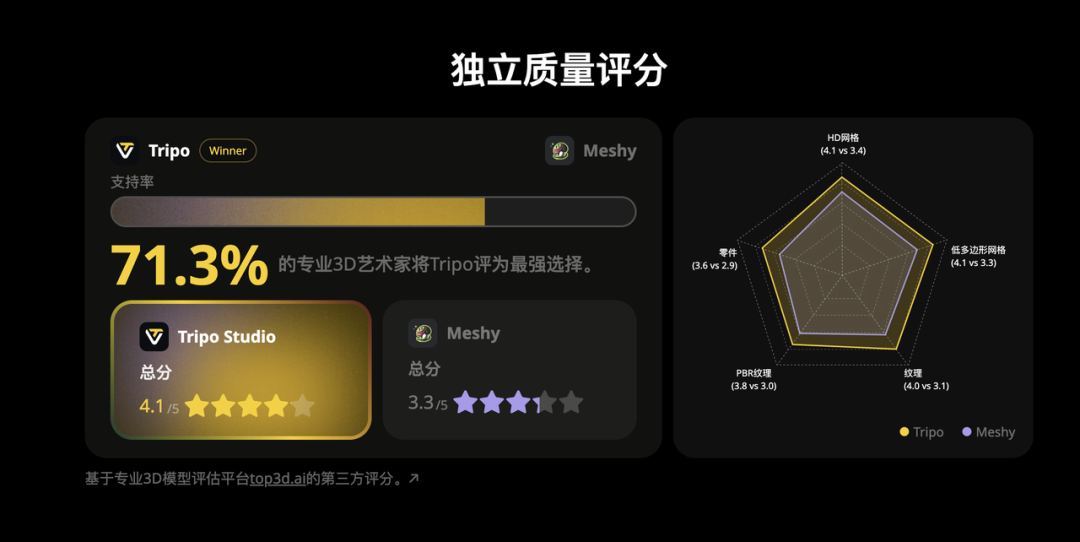
Tripo showing itself surrounding Meshy on all sides
Tripo also lists these weaknesses for Yingmo:
Supports basic image-to-3D and text-to-3D creation, but complex structure reconstruction is limited;
No equivalent Smart Mesh workflow for automated low-poly topology generation;
HD generation quality still unstable on complex structures;
Offers AI texturing, but texture detail and readability may be more limited;
No built-in rigging or animation workflow, difficult to meet production-ready character asset needs;
Model segmentation requires more steps and longer wait times;
No integrated 3D print workflow or professional optimization support like Pro Refine.
One more attack than against Meshy.
Meshy's counterattack is equally direct:
Meshy vs Tripo: both convert text and images to 3D models. But one difference matters crucially for makers: Meshy is the only AI 3D generator built specifically for producing printable, watertight files — with printability detection, one-click auto-repair, and direct sending to 9 slicer programs.
Meshy also says Tripo gives you raw meshes, while they give you truly printable, usable, deliverable finished products. And attached a capability comparison table:

Yingmo made some symbolic complaints about Meshy:
"Meshy's strength is speed, well-suited for rapid batch production of concept designs and prototype-stage model assets. Its quality has improved but typically still doesn't reach the realistic detail level of Rodin in Focal or Gen-2 modes. Want speed, choose Meshy; want quality, choose Hyper3D Rodin."
They also dinged Tripo: "Tripo3D excels in speed and simplicity, very suitable for quick rough models and initial concepts. If you urgently need a 3D model and don't have high demands for perfect topology, then use Tripo3D."
The PhDs at Yingmo are still the kindest. Didn't go for the kill.
It's not hard to see that everyone's main criticism is that competitors can quickly generate a 3D shell, but the core details aren't as good as theirs.
This actually proves everyone's core isn't good enough, far from production-ready — otherwise why keep harping on obscure 3D industry jargon.
Honestly, mutual attacks in 3D are practically tradition. From the industry's birth to today, I've heard including but not limited to:
Some nine-figure funding round partly consisting of Alibaba compute credits; someone faking ARR by having suppliers fabricate numbers; someone reporting a competitor's unregistered foundation model to a major game studio; someone's features being pixel-for-pixel copies of a rival; someone's world model actually being a post-trained video model...
I consider the above pure slander — how could our honest, law-abiding Chinese AI companies do such things.
But Tripo's world model does suspiciously resemble a post-trained Wan. Video models and 3D seem completely unrelated at first glance, but there's a story connection.
Because AI 3D needs big narratives to raise big money, everyone's pitching AI real-time generated interactive games and interactive scenes. So how to do it?
Meshy's pitch is using coding agents as the skeleton, 3D for specific scenes, achieving "beyond world models." Tripo simply says once the 3D model is generated, they'll render it all with a video model — boom, real-time interactive scene.
This is somewhat similar to how Seedance 2.5 can first generate white models then video, but Seedance's video quality is clearly not something a post-trained Wan can touch. Looking forward to ByteDance's world model push ❤️
My only curiosity is, with the story already at this level, why doesn't Tripo post-train MiniMax H3? Do they have beef with our Lord Yan?
Can only say Melvin Chen's famous quote holds true: "This isn't urgent but must be done fast." Tripo's top priority for world model storytelling is finding some whiz kid to post-train H3.
Otherwise among all the whiz-kid-built H3-based world models, post-training Wan is indeed behind the curve.
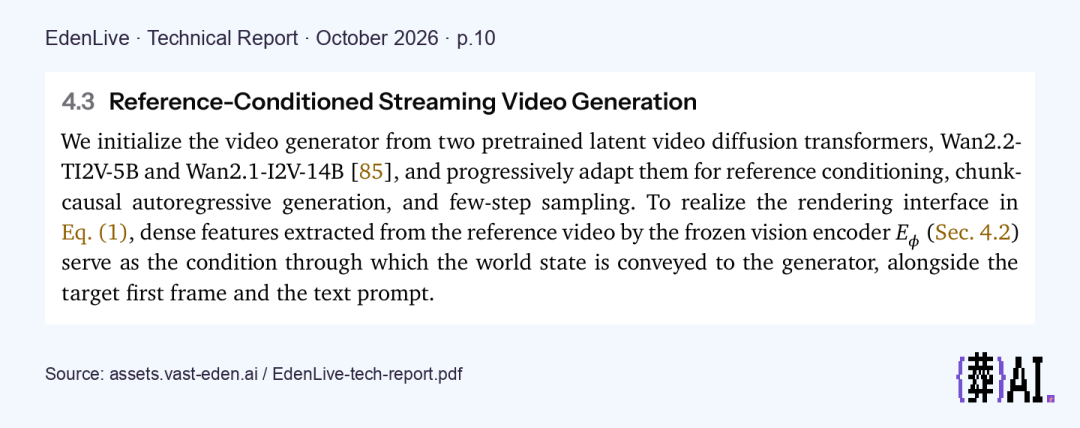
Current world model deployments from each 3D company: VAST's EdenLive, Rodin's world generation model WorldGen, and Meshy's "beyond world model."
I really want to ask: when do you start attacking each other's world models? That episode will definitely be good watching, looking forward to you all roasting each other to pieces.
Honestly, AI 3D has such a small market share, and everyone's still fighting — kind of pathetic, pure crab-bucket behavior at the bottom.
Simple logic: 3D mainly serves pro consumers and B-end users, currently making money primarily through 3D printing and gaming.
3D printing heavily depends on Bambu Lab, and Bambu Lab is 100% going to do this themselves.
The aforementioned Alex Ren wanted to use Hi3D to build a personalized factory selling 3D printed toys to everyone.
I opened the Goodthings mini-program: an 8cm figurine costs me ¥237. If this actually sold well, Pinduoduo should commit seppuku.

As for gaming, the most important high-precision, animation-ready modeling is still far from feasible. Either used for static objects or drafts, mainly serving as outsourced labor replacement.
Of the two major game studios, Tencent has its own Hunyuan 3D.
NetEase is more plausible — after all, William Ding is currently on a massive outsourcing purge and AI-ifying studios. These 3D model vendors can hand him the knife.
From what I can see, Meshy is the most hype-driven. Early this year they invested in a bunch of gaming media to directly announce they'd make AI games;
By July when their valuation crossed ¥10 billion, they announced they'd enter real-time interactive multimodal content experiences — this is basically coming for my guy Vivix, really want to see what Meshy's multimodal content turns out like.
Infinitely bullish 👍
Final question: are 3D model companies really worth ¥10 billion?
My confusion mainly stems from Manycore Tech, hyped as one of Hangzhou's "Four Little Dragons" — a 3D home decoration company that later started riding the 3D model wave — now trading at under $700 million market cap.
Is Manycore undervalued, or are these 3D startups overvalued?
Although this track is genuinely kind of boring, given that all major language models have gone crazy for 3D, we'll next conduct real-world tests of various 3D foundation models — if you're willing to call them that — to evaluate the best 3D data vendor for you.
(Cover image generated by ChatGPT, purely human-written)
Some Monday office entertainment: tonight at 8pm, livestream on WeChat Channels from "Buried Love Salted Fish," roasting domestic foundation models one by one. Come watch.