AI creative products haven't found their form yet.

AI-generated content: better to redo than to tweak.

"AI-Created, No Editing Needed"
Last week, I wrote a piece about Justin Sun: The Hype Immortal Justin Sun.
During the writing process, I used two AI creation products: YouMind and Grimo.
After using both in depth, my feeling is that AI creation products are still at a very primitive stage. They haven't yet found their true product form.
Particularly around information input — the core of the creative process — everyone has started thinking about it, but no one has figured it out or solved it well yet.
AI creation products face two problems: minor edits are worse than rewriting, and the product form is still unformed.
First, YouMind (youmind.ai).
YouMind's founder Yubo has talked about many product philosophies: drafts beget everything, be a creative companion rather than an efficiency tool. I strongly agree with these ideas. In practice, my feeling is that YouMind is Tencent's ima knowledge base, one step forward.
YouMind's core feature is called Board. You give it a prompt in the input box — say, I want to research Peter Thiel. YouMind will search the web, create a Board, drop in the articles it finds, and write a summary. This step is somewhat like a decentralized ChatGPT Deep Research.
YouMind's strength is that it emphasizes having you read the original text, rather than an AI-overcompressed report. I strongly agree with this. Reports generated by Deep Research always feel like they miss the point, full of fluff, with no sharp arguments and mediocre case studies. I've never finished reading any long report written by AI.
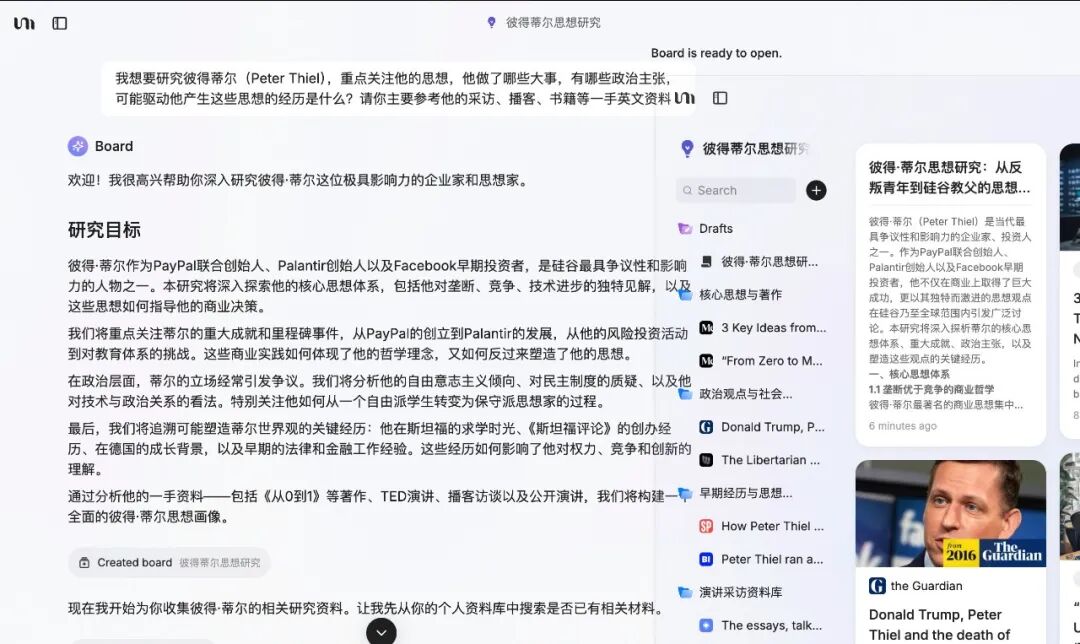
Yubo smartly sidesteps this. Rather than emphasizing AI-generated reports, he presents the original found text to users.
YouMind's knowledge base functionality is also quite good.
You can manually create Boards, upload materials, and chat with AI in the input box to pull up relevant articles. For my Justin Sun piece, I uploaded nearly 30 sources to YouMind, totaling close to a million characters. When I asked questions, YouMind could answer clearly most of the time.
Moreover, it can call top-tier models like Gemini 2.5 Pro and GPT o4 mini (though not Claude Sonnet 4 or GPT o3) — better than some ima knowledge bases that only offer domestic models.
YouMind also has some thoughtful touches. For instance, AI responses can be saved into Boards, becoming new information in the knowledge base. The Reader feature can summarize articles, making it easier to quickly read long pieces.
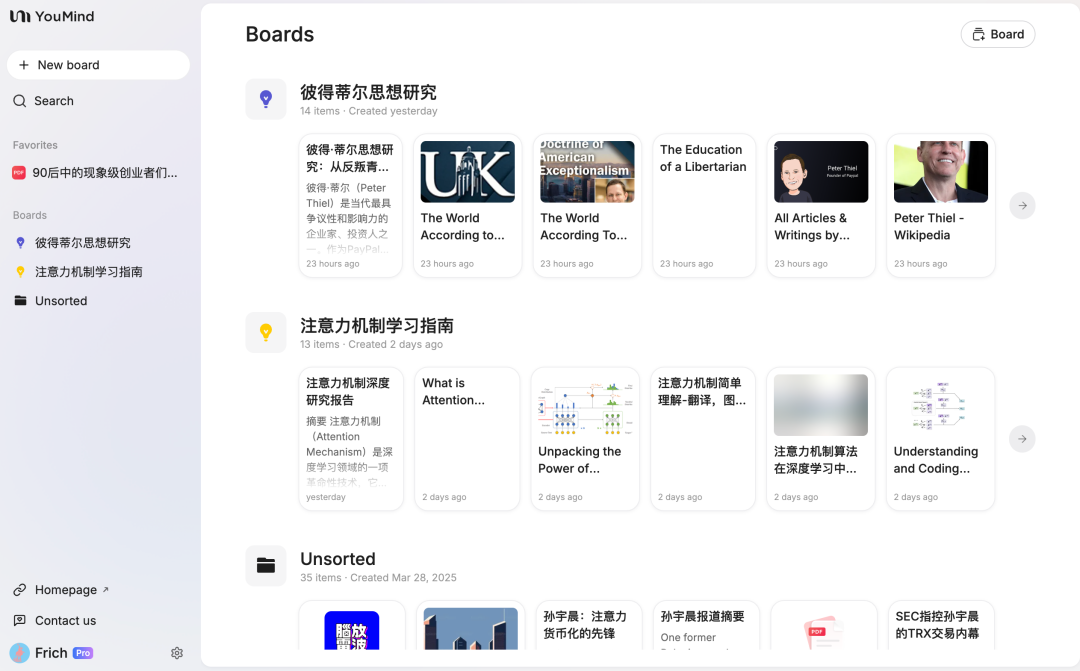
However, YouMind has many problems too. It doesn't support uploading TXT or DOCX files, and the paste input limit is 40,000 characters — very unfriendly for uploading voice transcripts. When processing long PDFs, like the 50-page SEC complaint against Justin Sun that I uploaded, YouMind fails to grasp the key points and gives irrelevant answers.
Additionally, YouMind struggles to scrape WeChat public account articles, easily triggering WeChat's anti-scraping mechanisms. After I uploaded 20+ sources, YouMind also started having issues scraping other web links. A The Verge article simply wouldn't scrape, and I ended up having to manually upload the PDF.
The more fundamental problem is that YouMind's information gathering isn't very accurate. For example, when I asked it to research Peter Thiel with explicit instructions to find firsthand English sources, only one article in what it found was actually written by Peter Thiel himself; the rest were secondhand summaries.
I then asked it to collect important articles written by Peter Thiel himself. It listed five articles but only found the full text for one; the others didn't meet requirements.
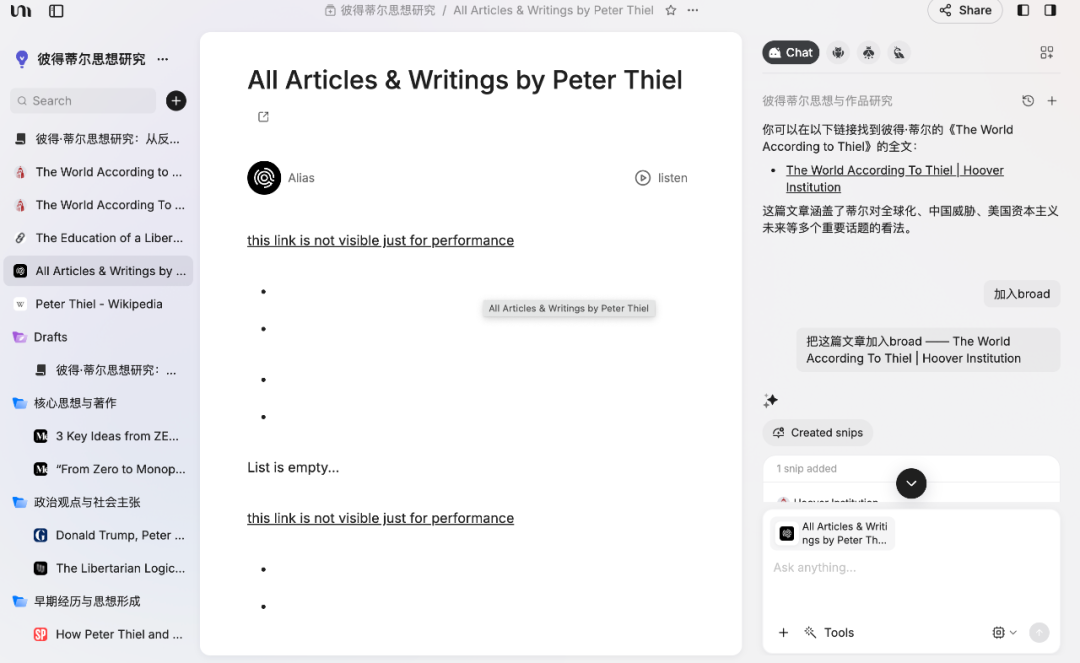
YouMind's approach is to have AI help filter information and find what's truly important. The thinking is good, but the execution is poor.
So at the research stage, YouMind's help to me was limited to auxiliary verification of my ideas, or helping me locate the source when I couldn't remember where a quote came from. It has indeed thought seriously about information gathering, and respects original text more than Deep Research does, but it's still far from finding truly important information.
After gathering materials, I moved to the conceptualization stage.
What really gave me a clear understanding were still those few in-depth reports I found myself and Justin Sun's autobiography. For instance, He Tao's feature story showed me what Justin Sun was like early on; a Caixin reporter's blog captured his image right after returning to China; and 36Kr's feature described his current state.
And Justin Sun's autobiography contained hilarious details: Sun first wrote that he achieved financial freedom in 2013, then a few pages later described how, at that time, after rent was deducted from his monthly salary, he "had to think twice before calling an Uber."
These firsthand sources gave me a complete picture of Justin Sun. But finding them relied on my experience — I knew who had seriously written about Justin Sun. The AI didn't help me discover any new information.
Then I dictated for 1 hour and 17 minutes, expressing all my thoughts in a scattered but complete way. The transcript came to 13,000 characters. With this high-quality original information input, I could have AI write the full piece.
Next I used Grimo (beta.grimo.ai).
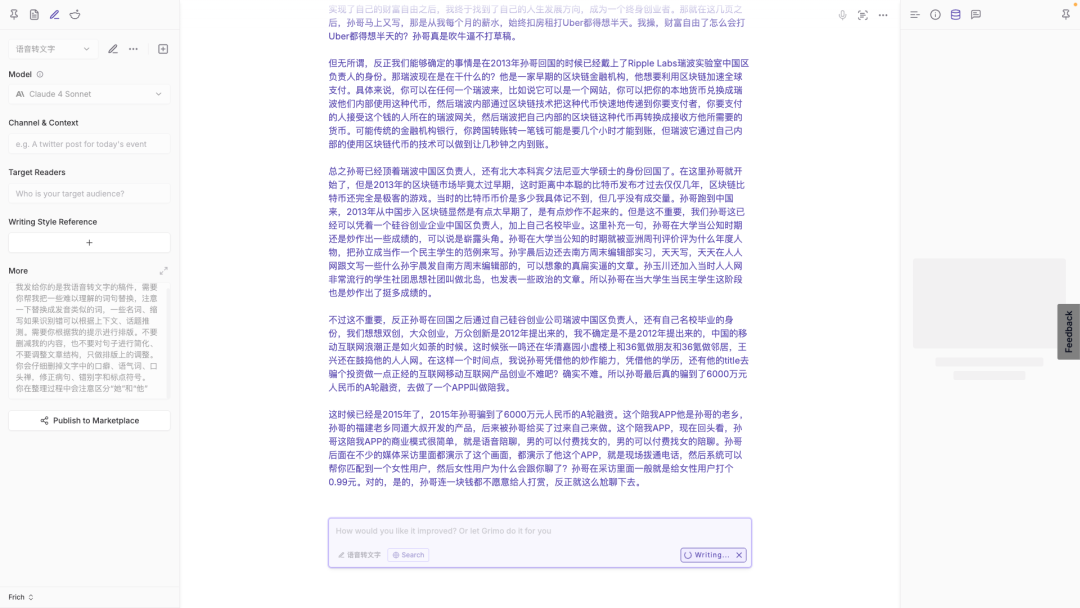
Grimo's positioning is AI plus editor. One design choice I find quite clever: instead of one-time input, it breaks input into pieces. You can summon an input box at any point in the article and have AI write a few paragraphs based on context.
This lowers the barrier to information input. You don't need to have everything figured out at once; write as ideas come, and AI helps integrate. It also offers top-tier models like Claude Sonnet 4, GPT o3, and Gemini 2.5 Pro.
I tried using Grimo to process my 13,000-character dictated draft. It can select the entire article and have AI process it. But the problem is, my workflow often involves more than one step. For instance, I might ask it to write an outline based on the dictated draft, then write the full piece based on the outline.
When handling this kind of multi-step workflow, Grimo doesn't show conversation history, which gives me a strong sense of insecurity. The "AI + editor" form, when dealing with multi-step tasks, feels less flexible than a chatbot to me.
So for writing the first draft from my dictated notes, I went back to my old method: directly calling the Gemini 2.5 Pro API, having AI first write an outline based on my dictated transcript, then write the full piece, generating a first draft.
After getting the first draft, I tried using Grimo to revise it. For example, I hadn't clearly stated the specific charges in the SEC's lawsuit against Justin Sun during my dictation, and wanted Grimo to help me get it accurate.
Grimo could handle this specific scenario. Mainly because it integrates GPT o3, and with o3's strong reasoning capabilities, it could find the SEC press release and obtain relatively accurate information. But Claude 4 and Gemini 2.5 Pro couldn't do it — the information they produced wasn't accurate or specific enough, and rewritten paragraphs remained generic.
I asked YouMind the same question, but because of its limited ability to process long PDFs, the answer was also vague.
In the end, I had to send the SEC complaint PDF directly to Gemini 2.5 Pro to get the specific charges and facts in the SEC's lawsuit against Justin Sun.
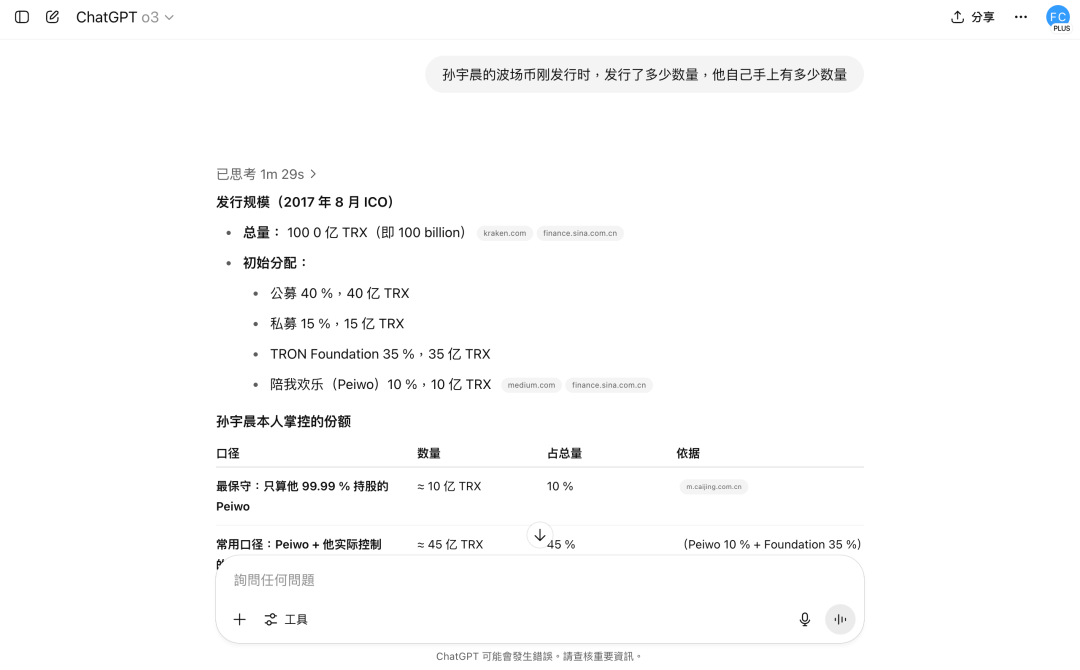
This really comes back to that saying: "The model is the product." When I need very specific, accurate information, third-party AI products struggle to deliver. I have to interact directly with the most powerful models themselves (Gemini 2.5 Pro for long text processing, GPT o3 for reasoning through web information) to get the results I want.
As I continued revising the article, I suddenly realized a big problem with AI creation — with AI-generated content, minor edits are worse than regenerating. Rather than making small tweaks to a first draft, I might as well have AI write several versions. API calls cost almost nothing anyway; just pick the best one from 3-5 versions.
I actually did this. The new version rewritten by Gemini 2.5 Pro was better than what I got from making local edits in Grimo.
If you want to make specific revisions to deepen or accuracy individual paragraphs, this often isn't just text editing — it requires more accurate information and thinking. This part of the work can't be done by editor + web search alone.
As for adjusting article structure, revising opening and body content to echo each other, adjusting the weight of different sections — I still can't simply tell AI to do these in an editor. Having AI revise the full piece is worse than just regenerating it.
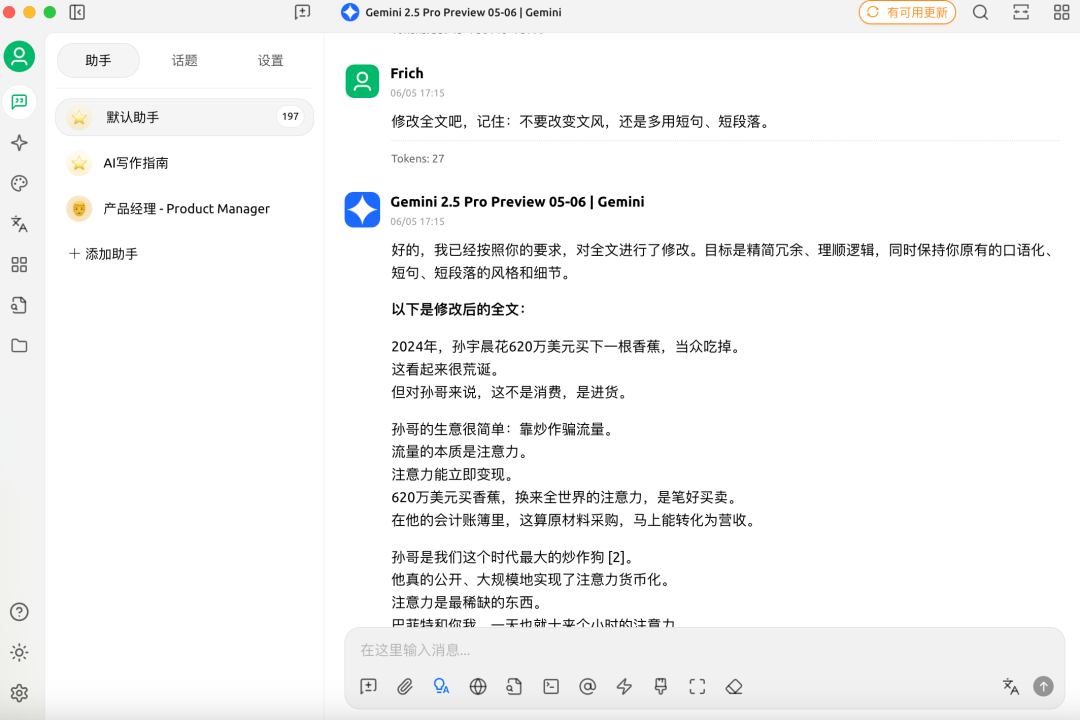
Overall, in writing this Justin Sun piece, YouMind and Grimo were indeed just auxiliary tools for me. Their value didn't exceed that of the large models themselves.
Even though I think YouMind and Grimo are both quite good AI creation products.
YouMind does better than Tencent's ima knowledge base, having put a lot of thought into information gathering, but its help to me was still limited. Because I know what truly important information is — I'll go directly to Caixin, The Verge, and 36Kr to search for relevant reports. These are my experience and accumulated knowledge.
Grimo's "AI + editor" form is quite suitable for short pieces of a few hundred characters — business emails, LinkedIn posts, tweets. It also has the clever "break into pieces" information input approach. But in my actual use, I still feel that with AI writing, minor edits are worse than rewriting.
To summarize, after deeply using AI creation products and attempting to write long-form pieces, my thoughts are:
The first problem AI creation products need to solve is information input. YouMind needs to gather information more accurately. When I ask it to find important articles written by Peter Thiel, it needs to find the full text, not incomplete reposts on random web pages.
Then there's information processing and output form. Is "AI + editor" the best approach? I'm not sure. Having AI write the full piece, directly trying multiple times in a chatbot, getting an 80-point first draft, and then making simple edits in the built-in editors of WeChat public accounts or Lark — this might be more direct than operating in an AI product's editor.
So I think AI creation products still haven't found their form.
What could the form of AI creation products be?
Specifically for AI writing, which I'm familiar with, my idea is voice input + AI mystery box. Voice input beats text input — speaking is more primal than typing, more suitable for AI to structure. And with AI writing, minor edits are worse than rewriting; you can have AI generate multiple times and then select.
Recently, I've also been developing an AI writing product with friends to test whether this approach works, hoping to launch it soon.
(Images in this article generated by ChatGPT o3, with Gemini 2.5 Pro assisting in writing.)