AI Programming Creates Worlds

The World Is Turning into Lego
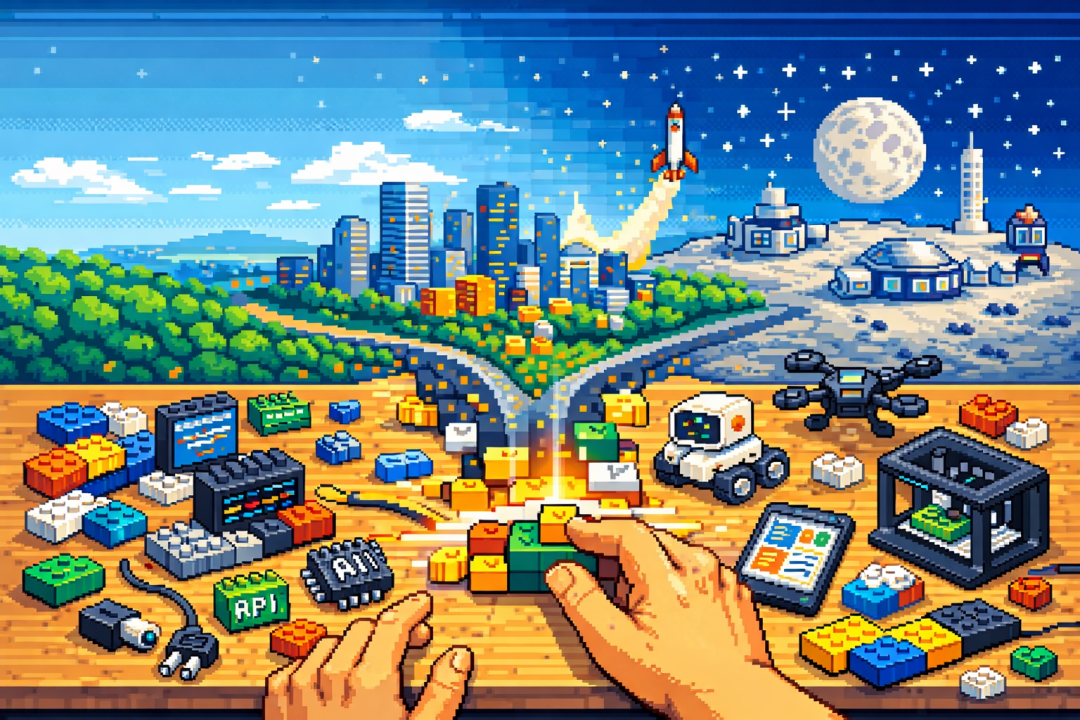
"The World Is Turning Into Lego"
One obvious trend: AI coding tools are becoming the engine of the digital world.
Most apps will eventually disappear. Because most software needs can be met by disposable programs generated by coding agents — used once and discarded, like 3D-printing a single part.
3D printing turns the physical world into Lego bricks; AI coding turns the digital world into Lego bricks.
Both are happening right now.
Let's start with the digital world.
I'm tinkering with an open-source project called the Funeral AI Simulator. Based on Funeral AI's past articles, it lets readers chat with our three writers — Xianyu, Muqiu, and Luozima.
First I needed to organize everything we've published: clean 60 PDF documents, convert them to Markdown, and build a directory index.
Pure data grunt work. I handed it to Claude Code, made by those evil Italians.
CC didn't process the PDFs directly. Instead it wrote several Python scripts on its own — extracting text from PDFs, converting to Markdown, stripping residual web links and junk text.
I only used natural language to tell it what I wanted. When the task was done, the scripts deleted themselves automatically.
This is disposable software: manufactured on demand, discarded after use. This is 3D printing for the digital world.
I learned a little Python once, but forgot almost all of it. I can barely remember Hello World. Yet now I can use Claude Code to do many things that previously required hiring a programmer for custom development.
The compilation layer in between has completely vanished.
It's the idea people have been hyping for years: everyone can talk to computers in natural language; programming languages are no longer mandatory.
A very certain trend: there will be enormous amounts of disposable software in the future, custom-built for your personal needs, used once and thrown away.
This naturally leads to another conclusion: the real opportunity lies in wrapper coding agents.
My friend Erlich built a Claude Code wrapper client called Proma.
The market has gone so insane that any AI product with even modest buzz attracts a swarm of investors eager to chat. Several adorable investors chased after Erlich asking: what's your moat for this thing?
The guy couldn't stop laughing. He said it took him a day and a half to build with CC — what fucking moat? 🔨
But Proma does work.
From my experience, Proma is functionally identical at the core to Anthropic's own wrapper, Cowork, as well as Cherry Studio, Stepfun Desktop Companion, and others.
Because they're all essentially putting a shell around the same engine.
The engine is generic; the shell is where developers differentiate. That's why the most certain opportunity in the first half of 2026 is coding agent wrappers.
The moat for wrappers is actually quite high. Everyone plugs into roughly the same engine, so the value lies in nailing the small features and interaction design that deliver a better user experience.
Not everyone uses the command line, but everyone can tap open an app. Lowering barriers is value.
And Claude Code isn't the only option.
Qwen Code, Kimi Code, GLM Code — these domestic coding agents are indeed somewhat worse than CC, but you don't need the best coding agent for general-purpose products.
Then there's our dear Taku. Though the guy keeps insisting he's built on a self-developed framework, not a CC wrapper, my testing shows the experience is roughly on par with all the wrapper products.
This shows everyone is still at the early wrapper stage; no one has broken out with differentiated killer moves yet.
It's just that CC has captured the mindshare for general-purpose engines.
If you want to use a coding agent today, CC is the first thing that comes to mind.
Codex is also very capable — I find it faster and more decisive than CC, without the psychological discomfort of using evil Italian products. I asked Erlich why he didn't wrap the Codex SDK. He replied, "I didn't even know that was an option..."
Let's return to the physical world.
3D printing is accelerating the Lego-fication of reality.
Six months ago I met Fu Cheng, product manager at MuleRun. His previous startup sold 3D-printed models on Temu.
The business logic was simple: buy model copyrights from indie developers. These models looked great, with polished exteriors, but the print engineering was relatively crude — one plate could only print one or two units, with lots of waste and slow speeds.
What Fu Cheng did was re-optimize the print engineering so one plate could produce four or five units. The optimized models sold on the Bambu Lab store — a nice little profitable business.
Now he's building MuleRun, an agent marketplace.
From selling 3D models on Temu to selling agents on MuleRun — the two are essentially identical. Both involve engineering optimization between standardized engines and customized shells.
Standardized 3D printers, customized models. Standardized coding agents, customized applications.
Fu Cheng was the first person to make me realize that 3D printing and AI coding are fundamentally the same. He himself connected the two tracks.
Bambu Lab has a product line called CyberBrick, selected for TIME's Best Inventions of 2025. It's essentially a bunch of standardized electronic modules.
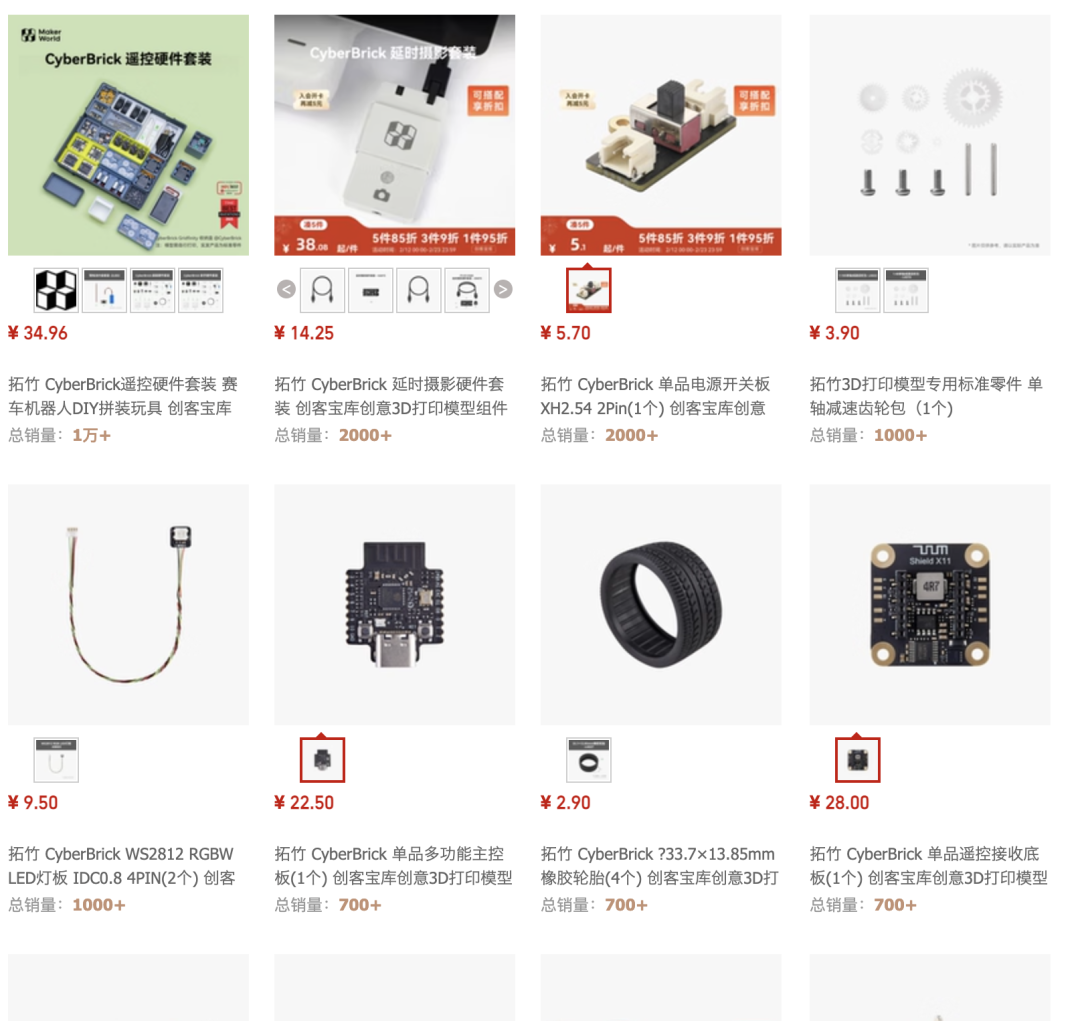
Remote control kit: ¥34.96. Time-lapse photography kit: ¥14.25. LED panel: ¥9.50... Everything works straight out of the box — just plug it in.
Want to build a remote-control race car, bulldozer, or tank? Download the design file, 3D-print the shell, plug in the electronic modules, configure some parameters, done.
This is physical-world wrapping.
The most direct case for 3D printing is on the battlefield.
Both Russia and Ukraine are extensively using 3D-printed drones. Among the better-known is Ukraine's Wild Hornets group, claiming 25 engineers producing roughly 100 3D-printed drones daily to intercept Russian drones.
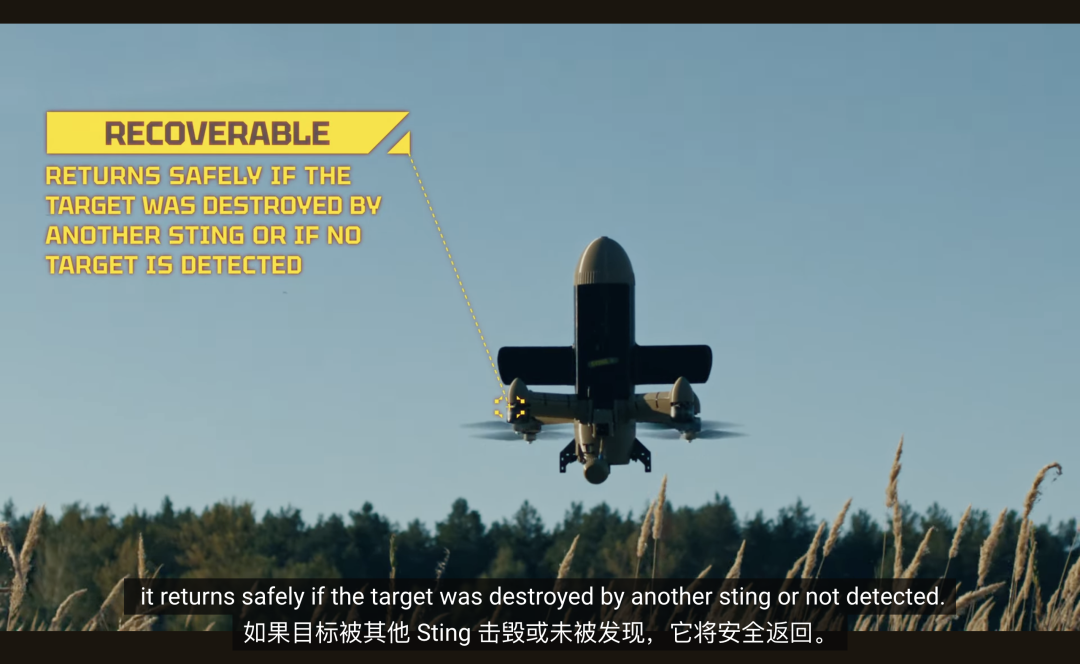
Their interceptor is reportedly priced at $2,500. Compared to a $3.3 million Patriot missile, 3D-printed drones are undeniably a disruptive value proposition.
Moreover, 3D-printed drones are low-barrier.
I casually found a bunch of European companies all advertising themselves as European-made 3D-printed drones. These drones look suspiciously similar to Wild Hornets' designs — I strongly suspect they're using the same blueprint 🤡
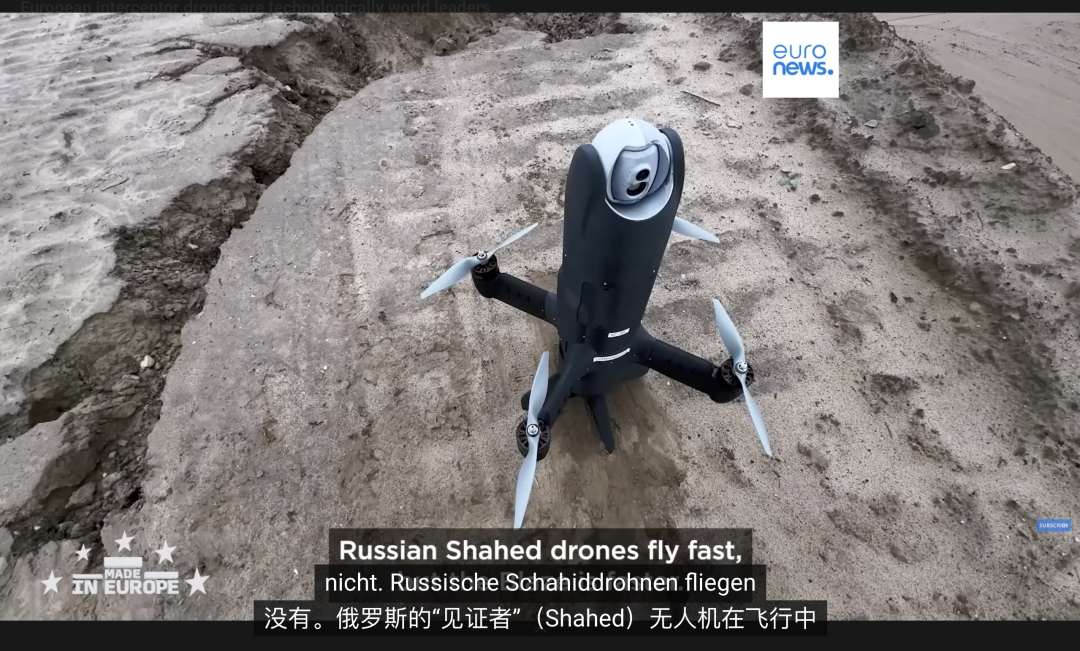
Core components: standardized, bulk-purchased. Shells: customized, 3D-printed on demand.
Disposable printed parts and disposable software follow identical logic — customized on demand, discarded after use. Blow it up and don't sweat it; you can parallel-produce dozens of agents or drones for a single mission.
An even more extreme case is Xiao Zhi AI.
On Taobao, for just ¥70, you can buy a Xiao Zhi AI. Based on Espressif's ESP32 development board, calling Qwen's API, you can have voice conversations with it. There's even a version with a camera.
For about a hundred yuan, you can buy an AI device that talks, sees, and connects to the internet. We might as well call this true embodied intelligence.
Add a camera and chassis to Xiao Zhi, and you've got an AI toy that elementary school kids are going crazy over.
Using Shenzhen electronics guys' mature solutions, you can easily do this: place the camera-equipped Xiao Zhi on your desk, have it watch what your cat is doing, and send you a message when the cat jumps on the dining table. Add motors and a chassis, and it patrols your house once an hour. Camera detects your kid secretly playing games — instant alert to parents' phones.
These needs used to sound like startup ideas — pet robots, child companion systems, the kind that could scam $2 million in investment. Now dozens of yuan solves it.
The core ESP32 development board retails for just ¥30. Add ¥10 more for a version with built-in camera.
And those overhyped AI companion toys? On Taobao you can directly buy kits with microphones, development boards, and display eyes already assembled.
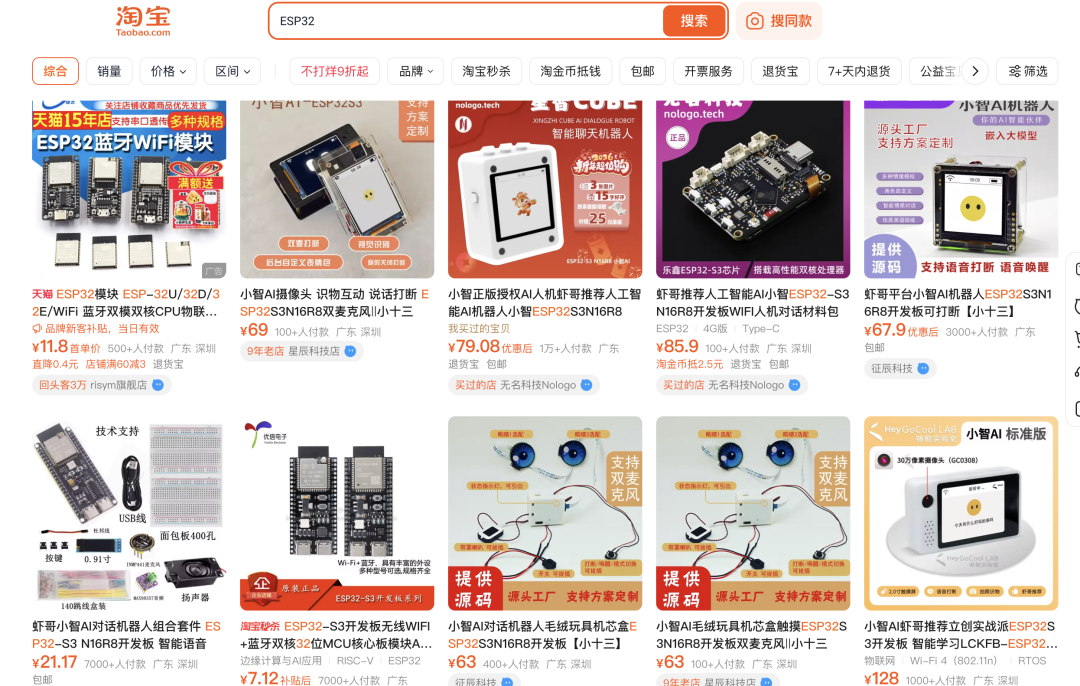
Why do these eyes look exactly like Fuzai, the "AI companion sales champion"? Don't tell me the Shenzhen bros are sharing the same solution 🤡
Then some guy pulled off something wild.
There's an open-source project called MimiClaw. The developer packed a complete agent architecture onto an ESP32 development board.
Hobbyist electronics tinkerers can spend just ¥30 on an ESP32, download and install MimiClaw, and achieve the experience of sending Telegram messages to make an agent do tasks — a budget OpenClaw alternative.
A few dozen yuan of hardware running an agent. What is the electronics tinkerer tradition, what is the Lianhua Mountain spirit? This is the magnificent crystallization of Huaqiangbei's machine soul.
Isn't this 114,514 times more respectable than those hype dogs awkwardly flaunting "AI evolutionary networks" and "AI genetic protocols" through some skill?
¥30 to run a private AI assistant. This fully demonstrates that AI hardware wrapping has also reached an inflection point.
Another certain opportunity in 2026 is cheap AI hardware.
We will definitely see a blooming profusion of AI hardware — diverse forms, diverse prices, especially in the ¥70-300 range where competition will be brutal. The Shenzhen electronics guys' cycle has returned 😭
Because the generic engine for hardware is ready, and users can freely customize shells with 3D printing.
Looking at digital Lego and physical Lego together: cheap agents plus cheap physical shells are rapidly converging.
The most direct picture is this: any electronic device with processing power exceeding a ¥30 development board can run an AI assistant.
Drones, robot dogs, electric scooters, farm tricycles, refrigerators, washing machines... all can collaborate. This generation of technology can finally deliver the IoT story that Xiaomi hyped in the last generation.
Technological innovation often happens at the margins. The future will first distribute among non-mainstream groups like electronics tinkerers and elementary school kids.
Speaking of which, I beg you investor elites to chat more with electronics tinkerers in your spare time.
Deploying capital is great; loose hands are even greater. But can your liquidity-driven approach be slightly more pragmatic? Deploying to gaming bros makes me sad 😭
Of course, everything now is still early stage. The steam engine revolution lasted 80 years; we've only experienced three years of this cycle.
3D printing today can only print drone shells; AI coding today mainly handles side projects. The vast majority of this world's software is still produced and run by humans.
But from another angle, coding agent capabilities are rising fast.
In early 2025, a product manager could whip up a Youware demo with Cursor in one night; by late 2025, a product manager could build Proma with Claude Code in a day and a half. Output value has improved at least 100x. Unimaginable just two years ago.
3D printing is also spreading rapidly.
Bambu Lab's annual revenue has already crossed ¥10 billion. I've seen short videos multiple times of 3D printer factories worldwide — brutally simple, just hundreds of consumer-grade 3D printers lined up, specializing in small-batch rush orders.
And get this: Chang'e-8, launching in 2029, will use lunar soil to print bricks on the Moon, preparing to build a lunar base.
The key is that the combination of coding agent and 3D printing capabilities isn't linear — it's exponential.
Software capability doubles, hardware capability doubles, combined they might increase tenfold. Plus the diffusion effect of open-source communities: every new solution gets modified, adapted, and optimized by thousands of developers.
AI coding creating the world is a happening thing.
But this isn't everyone's world — it's the builders' world.
You need curiosity, creative desire, willingness to spend time and energy tinkering with new tools, getting your hands dirty.
A simple estimate: take users of hardware products like DJI drones, Bambu Lab, Creality, plus users of software tools like Volcano Engine, Alibaba Cloud, AWS, Claude Code — deduplicate — and that's the builders in the world created by AI coding.
AI coding won't consume everyone's life. But it opens infinite space for builders to tinker, and this space keeps expanding as technology advances.
Connect a Xiao Zhi today, a robot dog tomorrow. The world created by AI coding spreads quickly from the computer desk in your bedroom to streets and factories.
Returning to the geopolitical narrative, we find China dominates most critical links.
Global consumer 3D printer shipments top four — Bambu Lab, Creality, Anycubic, Elegoo — all in Shenzhen. Development board ecosystems, also in Shenzhen and Shanghai.
The novel phenomena we describe are most vibrant in the Yangtze River Delta and Greater Bay Area. Southern China's hardware supply chain constitutes a dominant region; the United States can only eat dust on hardware supply chains.
Software is catching up fast too. Seed 2.0, Qwen 3.5, Kimi K2.5 — these domestic models are progressing rapidly. Domestic coding agents are usable too; the lag may be months, not a full generation.
All the Lego bricks are already on the table.
This round of industrial revolution is beginning. The participating elements we can now see are: cheap standardized intelligence supply from large models, powerful engines from coding agents, physical world shells from 3D printing and modular components.
Like the 3D-printed drones both sides use in the Russia-Ukraine war. People can very naturally use coding agents to produce a virtual agent, then add a physical world shell with a 3D printer. The proliferation of such customized small agents is a matter of the next year or two.
In the prelude to this industrial revolution, we see Chinese tech companies have firmly grasped these elements.
AI coding creates the world; China also creates the world. We will create a better world.
(Cover image generated by ChatGPT, writing assisted by Claude Code, human and Codex polish)
Subscribe to our Substack for exclusive content: