AI Wunderkind Takes Down the Sage

The little guy's already getting a bit big.
"The Kids Are Already Getting Too Old"
The hackathon we just wrapped at an internet café was great in every way except one: minors aren't allowed inside.
Based on my recent observations, in today's AI scene, banning minors from a hackathon is practically a crime against humanity — a giant step backward, cutting yourself off from money and talent alike.
After all, who doesn't know the iron law of startup success: the younger the age, the sharper the coding, the better the funding prospects?
I'm not making this up.
During that whole "lobster hype" wave, Zhongguancun hosted a "Lobster Competition," and the kid who took home the "Lobster King" medal, 200,000 RMB in prize money, and 10 billion tokens was a local Beijing eighth-grader. Later, the same kid brought a team of middle schoolers with an average age of 13 to a hackathon championship, and they got profiled as a model case.
And the coverage was absolutely unhinged. Take this headline for instance: "13-Year-Olds Built 100 Products, But They Say 'We're Just Messing Around.'"

I looked it up — normal humans generally speak complete Chinese sentences by age 4, hit cognitive maturity around 7, and can type fluidly on a keyboard by 10.
Conservatively speaking, even a prodigy who started chatting with Claude Code in voice mode at age 4 would need to crank out 10 products a year.
Oh shit, I almost forgot — Claude Code didn't exist when he was 4.
The official competition poster even had "the comment section completely swarmed by momfluencers."

I won't even get into how this whole "teaching 5 million people to memorize English words with AI" basically amounted to talking to Doubao, because in content creation, all roads lead to Rome and there's no right or wrong — the video blew up, he won.
But the last time I saw something get swarmed by momfluencers on Xiaohongshu was a self-taught Traditional Chinese Medicine tutorial. So I genuinely can't tell if this copy is sincere or satirical.
None of this is aimed at any specific tech giant or competition — it's just so emblematic I had to mention it.
I even suspect this is an elaborate smear campaign by unemployed liberal arts majors against underage STEM kids.
After all, before this, the AI world's favorite punching bags were liberal arts types who only knew how to build calendar apps, expense trackers, and spiritual healing products. Maybe those folks felt the mockery was overdone, so they got jobs at big tech companies and wrote these unhinged articles and captions, making netizens think these kids are even more addicted to AI than they actually are.
Of course, I clicked through to the little lobster kings' personal websites. They genuinely are prodigies, genuinely are geeks, genuinely understand tech. Competitive programming, personal projects — in terms of resources and ability, they absolutely demolish the mid-career and old-guard types doing AI content creation.
So I have zero interest in judging these prodigies (not that I'm qualified anyway). I just think some companies and parents are really using their kids as paid traffic boosts, huh.
Every other headline: "Middle Schooler Builds an Agent," "Elementary Schooler Completes App Development." College students are passing out from shock. You'd think bilingual kindergartens are teaching C language now.
At this rate, Shanghai elementary school interviews will soon add a programming competition round. Kids who haven't done a hackathon get relegated to rural kindergartens.
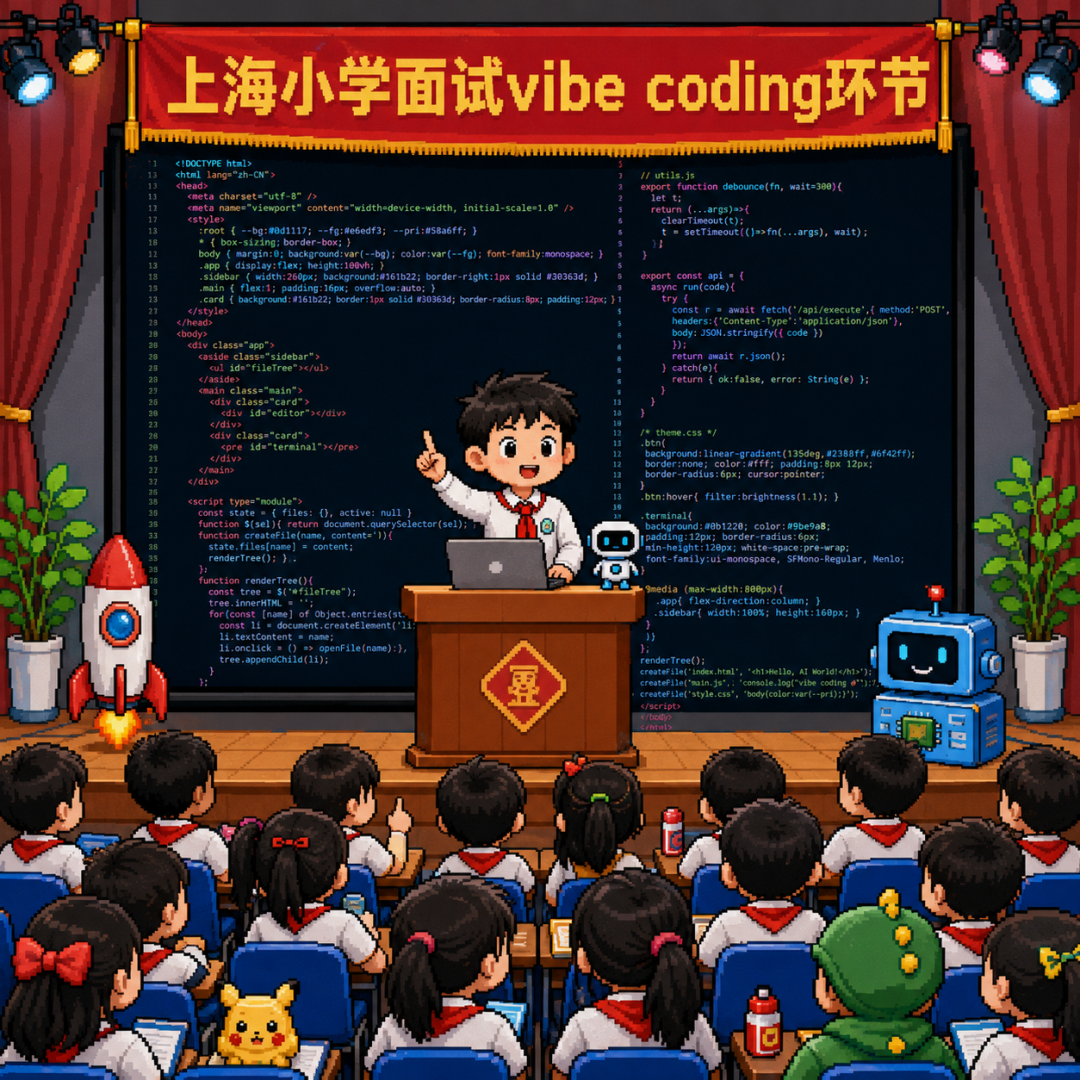
Coincidentally, hackathons as a format, vibe coding as a lifestyle, and prodigies with certain underperforming tech giants — it's a four-way mutual attraction, a match made in heaven:
Hackathons are getting shorter and snappier, less tech competition and more content creator runway show;
Vibe coding happens to lower the programming barrier, letting anyone whip up flashy software prototypes with a few lines of text, making the runway show even easier;
And prodigies benefit from the democratization of AI development, while using their "young age" and "low education" as spectacle to carve out an entirely new content niche;
Finally, some tech giants never caught this AI wave to begin with, so they're coasting on old momentum, treating AI as a cultural phenomenon for social media hype, desperately trying to get a seat at the table.
I get it though. Otherwise Diandian can't answer questions, Miaoda has zero name recognition, and Lingguang only exists in ads — what else can they do? Just host hackathon after hackathon, bring in prodigy after prodigy, have them build demo-only projects on-site with these AI products, to prove they're deeply connected to the AI era.
Essentially they're running hackathons as AI-themed talent shows, and of course talent shows need kids to perform.
Makes perfect sense.
In other words, they've run out of He Tongxues.
As the sole beneficiary of 5G, He Tongxue pioneered this path of packaging tech theory as variety show content. Unfortunately, his age and focus area can't keep up with the times anymore. What the AI world needs now is a younger, less-schooled, more hype-worthy Little He Tongxue.
"The little lotus just shows its sharp tip..."
Here's my sincere suggestion: just go all the way and host a fetal hackathon.
Recruit 100 expectant mothers as family members of contestants, X-ray specialists and infant linguistics experts as staff, and put on an unprecedented, spectacular hackathon with the lowest average age in history.
Undoubtedly, if even a fetus can use your product to vibe code some demo, then your product truly deserves recognition from every demographic and social class worldwide.
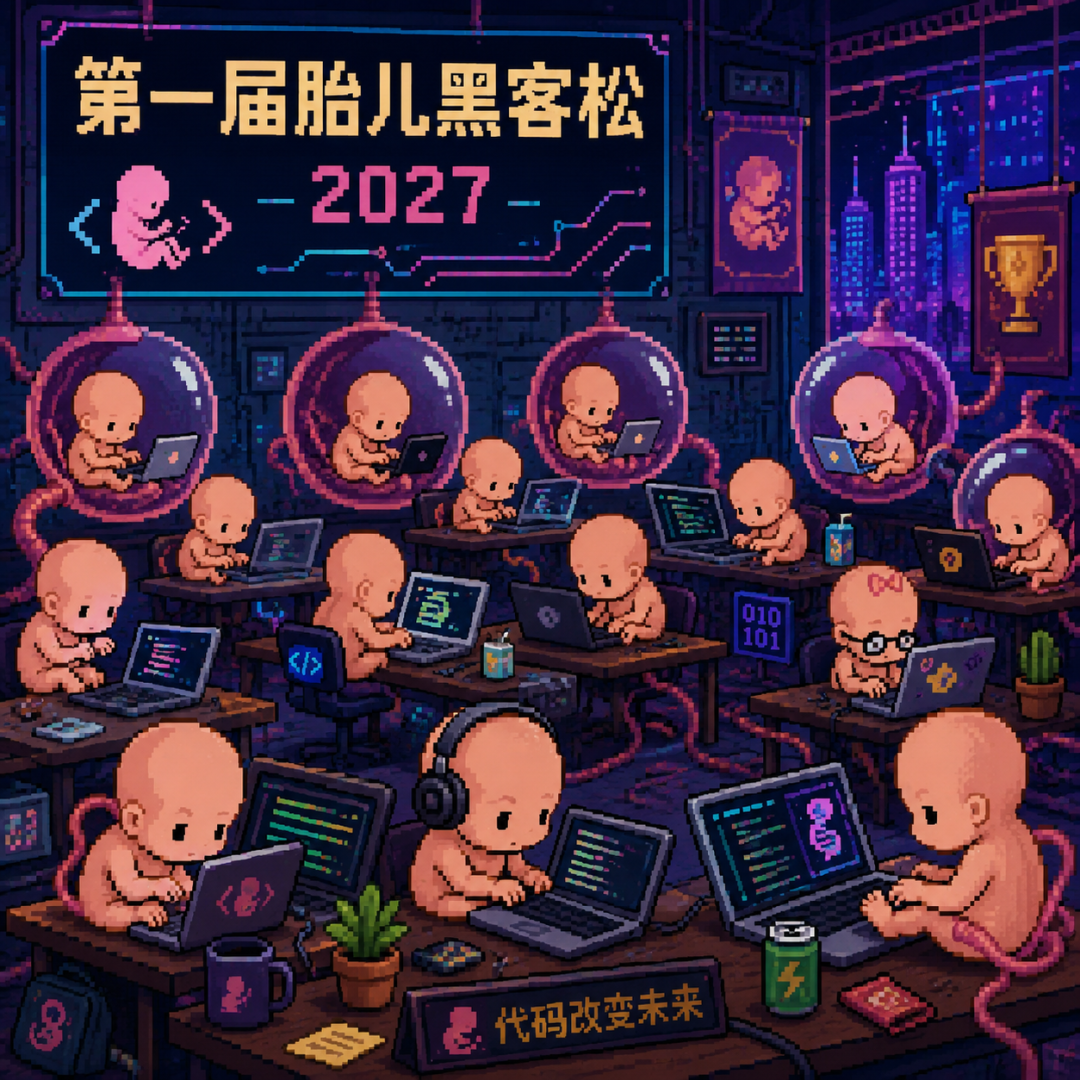
I've even planned out the competition segments for you.
First, AI zhua zhou — see which fetus grabs Codex, Claude Code, or Gemini. Domestic options fine too, you use whatever you grab.
Then straight to demo presentations. That's right, no live coding step, because from what I can tell, today's hackathon pros are all touring the country with pre-built demos anyway, barely anyone codes on-site. The parents can vibe out the product at home in their spare time.
Workshops run simultaneously, no need to bring in experts — just search Ximalaya for #prenatal #tech, find long-form audio tagged with both, and hit play. Can't find any? Have Doubao generate a few episodes. Honestly, the lectures at current hackathons are basically either ads or prenatal education anyway.
After workshops, straight to networking. Parent group chats, group photos, WeChat Moments reposts, media coverage. The myth-making machine starts!
Way more efficient than current hackathons, right? One event, 100 prodigies. One report a day, that's nearly half a year of content.
Or just host a pet hackathon.
Isn't there that thing about giving a monkey a typewriter and it'll eventually produce Shakespeare? Give your cat a keyboard, it might actually get 100 stars on GitHub.

Note: The above is satire and mockery. If anyone reads this and actually organizes such an ethically abhorrent event, I bear zero legal or moral responsibility.
Oh right — beyond tech giants' structural demand for prodigies at hackathons, the VC world's obsession with founder youth is also slightly terrifying.
Their daily mood: "Gen Z founders are the light of my life, the fire of my loins, my sin, my soul..."
They see minors and their eyes light up. In Western countries, this is how you get arrested.
And lower education is better too. From what I can tell, VCs investing in AI founders apparently operate on an internal caste system.
Brahmin founders: still in middle or high school
Kshatriya founders: expelled from university
Vaishya founders: voluntarily dropped out
Shudra founders: completed their education or born before 2000
We used to think lower education correlating with higher achievement was exclusive to rap.
We were wrong.
Or rather, if GAI and PG One had spent their school years carving code instead of lyrics into their desks, would China's richest person be someone else today?
History has no what-ifs. All I know is, even if they suddenly wanted to wrapper Suno and enter the AI music product赛道, they'd be barred from VC offices for the crime of being born too early.
After all, major VCs are busy hosting one Gen Z event after another. Age is the hardest gate; everything else is flexible — the kids are young, their products are prototypes too, there's plenty of time ahead, infinite possibilities.
I suspect these VCs just open Excel during interviews or events, highlight the age column, sort low to high, and start from the youngest. Over 25? Straight to the chopping block.
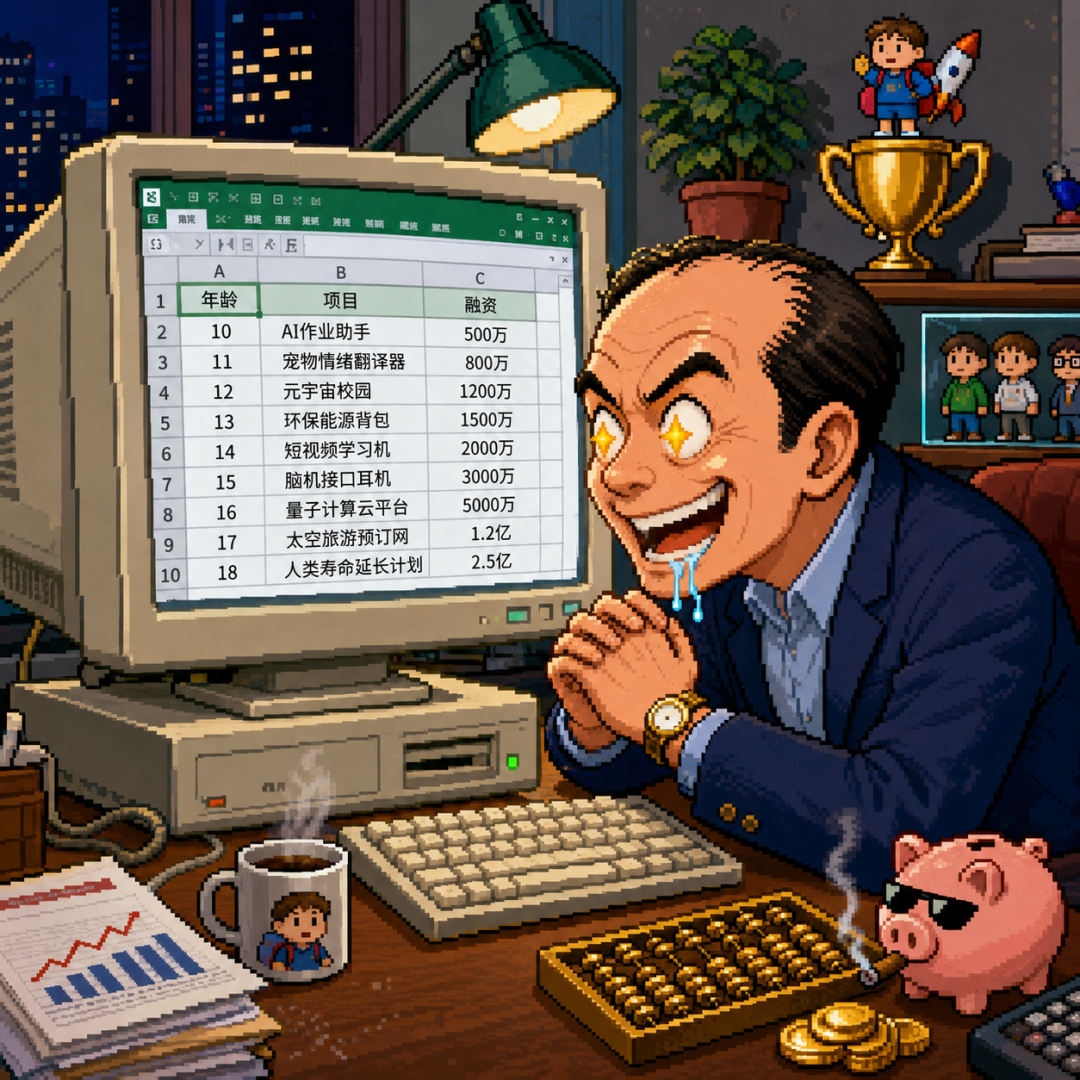
Very possible. There's this unsavory rumor that reached my ears: middle-aged investors seek out young Gen Z partners to demonstrate to peers that they can still empathize with new-generation thinking and context.
Totally understandable. Especially in 2026, with intergenerational internet warfare intensifying, memes like "boomer" and "dad vibes" are like steel wires pulling them closer to spiritual senility.
Spending money to connect with youth, and Silicon Valley's trendy longevity research — two sides of the same anti-aging coin. The latter pushes them farther from life's endpoint; the former pulls them closer to its beginning.
It is fear of death that drives investors to complete angel rounds. Gen Z entrepreneurship is fundamentally a business of selling anxiety.
So date young people, invest in young people's projects. It's all sustenance of love.
And to readers of this article right now — is anyone here not because they agree with anything this publication says, but simply because two of our three authors are Gen Z, and you've kept following just to inject some tirzepatide into your baijiu-soaked brain?
No offense.
All in all, the gaokao just happened, college life approaches. If you're a Gen Z aspiring to make it big in the venture world, you need to seriously consider your next move.
After all, the high school dropout window has already closed. Don't miss your next funding milestone.
(Cover image generated by ChatGPT; article purely human-written)
⬇️
Subscribe to our Substack funeralai.substack.com