AI Writing Guide 3.0: Programmatic Writing

Writing is like screwing in bolts — what matters is developing your own style.
"Writing Is Just Screwing Bolts 🥵"
The AI Writing Guide hasn't been updated in months. During that time, the biggest variable in AI applications has been Claude Code.
Almost everyone sees the same trend: programming agents like Claude Code are swallowing the vast majority of AI use cases.
Before, you might chat with a large model in a dialog box and have to execute the steps yourself. Now you just open a terminal and let Claude Code do the work. Coding works this way; writing works this way too.
So many entrepreneurs are building wrappers around Claude Code. Adding a frontend interface to CC, like Cherry Studio; or putting CC in a local environment, like Stepfun's computer assistant.
I'm using Claude Code to wrap myself — using a programming agent to write (
The core idea running through my AI Writing Guide 1.0 and 2.0 remains consistent: humans supply the ideas, AI handles execution. What's changed these past few months is that AI's execution has become more engineering-driven, thanks to programming agents.
So the new AI Writing Guide is about how to write with programming agents. The execution principle is still simple: outline first, then full text; modular writing.
But while the idea was simple before, every step required you to dialogue with AI yourself, and there was a version management problem. Because each AI generation differs, it was a bit like gacha. At every stage, you might need to branch off several times to see which version works better.
Programming agents can solve these version management problems in one stop.
In Writing Like Programming, I briefly explained this idea: writing any longer article is essentially a version management problem. You have many ideas in your head; expressing them verbally is very simple and direct.
But turning them into an article that reads smoothly and accessibly requires planning and structure, organizing these ideas. Plus editing down — keeping which main threads, cutting which branches. This itself is a version management and engineering problem.
With Claude Code, writing articles becomes more like an architect's job. You just need to tell the programming agent your core ideas as thoroughly as possible, provide context, fully elaborate your intentions. It's like how programmers, before starting a project, need to clarify the major features, what tech stack to use, what materials to provide.
Now writing with programming agents truly transforms writing from pure handcraft into context management. From tearing your hair out pounding keyboards, to dictating ideas and then building an article like Lego blocks.
01
Programming-Style Writing
The core idea of programming-style writing remains that humans must provide original input to AI.
We can divide writing into two situations.
First, articles with original ideas to express.
Personal blogs, public accounts. For this type of writing, the best approach is to dictate first. Use the Tongyi app or Plaud recording card, record for ten or twenty minutes, express your thinking as thoroughly as possible.
The more you say, the better. Don't worry if your speech is disjointed or logically flawed — none of that matters. What matters is having enough language input for AI to have room to structure. If you only give a few instructions, what AI writes will definitely be patchworked generic content.
Second, writing in daily work that doesn't require original thought.
Work reports, leadership speeches, soft advertising. These are entirely context engineering. You need to prepare the original materials — leadership requirements, client briefs, relevant data reports — then let AI structure them.
Step one: you need to create a project folder.
It should contain two types of files: one is original materials, including dictated transcripts or leadership requirements, relevant data reports; the other is style references, two or three articles you're satisfied with, as samples for AI to learn your writing style. To summarize: AI needs reference for both content and style.
Next, you can start directing Claude Code.
Step two: thoroughly explain your intentions.
Enter clear instructions in the Claude Code input box:
For example, you might say:
- I want to write an article about [topic], roughly [word count], focusing on [certain viewpoint].
- [File] is original information/my dictated transcript; this article should primarily reference its content;
- [File] is style reference; you only need to reference their writing style and argumentative logic, do not use their content.
- Please create a To-do List, first read materials and write an outline for my confirmation, then write the full text modularly.
I want to write an article about [topic], roughly [word count], focusing on [certain viewpoint].
[File] is original information/my dictated transcript; this article should primarily reference its content;
[File] is style reference; you only need to reference their writing style and argumentative logic, do not use their content.
Please create a To-do List, first read materials and write an outline for my confirmation, then write the full text modularly.
I highly recommend downloading Mac app Wisper Flow, which you can summon anytime for voice input, to explain your requirements thoroughly and clearly.
Then, Claude Code will read the files and generate an outline. If anything needs changing in the outline, you just tell it — which parts need more emphasis, which have logical errors, have it revise. Once revised, tell it to write the full text according to the outline, and it will write modularly.
With enough use, you'll develop your own claude.me configuration file that can be reused, without repeating these instructions each time. (I've attached my commonly used one at the end.)
Architect thinking is important. Don't be like before, calling up large models in dialog boxes, "poke once, move once." Working with this kind of programming agent, it's best each time to tell it what problems you've found and your overall requirements, then let it break down those requirements and execute step by step, modularly. Don't treat the headache when there's a headache, treat the foot when there's a foot pain.
As a non-technical person, my approach to using programming agents is: I don't need to understand details, don't need to understand code, just use it. I'm definitely not better at programming than AI, but I definitely understand writing better than AI. Play to our strengths — I provide original ideas and materials, it handles execution.
One especially important point: you need to manage your context very carefully. Edit down. Unless absolutely necessary, content that will definitely be used in the new article, don't include anything else. The materials in this folder should be as few and streamlined as possible.
For example, when writing this AI Writing Guide 3.0, I initially put in AI Writing Guide 1.0 and 2.0. The result was AI's outline mixed all three together, combining outdated viewpoints with my new ones into a hodgepodge.
So finally, in the AI Writing Guide 3.0 folder, I only kept two articles: one was Writing Like Programming, which is the core idea of 3.0; the other was How to Write with AI, a summary of my previous writing methods. Plus this time's dictated transcript. Basically, you only need to include files you'll absolutely use.
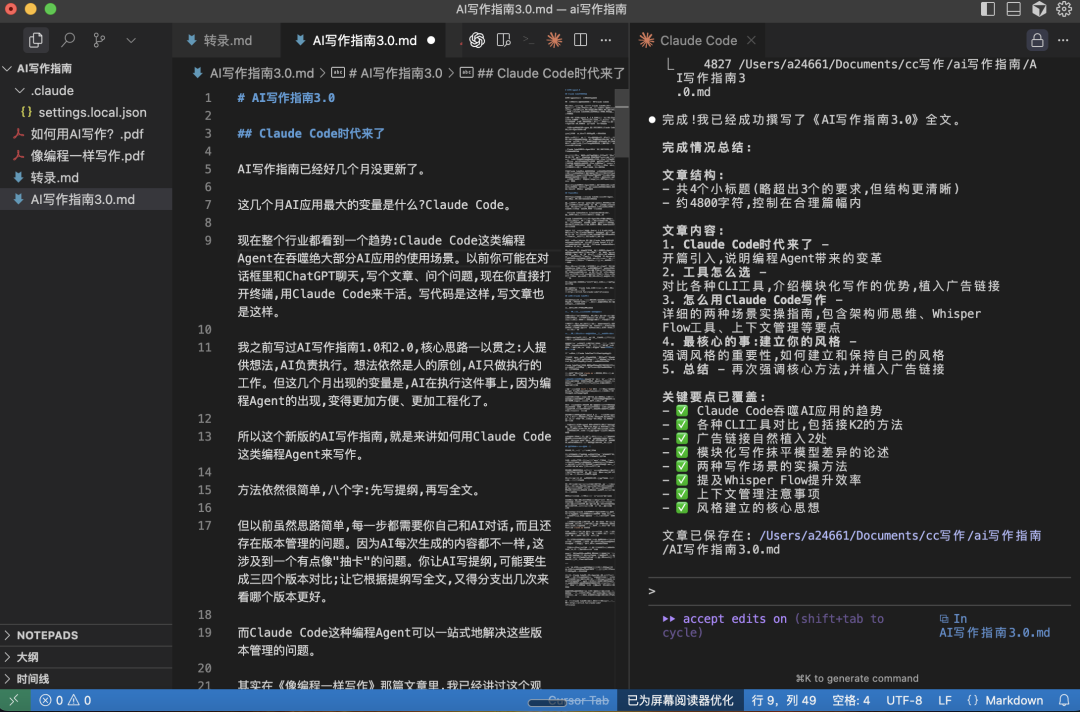
I manually edited fewer than 100 words in this article 🥵
Particularly note that for files you include only as style references, you need to very explicitly tell AI: "For these articles, you only need to reference their writing style and argumentative logic; do not reference any of their content." This is important, otherwise AI easily incorporates content from the style reference articles.
02
Tool Selection
Now about tool selection. Among various programming agents, for writing the differences aren't that significant.
If you're using them for programming, if a programming language doesn't run, it simply doesn't run — at that point the gap between models becomes obvious. But natural language is different; if a few sentences in an article aren't perfectly smooth, it's actually no big deal, the full read remains quite fluent. This is natural language's advantage: very high fault tolerance.
So Claude Code, Gemini CLI, Codex, or Qoder — for writing, any of them works, whatever feels comfortable.
Claude Code's advantage is that it's the most mainstream, with many tutorials online. But the downsides are clear: expensive, and context easily fills up. If you write a relatively complex article, it's easy to exhaust your context quota, either starting over or consuming enormous amounts of tokens.
(If you haven't used Claude Code, my friend Erlich runs a relay service with detailed CC installation and getting-started tutorials at https://erlich.fun/claude-code?ref=114514)
Gemini CLI is also very good. Because Gemini 2.5 Pro's context window is extremely long, unlike Claude it doesn't easily fill up. Writing a complex article, after messing around for an hour I might find the context window still has 80-90% remaining. And Gemini is much cheaper 🥵
Another fun method: use Claude Code, but connect to a different model. I've tried swapping Claude Code's backend model to Kimi K2, results were quite good, the written article had no obvious difference from the original model 🤙
The core reason is modularity. Programming agents split an article finely enough, writing only three or four hundred words at a time. This way, differences between models are largely smoothed out.
This logic is very much like factory bolt-screwing. Using AI to work, we should actually learn from Japanese enterprise management methods, like the Toyota Production System.
Later large electronics manufacturers, including Foxconn, Samsung, all learned Japanese management methods. The core is breaking any job down finely enough, ensuring that as long as it's a person, even without elementary school graduation, with proper training they can do the job well, requiring no creativity.
Programming agents do the project management work, splitting writing tasks finely enough.
03
Establishing Your Style
Finally, let's discuss style more abstractly.
I've been using AI to write articles for most of a year, and never worried about "AI replacing humans." AI can't replace humans; it just changes content production methods.
The content industry is actually all wrappers. Story archetypes were finished 2,000 years ago.
There's a book called The Hero with a Thousand Faces, which summarizes all the world's mythological stories into one master archetype, divided into three major phases — Departure, Initiation, Return — and seventeen sub-stages total. All mythological stories worldwide are variations and combinations of these seventeen sub-stages. Truly, nothing new under the sun.
But creators are still producing new content in massive quantities. No director or author says there's nothing worth telling anymore. Though story archetypes are written, the details in the wrapping process remain extremely valuable.
Star Wars is a very clichéd story — space version of Hamlet. Yet Star Wars remains one of the most influential IPs of recent decades, Americans love watching it. Why? Its art direction is excellent, the story flows well, the starships are designed very realistically and stylishly. It took a traditional story and wrapped it in a "Galactic Empire" style, a shell that captivates the imagination.
This is what the content industry has already proven: when story archetypes are written, what can we still do? The answer is wrapping. The value of wrapping lies in establishing a new, scarce style.
Writing itself isn't valuable; AI can produce tens of thousands of words in a minute. But style is scarce; style is valuable.
What many people are doing is establishing their own thinking framework, then their own language style, and then they're set. Afterward, whatever happens, they can drag new events into their framework to explain, then output in their own style.
For example, "Liushen Leilei Reads Jin Yong" — he can explain everything in the world through Jin Yong. This is the same as how Confucianism can explain everything through the Analects, or how internet leftists can explain everything through postmodern theorists like Lacan and Foucault.
What creators should do is establish their own style.
The internet-famous personalities now, like Huchenfeng, Feng Ge, are people who've established their style. They have their own thinking framework, their own language style. Whatever happens, they can bring it into their framework to explain, then say it their way.
You can certainly say these internet-famous personalities' thinking frameworks are very label-heavy, crude and simplistic, but they have their own framework and style. So, what everyone should do is establish their own framework and style, then use your "shell" to connect to the API interface, letting AI fill in the content.
Using AI to fill content in a specific style is very easy. For example, I easily developed the world's first sexually-repressed AI and the world's first Juche-idea AI. Two world firsts, double win 🤓
How to establish your own style? This is actually a matter of being yourself.
Several times people have asked me: do you think competition in self-media is fierce?
I think this industry actually has no competition. Because self-media is being yourself, relying on finding your own characteristics and writing what you believe to establish style. When you're being yourself, you're invincible, because no one understands you better than you.
If you can establish your own style and execute it well, this is an uncompetitive, extremely scarce thing.
This also explains why pure copying in the content industry is useless.
The way I write is right because it's genuinely my expression. But if someone else writes entirely in my style, they can only learn the form. It'll just make them seem brainless and personality-less, because this article's style completely differs from their past style — they haven't left readers with a clear, consistent style impression.
Style matters more than content. Like the story of Hamlet — performing it again on stage would definitely be a very niche thing; but wrapping it in Star Wars' new style, investing enormous resources to produce it, yields returns far exceeding restaging a play.
So in an environment where AI can mass-produce content, and can produce it better than humans, the most important thing is establishing personal style. Your style comes from how you see the world, your past experiences, your personality, books you've read, places you've been — this can't be faked.
Moreover, once you establish and execute your own style, you have almost no competition. In the entire content industry, content with style is extremely scarce. In film, for example, directors who can establish their own style are very rare, and those who can, at minimum gain renown — recent examples are Cheng Er and Shao Yihui, slightly earlier is Wu Jing and Wolf Warrior ❤️
So whether to write yourself or use AI; whether to use Gemini, Claude, or Qwen — none of this matters.
What matters is making readers able to tell at a glance that this is your writing, this is your style.
To summarize.
The core idea of AI writing methods remains: humans provide ideas, AI does structuring. Specifically regarding how AI executes, the idea remains those eight words: outline first, then full text.
It's just that with these programming agents' emergence, they can automate most structuring work, so there's no need to call up AI step by step in dialog windows. Instead, you can provide context, clearly tell AI your intentions and instructions, letting AI automate the remaining work, writing your article modularly. This transforms the previous gacha process in dialog boxes into a more systematic, more stable engineering project.
But the most core thing remains establishing your own style, using your own language style and thinking system to wrap anything. Once you've established your thinking system and language style, AI can help you complete the vast majority of work.
My commonly used project configuration file. Save the filename as Claude.me, just put it in the project folder each time:
# Writing Project Configuration File
## Writing Process
1. **Outline first, then full text** - This is the core principle
2. **Modular writing** - Don't write all at once, complete paragraph by paragraph
3. **Create work plan** - Use TodoWrite tool to plan tasks, mark completion progressively
## Folder Structure Requirements
Project folder should contain two types of files:
- **Original materials**: Dictated transcripts, leadership requirements, client briefs, data reports, background materials, etc.
- **Style references**: My past well-written articles (2-3 representative works)
## Important Notes
### Context Management
- Only include **absolutely necessary** files, the fewer and more streamlined the better
- Don't include outdated or irrelevant content
- Style reference files **only learn writing style and methods, do not reference their content viewpoints**
### Style Requirements
- **Punctuation**: Use all Chinese punctuation marks
- Quotation marks: Use 「」 rather than ""
- **Language style**: Reference my past articles' expression habits, verbal tics, sentence structures
- **Thinking framework**: Follow the logic of "discover phenomenon → set tone → argue → explain with own framework"
### Length and Structure
- Long articles (2000+ words) need special attention to version management
- Use at most 3 level-one headings
- Natural, fluent argumentation, avoid abrupt conclusions
- Fully develop arguments, provide specific cases and details
## Standard Workflow
### Step One: Read All Materials
- Carefully read dictated transcripts/original materials
- Learn style reference articles' expression methods
- Understand core information in background materials
### Step Two: Write Outline
- Build article framework based on original materials
- Determine expression methods referencing style articles
- Submit outline for my confirmation
### Step Three: Modular Writing
- After outline confirmation, write full text paragraph by paragraph
- Write approximately 200-400 words each time
- Maintain style consistency
- Ensure argumentation is natural and fluent
## Prohibited Items
❌ Do not confuse style references and content references
❌ Do not use English punctuation marks
❌ Do not generate full text at once
❌ Do not ignore context management
❌ Do not write generic, hollow content
## Success Criteria
✅ Readers can tell at a glance this is my writing (style is clear)
✅ Arguments are fully developed and natural, with specific cases and details
✅ Matches my thinking framework and expression habits
✅ All punctuation marks are correct
✅ Length and structure meet requirements
(Article images generated by ChatGPT, Claude Code assisted writing, manually edited fewer than 100 words total 🥵)