A Year After Burying AI, I No Longer Write With AI

Use it or don't.
"Take It or Leave It"
The day before yesterday last year, ZangAI published its first article: "Only Hypebeasts Do 'One-Sentence Generation' AI."
At the end of that piece, there was a parenthetical: "(Images in this article generated by ChatGPT 4o, writing assisted by Claude Sonnet 4.)"
This became a ZangAI convention. We'd disclose our writing process at the end of every article.
But now, I barely use AI to write anymore. So much so that when family members ask if our "purely human-written" tag at the end is some kind of anti-AI protest...
That's pretty funny, folks.
The reason we started ZangAI was to build an AI writing product. But execution went off track — the writing product never materialized, and we went careening down the path of self-media instead.
This is purely an information input problem.
The writing process itself is creation. When a person types, they think, constantly generating new ideas. The process is the information input.
AI writing, by contrast, can only compress existing information. It's fine for structured text, terrible for creative writing.
My trigger for using AI writing was Claude Sonnet 3.5. October 2024, when the new 3.5 dropped — that's when AI's writing ability surpassed mine.
I'd just switched jobs, doing short video at Huxiu. Back then Dario hadn't gone full crazy mode yet, Claude didn't ban accounts, wasn't as evil as it is now.
The new gig was pretty cushy. Weekly KPI: two videos. With Claude, I could bang out a script in an hour or two. Left plenty of time for Plants vs. Zombies Fusion Edition and browsing Zhihu.
My AI writing method: talk a lot, twenty or thirty minutes, get my thoughts clear. Feed the transcript to AI, let it draft an outline first, then the full piece.
Core logic was simple. AI can only compress existing information from the internet, rarely create new information. So to get good output from AI, you have to give it sufficient information input.
Still the human doing the thinking. AI just structured the information.
Later, Muqiu and I wanted to productize this workflow into a standalone AI writing tool. So we roped in Erlich to develop it.
Side note: Erlich's now doing Proma (proma.cool), billing itself as the smoothest wrapper Agent. Dude's basically hosting product launches in his WeChat Moments, mental state seems solid.
Anyway. As we started writing ZangAI, we also hacked together the AI writing product. Very simple: a website with an input box on the homepage, plus a voice input button.
User talks to the site, AI transcribes and organizes the speech into an outline. User edits the outline in the editor, then AI writes the full piece based on outline plus transcript.
Main problem: AI hallucination was pretty bad back then. Same input, wildly different outputs each time. Some paragraphs in an article would be great, others completely unusable.
Our solution was semantic replacement — three versions written simultaneously by different models, users could swipe left/right to swap paragraphs. Another "brute force" approach 🤓
Another problem: I didn't use my own product.
Real talk, our website was pretty janky. Compared to the Claude web app, we basically added a voice input button and wrapped a "outline first, then full text" workflow. Too little value added. The more I worked on it, the more pointless it felt.
I even shared the product on Zhihu, right in the big conference room where we held the ZangAI Hype Competition. Dozens of Zhihu folks in attendance, everyone seemed into it live. I handed out beta URLs and free credits.
Nobody used it 🤡
Fair enough. I was already using Claude code to write, so why would I use some workflow website?
Others building writing products at the time included Stain's Grimo, which we covered in ZangAI's second article. I gotta say, somewhat useful but not that useful. Main value was as a relay station, letting users access Claude cheaply.
Relay stations aren't the problem. The past year has proven that the main value of AI apps is being relay stations — but the relay station value for text, image, and video models differs completely.
Text model relay stations are programming Agents. Stain himself said he shut down Grimo because he saw Claude code. Shanghai people don't deceive themselves 👍
The ceiling for image model relay stations is Lovart, but let's be real — how much is a Nano banana annual membership? You couldn't burn through crazy revenue even if you tried.
So yeah, Mian really found the meta. Video model relay station LibTV is a much bigger story.
But water under the bridge. Stain cranks out new projects every so often — AI game engine hype a while back, recently going on about Agent-native identity. When I asked him what he's mainly hyping these days, he said "Bro's chasing AGI now, not interested in hype."
Anyway, blessings 💗
Back to AI writing. Another reason I don't use it: ZangAI articles have gotten increasingly unstructured.
The last article I remember writing entirely with AI was six months ago: "Peter Thiel Is China's Rape Dream Chaser." Four subheadings, used Claude code and Moonshot AI K2 Thinking.
Also updated a piece on "Inspiration-Style Writing," my last article on AI writing methods.
But the trend this past half-year: me, Muqiu, and Luozima have all, without planning it, written increasingly unstructured pieces. Only weekly reports and formal reports need structure — structure is anti-human.
We normally just talk however thoughts come. So the most natural, human, joyful way to write is: write however thoughts come.
Think about it. I'm doing self-media, if I still wrote structured pieces wouldn't that just be corporate work?
And unstructured creative writing? AI can't handle that. Because AI only understands compressing information, struggles to judge information weight. It mainly takes my logically chaotic speech and sorts it out, serving as entropy reduction.
But the compression process, the sorting process, the writing process — the process itself is creation.
When I write myself, I constantly generate new ideas while judging their weight, so I can write however thoughts come.
But AI-written articles, especially ones with strong voice, are generally accurate in broad meaning, yet specific paragraphs read vaguely off.
Because frontier models have all gained the ability to judge importance of structured information, but none yet possess the ability to judge importance of details — specific word choice, expression style.
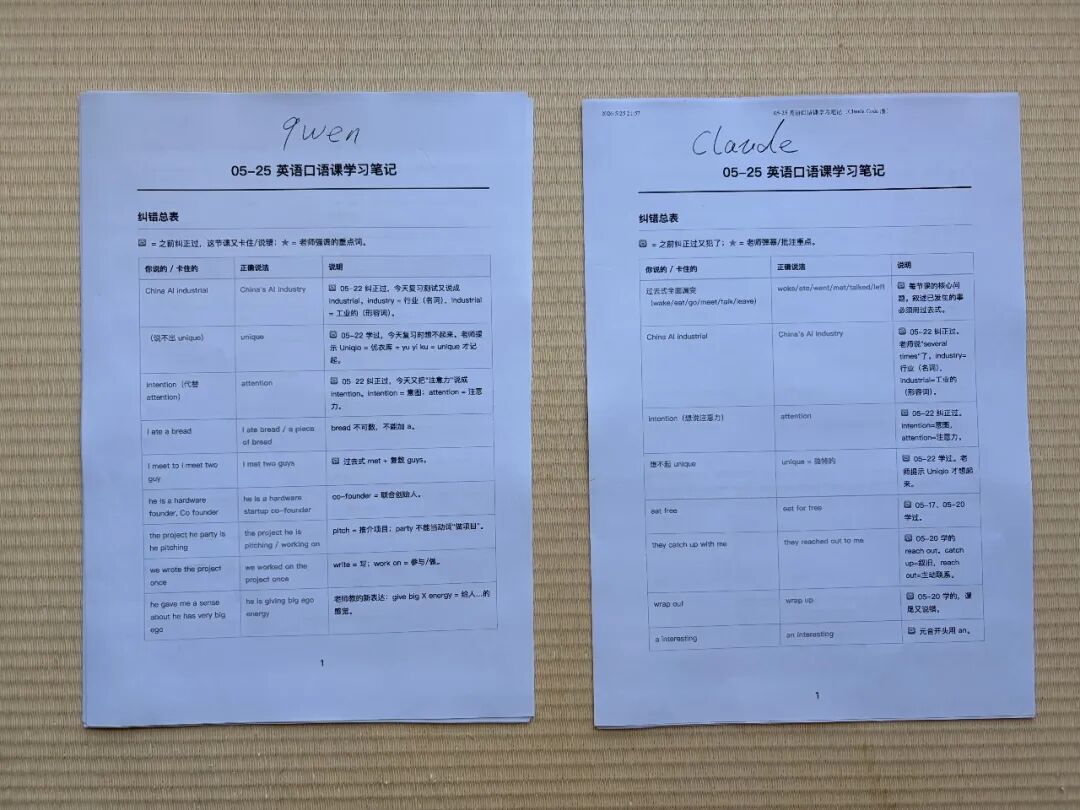
Claude might be relatively better. Example: I've been taking spoken English classes lately. After class I feed recordings and past materials to AI to organize into study notes.
Studying hard 🫡
I used both Claude code and Open code with Qwen 3.7 Max. Claude's notes: 5 pages. Qwen's: 7 pages.
My teacher and I carefully reviewed both. Both broadly accurate in meaning. But Qwen's extra two pages weren't important information — they repeated fragmented grammar mistakes and newly learned expressions across different category sections.
Not wrong per se, just worse information weight judgment than Claude. Qwen tends toward retention and expansion, lacks selectivity. My guess: Qwen 3.7 Max's emphasis on long-horizon task execution creates high-recall tendencies.
Something like that. The problem I encountered with AI writing: AI can judge weight of structured information accurately, produce broadly accurate meaning.
But for unstructured information that constitutes style and humor — specific word choice and sentence construction — it lacks judgment. If I emphasize these details, AI overcompensates.
But honestly, the main reason is: handwriting is just more fun than AI writing now 🤓
AI writing helped me overcome writing anxiety. Now writing itself is entertainment to me. Entertainment shouldn't be outsourced to AI.
Finally, sharing the ZangAI writing style Skill:
https://github.com/FrichXi/zanai-writing-skill
Several people have sent me AI-simulated ZangAI articles. I can only say: similar in form but not in spirit, reads kinda weird. The reasons are everything above — I made this Skill myself six months ago, didn't release it because I couldn't achieve the spirit either.
Sometimes I make myself laugh while writing, genuinely amuse myself. What can a pile of AI scrap metal compete with? 😘
(Cover image generated by ChatGPT, purely human-written)