How a Shandong-Based AI Wrapper Earned Its Seat at the Table | A Conversation with the Founder of Cherry Studio

Wrapped in Greatness 🍒

"Shelling Greatness 🍒"
In this wave of AI entrepreneurship, Cherry Studio and its founder Yinsen are absolute outliers.
Cherry Studio emerged from the open-source community. Unlike most apps that talk a big game but are essentially wrappers, Cherry is the wrapper itself — the product logic is simple and blunt: let everyone freely switch between models for conversation.
Yinsen discovered it on GitHub. At the time, he was working at a startup completely unrelated to AI. He reached out to the project initiator, Wang Qian. Coincidentally, both were in Shanghai, living 800 meters apart. They grabbed coffee, hit it off.
"I hadn't thought about leaving my previous startup. If you'd asked me a year ago whether I'd start a company or leave that job, my answer would probably have been no. I was doing fine there," Yinsen said.
It wasn't until early 2025 that this venture officially began.
Oh right — Yinsen's first job was as a postal clerk, and he even hauled fertilizer. Before turning 20, he thought his destiny was to return to rural Shandong as a postal clerk and live out an unremarkable life.
Perhaps because of this, one investor summarized his profile as "village dog."
He joked that he shattered investors' comfort zones. "I can't craft some story about being a middle-school dropout genius. Obviously I'm not. I did go to school — I just wasn't good at it," Yinsen said.
He still managed to secure investment from two well-known dollar funds.
Yinsen's early investor Gaoliming has met countless founders. The first time he met Yinsen, he realized this wasn't your typical blue-chip entrepreneur. But after 20 minutes of conversation, "he grew taller and taller in my mind — a Yao Ming sitting in a crowd."
Gaoliming said Yinsen can distill complex, messy things into simple, essential elements. "I'd describe something abstract, and he'd quickly find a metaphor. That's classic leadership material."
We half-jokingly asked him how he felt about Cherry Studio being the wrapper itself.
Yinsen's answer: from an evolutionary biology perspective, everything with thick shells went extinct — an absurd yet somehow reasonable response.
"Look at the Permian-Triassic periods and such. Armored animals were actually very common. Stack the thickest armor, take the hardest beating — that's how it went."
In a four-hour conversation, Yinsen described Cherry Studio's goal with clarity and bluntness: unwaveringly use the Claude Code wrapping approach to let users access Agents with the lowest possible barrier. The commercial path is equally simple:切入 the B2B enterprise market.
Cherry Studio's latest development: launching "perhaps the easiest way for ordinary users to install OpenClaw."
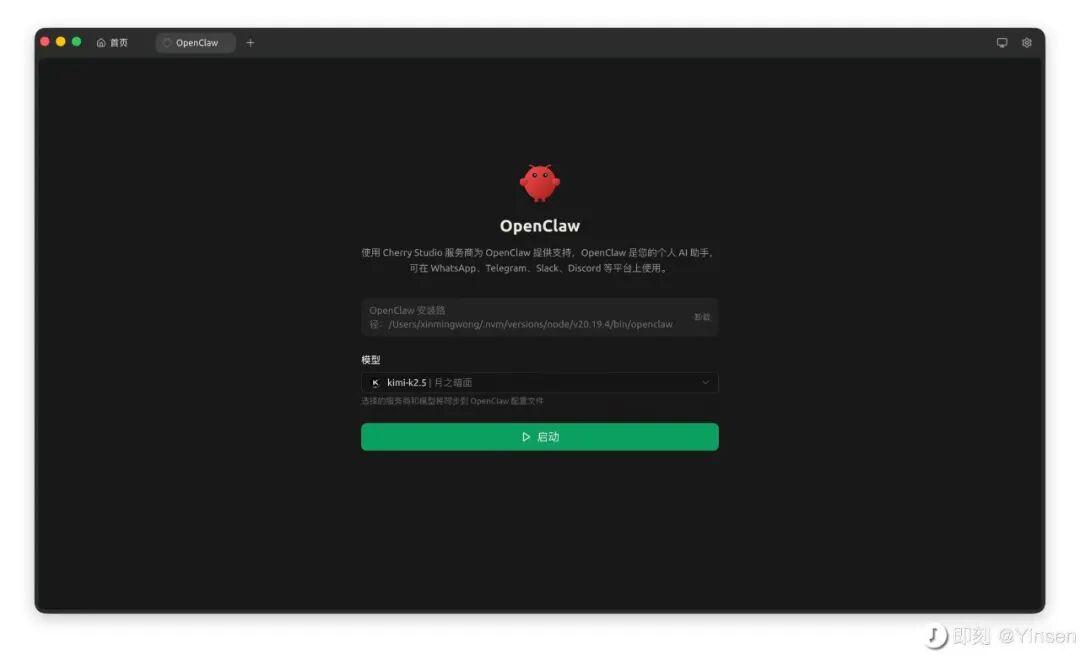
Historically, tool products sat at the bottom of the internet food chain — hard to monetize, low ceiling. But Yinsen says large language models have given tool products an unprecedented opportunity.
He also believes the essence of Agents is taking over all human work in society. In the future, people will only interact with clusters of Agents, and what Cherry Studio ultimately aims to become is the final interface between humans and AI.
"I'm seeing a leader in the making," Gaoliming said.
However, to this day, Yinsen, Xianyu, and I still have no idea what that means 😭
Below is the conversation. You're also welcome to watch our video podcast:
01
"I'm Not an Inferiority Complex Person, But I Can't Get Arrogant Either"
Xianyu: Cherry Studio is my most frequently used large model client in daily life. It's also the one with the largest user base among open-source third-party clients. Yinsen, please introduce it first.
Yinsen: Cherry Studio is what people colloquially call a "wrapper" Chatbox client. From initially only having AI conversations, to later supporting knowledge bases, MCP protocols, and recently Agent-related features.
Xianyu: What's your own background?
Yinsen: My background is actually very poor, close to never having really studied.
Xianyu: I also graduated from a second-tier university.
Yinsen: I might be even worse than you. I'm a vocational college graduate. At YITU, the department I worked in, my boss at the time had a bachelor's, master's, and PhD from Zhejiang University. Many in our department were from the ACM class of Shanghai Jiao Tong University's computer science department.
Xianyu: Would investors like this more?
Yinsen: I think this is a very ordinary thing.
Xianyu: No, a vocational college graduate joining YITU is not ordinary.
Yinsen: If we're chatting casually, actually my first job was as a postal clerk.
Mailing letters and packages, helping people deposit and withdraw money, topping up phone credit — I worked at the post office for a full year. It was truly a life where you could see the end from the beginning.
There were actually six people at the post office, including the director. I was the only one with formal staff status.
Later there was a turning point: I bought a Xiaomi phone. Right after I graduated, Xiaomi phones launched at 1,999 yuan. My monthly salary was just over 800 yuan at the time. I borrowed 2,000 from my dad and paid him back over two or three months.
After buying the phone, I downloaded all kinds of apps. I can't quite remember the storage capacity back then, I think it was 4GB ROM. Basically every day I'd install and uninstall, uninstall and install.
After downloading these apps, I'd send suggestions to the companies behind these app developers. Most ignored me, but one thought my suggestions were excellent. Back and forth, I somehow got an offer.
Xianyu: You later joined YITU at the height of the "AI Four Dragons" era. What was the atmosphere like?
Yinsen: Before I joined YITU, I called my dad and said I'd joined the most awesome AI company. My dad was surprised; he didn't really understand what an AI company was. I said we'd been on CCTV. He thought that sounded impressive and asked what we did.
I thought about it and said we made AI cameras that could recognize people and control access. My dad said it didn't sound that high-tech. At the time I thought my dad just didn't get it — the old man didn't understand.
Inside YITU there were many different slogans, like "In computer science, it's unimaginable that anything could be more interesting than AI" and "AI is a fast lane, and we're incredibly fortunate to be on board."
But after about half a year, I felt many projects were very B2B sales-driven, with AI technology applied in rather single-point ways to products.
Back then we thought AI vision could recognize everything — all cameras, all image information that could be captured could be understood. Actually that wasn't possible. A term we often used was "people-vehicles-non-vehicles" — we could only recognize people, vehicles, and non-motorized vehicles. The application scenario was identifying traffic violations on the road.
Xianyu: So essentially your father, a Shandong man, was correct in his judgment.
Yinsen: My dad, someone completely ignorant of technology, had a neutral public perspective. Actually, the previous generation of AI companies hardly entered the public consciousness at all.
Xianyu: What did you do at YITU?
Yinsen: At YITU I was a software product manager in the intelligent hardware department.
Xianyu: Did you find life interesting back then? Could this interestingness have come from being the person with the worst educational background at YITU, yet being able to develop the same products alongside you — I'm awesome.
Yinsen: I really didn't have this mentality.
I thought they were doing too poorly, having to eat at the same table as me (laughs). Once we had a table of seven or eight people, some from Shanghai Jiao Tong, some from Fudan. I said if you've ended up eating at the same table as me, you need to reflect on yourselves.
I'm not an inferiority complex person, but I can't get arrogant either.
My motivation for doing this: first, it was something new to me; second, joining an AI company gave young people a sense of conviction — they feel this is something extremely valuable for the future. Doing some dirty and tiring work wouldn't shake a young person's conviction in the short term.
Xianyu: Back then YITU's story was that the Cambrian explosion happened because organisms developed eyes, and we were also doing vision, so we were bound to become awesome.
Yinsen: At that time, people's understanding of AI was actually extremely vague. What exactly is AI? What can AI actually do? No one could give a good answer.
You just thought: human eyes can recognize things, so if machines can recognize things, is that AI?
By today's strict definition, it was at best using deep learning technology to achieve improvements over traditional CV techniques. It didn't represent the emergence of truly general capabilities.
Xianyu: You later went to ByteDance.
Yinsen: I wasn't at ByteDance for very long. At that time I was on a cloud computing infrastructure team, doing virtualization, containers — rather technical stuff. Honestly, this deviated somewhat from my main thread.
Whether I was doing B2B products or B2C products in the past, overall I was doing user-facing products.
Muqiu: Did you call your dad again before joining ByteDance?
Yinsen: Still had to call. When you change jobs, you should notify him.
Muqiu: You didn't tell him you'd joined China's greatest company?
Yinsen: Not that far.
Actually, I'm not very sensitive to certain companies' success or what makes them great.
Typical examples like Douyin, Kuaishou, Pinduoduo, Xiaohongshu — I don't use any of these products. But back then I thought YITU, a company with the ideal and conviction of using technology to change the world, was awesome. For things that are really fun to use, really good at killing time — I'm not sensitive to those. That was also the delusion of youth.
I was in Shanghai. Pinduoduo and Xiaohongshu both rose up in Shanghai. But until they got very big, until one day everyone around me was using them, I didn't know they were such massive companies.
I even doubted at one point whether I had judgment problems — completely ignoring the rise of internet new money, only paying attention to geeky stuff.
Xianyu: Why does this sound a bit boring?
Yinsen: I'm a boring person. I watch Geekbench all day, used to play with routers, play with NAS — fairly typical engineering guy interests.
I also developed a habit: whichever app I used for the longest time on my phone, I'd uninstall it.
Xianyu: When you said all that just now, were you proud?
Yinsen: I don't think I'm proud. It's very natural.
I hadn't even registered for Douyin before joining ByteDance. When Douyin started gaining traction in 2017, I thought it was third-rate software, vulgar.
Xianyu: Was that long speech you just gave your own independent thinking, or because you grew up in Shandong, influenced by Confucian culture?
Yinsen: It's just a very personal view. I'm not a typical Shandong person either, and I don't think Confucius-Mencius thought influenced me much.
Mainly I think if you want to watch vulgar things, rather than scrolling Douyin you might as well just go watch porn.
Xianyu: You went from ByteDance to Black Shark, a gaming phone company. Isn't gaming just as vulgar?
Yinsen: I didn't even play games before. At the time, Tencent was planning to acquire Black Shark, so I went in as an advance scout — an opportunist, basically.
The first half of the year started off fine. The internal atmosphere was very upbeat. We were about to pivot to XR.
At the end of September, I took some leave. While I was away, a colleague messaged me saying the company was in trouble, that it was going under. I thought it was nonsense.
Turns out it was confirmed — Tencent terminated the acquisition. I came back after the October holiday, and there were hardly any people left. The whole thing lasted just over six months.
Muqiu: What did you feel? A company just over because an acquisition fell through?
Yinsen: I realized how fragile companies are. Once cash flow stops, it's like a heartbeat stopping — it's over. There's no resilience like you'd imagine.
A thousand-person company isn't small, but it can collapse in an instant.
At the end of December, there was still a VP at the company. One day he gathered the remaining hundred or so of us and said, "I really feel terrible about this, brothers. I wanted to keep everyone and explore other directions, but it looks like there's no opportunity in the short term. I can only say goodbye." And that was it — dissolved.
Xianyu: Is this what they mean when they say a speck of dust from a giant factory becomes a mountain when it lands on a smaller company?
Yinsen: Yes.
Because I'd already worked at big companies. Before going to one, you have these illusions. By then, some of that had worn off. I was thinking, when does it end at a big company? I still needed to build something myself.
02
"Tool Products Have an Unprecedented Opportunity"
Xianyu: Tell us about founding Cherry Studio.
Yinsen: My original thought was that AI was developing so fast that as a user, I couldn't keep up with a lot of things.
Given my habits and style, passive learning works best for me, so I thought I'd build something myself.
I first considered an AI NAS, since NAS has data storage as a foundation, plus with a compute card you could do a lot of inference work. But then I sobered up — NAS is obviously a niche product.
Then I found my co-founder Wang Qian's project on GitHub. He released the first version at the end of July; I found him in early August. The product itself was still pretty simple then, but it was similar to what I wanted to build.
Coincidentally, we were both in Shanghai, living in residential complexes 800 meters apart. We met for coffee, had a meal, hit it off, and just started building in the open-source community.
The idea was simple — through the process of doing this, I'd learn more about AI. That process itself was already enjoyable.
Xianyu: Why do you sound like a successful entrepreneur now? Doing things not for money, but for learning.
Yinsen: That really was the case at the time.
I hadn't even thought about leaving my previous startup then.
If you'd asked me a year ago whether I'd start a company or leave that job, my answer would probably have been no. I was doing fine there, had worked on several important projects.
Everyone was saying the macro environment was bad, that entrepreneurship was hard. I hadn't considered starting a company then.
Xianyu: So your idea at the time was to build a third-party large model client?
Yinsen: My Claude account had been banned three times, GPT once. I was even a paid subscriber, and they didn't refund me. That really pissed me off.
Then I saw some domestic models coming out. If you wanted to use them, besides registering for their apps, there wasn't really another way. You still needed a client.
I looked at other products, including Chatbox, and felt they were all missing something. I needed to build something that felt right in my hands.
Tool products have historically been at the bottom of the internet ecosystem — hard to monetize, low ceiling. People looked down on them. But this was all I was good at. For a long time I was even troubled by this, or found it hard to bear. Eventually I made peace with it — just do what you're good at.
And I felt that with large language models this time, tool products had an unprecedented opportunity.
The excitement and freshness Cherry Studio gave me came from every feature request I made — that freshness was actually given by the model, not the tool itself.
You could cut 95% of Cherry Studio's features and leave only a chat window, and it would still give users that sense of freshness.
Xianyu: You launched in the second half of 2024. Did you really start gaining traction because of DeepSeek R1?
Yinsen: We'd been at it for about four or five months before the Lunar New Year. We had around 4,000 stars on GitHub, growing by nearly 1,000 per month. After DeepSeek blew up, we roughly quadrupled in a month.
Xianyu: How did you catch that traffic?
Yinsen: We didn't catch it — it just fell on us. Because the DeepSeek official site kept crashing, and SiliconFlow launched an API, people needed a frontend, and it flowed to Cherry Studio.
Xianyu: What did the growth process look like?
Yinsen: It started growing around February or March last year, and traffic stayed heavy through April or May. Then it started to decline — not just Cherry Studio, but other products in the industry too.
Many teams that had raised a lot of money would do PR or buy traffic, and their numbers would spike instantly, but the drop-off was just as fast.
User growth is almost completely synchronized with model progress. When the Nano banana pro model came out, designed Agent also blew up for a while.
Xianyu: My experience with Cherry Studio is that new features get added pretty quickly. When I first started using it, there was already a knowledge base feature — Chatbox didn't have that at the time, though the knowledge base wasn't really useful. And you just mentioned MCP support, plus the Claude Code integration now.
When did you decide to add these features? Or do you just add whatever's trending?
Yinsen: We're not pursuing a "small but beautiful" route. We want rich features, the latest features.
We saw some products doing knowledge bases — there wasn't really a trend to follow then, but we felt it was a needed feature. As we kept iterating, we maintained that habit and way of thinking.
We were already working on MCP before the a16z report came out.
I saw a developer on Twitter suggesting to another project that they support MCP — he'd already written the code, they just needed to support it. They thanked him and declined.
So I said, do it for us, for Cherry Studio. He hesitated at first — said he preferred that other project. But later I won him over with sincerity.
Xianyu: What was that project called?
Yinsen: I can't even remember its name anymore. It's become irrelevant.
Xianyu: Is it really irrelevant?
Yinsen: Truly irrelevant. Chatbox-type products have gone through ups and downs. Though it's only been a few years, not many projects have survived.
These products catch fire for a while, people stop using them, and the developers abandon them. That's the fate of most of them.
Xianyu: Are many of Cherry Studio's useful small features your own ideas?
Yinsen: My co-founder probably came up with more of them.
Even though he's in engineering, he has very good product sense.
Xianyu: So you don't write code yourself, and your co-founder has more product sense than you — what do you do?
Yinsen: I'm... a useless product manager.
Muqiu: Were your early conditions scarce?
Yinsen: Our rented office was a 50-square-meter warehouse. In summer the AC didn't even work — it was unbearably hot.
Xianyu: You're telling this story already?
Yinsen: It's true.
Xianyu: You both used to make decent salaries. Pool some money, a few thousand yuan a month in rent, you could have rented a decent office. No need to suffer like this from the start.
Yinsen: Wang Qian and I are both people who don't fuss about these things. At the time we just wanted somewhere close to home, somewhere quiet.
Xianyu: Let me say this in advance, in case you become successful later and bring up this story — though your startup conditions were tough at first, you brought the suffering on yourself.
Yinsen: Right, self-inflicted suffering (laughs).
03
"Agent Eats Everything"
Xianyu: From development in the second half of 2024 until now, what direction have you set for Cherry Studio?
Yinsen: At first it was just making the ultimate Chatbox, then considering whether to do plugins, whether to build third-party apps inside it. There was no talk of Agent then — just making the toolkit more and more comprehensive.
But one day we suddenly understood what Agent was, and we felt Agent should be our future direction. So now we're unwaveringly building Agent.
Xianyu: What do you mean "one day suddenly understood what Agent is"? That sounds made up.
Yinsen: It's real. What really made me understand Agent was Claude Code.
Claude Code launched in May. Since I can't code, one day I told it: go look at our project on GitHub and see what issues there are. And it actually went and looked.
After that I said, check if you can solve this issue. It solved it, set up the environment on my computer itself, and actually built a version.
The feeling was very similar to when I first used ChatGPT. ChatGPT felt like it knew everything, could tell you anything. But Claude Code felt like it could actually help you get things done.
Someone in a room telling you lots of truths versus someone walking out of that room and doing everything for you — completely different feeling.
Before, everyone kept talking about environment, environment this, environment that — environmental protection, family of origin environment...
Xianyu: Where'd all these bad jokes come from?
Yinsen: The word's been worn out. But when I used Claude Code, I truly felt environment.
Claude Code is textbook-level — every module designed with extreme clarity and clear objectives.
At that point our numbers were already decent, growth was strong. But I wondered if Cherry Studio could keep maturing and improving, only to suddenly become obsolete one day. Do you understand that feeling?
Xianyu: Like the fall of ancient Rome, the destruction of Pompeii...
Yinsen: Everyone's building gas cars — Mercedes-Benz, Rolls-Royce, then Porsche — engines getting more and more refined. Then one day Tesla launched.
The auto industry took a century or two to reach that inflection point. In AI, that timeline gets compressed extremely short. Cherry Studio might become instantly obsolete the day it reaches perfection.
We'd been doing plugins, AI apps, third-party development frameworks — all ways to address that anxiety. Later we realized these were all superficial.
Xianyu: Tencent did VR to relieve anxiety too.
Yinsen: That's exactly what it was — relieving anxiety.
The best teams in most industries don't make unnecessary moves. Anthropic doesn't make unnecessary moves. Of course, it's evil — that's the unnecessary move.
Xianyu: Very evil company.
Yinsen: Right. We must criticize it, harshly criticize it. There's another company called OpenRouter that also doesn't make unnecessary moves.
Not making unnecessary moves means they've thought things through clearly enough. They don't need extra moves to relieve anxiety. I think all good companies today share this trait.
Xianyu: Does Cherry Studio have it?
Yinsen: I think for a long time, it didn't.
Xianyu: Does it have it now?
Yinsen: It has it at this stage.
Xianyu: So is Cherry Studio a good company now?
Yinsen: That's a bit thick-skinned. I need to reflect on that.
The changes brought by Agent swept away my anxiety at the time. I even had a vague feeling that maybe Agent is the final answer.
Xianyu: Can you summarize what the essence of Agent actually is?
Yinsen: The essence of Agent is taking over all human work in society.
Xianyu: Kind of like that very evil bald founder at a16z wrote over a decade ago, Why Software Is Eating the World. The example he gave was that companies that could use software would destroy companies that didn't. His final conclusion was that we absolutely had to bet on the internet.
Yinsen: I think the point you raised is excellent.
I've heard that phrase, but today it takes on completely different meaning.
Xianyu: Claude Code eats everything.
Yinsen: Agent eats everything.
The foundation of "software eats everything" has a core production factor: people. Because all code is written by people, the steering wheel is still in human hands.
If that steering wheel is handed to AI, if AI takes over that task, then what eats the world might be Agent.
Muqiu: What does this have to do with Cherry Studio today?
Yinsen: If this scenario comes to pass, the human-AI interaction interface becomes extremely simple.
Humans won't need to face countless backends anymore, just one interaction interface.
I hope Cherry Studio is that final interaction interface.
Xianyu: Damn. That's a bigger story than what your investor told me.
Yinsen: That's why I'm the founder, and he can only be an investor.
Xianyu: Excellent. That's the spirit.
We talked about so much, but you decided to integrate Claude Code before National Day, and Claude Code was released in May. Why did it take five months to make that decision?
Yinsen: It went through two stages. The first stage was seeing something good and it gave you delusions, making you think you could do it yourself, write it yourself.
Just like early on, some application companies thought they could build models too. Later, many companies also had delusions that they could build Agent.
But globally speaking, I think there are fewer than 100 people at Claude Code's level.
We worked on it for over a month, the delusions disappeared, and we honestly stood at attention and took the beating, integrating via the Claude Code SDK.
Even after choosing a shortcut, the work was still done stumbling and crawling.
Xianyu: Do you want some water? You've been talking for over an hour without drinking. Is this a Shandong person's talent?
Yinsen: It's a founder's talent.
04
"One Day I Realized, Cherry Studio Is Pretty Similar to Lark"
Xianyu: Using Claude Code in Cherry Studio still has a pretty high barrier right now — finding model services, filling in the API Key, that whole process is still too complicated. How simple do you want to make it?
Yinsen: This is an inherent problem for an open-source project.
It's not purely commercial software with APIs pre-connected, ready to use out of the box. As an open-source project, it actually has no revenue, so it can't bear the cost of model services.
But commercialization will definitely solve this in the future. We need to provide a consumer-facing product where you can use it right after registering an account. Or we're now launching enterprise solutions that unify the model integration work.
Xianyu: After the commercial product, are you planning to release a separate version?
Yinsen: In the future, when we have the capability and resources.
Xianyu: You keep talking about having resources and capabilities — it feels like you're here crowdfunding.
Yinsen: It's a natural stage.
Xianyu: This Shandong drinking-table banter is excellent. Specifically, what's your plan for domestic B2B enterprise services?
Yinsen: Extremely simple — just solving the problem of enterprises using different models for conversations.
Many enterprise AI projects boast about all kinds of things — digital employees, digital workers — it's all fake. If you can freely and flexibly use various models within an enterprise, you've solved 80% of the problem.
Xianyu: Very commonsensical. We just went off on so many tangents, from knowledge bases to MCP to Claude Code. But actually my mom just started using Doubao.
I also gave internal company talks on how to use AI, but most people could only use DeepSeek. Getting others to use Gemini or Claude was an unsolvable problem.
Yinsen: But Cherry Studio can solve that.
Xianyu: Send me a 500 yuan red envelope later, okay?
Yinsen: Sure, okay.
Xianyu: Let's say I'm a boss, I install Cherry Studio on all 1000 of my employees' computers, these employees can switch between any model — is billing by usage?
Yinsen: We have two pricing models. One is buying a software license and they handle the API themselves. The other is buying tokens directly.
Xianyu: Are token prices higher or lower than official API pricing?
Yinsen: The same.
Xianyu: Very simple and crude, but very logical.
Yinsen: Essential things are all simple.
Xianyu: Besides providing APIs, what else do you want to do?
Yinsen: We want to break into the enterprise market. Of course, I'm going to brag again — the Industrial Revolution brought about something called the three-shift system. Before the Industrial Revolution, people worked from sunrise to sunset, right?
Xianyu: Not confident, you even have to ask me?
Yinsen: I'm not very well-educated.
Why did the three-shift system appear after the Industrial Revolution? Because people were no longer the core element of industrial production — people served the machines, so people could change their schedules.
Right now programmers are still the core production factor. If one day in the process of building information systems, people only need a few check points, to come by and see if the results match their expectations, then people will adjust their habits to match Agent's work patterns.
Today's internet companies, even the most brutal ones, you've never seen a three-shift system. At most it's 007. The reason there's no three-shift system is physiological rhythms and work need to coordinate. In the future when everything is taken over by Agent, people won't need to coordinate either.
So Cherry Studio's future goal is to make Agent the production factor inside enterprises, with people becoming marginal production factors.
Xianyu: I discovered you have an incredible ability — when you're telling stories, you can slow your speech way down, appearing very convinced. Specifically, walk us through your path.
Yinsen: For example, one day I was going to open Lark to send a message to a colleague — of course I don't have many colleagues. But I opened Cherry Studio by mistake, and this operational error gave me a wonderful thought: Cherry Studio is pretty similar to Lark.
Lark has contacts on the left, chat window on the right, input box, conversation flow; Cherry Studio has assistants called Legal Xiao Li, Operations Xiao Liu, also has an input box, also has conversation flow. One day it will become the only interface for employees to interact with the Agent system, they just need to interact with each Agent.
Xianyu: When you were looking around with your sword drawn, suddenly you saw — fuck, my Cherry Studio looks a lot like Lark, and then you thought about killing Lark?
Yinsen: It's an analogy, but my goal definitely isn't to kill it.
Lark is a tool for human-human collaboration. Cherry Studio is a tool for human-Agent collaboration. If one day enterprises don't need human-human collaboration anymore, then they won't need Lark.
Xianyu: But you don't have an editor.
Yinsen: It's been a while. I realized Cherry Studio actually needs this too. I was talking to a friend earlier, Cherry Studio needs a document.
Xianyu: Just like Lark needs Lark Docs.
Yinsen: Needs Lark Docs, you're absolutely right.
Lark Docs is a place for deeper interaction and沉淀 with users — you interact first, then it沉淀s down. If we need an editor, maybe Lark's multidimensional tables are as important as docs, but I haven't thought this through clearly.
Muqiu: You're really copying Lark
Xianyu: About to copy, thinking about copying, wanting to copy.
Yinsen: Can't say copy. Homage, this is homage.
Muqiu: By your logic, next year when I go to the airport, I'll see billboards saying "Advanced Enterprises Use Cherry Studio First"?
Xianyu: Then you'd get sued, can't even come up with a new slogan.
Yinsen: Of course you'd also need somewhere to spend the ad money.
Xianyu: Right now I have this feeling — before when I talked to your investors, they said you weren't that good at storytelling, that the investors saw Cherry Studio as the next-generation Lark, next-generation WPS. But now I feel like you've got a lot of bad ideas in your belly.
Yinsen: I have a habit — I don't design an extremely comprehensive blueprint or framework at the earliest stage, but I can walk and watch, gradually building up that blueprint.
Xianyu: Isn't this just "Duke Zhou feared slanderous rumors, Wang Mang was modest before usurping" — you gradually discover how awesome you are, then you can start drawing pies.
Yinsen: It's not drawing pies. I really believe it.
05
"One Day I Had My Eye on Doubao's Users, Then Slapped Myself"
Xianyu: You mentioned before that a sow breeding client came to you, tell us about that.
Yinsen: We previously tried doing some large-B clients, all of whom came to us proactively. Insurance, scientific research, also power, steel, automotive and other industries.
Xianyu: You saying this, plus your whole vibe, really makes you look like a Shandong big brother preaching enterprise spirit to us.
Yinsen: The Shandong temperament hasn't been worn away yet.
Validation did show us many real needs, but later we felt our pricing was still too high.
So we made a very cheap version, a 5000 yuan version. Once this goes out, we hope clients all come contact me.
5000 yuan, can't lose out, can't be fooled.
Xianyu: Crazy advertising.
Yinsen: The ad density is too high.
That guy I mentioned who wanted to do sow breeding — he actually reached out to me many times. He asked about a lot of our features, and even asked if we supported Lark login, which means he's a Lark user — not throwing shade at Lark here.
In the end, he went with the community version of Cherry Studio.
Xianyu: Right now when an average user downloads Cherry Studio, they actually get some free API credits.
Yinsen: Zhipu AI and SiliconFlow each provide a bit.
Xianyu: What else can you do with that?
Yinsen: I think it's enough.
Xianyu: So if you don't pay, this is as far as you get.
Yinsen: If you don't pay, this is as far as you get.
For an early-stage startup, there are so many things to do. This is obviously something that needs doing, but whether it's important — I'm putting a question mark on that.
Another example: one day I saw people on Twitter discussing how Doubao now has extremely high penetration in China, how basically everyone is using it.
I felt a wave of despair for a moment, thinking "my god, Doubao has taken all the market." Then I wanted to slap myself — "who do you think you are, eyeing Doubao's users?" That was an irrational reaction.
Doubao's target audience is definitely all-stage, with a low enough threshold. Like scrolling through TikTok — forget about being a person, even a monkey could scroll. They're going for the greatest common denominator of user experience.
For Cherry Studio, that's not it. Chasing very consumer-oriented users has no value for us.
Even between Power C users and SMB users, I'd probably lean toward SMB. Power C is an important decision-making individual, but not necessarily the best paying customer.
Xianyu: Obviously I'm your Power C user.
Yinsen: Right, and you haven't given me any money either.
Xianyu: I can only write articles saying Cherry Studio is great. I'm not going to directly send you money.
Yinsen: That's already not easy (clasps hands in gratitude 🙏).
Xianyu: Two-faced.
06
"Before 20, my destiny was to return to my Shandong village and work as a post office clerk"
Xianyu: What do you think you're great at?
Yinsen: What am I great at? This is really...
Xianyu: Right, nobody asks you this kind of question.
Yinsen: This is the first time I've been genuinely stumped.
I think I do have some strengths. I consider myself very honest — I basically don't lie to myself.
Another thing is I have an instinctive ability to build frameworks, to put seemingly fragmented things into a framework.
Xianyu: After that whole Lark spiel just now, I deeply feel that.
Yinsen: Why I say it's instinctive.
Actually I haven't had much training in this. Before, at mid-tier and big companies, I rarely studied hard to learn their so-called management thinking, business thinking, or internet jargon.
You can probably tell — I rarely throw around big words.
Xianyu: You speak Shandong jargon.
Muqiu: But some investors say they see you as a "country bumpkin" founder. Do you agree?
Yinsen: Calling me earthy is fine, but why the dog part (laughs). There's nothing I can do to change this.
Muqiu: Do you get questioned more because of your background?
Yinsen: There definitely is skepticism. For example, this one firm famous for investing in elites — ask them to invest in a PhD, easy; Tsinghua or Peking University undergrad, they think that's fine too; a 985 grad, they're a bit reluctant; a 211 grad already causes them considerable pain.
I basically tore right through their comfort zone.
Muqiu: Is this background more helpful or more of a disadvantage for your entrepreneurship?
Yinsen: It doesn't matter. I have no choice. I can only do this kind of thing based on this foundation.
It definitely doesn't add points. It definitely subtracts points. But if you want to deduct, deduct — there's nothing I can do.
I can't craft a story about being a middle school dropout genius. Obviously I'm not. I did go to school — I just didn't do well.
Muqiu: Did you think about changing jobs during university?
Yinsen: No, I was very late to mature. Before 20, I felt my destiny was to return to my Shandong village and work as a post office clerk, then live out a mediocre life.
Xianyu: Was this your fear, or did you feel this was your destiny?
Yinsen: I felt it was my destiny. I didn't feel fear, because it was normal. That's just everyone's life.
When I first started working at the post office, I was a general counter clerk. Back then the post office also sold fertilizer and pesticides. I even had a job loading fertilizer onto tractors. After loading, I'd come back and do savings business, and do fingerprint authorization.
I didn't actually feel it was bitter, or wonder why I had to do this kind of work. I never thought that way.
Xianyu: Quite the model worker for the new era — capable of both desk work and hauling fertilizer. Sounds quite positive energy.
Yinsen: I didn't feel it was positive energy.
It was just my job at the time. I really did work my way through it.
Only later did I feel this wasn't what I wanted to do. Today you'll notice I talk about a lot of new things. I don't like talking about repetitive things, and I don't like doing repetitive things.
Xianyu: How many times have you told this Lark story?
Yinsen: Getting a bit tired of it. Don't want to tell it this way next time.
Xianyu: Next time craft an even more impressive story.
Yinsen: Sure, next time it'll be punching OpenAI and kicking Anthropic.
Muqiu: You said you might live a life where you could see the end from the start. From that to today doing Cherry Studio — do you feel much has changed?
Yinsen: Objectively it's big, but subjectively I feel it's okay.
Actually I've been asked similar questions before, so I came prepared.
Around 2021, a colleague was at NIO. They were going to do Onvo, targeting white-collar workers in their twenties and thirties, and their car was going to compete with Model Y. I happened to be a Model Y owner.
So they surveyed me. They asked, do you think you're hardworking?
By then I was already at ByteDance. Objectively speaking, from Shandong village, garbage education credentials, from post office to a top-tier tech company — the difference looks pretty big.
Objectively there seem to be results of hard work, but subjectively I don't feel I worked hard.
Frankly, in all my past work experiences, I never felt any company made me go all out, push forward relentlessly, not sleeping or eating. Today, this past half year has been my most hardworking half year.
I'm not someone who works hard subjectively, but if pushed I can work hard a bit.
Subjectively I don't feel a big difference. That was one life, this is another life. But the positive meaning this life brings is, I've seen things I completely couldn't see before, and I have the opportunity to see even more.
I very much enjoy this feeling.
Muqiu: So do you have ambition or not?
Xianyu: Another awkward question.
Yinsen: I'm intermittently manic. Sometimes I feel I need to be the most awesome in the world, crush these traditional companies. Sometimes I feel whatever, who cares.
I'm not like the villain in that movie with an extremely strong conviction that I must destroy this world. I don't have that kind of ambition.
But sometimes doing something big excites me, makes me feel it's interesting.
Xianyu: Isn't this like Cao Cao before he made it big, saying his ambition was to have "Tomb of Lord Cao, Former General Who Conquers the West of Han" carved on his tombstone when he died.
Yinsen: That works. I get your literary cultivation.
Muqiu: When did you decide to raise funding?
Yinsen: Actually I never gave up on it.
When I first came out earlier this year, you know I had no entrepreneurship experience, no experience of intensive communication with investors.
I contacted twenty or thirty. At first you have a halo effect, you have filters, you still answer their questions seriously. After chatting, almost none followed up. I felt this was too draining for me, and they always asked what my moat was.
I thought, I made an open-source project, what moat? The code is all online, there's really no moat. If I can't answer, I just disappeared.
Muqiu: So early this year when you first started, you hit some walls.
Yinsen: I'm still grateful they reached out to me proactively.
Later I met Teacher Gaoliming Gao through a friend. Teacher Gao gave me a lot of different inspiration, and I took some money from him then.
After taking his money, some other friends introduced investors. Essentially my thinking gradually became clearer, and I could explain things to investors, so it got better.
Muqiu: Our previous guest said she wouldn't invest in products closest to the model, because such products are closest to the model and have the lowest barriers. And you are the shell itself. What do you think of this judgment?
Yinsen: From a biological evolution perspective, those with the thickest shells all went extinct.
Xianyu: Damn, you can use biological evolution for this.
Yinsen: Really, look at the Permian, Triassic and so on — armored animals were actually very numerous. Stack the thickest armor, take the hardest beating — it's all like this.
The survival strategy for startups must be flexible positioning, not the thickest armor.
Muqiu: You've gotten to today being pushed by the wave. Have you thought about what if the wave stalls?
Yinsen: Of course I worry.
But my understanding is that model language capability has already peaked, but Agent is a completely different matter from model language capability.
To make an analogy: it's like a person studying — they can study at China's best schools, Tsinghua, Peking University, Fudan, Jiaotong, or MIT, and then there's no better school for them...
Xianyu: Could also study at postal college.
Yinsen: I suspect you're throwing shade at me.
Textbook knowledge has already been exhausted by them. But human achievements don't stop at school. Working five years, ten years, twenty years — the achievements they can attain are different.
Their capabilities will differ, their cognition will differ.
I can responsibly say that today all models' Agent capabilities are far from adequate. It's only been five years since GPT-3. After that, Agent's growth curve definitely still has at least a five-year window.
In this process, whoever first forms data feedback loops, forms data flywheels, has a chance to win out. The gap widening will be more brutal than the model foundation training, pre-training back then.
Xianyu: Then how do you get data?
Yinsen: I don't make large models.
Xianyu: You're instructing model factories how to work?
Yinsen: I'm instructing their work. So as model agent capabilities continue improving, Cherry Studio's growth won't stop.
Xianyu: Rising tide lifts all boats.
Yinsen: We're just a small wooden plank, on the water surface. If Agent crosses that line, Cherry Studio's position is here, and it won't drop further.
Xianyu: Then what would cause Cherry Studio to fail?
Yinsen: Cherry Studio **in its current model can also solve many problems, can also find its own survival space — maybe ending up as a $100 million valuation company with a few dozen people. Or a bit bigger, $1 billion valuation, 100 employees.
But what we hope for is definitely $10 billion market cap, $100 billion market cap.
Xianyu: You also want to change the world.
Yinsen: Why not? If you see an opportunity like this, take a shot. Even if you fail, it doesn't cost you anything.
Xianyu: And if you fail, you end up hauling fertilizer?
Yinson: I don't think I'd be hauling fertilizer even if I failed. At worst, I'd just go back to my old life.
Muqiu: Since you've decided to change the world, why did you only decide to start a company early last year?
Yinsen: The timing and mindset just aligned. These things happen naturally.
It's not like I had to go start a company. Some people do it that way — you gotta get out there to make it happen. But for me, it was just the best possible moment.
07
"This Is the Best Position I've Ever Been In"
Xianyu: What have you been thinking about lately?
Yinsen: I actually have been thinking about something.
Xianyu: The way you just phrased that makes it sound like you rehearsed this question.
Yinsen: You know, the human brain has roughly 80 billion neurons, and each neuron has thousands of synaptic connections. You can think of each connection as a parameter. The human brain's parameter count is two to three orders of magnitude higher than today's largest models.
What we're seeing today is an opportunity. Large language models seem capable of taking over humanity's mission of building the world through language. Once this task gets uploaded to machines, will humans uncover new possibilities? Will we achieve another civilizational leap? I think it's possible.
Xianyu: Damn, okay. Cherry Studio wants to achieve the Lark leap, and you're over here thinking about human civilizational leaps.
Yinsen: Think about it — before language, humans survived like animals. Once we had language, the physical demands dropped way off. We went from pack animals to civilized society. Could human society achieve another civilizational leap this time? Like, gaining superpowers?
Xianyu: Superpowers now?
Yinsen: I don't know, I'm just throwing ideas around. But I feel like maybe there's an opportunity there.
Muqiu: We just went through your entire journey. Is this startup the best position you've ever been in?
Yinsen: Obviously.
Xianyu: Did you call your father and tell him what you're doing?
Yinsen: I just told him I'm starting a company, doing AI. He completely couldn't understand it. Said, "Can't you just find a proper job?"
Why do I think this is the best? Because I genuinely believe in this direction. Look at my past — I never seriously built a mobile internet app, always worked on marginal products. I don't like stuffing ads into products, trying to trick users. But large language models — this is something I'm willing to start a company for.
I was at an event once, and the roundtable host asked, "Do you think this is a great opportunity for grassroots entrepreneurs?" I felt like that question was aimed right at me, haha.
I said this is the best entrepreneurial opportunity for everyone. Industry big shots who haven't been seen in years are popping up again. College students are starting companies right after graduation. This is the best opportunity for everyone.
You have to choose the fastest-growing area for entrepreneurship. In Gao's terms, the steepest slope. Yang Zhenning made a similar point — young people choosing a research direction should pick where results are coming fastest, not some fringe topic.
The more competition, the better the game. On the steepest slope, of course your position is the best.
(This article's cover image was generated by ChatGPT; the writing is entirely human.)
Subscribe to our Substack