ChatPods reminds me of Yuanfudao.

Yuanfudao Leads the Version Race
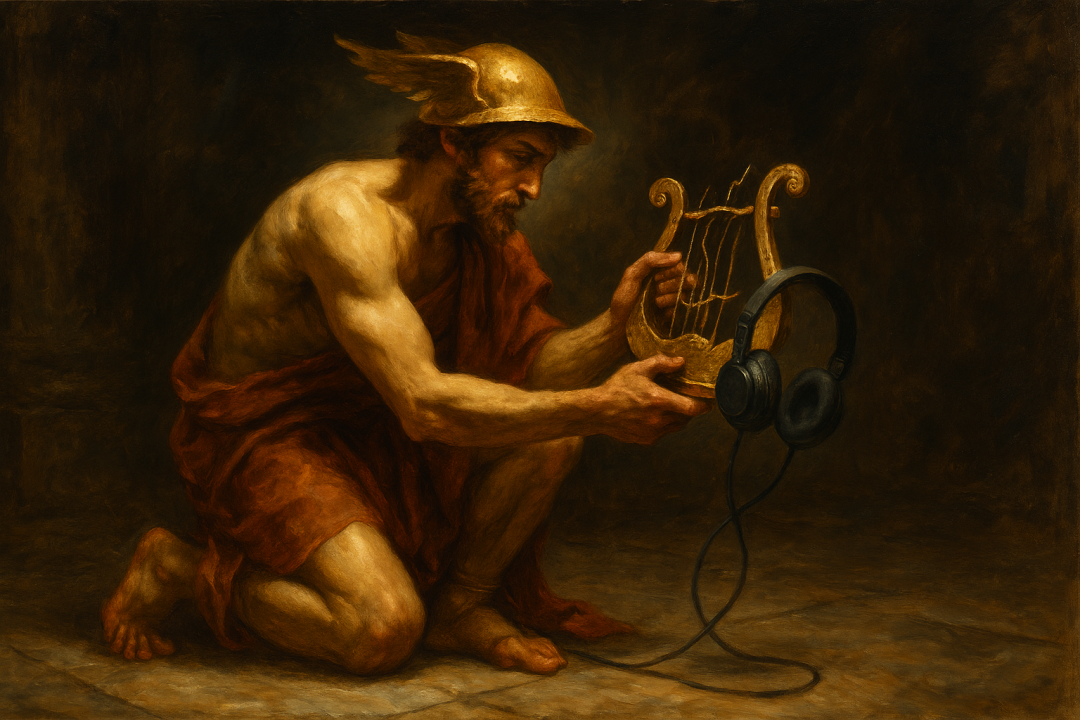
"The Yuanfudao Playbook"
ChatPods should be dead and buried by now, so dragging it back out feels almost gratuitous.
But AI podcasting is suddenly hot again. The market is flooded with related products, and ByteDance's Doubao just launched its own AI podcast feature.
As a podcast producer who's spent years serving podcast companies (side hustle game strong, I guess), I can't stay quiet — AI podcasts are a tool opportunity at best, not a platform play. Building an "AI podcast platform" is pure investor-theater.
Zhang Yueguang's team is valued higher than Xiaoyuzhou, and has raised more than plenty of newer funds. Instead of building a laughable AI podcast app, I'd suggest pivoting straight to being a GP — invest in projects, incubate stuff 🐣
Let's look at the actual products.
ChatPods, Zhang Yueguang's team's AI podcast product, centers on "algorithmic recommendations + voice summaries." The logic: every day, algorithms recommend a few podcast episodes, then AI generates a few minutes of audio explaining roughly what each episode covers. You can interrupt anytime to pick one to listen to.
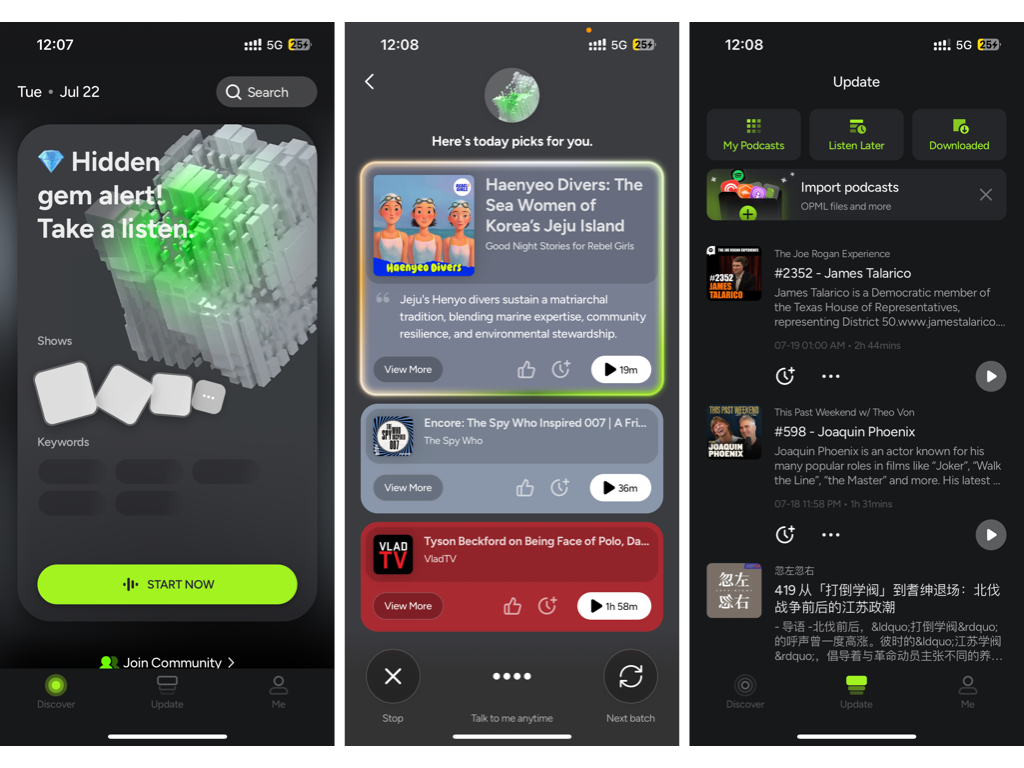
ChatPods' entire product logic rests on a false premise: that users need an AI to help them efficiently filter podcasts. It's solving a problem that fundamentally doesn't exist.
Podcasting is classic low-frequency, long-form content with high fan loyalty.
A single episode easily runs one to two hours, so the cost of choosing is high. Listeners don't casually sample — they stick close to hosts they love. What audiences consume isn't just information density; it's trust and companionship with the host as a person.
This fan loyalty reinforces, and is reinforced by, podcasting's low-frequency consumption. You can't binge hundreds of podcasts in a day the way you scroll through hundreds of short videos. Most people listen to one or two episodes max per day, and top-tier podcasts supply more than enough content. The Matthew effect in podcasting is even more severe than in short video.
This creates what I call the "vertical content platform dilemma": subscription models are basically sufficient, and recommendation algorithms don't add much incremental value. Vertical content platforms don't add much value either.
Most importantly, audio podcasting is a small market. It's not just that Xiaoyuzhou doesn't make money — Spotify couldn't make podcasting work either. In 2020 it acquired a bunch of podcast production companies and production/distribution tools, a.k.a. podcast infra (yeah, I know, ice-cold joke), but podcasting dragged down profits so much that in recent years it's mostly dismantled those operations.
Of course, everything we're discussing here is audio podcasting. Video podcasting is a video platform opportunity. Bilibili has been trying to follow YouTube's lead and push into video podcasts lately. Whether it works remains to be seen, but it always sounds to me like Uncle Chen got sold on the idea by some -1 who loves Xiaoyuzhou.
The conclusion is simple: podcasting is a solopreneur business, not a platform opportunity.
You can become a well-known KOL by podcasting, interviewing big names like Lex Fridman. But podcasting can't support a content platform that meets investor expectations.
As a positive example, there's actually one AI podcast app that does things well: Snipd.
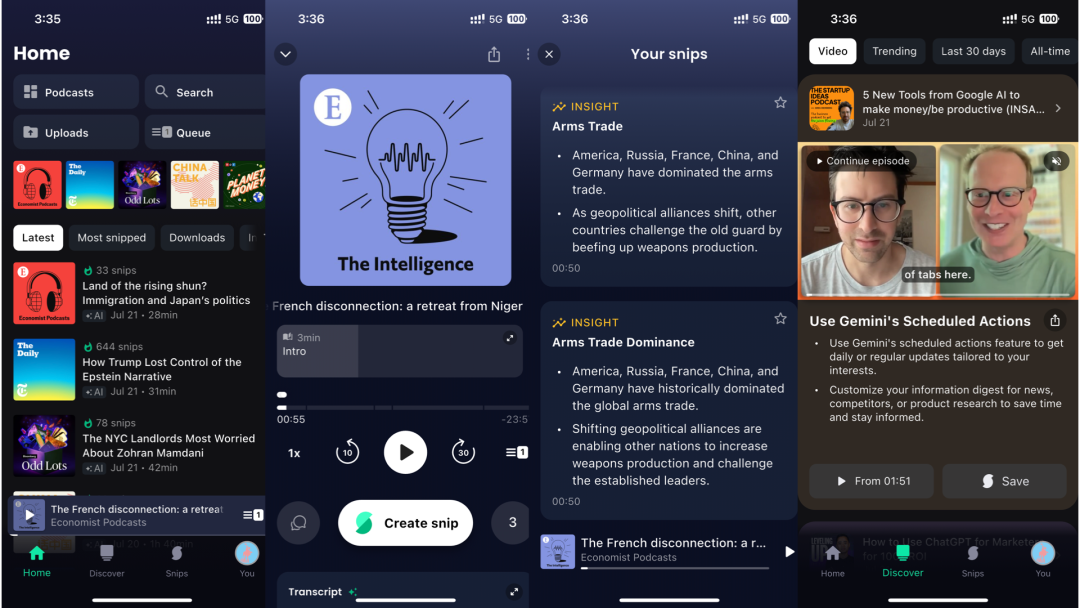
Snipd's functionality is simple: AI summaries plus transcripts. It generates a brief summary for each episode, and you can click through to read the full transcript. When you hear something you want to save, you hit the big "Create snip" button, and it captures what was being discussed at that moment.
Simple features, but always centered on structuring podcast content. Completely non-intrusive too — if you never click on the transcript, Snipd is just a good-looking podcast app.
You have to first be a good-looking, usable podcast app. Only then can you talk about whatever AI features you have.
Some people, meanwhile, are constantly trying to make AI into a big splash, generating content that users never asked for 😠
Today's star AI founders face what I'd call a "lottery dilemma."
Star founders, because of some small tool or divine aura, hit the jackpot — raising far more funding than their current traction justifies. But too much money traps you in your own valuation.
Forced to tell a platform-level story, founders end up burning cycles on directions that don't hold up, producing comical products like "AI podcast platforms."
The whole scene reminds me of the education sector after 2021. Companies like Yuanfudao had massive funding sitting in their accounts, but their core business suddenly vanished 😭
Yuanfudao didn't go all-in down a wrong path. Instead, it transformed into an internal incubator, using that capital to experiment with small businesses — down jackets, coffee, even high-end postpartum care centers.
Yuanfudao was indeed the advanced build. Today's lottery-winning AI founders should learn from them. Until you've figured out a real platform-level opportunity, becoming an incubator and building valuable small tools beats making laughable AI podcast apps.
(Article illustrations generated by ChatGPT o3, with writing assistance from Gemini 2.5 Pro.)